An advantage of wearing a hijab in an airport in a Gulf State

THINGS DID NOT BEGIN well for me when I arrived at Bangalore Airport’s recently opened Terminal 2 prior to boarding an Emirates airline flight to Dubai, where we were to catch another flight to London. We arrived at the airport in good time – before the check-in desks were open. After finding somewhere to sit, I walked to the Chaayos refreshment stall and asked for two cups of south Indian filter coffee. The server must have misheard me and only charged me for one. When this arrived instead of the two, I was expecting, I paid for another cup. While it was being made, I carried the first to my wife. I returned to the stall and picked up the second cup. It was filled to the brim, very hot, and the cup was poorly insulated. Just before I reached where we were sitting, my hand moved slightly, and the boiling hot coffee fell on my palm. This was extremely painful. I dropped the cup and the rest of its contents. I rushed to the washrooms, and after finding a tap that worked, I rinsed my palm in cold water. Meanwhile, my wife managed to get me some ice to put on the scalded part of my hand.
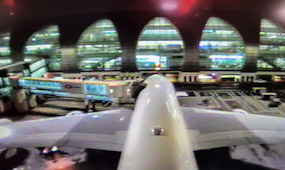
Dubai Airport

After dropping off our baggage and collecting boarding passes (printed on extremely thin paper), we headed for the security check. This involves divesting oneself of anything that contains metal before walking through a metal-detecting arch and then being frisked by a security official. Because the trousers I was wearing were too big, I had to keep one hand on them to stop them falling down. Meanwhile, I was somewhat shocked, and my hand was still smarting after the scalding.

After the frisking, I went over to the conveyor belt that carried our hand baggage and other items slowly through an x-ray machine. After rescuing both my wife’s and my own cabin baggage, telephones, wallets, coats, neck cushion, and my trouser belt, I secured my trousers with the latter. It was then that I realised that my boarding pass was nowhere to be seen. I was horrified – in so many decades of flying, I had never lost a boarding pass.

We reported the loss to the security supervisor – a female officer. She rang for an official from Emirates airline. While waiting for him to arrive, she said to my wife in Hindustani:
“He should not worry. They won’t leave him behind.”
After an agonising wait – actually, it was no longer than about 15 minutes – the official arrived. By then, I was feeling both anxious and extremely upset. The Emirates man explained that I would be issued a new boarding pass at the boarding gate. Not entirely happy with that, we left the security area, and headed for the departure lounges. On the way, we came across an empty baggage trolley, and began loading it with our carry-on bags and coats. As we were doing that, something fell to the ground – it was my missing boarding pass. In an instant my mood of melancholy and apprehension switched to one of immense happiness and relief. I rushed back to the security supervisor to tell her the good news. As the Emirates man was still around, I told him and shook his hand.

The flight to Dubai was pleasant. There was nothing to complain about. At Dubai, we had to pass through another security check. This time, I decided not to remove my belt before passing through the metal detector. Instead, I untucked my shirt and covered my belt with it. Despite there being a large metal buckle on the belt, the detector did not detect it. Nobody stopped me. Meanwhile, passengers’ hand baggage was passing through an x-ray machine so quickly that I doubt there was time to examine the series of x-ray images in any detail – if at all.
After enjoying exorbitantly expensive hot drinks, which I did not manage to spill, we entered a departure lounge dedicated to our flight to London. Before entering the lounge’s seating area, an official examined each passenger’s passport and boarding pass. Most passengers, including my wife and I, had to head for a line of trestle tables. By each of them there was a male or female security official. A few passengers were sent straight into the seating area, bypassing the tables.

The officials standing at the tables first searched the contents of bags – rather cursorily. Then, using an electronic wand, they frisked the passenger. After that, each passenger was asked to present their hands, palms facing upwards. An explosives detector sponge was rubbed on each palm, on the clothing, within the footwear (which had to be removed), on the mobile ‘phones, and other carry-on items. After placing the (re-usable) sponges in a machine, we were allowed to sit down and await the flight. My wife told me that the security lady who examined her was both rude and rough.

This process took quite a while. I sat watching it and gradually, I and my wife became aware of something curious. About a third of the passengers on our flight were women wearing hijabs (Muslim head coverings). This was not surprising in an airport in a Gulf State. What was astonishing was that not one of them had to be searched at the tables. They were allowed to board the flight without having been checked as thoroughly as the other passengers had been. Given that very recently, soldiers wearing hijab were able to enter a hospital in Gaza and attack it with firearms, was it wise to assume that because they were wearing hijab, the passengers on our flight to London were beyond suspicion, whereas all the other passengers – both male and female – needed to be regarded as potential terrorists?

The flight to London could not be faulted. And in case you are wondering, by the time we landed at Heathrow, my scalded palm was neither painful nor inflamed.
Woodwork or Latin

A FRIEND POSTED A PICTURE of something he had created in wood at school when he was about 14 or 15 years old. It looks to be an extremely competent creation. Seeing this, reminded me of when I had to attend woodwork classes at roughly the same age at my secondary school, Highgate in north London.

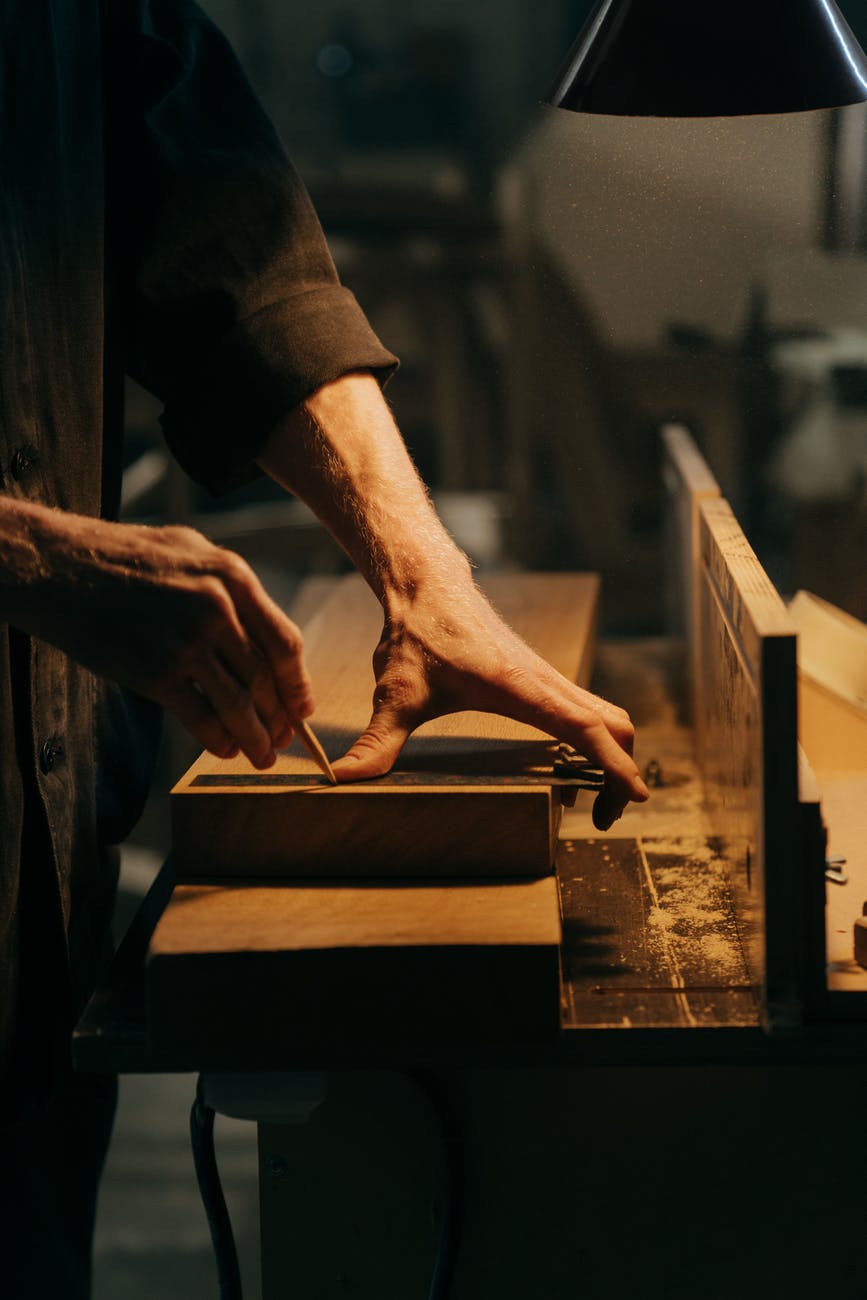
Photo by cottonbro on Pexels.com

Once a week, under the watchful eye of the woodwork teacher, Mr Bowles, I participated in a woodwork class in the school’s specially equipped workshop. Mr Bowles was well-known for saying of the timber he supplied in the class:

“Don’t waste it. You know that wood does not grow on trees.”

Although many years later, I was able to perform complex manual tasks whilst practising dentistry, in my early teens I was not skilled at performing three-dimensional manual exercises. I could draw and paint reasonably well, but model-making and woodwork were not amongst my skills.

I struggled with a tool called the sliding bevel when trying to create dovetail joints, which seemed to be of great importance to Mr Bowles. We were set what he regarded as simple tasks. With great difficulty, I completed two of these. I produced a tea tray, which was next to useless as it was only able to rest on two of its four corners at any one time. The bookshelf which could hold up to eight average thickness paperbacks suffered the same problem. Somehow, I had managed to introduce a twist into it so that its two ends were not in alignment. My parents, for whom it was suggested by our teacher that these would make fine gifts, were totally unimpressed. It would have been dishonest of them to have been otherwise.

My prospects of becoming a skilled carpenter were not looking great. Then, my fate changed suddenly one afternoon. I had just finished the school day and was walking across a polished wooden floor, when I slipped and fell. As I began to get back on my feet, I noticed that my left wrist was bent in an unnatural way and was a bit painful. Having recently completed a first-aid course, during which we were taught to tie complicated bandages instead of learning resuscitation and life support, I realised that I had most probably broken a bone.

I walked over to the caretaker’s home across the school’s quadrangle and found him. He said that he would ring my parents and while we were waiting for them to arrive, he gave me a cup of tea and biscuits. This kind gesture meant that I had to wait several hours before it was safe for me to have a general anaesthetic for setting my arm at the nearby Whittington Hospital.

My arm was encased in plaster, which remained in place for six weeks or longer. This accident was a lucky break for me. First of all, my popularity rating rocketed. Prior to my accident, many of my school fellows believed that I was rather unexciting and unadventurous, not even a ‘nerd’. Seeing my arm in plaster, suggested to these classmates that I must have been up to no good. Maybe, I had fallen out of a tree or had an accident on roller skates or on a bicycle. I kept quiet about the innocuous cause of my fracture and enjoyed experiencing the increase in my ‘street cred’. Even after my plaster was removed, my schoolmates retained their improved opinion of my personality.

Doing woodwork with one arm in plaster was not thought advisable. So, I was excused from the second and final term of woodwork classes. Actually, I doubt that using only one arm would have affected my woodwork much, as it was already appalling with two arms. 

At the end of the school year during which we had to study woodwork, we had to make subject choices. Basically, the choice was to follow the ‘arts’ or the ‘sciences’. The choices were history or physics; geography or chemistry; and … wait for it … Latin … or  … woodwork.  To be honest, the latter was a ‘no brainer’ of a choice. Woodwork did not get my (or my parents’) vote. But, as it is good to be truthful, my Latin was barely better than my woodwork. Although I struggled with Latin at school, it has proved useful especially when studying anatomy and, also, when wandering amongst tombstones. As for woodwork, Mr Bowles might be pleased to learn that over the years I have put up several shelves that were able to carry heavy loads. Now, as you read this, do not get any ideas about getting in touch with me to put up shelving in your homes.

Save the planet, lose your life


In January of this year, I posted a piece about drinking straws, https://adam-yamey-writes.com/2019/01/24/drinking-through-a-straw/,  and how plastic straws are being replaced by paper straws, which go soggy before you finish your drink.

Well, now you can obtain re-usable drinking straws made of metal. Some of these come with fine brushes to help clean the straw after use. Great idea, you might think, although I would have some concerns about maintaining the hygiene of these straws. Also, I wonder how much energy needs to be expended to create a metal drinking straw.

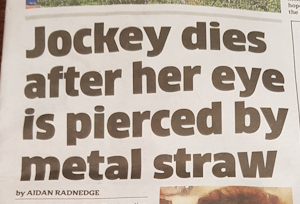
Today, 9th July 2019, I spotted a worrying item in the Metro, a London daily newspaper. The article described a terrible accident during which someone fell on to her metal straw, which then pierced her eye and entered her brain. This resulted in the poor woman’s death.

Even if it does help save the planet, you won’t catch me using a metal straw!


Keeping fit

Evening jogger_240


While I was engaged to my wife, she suggested that I join her at her health club and try some of its facilities.

The first time I went, I decided to go swimming. After swimming two lengths very slowly, I managed to climb out of the pool, exhausted and breathless.

For the next visit, my wife-to-be suggested that I try a session in the sauna. She thought it would do me good and would  not be particularly exhausting. I removed most of my clothes and sat alone in the poorly-lit sauna room. After a few minutes I began feeling cold, and started shivering. Fed up with this miserable experience, I left the sauna, and got dressed. The sauna had not been switched on!

Undismayed by this, I decided to give the sauna another try a week later.  This time it was switched on, and steaming hot. Because my first visit had been so boring, I decided to take a magazine into the sauna to read to pass the time. I took my place on a bench alongside some very muscular men and opened my copy of a glossy BBC clasical music magazine. Within minutes, the glue holding my magazine together melted. Numerous pages covered with fascinating information about classical music floated gently downward on to the floor of the sauna, Sheepishly, I recovered some of them, and then hurried out of the sauna.

“Why not try the exercise cycles next time? ” my wife asked. “Good idea,” I replied reluctantly. So, a week later, I sat in the saddle of an exercise bike. My wife was seated on a neighbouring cycle pedalling away while reading a book resting on the handle bars. The third cycle in the room was being pedalled furiously by a man lstening to his Sony Walkman through a pair of headphones. Meanwhile, I was just trying to move my cycle’s pedal … completely unsucessfully. After a few minutes, I abandoned the cycle, and after that I have never bothered with health clubs again. 

“That’s a pity,” you might think.

But, maybe not, as I will explain.

When I was practising as a dentist, quite a few patients, often young men, used to limp when they walked into my surgery. Almost everyone of them had injured knees or tendons whilst playing football or running, or trying to keep ‘fit’. When I saw them, I thought how lucky I was that I did not become addicted to ‘keeping fit’.

Disabled drivers

During our very recent stay in the Cochin/Ernakulam region of Kerala in the south of India, we encountered two drivers with disabilities.

The first was in central Ernakulam. He was the chauffeur working for a friend. His right arm was encased in surgical plaster of Paris from above his elbow to his finger tips. He drove well despite having only one functioning arm. Luckily for him, he was driving a car with automatic gear changing.

We met the second driver twice in picturesque Fort Cochin. He wore a surgical support collar around his neck. It was khaki in colour and matched his khaki autorickshaw driver’s uniform jacket.

The first time we were driven by him, we noticed his collar, but made no reference to it. The next time he stopped to pick us up, we asked him about the collar, guessing that he might have been involved in accident. We were not expecting his explanation.

The poor fellow related that when his wife had deserted him for reasons that he did not tell us, he had tried to commit suicide. Fortunately, his attempt failed because now his wife has returned to him.

My cat

I love cats. I have only ever ‘owned’ one. I named it Crumpet.

I was less than ten years old when Crumpet entered my life. I was lying in bed at home, recovering from a bout of tonsillitis, when my late mother brought Crumpet into my bedroom. She had only just bought the cat at a pet shop to cheer me up.

My mother, who was always nervous about me risking injury, would not allow me to open the tins of cat food that Crumpet enjoyed. She was concerned that I might cut myself on the sharp edges of the open tin lids. So, as my mother did not want to disturb my father, who did much of his academic work at home, she became responsible for feeding Crumpet.

Cats tend to be quite self oriented. They favour the people who feed them. In Crumpet’s case, it was my mother who received much of the cat’s attention. Our cat used to rub herself against my mother’s legs affectionately, especially when my mother was opening the cat food.

Now, here’s the rub. My self sacrifying mother could not bear cats. She put up with Crumpet for my sake.

Crumpet must have realised that my mother was not keen on her because after a few weeks our pussy abandoned our home for another about one hundred yards away from ours.

Since Crumpet deserted us, I have never kept another pet, but my fondness for cats has remained.