
IN AUGUST 2011, my wife was invited to attend a Loreto House School reunion in Calcutta (Kolkata). As I had never been to the city before, I accompanied her. While my wife took part in the daily activities with some of her former schoolmates, I explored, and fell in love with, the great city on the Hooghly River – one of the channels through which the Ganga (Ganges) makes its way to the sea.
Throughout our five-day visit to the city, the monsoon rains fell heavily and incessantly. I walked around Calcutta in sandals without socks – often wading through filthy water that submerged my feet and lapped around my ankles. Fortunately, my feet did not become infected by whatever might have been lurking in the water. However, the monsoon did not affect my enjoyment of the vibrant, but delightfully decaying. city – one could almost say it is India’s own distinctive version of Havana in Cuba.
One day, I visited Jorasanko, the palatial residence of the Tagore family, whose members included not only the Nobel Prize winner, the polymath Rabindranath Tagore (1861-1941), but also artists such as Abanindranath and Gaganendranath (both Tagore). After seeing around the fascinating rooms of Jorasanko, which I enjoyed so much that I visit it whenever I am in the city, I sploshed through the flooded streets towards the Hooghly River. On my way, I walked along a busy street lined with shops and filled with crowds of people. A steady stream of rickshaws pulled by thin, sinewy men – each of the vehicles laden with two or three passengers – made its way through the busy throng. The huge wheels of these vehicles keep the passengers high above the water flooding the streets, but the pullers’ feet were permanently submerged.
I noticed that some shops – often those of clothing and textile merchants – men were distributing hot food – rice and dal – to occasional passers-by. I stopped at one of the stores, and asked about the food distribution. It was explained to me that during Ramadan, it was a virtuous thing to feed the poor. This kindness impressed me, especially as those who were serving it were fasting.
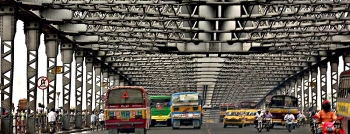
Eventually, after boldly crossing a wide road clogged with slow moving heavy traffic, I stepped onto the Howrah Bridge, a gigantic steel bridge – a Meccano lover’s dream come true. It traverses the Hooghly – a section of the great Ganges River system. It was constructed between 1935 and early 1943. At first, the bridge crosses over a large market that is strung along the riverbank. Then, after a few yards, it is over the water. I walked along the downstream facing pedestrian walkway, dodging many porters carrying heavy and bulky loads on their heads. I took numerous photographs until I was two thirds of the way across the river. There, I met a policeman with an ancient-looking rifle – its leather strap slung over his shoulder. Politely, he informed me that photography was forbidden on the bridge. By then, I had sufficient images stored in the memory of my digital camera.
Once over the river, I headed through the streaming rain and thick crowds to a boat station close to the Howrah railway terminus. My plan was to travel on a river bus downstream to a landing stage not far from Park Street. I bought a ticket which was printed on such very poor-quality paper that it had to be kept dry to stop it dissolving or falling to pieces. I asked someone on the floating platform at the water’s edge if the boat that was approaching was heading for my planned destination. I received what I believed was an affirmative reply, and then boarded a relatively empty boat with plenty of free seats. We set off.
To my surprise, the boat headed upstream rather than downstream. Soon, we passed beneath the Howrah Bridge. We sailed a long way upstream away from the city centre. The banks of the river were lined with unattractive industrial buildings, and these were punctuated by occasional bathing ghats. We were heading away from the pleasant old part of the city in which Park Street is located.
I disembarked at the boat’s first stop. Had it not been raining so heavily I would have stepped out of the boat station to explore the area around it. Instead, I bought another flimsy ticket to return to Howrah. This time, I asked several people to tell me at which of the two floating embarkation pontoons I should board the downstream boat. I waited close to the water while a large crowd of fellow passengers gathered behind me. I wanted to be sure of embarking first.
The boat approached where we were all standing. I could see from afar that it was ‘packed to the gills’ with people. When the boat was about 18 inches away from the pontoon, I felt a great push from behind me and I was catapulted across the water towards the approaching vessel. Luckily, I was able to grab something on the boat, and this saved me from falling into the water and being crushed between the boat and the pontoon. Had I not been able to do this, I feel sure my life would have ended prematurely.
The boat was stuffed with people – I am sure that sardines are less tightly packed in tins. I wanted to try to take a photograph to capture an image of this crowd, but I could not because so great was the pressure exerted by those around me that I was unable to raise my hands from beside my body. Thus wedged, I looked around and noticed there were only a few lifesaving flotation items. If our boat had sunk, I imagine that only a few of us on board would have survived.
It was a great relief to disembark at Howrah. I was drenched, somewhat shaken, and hungry. I decided to take a taxi to Flurys in Park Street. It is a European style tearoom/restaurant that served what I was yearning at that moment – toasted club sandwiches. I boarded a dented yellow Ambassador taxi in a car park near the railway station. We inched our way forward into a mass of other similarly damaged taxis. The crowded taxis were so close to each other that it felt as if they might become welded together. It took almost an hour for my driver to skilfully manoeuvre his vehicle a couple of hundred yards from where I boarded it on to the beginning of the bridge.
At last, we arrived at Park Street, where, slightly drier because of sitting for ages in the taxi, I settled down at a table in Flurys. I ordered my sandwich and savoured the peaceful atmosphere in the tearoom*.
Despite my near escape from severe injury (or worse) on the banks of the Hooghly, my enthusiasm for Calcutta remained undiminished.
*Note: when I last visited Flurys in January 2025, it had lost most of its charm; it has become a place for tourists and Instagrammers.
This is a chapter in my book “The Hitler Lock & Other Tales of India”, which is available from Amazon

