
I carry my home
No, it’s not a caravan
I’m a snail you know

I carry my home
No, it’s not a caravan
I’m a snail you know
DO HO SUH is an artist who was born in South Korea in 1962. He was awarded a Bachelor of Fine Arts and Master of Fine Arts from Seoul National University, and then later, a Bachelor of Fine Arts in painting at the Rhode Island School of Design. He lived and worked in Seoul, then in New York City, and now in London. So, during his life, he has changed homes several times while moving from place to place. His exhibition that is on show in London’s Tate Modern until 19 October 2025 is called “Walk the House”. The exhibition is his artistic interpretation of what the concept of home means and of his experiences of moving from one residence to another.

Th artist’s works in the exhibition range from sketches, paintings, and sculptures to spectacular three-dimensional installations. Some of the installations can be entered and explored by visitors. In one of them, called “Nest/s”, the artist has stitched together a series of rooms made of translucent cloth that evoke places where he has lived in Seoul, New York, London, and Berlin. Visitors walk along a tunnel from room, thus following in the footsteps of the artist as he changed homes. Another large installation that can be entered is a large room made of translucent, white polyester. To the walls of this structure, the artist has attached models of appliances and fittings that were in each of the homes he has lived. The items that have been attached have been colour coded: a different colour for each of the places in which he has dwelled. One other thing that particularly appealed to me is a translucent resin model of the house in which he lived in Providence, Rhode Island. Visible within this model there is a model of Suh’s childhood home in Seoul.
The Tate’s web page for this exhibition explained:
“Is home a place, a feeling, or an idea? Suh asks timely questions about the enigma of home, identity and how we move through and inhabit the world around us.
With immersive artworks exploring belonging, collectivity and individuality, connection and disconnection, Suh examines the intricate relationship between architecture, space, the body, and the memories and the moments that make us who we are.”
And this does well summarise what can be viewed in this exhibition, which is well worth visiting.
THE PUARESHWAR MAHADEV Shiv temple is about 24 miles west of Bhuj. Built about 1200 years ago, it is possibly the oldest surviving Hindu temple in the Kutch region of Gujarat. Partially restored, this attractive small mandir is still in use but has lost most of its roof.

As we approached the temple, I noticed that near it, there were numerous small piles of stones. Each of the precarious looking piles consisted of several rock’s or fragments of masonry piled carefully, one on top of another. I asked our driver, who had suggested we visit this temple on our way to Narayan Sarovar, about these small piles. He said that they were constructed by people, praying to obtain or build a home of their own.
After visiting, Narayan Sarovar, its lake and mandir, we stopped to see the mandir at Koteshwar, which is on a spit of land near India’s border with Pakistan. Outside this temple, there were many piles of stones just like we had seen at Puareshwar.
Although I have visited many Hindu temples in India during 30 years of travelling to the country, it was only yesterday, the 27th of November 2023, that I first became aware of these small stone offerings. According to one online article I found (https://medium.com/six-word-photo-story-challenge/prayer-stone-stacks-a-belief-b7fc0edc5d9a), stones are piled outside temples all over India by people hoping to build their own homes. I will now look out for them whenever I visit a mandir.
WE FIRST VISITED the grounds of Boston Manor in the London Borough of Hounslow in April 2021.

Plenty of covid19 restrictions were then in force and the old Jacobean manor house was inaccessible both because of the pandemic and also because the building was undergoing extensive restoration works. We were able to enjoy the lovely grounds that surround the manor house. In July 2022, long before the manor house’s restoration was completed, I published my book about west London, “BEYOND MARYLEBONE AND MAYFAIR: EXPLORING WEST LONDON”, and included a chapter about Boston Manor. Here is a part of this chapter:
“… the name Boston is derived from an older name ‘Bordeston’, which comes from the word ‘borde’, meaning ‘boundary’. Another etymology of the name, which is unrelated to that of the Boston in Lincolnshire, is that it derives from the name of a Saxon farmer named ‘Bord’. Whatever the origin of the name, Boston Manor, the house, and its lovely gardens (now known as Boston Manor Park), which reach the bank of the River Brent, stands on the border between Hanwell and Brentford.
Until the Priory of St Helens in Bishopsgate (in the City of London) was suppressed in 1538, the Manor of Bordeston was owned by it. King Edward VI granted it to Edward, Duke of Somerset (1500-1552), Lord Protector of England during the earlier part of his reign, and later, it reverted to the Crown. In 1552, Queen Elizabeth I gave the manor to the Earl of Leicester, who immediately sold it to the merchant and financier Sir Thomas Gresham (c1519-1579). After several changes of ownership, the property was sold in 1670 to the City merchant James Clitherow (1618-1682). The new owner demolished much of the existing manor house. He modified and enlarged Boston House, which was originally built in the Jacobean style by Lady Mary Reade in 1622, widow of Gresham’s stepson, Sir William Reade. This house with three gables still stands (but was closed when I visited it during April 2021 because it was undergoing extensive repairs). It looks out onto grounds planted with fine trees, many of them Cedars of Lebanon. The grounds, which include a small lake, slope down gently towards the River Brent.”
Today, the 26th of October 2023, I revisited Boston Manor. Fortunately, the Jacobean manor house’s restoration had been completed. After enjoying coffee in its fine café and walking around the grounds ( part of which is beneath an elevated section of the M4 motorway), we were able to enter the manor house. Visitors are allowed to wander freely through rooms on the ground and first floors. Each room is identified by informative labels. In one of the rooms, there are portraits of several members of the Clitherow family. One was painted by Godfrey Kneller (1646-1723), and another by George Romney (died 1802), who lived in Hampstead for a few years at the end of the 18th century. Several of the rooms have beautiful three-dimensional plastered ceilings. These have been restored well to look like they must have done when they were first installed. Reproductions of the original wallpapers line many of the walls and the grand staircase. The reproductions were based on the few fragments of the original wall papering that were discovered. A couple of wall panels have large expanses of original wallpaper that have survived the passage of time. Although the manor house was stripped of the Clitherow’s furniture long ago, Hounslow Borough Council have restored the rooms magnificently.
Boston Manor house is not nearly as architecturally exciting as its neighbours Osterley House and Chiswick House, but it is older than them, and in good condition. I feel it ought to become as well known as the more frequently visited stately homes nearby.
My book about west London is available as a paperback and a Kindle from Amazon websites such as follows:
MY FATHER, BASIL Yamey (1919-2020), lived until he was over 101. Between about 1950 and 1991, he lived in our family home in Hampstead Garden Suburb. From my birth until 1982, I lived there, and afterwards I visited my then widowed father almost every weekend.
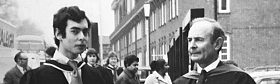
Dad was an academic, an economist, at the London School of Economics (‘LSE’). He became a senior professor long before he retired.
Although I have no knowledge of economics even at an elementary level (and this is not me being modest), I lived with an acknowledged leader in the field of microeconomics. Recently, the LSE published some of my memories of living with a professor: my late father. These memories are published on an LSE blog: https://blogs.lse.ac.uk/lsehistory/2022/07/06/at-home-with-basil-yamey-as-recalled-by-his-son/
I hope that you will enjoy these glimpses of the home life of a significant academic.
I LIVED IN A detached house (see the picture) in north London’s Hampstead Garden Suburb during the first three decades of my life. My bedroom window was that on the first floor facing the street, Hampstead Way. Externally it looks much as it did when I lived there. This is not surprising because the houses in the Suburb are all subject to strict preservation orders,which forbid alterations of the appearances of the exteriors of the Suburb’s buildings.

Although I was privileged to have lived in this part of London, it was never my favourite area of the city because during my youth, it was a dull place to be a child or even an adolescent.
By the way, although the name ‘Hampstead ‘ is part of the suburb’s name, the area is completely different from Hampstead proper: it lacks the vibrancy and vitality of old Hampstead village (or town, if you prefer). As a youngster, and still today, I have always enjoyed my visits to Hampstead Village

PLATTS LANE WINDS its way between London’s Finchley Road and West Heath Road in Hampstead. It follows the route of a track between Hampstead Heath and West End (now West Hampstead). This track was already in existence by the mid-18th century. According to a historian of Hampstead, Christopher Wade, the thoroughfare was first called Duval’s Lane to commemorate a 17th century French highwayman. Louis (alias Lodewick alias Claude) Duval (alias Brown) who was, according to another historian, Thomas Barratt, famed for being gallant towards his victims, many of whom he robbed on Hampstead Heath. Barratt related:
“It used to be told that, after stopping a coach and robbing the passengers at the point of the pistol on the top of the Hill, he would, having bound the gentlemen of the party, invite the ladies to a minuet on the greensward in the moonlight.”
Duval was hung at Tyburn soon after 1669.
Over time this track’s name became corrupted to Devil’s Lane. A pious local resident, Thomas Pell Platt (1798-1852), probably put an end to that name after he had built his home, Childs Hill House, nearby in about 1840.
Platt graduated at Trinity College in Cambridge in 1820 and became a Major Fellow of his college in 1823. While at Cambridge, he became associated with the British and Foreign Bible Society and was its librarian for a few years. He was also an early member of The Royal Asiatic Society (founded 1823) as well as a member of The Society of Antiquaries of London. In 1823, he prepared a catalogue of the Ethiopian manuscripts in a library in Paris. In addition, he did much work with biblical manuscripts written in the Amharic and Syriac languages. Apart from being a scholar, he was an intensely religious man. He died not in Hampstead but in Dulwich.
Platt lived near the lane named after him for quite a few years. The same cannot be said for a later resident of Platts Lane, Tomas Garrigue Masaryk (1850-1937), who was born in Moravia (now a part of the Czech Republic). Masaryk added the name Garrigue to his own when he married the American born Charlotte Garrigue (1850-1923) in 1878. A politician serving in the Young Czech Party between 1891 and 1893, he founded the Czech Realist Party in 1900. At the outbreak of WW1, he decided that it would best if the Czechs and Slovaks campaigned for independence from the Austro-Hungarian empire. He went into exile in December 1914, staying in various places before settling in London, where he became one of the first staff members of London University’s School of Slavonic and East European Studies, then later a professor of Slavic Research at Kings College London.
In London, Masaryk first lived in a boarding house at number 4 Holford Road in Hampstead (http://tg-masaryk.cz/mapa/index.jsp?id=285&misto=Pobyt-T.-G.-Masaryka-1915-1916). In June 1916, he moved from there to number 21 Platts Lane, which was near to the former Westfield College where his daughter Olga was studying. The house, the whole of which he rented, became a meeting place for the Czechoslovak resistance movement in England. Masaryk stayed in Platts Lane until he departed for Russia in May 1917. It is possible that he returned there briefly when he made a visit to London in late 1918. On the 14th of September 1950, the Czechoslovak community affixed a metal plaque to the three-storey brick house on Platts Lane, which was built in the late 1880s. It reads:
“Here lived and worked during 1914-1918 war TG Masaryk president liberator of Czechoslovakia. Erected by Czechoslovak colony 14.9.1950”
Actually, Masaryk only used the house between 1916 and 1917. The year that the plaque was placed was a century after Masaryk’s birth year. The day chosen, the 14th of September, was that on which he died in 1937.
Not too far away from Masaryk’s Hampstead home, there is a place on West End Lane that used to be called The Czechoslovak Club before it became the Czechoslovak Restaurant and currently Bohemia House. Here you can see a portrait of Masaryk and enjoy yourself sampling Czech beers and food. The establishment is within the Czechoslovak National House, which was founded as a club in 1946.
The houses where Czechoslovakia’s freedom fighter lived in London still stand in Hampstead. However, that is no longer the case for another freedom fighter and founder of a new nation, who lived near Platts lane on West Heath Road, the wealthy barrister and founder of Pakistan, Muhammad Ali Jinnah (1876-1948). In the 1930s, Jinnah practised law in London. One of his biographers, Hector Bolitho (1897-1975) wrote (in 1954):
“One day in June 1931, when Jinnah was walking in Hampstead, he paused before West Heath House, in West Heath Road. It was a three-storied villa, built in the confused style of the 1880s, with many rooms and gables, and a tall tower which gave a splendid view over the surrounding country. There was a lodge, a drive, and eight acres of garden and pasture, leading down to Childs Hill.
All are gone now, and twelve smaller, modern houses occupy the once-pretty Victorian pleasance. Nearby lives Lady Graham Wood, from whom Jinnah bought the house; and she remembers him, on the day when he first called, as “most charming, a great gentleman, most courteous…
… In September 1931 Jinnah took possession of West Heath House, and he assumed the pattérn of life that suited him. In place of Bombay, with the angers of his inheritance for ever pressing upon him, he was able to enjoy the precise, ordained habits of a London house. He breakfasted punctually and, at nine o’clock, Bradbury was at the door with the car, to drive him to his chambers in King’s Bench Walk. There he built up his new career, with less fire of words, and calmer address, than during the early days in Bombay.”
It was at West Heath House that Jinnah entertained Liaquat Ali Khan (1895-1951), another of Pakistan’s founding fathers and its first Prime Minister, who had arrived from India. Bolitho wrote:
“A great part of the fortunes of Pakistan were decided оn the day, in July 1933, when Liaquat Ali Khan crossed Hampstead Heath, to talk to his exiled leader.”
Bolitho recorded that Liaquat’s wife recalled the occasion:
“Jinnah suddenly said, ‘Well, come to dinner on Friday.’ Sо we drove to Hampstead. Іt was a lovely evening. And his big house, with trees—apple trees, I seem to remember. And Miss Jinnah, attending to all his comforts. I felt that nothing could move him out of that security. After dinner, Liaquat repeated his plea, that the Muslims wanted Jinnah and needed him.”
At the end of the evening, Jinnah said to Liaquat:
“’You go back and survey the situation; test the feelings of all parts of the country. I trust your judgment. If you say “Come back,” I’ll give up my life here and return.’”
Jinnah returned to India in 1934, and Pakistan was created in August 1947.
Judging by Bolitho’s description, Jinnah’s Hampstead house could not have been very far from the house which Masaryk rented in Platts Lane, which, like Jinnah’s garden, is close to, or more accurately on, Childs Hill. I have found Jinnah’s house marked on a map surveyed in the 1890s. It was located on the west side of the northern part of West Heath Road, about 430 yards north of Masaryk’s residence on Platts Lane.
It might come as much of a surprise as it was to me to learn that the founders of two countries, each of which was founded soon after the ending of World Wars, both lived in Hampstead for brief periods in their lives.
WE TRAVELLED TO HADLEIGH in Suffolk to see its church, its mediaeval guildhall, and its Deanery Tower. After viewing these buildings on a drizzly afternoon, we walked along the High Street, looking at some of the lovely old buildings along it. Several of them have coloured pargetting (decorative plasterwork). Then, we spotted MW Partridge &Co on the corner of High Street and George Street. From the outside, there is nothing remarkable about this hardware store.

Stepping inside Partridges is like entering an enormous. well organised Aladdin’s cave. Apart from food and plants, there is almost nothing that cannot be found in the shop. One room leads to another, and then another, and yet another, each filled with everything that you might ever need to maintain your home and garden. Remarkable as this is, what is truly fascinating is that apart from one room built as an annexe in the 20th century, the rest of the shop is supported by old-fashioned timber beams and pillars.
According to the company’s history (www.partridgeshadleigh.co.uk/index.php?main_page=about_us), there has been an ironmongery business on the spot since 1823, if not before. In 1823, the ironmonger and iron founder Thomas Pritty acquired the business from a Charles Pretty (or ‘Pritty’). After passing through a couple of other owners, Maitland Walter Partridge and Daniel Partridge of Kersey bought the concern in 1929. This partnership did not last long, and in 1934 Maitland and his sister Edith registered the name M W Partridge & Co. Partridges have been in business ever since.
BROTHER PETER IS one of six retired ex-servicemen who reside at The Lord Leycester Hospital, one of the oldest buildings in the town of Warwick apart from its famous, much-visited castle. He explained to us that the word ‘hospital’ in the name refers not to what we know as a medical establishment but to a place providing hospitality. The men, who reside in the Hospital are known as the ‘Brethren’.

The Hospital is contained in an attractive complex of half-timbered buildings that were erected next to Warwick’s still standing Westgate in the late 14th century. They are almost the only structures to have survived the Great Fire of Warwick that destroyed most of the town in September 1694. The buildings and the adjoining chapel that perches on top of the mediaeval Westgate were initially used by the guilds of Warwick, which played a major role in administering the town and its commercial activity. The ensemble of edifices includes the mediaeval Guildhall in which members of the guilds carried out their business. Between 1548 and 1554, it was used as a grammar school.
In 1571, Queen Elizabeth I’s favourite, Robert Dudley, Earl of Leicester (1532-1588), who lived in nearby Kenilworth Castle, was asked by the queen to clear the streets of Warwick of ailing, infirm, and disabled soldiers, by establishing a refuge (i.e., ‘hospital’) to shelter them. It is said that Dudley persuaded the town’s officials to give him their Guildhall to be used for this purpose. This ended the guilds’ use of the complex of mediaeval buildings, now known as Lord Leycester’s Hospital.
Initially, Dudley’s hospital provided accommodation for The Master, a clergyman, and twelve Brethren, poor and/or wounded soldiers, and their wives. According to the excellent guidebook I bought, the original rules of the hospital include the following:
“That no Brother take any woman to serve or tend upon him in his chamber without special licence of the Master, nor any with licence, under the age of three-score years except she be his wife, mother, or daughter.”
To accommodate them, modifications of the interiors of the buildings had to be made. Brother Peter, with whom we chatted, is one of the current Brethren. He introduced us to another of his fraternity, a young man with a scarred head, who had survived an explosion whilst serving in Afghanistan.
Dudley’s arrangement survived until the early 1960s, when the number of Brethren was reduced to eight. By this time, the Master was no longer recruited from the clergy but from the retired officers of the Armed Forces. What is unchanged since Dudley’s time is his requirement, established in an Act of Parliament (1572), that the Brethren must attend prayers in the chapel every morning. They recite the very same words chosen by Dudley when he established the hospital.
We did not have sufficient time to take a tour of the buildings that comprise the hospital, but we did manage to enter The Great Hall, which now serves as a refreshment area for visitors. This large room has a magnificent 14th century beamed timber ceiling made of Spanish chestnut. It was here that King James I was entertained and dined in 1617, an event lasting three days. We were also able to catch a glimpse of the Mediaeval Courtyard, which is:
“… one of the best preserved examples of medieval courtyard architecture in England.” (https://en.wikipedia.org/wiki/Lord_Leycester_Hospital).
The Lord Leycester Hospital is less well-known than the nearby Warwick Castle, which has become something of a costly ‘theme park’. However, the hospital is a far more interesting place to visit, However, you will need to go there before the 23rd of December 2021, when it will be closed for restoration for quite a lengthy period.
BULL HOUSE STANDS on the High Street immediately beneath the remain of the castle that dominates the Sussex town of Lewes near Brighton. Its neighbour is an older, half-timbered edifice that now houses The Fifteenth Century Bookshop, a supplier of second-hand books, which was unfortunately closed when we passed it on a Sunday morning.
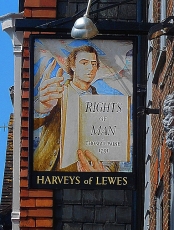
In the year 1768, the owner of Bull House, a tobacconist named Samuel Ollive, and his wife Esther, took in a lodger, who had arrived in the town. This man was an excise officer aged about 31. His name was Thomas (‘Tom’) Paine (1737-1809). 1n 1771, Paine, already a widower, married Elizabeth Ollive, daughter of Samuel and Esther. At of that time, he became involved in the Ollive’s tobacco business as well as the administrative affairs of the town of Lewes. A year later, as part of a campaign to improve the remuneration of excise officers, he published a pamphlet. “The Case of the Officers of Excise”. Tom enjoyed lively discussions and debates at the town’s ‘Headstrong Club’, which met at the White Hart Inn on the High Street. This hostelry can still be seen today.
The year 1774 found Tom in trouble. He had been accused of being absent without permission from his position as excise officer. Also, his marriage failed, and he separated from his wife Elizabeth. To avoid a spell in a debtors’ prison, he sold all his possessions. He left Lewes and went to London, where he was introduced to the revolutionary Benjamin Franklin (1706-1790), who recommended that Tom should emigrate to North America. Tom set sail from England and arrived in Philadelphia in November 1774.
The pamphlet that Paine wrote in Lewes was followed by many more published writings. Amongst these is his best known, “The Rights of Man”, published in 1791, in London, England, where Tom had returned in 1787. This work is described in a guidebook to Lewes as “…the bible of English-speaking radicals.” Whether Tom ever returned to Lewes after his first excursion to what is now the USA, I do not know. If it ever occurred, it is not mentioned in my guidebook, and I have not found any reference to it.
 yamey
yamey 