VISITORS TO LONDON (and residents of the city) should not miss visiting Kenwood House, which is in north London between Hampstead and Highgate. Not only does it contain a magnificent collection of Old Master paintings that can be compared favourably with what can be seen in Britain’s finest public art galleries, but it also has a beautiful library.
In my book about Hampstead, “Beneath a Wide Sky: Hampstead and its Environs”, I wrote:
“The first house to stand on the site of the present one was built in brick by John Bill (1576-1630), printer to King James I. He bought the Kenwood Estate (which was known as ‘Caen Wood’) in 1616. After several changes in ownership, the Estate was bought in about 1747 by a former Prime Minister and King George III’s close associate, John Stuart, third Earl of Bute (1713-1792). In 1754, Bute sold the property to the lawyer and law-reformer William Murray (1705-1793), who became the First Earl of Mansfield, and was Lord Chief Justice of the King’s Bench from 1756 to 1788. In 1778, he was a supporter of the Roman Catholic Relief Bill that led to the violent protests described above. During the First Earl’s stay in the House, he employed the architect Robert Adam (1728-1792) to make improvements.”
The library was one of the improvements that Robert Adam created at Kenwood. The library or Great Room was constructed between 1764 and 1774. It was intended both as a reception room and a library, which might explain why so little of this large room’s wall space is occupied by bookshelves. Most of the wall space is occupied by mirrors and windows. Lord Mansfield would have been used to host guests, hold dinners, and for music performances.
The library’s architecture is based on that of Roman public bath houses. John Summerson (1904-1992), the architectural historian, wrote of its design in his “The Iveagh Bequest, Kenwood : a short account of its history and architecture” (published 1988):
“This is one of the finest Adam rooms in existence … The shape of the room, with its curved ceiling leading into two apsidal ends, on the chords of which are pairs of columns, is one which Adam used for several of his most stately interiors. Apart from the plan, a great innovation for England was the flat arched ceiling which Adam frankly describes as ‘extremely beautiful …”
Although the library is the finest of Adam’s creations at Kenwood, there are others that deserve to be admired. These include the orangery, the entrance hall with its magnificent stucco ceiling, and the library’s anteroom. In this piece I have concentrated on the interior of Kenwood House, but a visit to this wonderful place should be accompanied by a stroll in the place’s superb, landscaped gardens.
A NARROW ROAD LEADS away from the town of Mandvi (in Kachchh, a part of Gujarat) into an arid sandy area close to the seacoast. Scrubby bushes populate most of this flat terrain. After a few miles, a red building can be seen on the horizon. As you approach it, you can see that it resembles no other in the surrounding area, or, for that manner, in any other part of India. However, if you are a Londoner, it would seem familiar, although quite incongruous.
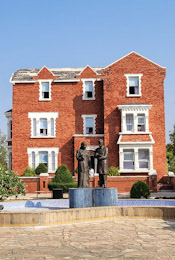
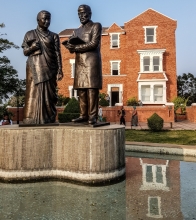
Replica of India House near Mandvi, Kachchh
The house in the desert is an accurate replica of a typical Victorian house, such as can be found in North London. In fact, it is a full-size copy of number 65 Cromwell Avenue in London’s Highgate area. The reproduction near Mandvi was built as part of a complex to commemorate Shyamji Krishnavarma (1857-1930), who was born in the centre of Mandvi.
Krishnavarma, who became a barrister and worked in various Princely States, moved to London, where he lived until about 1907. He moved to Paris, and then to Geneva, where he and his wife lived until they died.
In London, Krishnavarma lived opposite Highgate Woods. He invested wisely, and became interested in the works of English men, who had their doubts about Britain’s domination of India. He became an opponent of British rule in the Indian subcontinent. At first, his interest was mainly intellectual. However, in 1905, following the partition of Bengal, he became an activist.
One of his several activities was to purchase number 65 Cromwell Avenue. He had it adapted to become a ‘home away from home’ for Indians studying in London – they frequently had to endure the racist attitudes of English people. He named the building ‘India House’ (which should not be confused with the present Indian High Commission in London).
Apart from providing Indian food, some accommodation, and some leisure facilities, India House also hosted meetings that discussed the injustice of British rule in India. Soon, India House attracted the attention of the British police. This was because India House was becoming a nucleus or hotbed of anti-British activism. For example, some of the people who frequented the House experimented with bomb making and smuggling firearms to freedom fighters in India.
Krishnavarma left London in 1907, when he feared that he might be arrested. India House continued to be active until mid-1909 when one of its visitors assassinated an important colonial official.
Krishnavarma wrote in his will that after he was cremated, his ashes should be returned to India only after it had become independent of the British.
In the early part of this cemetery, the Chief Minister of Gujarat, then Narendra Modi, decided to bring Krishnavarma’s ashes to India – to Mandvi. Some years later, a complex to commemorate Krishnavarma was built outside Mandvi. Part if this is the replica of Highate’s former India House. The ashes of Krishnavarma and his wife are stored in urns on display in a building next to the replica.
If this story interests you and you want to know much more about India House, its replica, Krishnavarma and his fellow freedom fighters, including the currently influential VD Savarkar, you should read my, dare I say it, very informative book. I have produced two versions of it. One, the latest edition is “Indian Freedom Fighters in London 1905-1910), and is available here: https://www.amazon.co.uk/gp/aw/d/0244270716/ . The other “Ideas, Bombs, and Bullets”, which can only be delivered to addresses in India in available here: https://store.pothi.com/book/adam-yamey-ideas-bombs-and-bullets/.
I LIKE THE WORD “environs”. I believe that I first encountered it as the title of an American road map of Philadelphia, which I acquired when I was living in Chicago, Illinois, in 1963. In those days, I was an avid collector of maps, and I had a relative who lived in Chicago and worked for the Sinclair Oil Corporation. It was he who gifted me a collection of Sinclair’s company road maps and some others, which included the one mentioned already.
The word ‘environs’ is according to an etymological website (www.etymonline.com):
“… late 14c. (implied in environing), “to surround, encircle, encompass,” from Old French environer “to surround, enclose, encircle,” from environ “round about,” from en- “in” (see en- (1)) + viron “a circle, circuit,” also used as an adverb, from virer “to turn” …”
So, it was an appropriate word to use in my book “BENEATH A WIDE SKY: HAMPSTEAD AND ITS ENVIRONS”, which I published in 2022. The ‘Wide Sky’ refers to the firmament above Hampstead, which fascinated, and was often painted by, the artist John Constable. The ‘environs’ include several places around Hampstead, which are described in the book, and listed below.
My book includes West Hampstead and North End, which although some distance away from the heart of Hampstead, have always been considered part of Hampstead. Its many residents have included a former British Prime Minister -William Pitt, the Elder – and a famous architectural historian – Nikolaus Pevsner. Golders Hill Park, once the grounds of a stately home, lies partly in the borough of Camden, and partly in Barnet. So, much of it is an environ of Hampstead.
Hampstead used to be separated by countryside from Swiss Cottage. I have written about this place, which is where I went to school between 1960 and 1965. Close to my old school, there is a drama school and a separate, highly acclaimed theatre. Although not as old as Hampstead, Swiss Cottage is not devoid of interest. For example, Sigmund Freud lived the last years of his life in the area. And near his former home, there is the Tavistock Institute, which has attracted some controversy in recent years. And the architecturally interesting Swiss Cottage Library, built in the early 1960s, is well worth a visit.
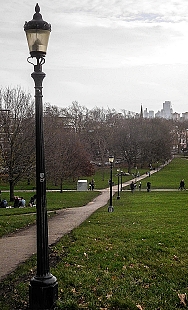
Primrose Hill (see photo above) also deserved a chapter in my book. It was visited by the artist/poet William Blake. The windows of the house where the philosopher Friedrich Engels for several years lived looked over towards the Hill. It was here that Karl Marx visited his friend Engels often. Nearby, later, the poet Sylvia Plath also resided for a while.
I have written quite a long chapter about Highgate, which is where I went to school between 1965 and 1970. Like Hampstead, the old village is rich in historic buildings and has had many now famous residents. This chapter also includes amongst many other places of note Highgate Cemetery, Kenwood, and its close neighbour the Spaniards Inn. Lesser-known places including a former school for Jewish boys and a block of flats designed by the Modernist Lubetkin are also described in this section of my book.
As you are probably beginning to realise, my book about Hampstead, which focusses mainly on the place, does include a great deal about areas that surround the old village. Apart from being factual, my book includes personal reminiscences of all the places described in it. What you will find when you read it is that you are in the hands of a guide who has known the area well for over six decades.
To obtain a copy of the book (or its Kindle version), head for an Amazon website such as:
IN 1916, A FAMOUS poet, TS Eliot (1888-1965) taught at Highgate School in north London. I was a pupil at this establishment much later, between the year when Eliot died and 1970. One of Eliot’s pupils during his short spell at Highgate was to become one of Britain’s Poet Laureates: John Betjeman (1906-1984). Betjeman wrote (quoted in https://bradbirzer.com/2015/07/06/john-betjeman-remembers-t-s-eliot-as-teacher/):
“In 1914-15 I spent two unsuccessful terms at Highgate Junior School. Mr Eliot was a tall, quiet usher there whom we called ‘The American Master.’ Some of the cleverer boys from Muswell Hill (I was from Highgate) knew he was a poet. How? I have often wondered, for I cannot imagine him telling them or anyone that he was a poet, and I did not know that he had published any poems in England as early as that.”
Betjeman’s association with Highgate where he lived as a child briefly and was educated for less than one year was much shorter than his association with the county of Cornwall.
Betjeman’s family had a house in Trebetherick, near Polzeath in Cornwall, where many holidays were spent. In later life, the poet resided there. The small church of St Enodoc is about 930 yards south of Trebetherick. In the middle of a golf course overlooking the sea, the church dates from the 13th century. Much of it was built by the 16th century. Over the centuries, St Enodoc has often been submerged by drifting sands from the nearby beaches. Between the 16th century and the mid-19th century, the church was completely submerged. In 1863-64, the church was freed from the sand and restored under the supervision of James Piers St Aubyn (1815-1895).
When staying or living at Trebetherick, Betjeman visited St Enodoc regularly. In 1945, he published a poem “Sunday Afternoon Service in St Enodoc Court, Cornwall”, in which he describes his impressions of the church affectionately. Author of much poetry and several books about Cornwall, Betjeman died in his home at Trebetherick. He was buried in the small graveyard that surrounds St Enodoc, a building that still appears to be partially buried in the hillside. His grave is marked by simple stone with a beautifully carved inscription. Born in Lissenden Gardens, now in the Borough of Camden, Betjeman lived briefly in Highgate’s North Road in a house opposite Highgate School. However, it is with Cornwall rather than Highgate that most people connect with the former Poet Laureate. As a former pupil at Highgate School, I was pleased to pay my respects at Betjeman’s grave in Cornwall.
KENWOOD HOUSE IS NEAR both Hampstead and Highgate in north London. It offers the visitor the chance to view not only its lovely grounds and fine interiors designed by the architect Robert Adam (1728-1792), but also a fabulous collection of paintings, many by world famous artists including, to mention but a few, Rembrandt, Frans Hals, Van Dyck, Vermeer, Reynolds, and Gainsborough.
Merlin (painted by Gainsborough) and the invalid cahir he invented
One of the paintings by Thomas Gainsborough (1727-1788) is a portrait of the inventor John Joseph Merlin (1735-1803). The latter was born in Huy (Belgium), and as a young man, he worked in Paris making clocks and mathematical instruments. In 1760, he moved to England to work as a technical advisor to the then new Spanish Ambassador to London. By 1766, he was working with the London jeweller James Cox. Then, he was creating mechanical toys including the Silver Swan, an automaton, still working, that can be seen at the Bowes Museum in Barnard Castle (Durham).
In addition to these ‘toys’, Merlin invented some useful items. These included roller skates; various clocks including one that was powered by changes in atmospheric pressure; improvements to keyboard musical instruments; playing cards for blind people; prosthetic devices; and a self-propelled wheelchair known as ‘the Gouty Chair’. There is an example of this ingenious wheelchair on display beneath Merlin’s portrait in Kenwood House. In my book about Hampstead and its environs, I described it as follows: “Two handles at the ends of its armrests are connected by rods and cogwheels to some wheels on the floor below the chair. The occupant of this chair could rotate the handles, and thereby propel this early form of wheelchair around the room.”
In the same room as the invalid’s chair, there is another of Merlin’s creations: a skeleton clock made by him in 1776. This kind of timepiece is one, whose working parts are not concealed by casing or any other features that usually hide them.
The portrait of Merlin, painted in 1781 by his friend Gainsborough, shows him in a red jacket, holding a small beam balance in his left hand. Apparently, this was one of his creations. This precision instrument is the only clue that the subject of the painting had anything to do with jewellery or instrument making. His right hand is tucked into his jacket:
The painting hangs in Kenwood House because it, like many of the others on display there, were part of the collection of the philanthropist and brewer (of the Guinness beverage) Edward Cecil Guinness, 1st Earl of Iveagh (1847-1927), who bought the house in 1927, and bequeathed it and his collection of paintings housed within it to the nation. You can discover more about Kenwood and nearby Highgate village in my book “Beneath a Wide Sky: Hampstead and its Environs” (https://www.amazon.co.uk/dp/B09R2WRK92 OR https://www.bookdepository.com/BENEATH-WIDE-SKY-HAMPSTEAD-ITS-ENVIRONS-2022-Adam-Yamey/9798407539520 )
LONG MELFORD IN Suffolk is a village that I have passed through several times. It was only during our most recent visit in August 2021, when we stopped there to see its church and Melford Hall that I realised that the place has a connection with Highgate School (in north London), which I attended between 1965 and 1970.
Melford Hall sits on land that was once owned by the abbots of St Edmundsbury. As with all monastic property, it passed into the hands of King Henry VIII when he ordered the dissolution of the monasteries in the 16th century. The king with an eye to profit rather than the prophets sold the properties he had confiscated to wealthy buyers (nobles, merchants, and lawyers). Melford Hall and its lands were sold to a local lawyer, William Cordell (1522-1581). His father was a personal assistant (‘steward’) to Sir William Clopton, a lawyer and owner of Kentwell Hall at Long Melford. Young Cordell was sent to study law at Lincolns Inn and was called to the Bar at the early age of 22. An active politician during the reigns of Queens Mary I and Elizabeth I and a founder of the Russia Company, William Cordell acquired great wealth. It was he that bought the estate at Long Melford along with its stately home, Melford Hall. In addition, he married Sir William Clopton’s granddaughter, heiress to estates in Lincolnshire and Yorkshire.
Cordell did not build Melford Hall, but he did modify it in various ways. However, he did build the nearby Hospital of the Holy and Blessed Trinity in 1573. Situated across from the cathedral-like parish church, this was an almshouse for 12 aged men and women. The Great Church of The Holy Trinity stands behind and above the almshouse. It is a superb example of 15th century gothic architecture and is distinguished by having a separate Lady Chapel, which cannot be entered from the church, at its east end. It is one of the only parish churches in the country, which was never part of an abbey, to have such a feature. Within this fine church, Sir William Cordell’s elaborate sculpted tomb can be found in the chancel to the right (south) of the high altar. He died childless.
Amongst other important roles, William Cordell became Recorder of London. He succeeded his acquaintance, another lawyer from Lincolns Inn, Sir Roger Cholmeley (c1485-1565). Sir Roger was the founder of Highgate School during the final months of his life. This is the school I attended many years later.
Thomas Hinde, author of “Highgate School. A History” wrote that after Cholmeley, William Cordell was the school’s greatest early benefactor. Connected with two other educational establishments, St Johns College in Cambridge and Merchants Taylors’ School, Cordell became a Governor of Highgate School in 1576.
When I was at Highgate, it only admitted boys. Some pupils, including me, were day boys, and others were boarders. The boarders lived in one of four houses: School House, The Lodge, Grindal House, and Cordell House. Grindal was named to commemorate Bishop Edmund Grindal (c1519-1583), who helped establish Highgate School and Cordell was named to honour William Cordell. Until We visited Long Melford, I had no idea about the reason for giving Cordell House its name.
Returning to Melford Hall, once the home of William Cordell, it has passed through many generations of the Hyde Parker family, who acquired the hall and its grounds in 1786 from a descendant of both William’s sister and his cousin, Thomas Cordell. In 1890. The Reverend Sir William Hyde Parker (1863-1931) married Ethel Leech (1861-1941) in 1890. Ethel had a cousin, who has become extremely well-known, the children’s author Beatrix Potter (1866-1943). She used to visit the Hyde Parkers at Melford Hall, where she stayed occasionally. She used to draw and sketch many features of the hall and its grounds. We were shown one of the bedrooms in which she used to sleep. Nearby in a glass-fronted display cabinet, you can see a toy duck, wearing the outfit that Beatrix had created for it. This duck was the inspiration for her book “The Tale of Jemima Puddleduck”, which was first published in July 1908.
I had seen photographs of Melford Hall, which made me want to visit it, and I was not disappointed. However, I had not expected to learn that the Hall and the village have connections with both Beatrix Potter and one of the earliest benefactors and governors of the secondary school I attended in Highgate. Our visit to Long Melford certainly broadened our minds, as the popular saying goes. I will leave you with how GK Chesterton, who attended St Paul’s School rather than Highgate, expressed this idea in his “The Shadow of the Shark”:
“They say travel broadens the mind, but you must have the mind.”
A MOTHER OF FAMILY-planning and women’s rights, Marie Stopes (1880-1958) lived at number 14 in Hampstead’s Well Walk between 1909 and 1916. I remember seeing a plaque recording her residence in Hampstead. However, I do not recall seeing the plaque to one of her neighbours, the socialist Henry Hyndman (1842-1921) on number 14. It was only when I acquired a copy of an excellent guide to Hampstead, “Hampstead: London Hill Town” by Ian Norrie, the owner of the former Hampstead book shop, ‘High Hill Books’ and Doris Bohm that I discovered that Hyndman had lived and died in Well Walk. Hyndman, a politician, lawyer, and skilled cricketer, was initially of conservative persuasion but moved over to socialism after reading “The Communist Manifesto”, written by Karl Marx in 1848. Although anti-Semitic, he was amongst the first to promote the writings of the (Jewish) Marx in England.
Replica of Highgate’s former India House in Mandvi, India
It is an extremely pleasant walk from Well Walk, across Hampstead Heath, Kenwood, and through Highgate village to Highgate Wood, opposite which the Indian born barrister Shyamji Krishnavarma (1857-1930) lived in self-imposed exile with his wife Banumati. Born during the year when The Indian Rebellion of 1857 (First Indian War of Independence or ‘Indian Mutiny’) commenced, it seems that it was appropriate that he was a keen promoter of India being liberated from the British Empire. Krishnavarma, in common with Hyndman, believed that it was wrong that the British should control and exploit the inhabitants of India. They corresponded and most probably met each other.
In 1905, responding to events in India such as the unpopular partition of Bengal, Krishnavarma, a wealthy man, decided it was time to do something about bringing down the British in India. He did three main things. He began publishing a virulently anti-colonial newspaper, “The Indian Sociologist”; he gave money to create scholarships for Indian graduates to study in England; he bought a large house in Cromwell Avenue, Highgate. He was also one of the founders of the Indian Home Rule Society, whose views were in stark contrast to those of the Indian National Congress, which at that time, put great faith in the supposed benevolence of the British Empire towards its Indian subjects.
The scholarships had several conditions attached. The most important of these was that the recipients had to promise that they would never ever work for, or accept posts from, the British Empire. The candidates for these scholarships were usually recommended by people in India, such as Bal Gangadhar Tilak, who were working actively to end British Rule.
Krishnavarma, recognising that many Indian students faced considerable hostility in Britain at the start of the 20th century, used the house he bought in Cromwell Avenue to create both student accommodation and a community centre, a home away from home for Indian students in England. He called the building ‘India House’, which should not be confused with the better-known India House in Aldwych, the Indian High Commission.
The grand opening of India House in Highgate was on the 1st of July 1905. The inauguration speech was given by Henry Hyndman. I do not know whether he was already living at Well Walk when he opened the student centre in Cromwell Avenue.
Soon after it opened, India House became an important centre of anti-British activity. Under Krishnavarma’s leadership, and given his anti-colonialist views, India House became of increasing interest to the British police and intelligence agencies. In 1906. Vinayak Damodar Savarkar (1883-1966), a law student and leader of a secret revolutionary society, became a recipient of one of Krishnavarma’s scholarships. He lived in India House, where he wrote a couple of anti-British books, which were banned in British India. In brief, believing in armed revolution, Savarkar became one of the most dangerously anti-British activists in Europe. When Krishnavarma and his wife shifted to Paris in 1907, Savarkar became the ‘head’ of India House. Under his watch, smuggling of arms and proscribed literature to India was carried out. He encouraged experimentation in bomb-making, and was not dismayed when one of his fellow house-mates, Madan Lal Dhingra, assassinated a top colonial official in South Kensington in 1909. The assassination led to increased police surveillance and India House, which had been opened by Hyndman, closed by 1910.
I have introduced you to this lesser-known aspect of the history of the Indian Freedom Movement for two reasons. One is to explain my delight in discovering that I must have walked many times past the house in Well Walk where Hyndman lived (and died). For me, Hyndman has assumed greater interest than his deservedly far better-known neighbour Marie Stopes. The reason for this is that about five years ago I was in the town of Mandvi in Kutch (part of India’s Gujarat State). Krishnvarma was born in Mandvi and is now commemorated there. Apart from the modest house in which he was born, there is an unexpected surprise on the edge of the town. It is a modern replica of the Victorian house in Cromwell Avenue (Highgate), which was briefly home to Krishnavarma’s India House. Seeing this extraordinary replica of the house inaugurated by Hyndman in a flat desert setting got me into researching its story. In the end, I published a book about the Indian freedom fighters in Edwardian London, “Indian Freedom Fighters in London (1905-1910)”, which explores the story I have outlined in far more detail.
[“Indian Freedom Fighters in London (1905-1910)” by Adam Yamey is available from amazon, bookdepository.com, lulu.com, and on kindle. Or specially ordered from a bookshop: ISBN 9780244270711]
THE GROUNDS OF KENWOOD House in north London are delightful at any time of the year. Here you can enjoy the marvels of a fine country house in magnificently landscaped grounds, rivalling rural spots like, for example, Stourhead, Blenhheim, and Compton Verney, without leaving the metropolis. Amongst Kenwood’s many horticultural attractions are the superb flowering bushes such as camellias, azaleas, and rhododendrons.
Kenwood House
Kenwood was within about half an hour’s brisk walk from my family home in Hampstead Garden Suburb and even nearer Highgate School, which I attended between 1965 and 1970. In amongst the flowering bushes, I remember that there used to be an open-fronted, small round hut with a conical roof. Inside it, there were benches that served as seats. This edifice was labelled ‘Dr Johnson’s Summerhouse’. The Dr Johnson to which this referred was one of Britain’s greatest literary figures, the writer and lexicographer Samuel Johnson (1709-1784). When I used to see this hut during visits to Kenwood in the late 1960s and the 1970s, I used to try to imagine the great Johnson sitting, resting and enjoying the view of the lawns and trees, some of which we can still see today. But, in those days, I was unaware that he never did enjoy these views from this spot.
It turns out that Dr Johnson used his summerhouse not in Kenwood but far away at Streatham Place in what used to be countryside south of London during Johnson’s lifetime. Shaun Traynor wrote:
“Streatham Place, the grand country house of the brewer Henry Thrale and his wife Hester, became for a time in the mid to late 18th century a setting for some very distinguished literary and artistic company. To this house, then sitting amid extensive grounds in the countryside south of London, came leading figures of the day: Edmund Burke, David Garrick, Sir Joshua Reynolds (who was to paint the Thrales), Oliver Goldsmith and – most significantly – Dr Johnson.” (https://www.johnsonsocietyoflondon.org/resources/Documents/Dr%20J’s%20Summerhouse%20-%20Shaun%20Traynor/Sam%20J%20summerhouse%20Shaun%20Traynor.pdf).
He added that the grounds of Thrale’s home contained a secluded summerhouse in which Johnson used to read and write. When Henry Thrale (born between 1724 and 1730) died in 1781, his widow Hester remarried, and the Streatham Place with its summerhouse were sold. Thrale’s daughter Susannah, who had been fond of Johnson, moved the hut to her home in Knockholt, Kent in 1826. According to Traynor:
“She erected it on rising ground in the very centre of the grove making all paths lead to it, and making the grove a kind of shrine to Dr Johnson’s memory.”
The years passed, and the summerhouse fell into disrepair. In 1962, a local man, who had great feelings for its historical significance, bought it and then presented it to London County Council (‘LCC’) so that it could be displayed to the public. After restoring it, it was placed in Kenwood at the spot where I recall seeing it, in 1968 (http://www.thrale.com/samuel_johnsons_summer_house). Although it is not inconceivable that Johnson might have visited Kenwood, it is not at all likely that he passed much if any of his spare time in a summerhouse in that garden.
In about 2017, after not having visited Kenwood for two or more decades, I paid it a visit. One of the first things I looked for was Dr Johnson’s summerhouse. I knew exactly where to look, but it was no longer there. After peering in amongst the large clumps of bushes in the spot where I remember that it used to stand, I found an octagonal concrete base. I wondered whether the summerhouse had once stood there. On enquiring at the information desk within Kenwood House, I learnt that the base was all that remained of what I had remembered seeing. I was told that the summerhouse had been destroyed by fire. This fire occurred sometime after 1984, probably 1991 (www.moruslondinium.org/research/dr-johnsons-streatham-park-mulberries). I was saddened to learn of this.
However, all is not lost. Alan Byrne, an artist who used to love sitting in the original Johnsonian summerhouse in Kenwood, has created an accurate replica of the refuge that the great writer used to enjoy. Using detailed plans of the original and other records, he produced an accurate reconstruction during the years 1997 to 1999 (https://www.johnsonsocietyoflondon.org/Dr-Johnson-summerhouse-photos-and-narrative). It stands in his garden in Islington.
Even without Dr Johnson’s summerhouse, Kenwood is well-worth visiting. The gardens alone are splendid, but when it is open, Kenwood House is a ‘must-see’. It contains some fine rooms decorated by Dr Johnson’s contemporary, the architect Robert Adam (1728-1792) as well as a collection of fine-art paintings that is, after the National Gallery, one of the best in London. When you feel that you have seen enough of Kenwood, then treat yourself to a stroll through its grounds and the contiguous Hampstead Heath to historic Hampstead, a place which offers a great range of eateries and pubs. And, incidentally, Samuel Johnson was no stranger to the place as the historian Thomas Barratt revealed:
“‘Mrs. Johnson for the sake of the country air,’ writes Boswell, ‘had lodgings at Hampstead, to which Johnson occasionally resorted. ‘For his own part, Johnson would doubtless have preferred Fleet Street; but he was fond of his wife, and felt in duty bound to minister to her pleasures as far as his limited means admitted.”
I can sympathise with Mrs Samuel Johnson. I much prefer Hampstead to Fleet Street, even if the former has less countrified air than it did in the 18th century.
AT SCHOOL, MY CHOSEN SPORT was cross-country running. Twice a week I spent an hour or so doing this in the grounds of Kenwood and the part of Hampstead Heath near to Highgate in North London. I have written about this before (https://adam-yamey-writes.com/2020/06/14/my-sporting-life/), but there is one aspect of it that I did not cover. Once a year, those who did cross-country running were accompanied by a teacher, Mr Bowles, who believed that getting covered in mud was an essential part of this form of exercise. I did not share his odd belief. There was one place on the Heath where filthy red coloured mud was guaranteed. This was at a point 410 yards south east of the centre of the grand south facing façade of Kenwood House and a few yards northwest of The Stock Pond, one of the series of Highgate Ponds.
The reason that this spot, favoured by Mr Bowles, was and still is, always sodden is that it surrounds a natural spring, which issues from a cylindrical stone well-head covered with stone carvings. These include depictions of a squirrel, a fish, and the head of a man with a luxuriant moustache. The water issues from a pipe emerging from the man’s mouth and then drops into a carving of a scallop shell before some of it falls into a drainage grid and the rest all over the place.
This well head is called Goddisons Fountain. It was constructed in 1929 (https://insearchofholywellsandhealingsprings.com/2019/04/19/the-healing-springs-of-hampstead/) and named in honour of Henry Goddison, who campaigned vigorously for saving Kenwood and Hampstead Heath from being built on and for preserving it for the use of the public. It is not known whether there was a spring on this spot prior to 1929, but it is not unlikely that there was.
Goddisons Fountain is the last surviving spring issuing chalybeate (iron rich) water in the Hampstead/Highgate area. Prized for its supposed curative properties, especially during the 18th century, there were several springs issuing this kind of mineral water in Hampstead. A fine example of a now disused spring well-head can be seen at the eastern end of Well Walk in Hampstead. It was for public use and located across the road from the Hampstead spa that thrived during the 18th century (https://adam-yamey-writes.com/2021/01/15/a-house-a-spa-and-grays-anatomy/).
If, unlike many who stroll on the Heath, you do not wish to try the chalybeate water issuing copiously from Goddisons fountain, the next nearest source of this once highly prized water is about 47 miles south east in The Pantiles at Royal Tunbridge Wells in Kent.
The water flowing from Goddisons Fountain is one of many sources of the water in the Highgate Ponds, which include (descending the slope from Kenwood) the Wood Pond; the Thousand Pound Pond with the trompe l’oeil bridge designed by Robert Adam; the Stock Pond which is directly below Goddisons Fountain; the Ladies’ Bathing Pond; the Bird Sanctuary Pond, where I spotted a heron; the Model Boating Pond, where I saw no boats; the Men’s Bathing Pond; and Highgate Number 1 Pond. The water from the topmost pond flows through the lower ones sequentially. Most of these ponds were dug before the 18th century as reservoirs for London’s water. They were kept full by damming the Hampstead Brook, a tributary of the now hidden River Fleet, in 1777. In addition, numerous streams in the grounds of Kenwood and on Hampstead Heath were diverted to keep them topped up. Now, the ponds form a valuable publicly accessible leisure amenity. Hardy souls gain great enjoyment in swimming in the gender segregated open-air ponds, whose waters are not subjected to any purification or disinfection procedures. During the present covid19 ‘lockdown’, it is only wildfowl that can enjoy their water.
As we looked at Goddisons Fountain today in late January 2021, I recalled my muddy encounters with it in the company of Mr Bowles and realised that I had not seen it since early 1970, that is just over half a century ago. And it was not until I wrote this that I learned that the fountain is the last surviving chalybeate spring in the part of the world, where I was brought up.
ELEGANT BELGRAVE SQUARE is but a stone’s throw from Hyde Park Corner. Many of its neo-classical buildings are home to diplomatic missions and their staff. As with many London squares, the centre of Belgrave Square contains a private garden. That at Belgrave Square is adorned with sculptures, mostly statues of eminent people. At each of its four corners, there is one. The people depicted at these four positions are Prince Henry the Navigator (1394-1460); Christopher Columbus (1451-1506); Simon Bolivar (1783-1830), the liberator of Venezuela, Bolivia, Colombia, Ecuador, Peru, and Panama; and José San Martin (1778-1850), liberator of Argentina, Chile, and Peru. Almost facing San Martin on the north east corner of the square is a statue of Sir Robert Grosvenor, First Marquess of Westminster (1767-1845), upon whose estate Belgrave Square was built.
Elias George Basevi
On the eastern side of the square, close to the statue of Simon Bolivar and within the garden, there is a sculpture by Enzo Plazzotta (1921-1981), which was completed after his death by Mark Holloway. It is called “Homage to Leonardo. The Vitruvian Man”.
Interesting as all the above-mentioned are, the sculpture that intrigued me most is a bust of Elias George Basevi (1794-1845), who is described on his plinth as ‘architect’. I guessed that he was likely to have been involved in the design of Belgrave Square, and I was right. According to a plaque on the base of Grosvenor’s statue, he designed the neo-classical terraces surrounding the square for the Haldimand Syndicate, which was under the control of the brothers George (1781-1851) and William (1784-1862) Haldimand, of Swiss origin, sons of a banker born in Switzerland and an English mother. In 1825, William, a Member of Parliament:
“… negotiated successfully with the 2nd Earl Grosvenor, Seth Smith and William Cubitt for a 99-year lease on Belgrave Square, where he had 49 houses built: 16 to be owned by George Haldimand, 14 by himself, eight by Prevost, four by Smith and three by Cubitt…” (www.historyofparliamentonline.org/volume/1820-1832/member/haldimand-william-1784-1862)
The Haldimands were related to Frederick Haldimand (1718-1791), who became Governor of Quebec in 1777. Thomas Cubitt (1788-1855), who was involved in creating the square, was a major Victorian property developer.
As for Basevi, at first, I thought that his surname sounded Italian. His family might have come from that country as its origins were Sephardic Jewish. The Basevi surname is particularly associated with Sephardic Jews in Verona (https://judaism_enc.enacademic.com/2089/BASEVI). His father, Joshua, usually known as ‘George’, was a London City merchant (www.jewishencyclopedia.com/articles/2616-basevi-george-joshua). Elias George’s aunt, George’s sister Maria (née Basevi), was married to Isaac D’Israeli, whose son was Benjamin Disraeli, Earl of Beaconsfield (1804-1881), who was Prime Minister between 1874 and 1880. In 1810, Elias became a pupil of the great architect John Soane (1753-1837), who specialised in creating in the neo-classical style. According to the Dictionary of National Biography (‘DNB’) (https://doi.org/10.1093/ref:odnb/1615), from which I have gleaned much information about Elias, he:
“… also studied at the Royal Academy Schools, where Soane had recently been appointed professor of architecture. In 1815 he visited Paris with his brother, and on completion of his architectural training in 1816 he embarked on a three-year study tour of Italy and Greece, staying the longest in Rome and Athens, but also travelling extensively elsewhere in Italy and even visiting Constantinople.”
Regarding Belgrave Square, the DNB relates:
“Basevi designed and handled the construction of the terraced houses making up the four sides of the square (1825–40), though not the four detached villas at the corners. He treated the stuccoed terraces of eleven or twelve houses on each side as single palatial façades, giving each a central columnar portico and end pavilions in a similar manner to John Nash’s terraces in Regent’s Park … The financial success of this speculative development during an economically depressed period was due in large part to Basevi’s precise and scholarly attention to detail, not just in the design of the individual houses but also in the paving, street furniture, and composition of the square as a whole.”
Elias Basevi’s other projects included, to give just a few examples, St Thomas, Stockport, Cheshire (1822–5); work at several country houses; a building at Balliol College Oxford; Beechwood House and The Elms in Highgate; and the Fitzwilliam Museum in Cambridge, whose construction was completed after his death. Beechwood House was built for the architect’s brother Nathaniel, a barrister, in 1840, who was married to a niece of Sir Robert Peel (1788-1850).
Noticing Basevi’s buildings in Highgate, I looked at John Lloyd’s “History, Topography, and Antiquities of Highgate”, published in 1888, and discovered more about Basevi. He wrote that the Basevi family had been prominent in the Anglo-Jewish community. One member of the family, Napthali, the grandfather of Benjamin Disraeli’s mother, was an early President of The Jewish Board of Deputies, which was involved in the struggle for the emancipation of the Jews. The Basevis moved away from the Jewish faith as did their kinsmen the Disraelis.
Elias Basevi married Frances Agneta Biscoe. They produced eight children, one of whom was given the name James Palladio Basevi (1832-1871), who became an officer in the Royal Engineers.
On a personal note, I attended Highgate School between 1965 and 1970. Some years later, I acquired a copy of the “Highgate School Register 1833-1988”. Today, I looked up ‘Basevi’ in the index of pupils and discovered that in March 1840, James Palladio Basevi joined the school. This son of the architect joined the school two years after the Reverend John Bradley Dyne (1809-1898) had become headmaster. Dyne was to raise the school’s reputation considerably. Other Basevi family members attended the school were William Augustus Basevi (joined January 1841), George Henry Basevi (joined January 1842) Frederick Biscoe Basevi (joined April 1844), Charles Edward Basevi (joined June 1844). All of these fellows were sons of the architect of Belgrave Square. Why they went to Highgate School is a bit of a mystery. Part of the reason might have been that their uncle, Nathaniel, had his home at Beechwood, a short walk from the school. however, their father, the architect lived in central London. The historian Alan Palmer, who used to teach at the school, wrote that out of the 43 graduates of Dyne’s first ten years, only 16 came from homes near the school. His reputation as a headmaster was already excellent by the time that the first of the architect’s sons entered the school, which attracted boarders.
Elias, who became a Member of the Royal Institute of British Architects, and a Fellow of both the Society of Antiquaries and the Royal Society, ended his life in a frightening way. The DNB relates his tragic ending:
“He died on 16 October 1845, aged fifty-one, after falling through an opening in the floor of the old bell chamber of the west tower of Ely Cathedral while inspecting repairs. His remains were buried in Bishop Alcock’s chapel at the east end of the cathedral.”
The bust of Elias George Basevi is smaller than the other commemorative sculpture placed in and around Belgrave Square and easy to miss if you are walking around the square. I only noticed it because I was watching two people walking with their dogs within the square’s private garden. Had I not seen the bust, I might have never explored the life of this man whose family had connections with Highgate, where I attended secondary school.






 yamey
yamey 