An oil painting hanging on a wall in a café in Hampstead

EVERY TIME I VISIT Hampstead, I feel pleasant twinges of nostalgia not only because I was brought up in the area but also because of my associations with the place after childhood. One place, which still exists, and has done so since it first opened in 1963, is Louis Patisserie on Heath Street. Originally, its shop sign bore the words “Louis Hungarian Patisserie” because it had been established by a Hungarian called Louis Permayer.

Sometime in 1970 or maybe the following year, I took a young lady, who is now my wife, to Hampstead on our ‘first date’. We had a genteel afternoon rendezvous at Louis. My wife remembers that she had coffee, and that it had been served with a separate bowl containing freshly whipped cream. Back in those days and for many years afterwards, Louis, with its wood-panelled walls, seemed to me to have a ‘touch of class’ as well as being evocative of Central Europe. The cakes and other baked items they used to sell were all good quality versions of what you might expect to find in a ‘Konditorei’ in Vienna or a ‘Cukrászda’ in Budapest.

Today (the 26th of February 2024), it was windy and extremely cold when we got off the bus in Hampstead. For old time’s sake, we entered Louis to warm up with hot beverages. Louis has long since changed hands, but the wood-panelling and several other original features still remain. However neither the hot beverages nor the patisserie items were of the same high quality as they used to be long ago. There are now other places in Hampstead where both the coffee and the food are superior to what is available at Louis, but none of these places bring back happy memories.

High on the end wall of the sitting area within Louis, there is a large, framed painting of a pond with buildings along one side of it. These are reflected in the water. In the foreground, three figures are depicted fishing with rods. The picture is painted with muted colours, or, possibly, the colours have faded since it was completed. Despite having visited Louis on numerous occasions, I had never looked at the painting properly until today. At the lower left corner of the painting, there is the artist’s name and a date:

“DC Towner 1972”

The artist was the painter and ceramics expert Donald Chisholm Towner (1903-1985). For many years, he was a resident of Hampstead, as this biography ( www.barnebys.co.uk/auctions/lot/donald-chisholm-towner-SrpyTddupt ) explains:

“… Towner was born at Eastbourne and studied at Eastbourne and Brighton schools of art and at the Royal College of Art under William Rothenstein 1923-1927. He moved to Hampstead in 1927 where he lived until his death and produced many paintings of the area and residents. D.C. Towner showed at the RA, Burgh House, NEAC etc.”

William Rothenstein (1872-1945), mentioned above, lived in Hampstead between 1902 and 1912, but by the time he taught Towner he was living elsewhere. It is unlikely that Towner lived in Hampstead because of Rothenstein. It was more likely that he chose the area because it was already favoured by many other artists.

Although DC Towner is not one of the greatest of the artists who lived and worked in Hampstead, his family name has related to the arts in another way – possibly better known than for his paintings. When his father, Alderman John Chisholm Towner of Eastbourne, died in 1920, he left 22 paintings and £6000 for the establishment of a public art gallery. Rehoused in a new gallery opened in 2009, the Towner Gallery still exists in Eastbourne. We visited it in its beautifully designed new home in 2019.

As the picture in Louis was painted in 1972, we would not have seen it on our ‘first date’. I do not know when it was purchased or acquired by the owner of the café. Who knows, but maybe the artist used to enjoy ‘Kaffee und Kuchen’ in the place where I took my future wife out one afternoon long ago.

PS: If you wish to see another of Towner’s paintings in Hampstead, you should visit the Lady Chapel of St John’s Parish Church in Church Row. In it, you can see Towner’s depiction of Church Row, where he lived, and his self-portrait – he used a mirror image of his own face for the Christ in this painting. The picture in the church was created to commemorate the artist’s mother, Grace Towner (1862-1949), who lived in Church Row and was buried nearby in St John’s cemetery.

Some interesting places around Hampstead

I LIKE THE WORD “environs”. I believe that I first encountered it as the title of an American road map of Philadelphia, which I acquired when I was living in Chicago, Illinois, in 1963. In those days, I was an avid collector of maps, and I had a relative who lived in Chicago and worked for the Sinclair Oil Corporation. It was he who gifted me a collection of Sinclair’s company road maps and some others, which included the one mentioned already.

The word ‘environs’ is according to an etymological website (www.etymonline.com):

“… late 14c. (implied in environing), “to surround, encircle, encompass,” from Old French environer “to surround, enclose, encircle,” from environ “round about,” from en- “in” (see en- (1)) + viron “a circle, circuit,” also used as an adverb, from virer “to turn” …”

So, it was an appropriate word to use in my book “BENEATH A WIDE SKY: HAMPSTEAD AND ITS ENVIRONS”, which I published in 2022. The ‘Wide Sky’ refers to the firmament above Hampstead, which fascinated, and was often painted by, the artist John Constable. The ‘environs’ include several places around Hampstead, which are described in the book, and listed below.

My book includes West Hampstead and North End, which although some distance away from the heart of Hampstead, have always been considered part of Hampstead. Its many residents have included a former British Prime Minister -William Pitt, the Elder – and a famous architectural historian – Nikolaus Pevsner. Golders Hill Park, once the grounds of a stately home, lies partly in the borough of Camden, and partly in Barnet. So, much of it is an environ of Hampstead.

Hampstead used to be separated by countryside from Swiss Cottage. I have written about this place, which is where I went to school between 1960 and 1965. Close to my old school, there is a drama school and a separate, highly acclaimed theatre. Although not as old as Hampstead, Swiss Cottage is not devoid of interest. For example, Sigmund Freud lived the last years of his life in the area. And near his former home, there is the Tavistock Institute, which has attracted some controversy in recent years. And the architecturally interesting Swiss Cottage Library, built in the early 1960s, is well worth a visit.

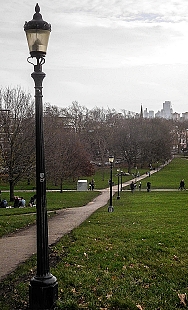
Primrose Hill (see photo above) also deserved a chapter in my book. It was visited by the artist/poet William Blake. The windows of the house where the philosopher Friedrich Engels for several years lived looked over towards the Hill. It was here that Karl Marx visited his friend Engels often. Nearby, later, the poet Sylvia Plath also resided for a while.

I have written quite a long chapter about Highgate, which is where I went to school between 1965 and 1970. Like Hampstead, the old village is rich in historic buildings and has had many now famous residents. This chapter also includes amongst many other places of note Highgate Cemetery, Kenwood, and its close neighbour the Spaniards Inn. Lesser-known places including a former school for Jewish boys and a block of flats designed by the Modernist Lubetkin are also described in this section of my book.

As you are probably beginning to realise, my book about Hampstead, which focusses mainly on the place, does include a great deal about areas that surround the old village. Apart from being factual, my book includes personal reminiscences of all the places described in it. What you will find when you read it is that you are in the hands of a guide who has known the area well for over six decades.

To obtain a copy of the book (or its Kindle version), head for an Amazon website such as:

https://www.amazon.co.uk/BENEATH-WIDE-SKY-HAMPSTEAD-ENVIRONS/dp/B09R2WRK92/

Having lunch with my father at the White House

AFTER MY MOTHER DIED in 1980, I began practising dentistry in Kent. Almost every weekend, I used to spend Saturday nights at my father’s house in Hampstead Garden Suburb. We used to have Sunday lunch together in one of his several favourite restaurants in Golders Green and Hampstead. Many of these restaurants no longer exist.

There were a few Chinese restaurants, which my father liked, in the Golders Green area. One of them was in Temple Fortune near the branch of Waitrose, which has been in existence since I was a child in the 1960s. The Chinese restaurant, which served a wonderful hors d’oeuvre that included a scallop in its shell, has long since closed.

In Golders Green Road, there were two more Chinese restaurants, both now gone. In one of them, my father was always greeted by the friendly manager (or, maybe he was the owner) with the words:

“Hallo Professor. How are you, professor?”

The food was well-prepared and tasty in both of them, just as it was in the Temple Fortune eatery.

Almost opposite the Hippodrome theatre, on the corner of North End Road and West Heath Drive, there was an Italian restaurant. Here, my father and I always received a warm welcome and enjoyed reasonably good Italian food. Currently, the site is occupied by a Turkish restaurant, which I have not yet tried.

Some weekends, we travelled up to Hampstead village. One of the two restaurants we visited occasionally was La Cage imaginaire, which still exists at its original location at the lower end of Back Lane, where it meets Flask Walk. Back in the 1980s, this place served classic French cuisine prepared to a high standard. I remember the cheese trolly which was richly supplied with ripe French cheeses. We revisited the place in about 2021 for ‘old times sake’. The management had changed and the food was nothing to write home about.

Today, the 3rd of November 2023, we ate at Mani’s in Hampstead’s Perrins Court. It was our third visit there, and the quality of the food in this busy eatery is highly satisfactory. Near the corner of Perrins Court and Hampstead High Street, there stands the Villa Bianca (‘white house’). This Italian restaurant must have first opened its doors to customers sometime in the 1980s. Never cheap, this restaurant was one of my father’s favourites in northwest London. Being a regular diner there, he was always welcomed like an old friend. Unlike many of the places where my father and I ate Sunday lunches in the 1980s and early 1990s, The Villa Bianca still exists, and is popular. Today, I looked at the menu. Although not suitable for those on a tight budget, many of the dishes did not seem much more costly than those served in far less fancy looking establishments.

DISCOVER MUCH MORE ABOUT HAMPSTEAD BY READING MY BOOK AVAILABLE FROM AMAZON, e.g., :https://www.amazon.co.uk/BENEATH-WIDE-SKY-HAMPSTEAD-ENVIRONS/dp/B09R2WRK92/

An old survivor in Hampstead

MUCH HAS CHANGED in Hampstead since I used to visit it every weekend during the early 1960s. The same is true for many places in London.

The Pimpernel on Heath Street, where my parents enjoyed espresso coffees, has long since closed. Likewise, my parents’ favourite Cellier du Midi in Church Row. Tragically, the High Hill Bookshop on the High Street disappeared many years ago, only to be replaced by yet another branch of Waterstones.

The venerable Everyman Cinema still functions, but now it is far more plush than it used to be when I was a lad. Of Hampstead’s many second-hand bookshops, only one, Keith Fawkes, remains. However, only recently I spotted Mr Fawkes sitting outside his shop, which has now been rebranded as ‘House Clearance Specialists’.

Another remnant of the Hampstead of my childhood is the Shahbhag Indian restaurant on Rosslyn Hill. Founded in 1954, my parents patronised it occasionally during the 1960s. I ate there once or twice in the late 1960s, but not since. By the 1970s, I had Indian friends, who introduced me to restaurants where the Indian food was far more authauthentic was offered at the Shahbhag. Unfortunately, many of these better eateries, many of which were on or near Warren, no longer exist.

During a recent stroll through Hampstead, I noticed that the Shahbhag was still in business. Seeing this sparked off the memories I have just described.

Once there were two in Hampstead; now there is only one

YESTERDAY (16th SEPTEMBER 2023), we met one of my cousins in Hampstead village.  We ate a very satisfactory lunch at The Flask pub in Flask Walk. We chose items from the ‘brunch menu’. Each of the three dishes we ordered was tasty and generous in portion size. The dish with wild mushrooms was exceptionally good.

Long ago, there were two pubs with the word Flask in their names in Hampstead: The Upper Flask and the Lower Flask. The Upper Flask was located close to where East Heath Road meets the top (northernmost) end of Heath Street, close to Whitestone Pond. It was a meeting place for noteworthy cultural figures, but it was closed in 1750. The pub in Flask Walk, where we ate lunch, was known as The Lower Flask. Here is something about it from my book “Beneath a Wide Sky: Hampstead and its Environs”:

“Once upon a time, Hampstead had two pubs or taverns whose names contained the word ‘Flask’. This is not surprising because the word ‘flask’ used to be common in the naming of pubs. One of them, the erstwhile Upper Flask, has already been described. The other, the once named ‘Lower Flask’, now renamed, is on Flask Walk, not far from Hampstead high Street. The Upper Flask was a remarkable establishment, as already described. It figures several times in ‘Clarissa’, a lengthy novel by Samuel Richardson (1689-1761), first published in 1747. The Lower Flask pub (in Flask Walk) is also mentioned in the novel, but unflatteringly, as:

“… a place where second-rate persons are to be found often in a swinish condition …”

Unlike the Upper Flask, the Lower Flask is still in business, but much, including its name and clientele, has changed since Richardson published his novel. Located at the eastern end of the pedestrianised stretch of Flask Walk, the Lower Flask, now The Flask, was rebuilt in 1874. Formerly, it had been a thatched building and was a place where mineral water from Hampstead’s chalybeate springs was sold. Oddly, despite visiting Hampstead literally innumerable times during the last more than 65 years, it was only on Halloween 2021 that I first set foot in the Flask pub, and I am pleased that I did. The front rooms of the pub retain much of their Victorian charm and the rear rooms, one of them with a glass roof, are spacious.”

Although the Flask Pub is interesting enough, there are plenty more interesting places to see along Flask Walk and in other parts of Hampstead. You can discover these by reading my book, which is available from Amazon websites such as:

https://www.amazon.co.uk/BENEATH-WIDE-SKY-HAMPSTEAD-ENVIRONS/dp/B09R2WRK92/

Why are Hunt and Keene together in Shepherds Bush?

I FIRST CAME ACROSS the critic, writer, and poet Leigh Hunt (1784-1859) when I was collecting information for my book about Hampstead. For some years, Hunt lived in a house in Hampstead’s Vale of Health. Amongst the many noteworthy people who visited him there regularly were the poets Shelley and Keats. Later, when I was writing my book about west London, I found out that Hunt had resided in Edward’s Square, Kensington. He had also lived in Chelsea. Until today (the 7th of August 2023), I had never seen a memorial to Hunt.  Today, I spotted one, a carved stone plaque, high up on the wall of the Bush Theatre that faces Pennard Road (in Shepherds Bush).

The theatre is housed in what was formerly one of several libraries established by the newspaper entrepreneur and philanthropist John Passmore-Edwards (1823-1911). The library building was built in 1895 and its external features are well-preserved. The theatre moved into it in 2011.

Hunt is not the only person commemorated on the plaque. Below his name is that of the artist Charles Keene (1823-1891).  In his book “A Few Footprints”, Passmore-Edwards wrote (in 1906) that he placed memorials of illustrious people in places near where they died:

“I have placed medallions of Charles Lamb and John Keats in the Public Library, Edmonton; of Sir Henry Austin Layard and Sir William Molesworth in the Public Library, Borough Road ; and of Leigh Hunt in the Public Library, Shepherd’s Bush…

… Mr. A. E. Fletcher, who unveiled the memorial medallion of Leigh Hunt at the Shepherd’s Bush Public Library, said: ” Let us remember Shelley’s fine description of Leigh Hunt as one of the happy souls who are the salt of the earth.’ We have learnt enough to admire him for his genius and his marvellous industry, to honour him for his fearless outspokenness and courageous sacrifice for principle, and to love him for his splendid faith in humanity and his buoyant optimism””

However, Passmore-Edwards makes no mention of Keene.

The plaque was probably affixed to the library when it was built. But why the two names are on the same plaque is a bit of a mystery to me. The only possible connection, which makes sense in the light of what Passmore-Edwards wrote, is that both men died reasonably close to Shepherds Bush.

A not so peaceful garden of peace

TODAY, OUR FRIEND took us to see a part of Hampstead, which I never knew existed. Called The World Peace Garden, it is located on a sliver of sloping ground bounded to the south by Hampstead Heath Overground station and to its north by a short stretch of the western end of the road called South Hill Park. Its dimensions are approximately 95 feet in length with a maximum width of about 29 feet. It is entered by a discrete opening on South Hill Park. Some steps lead downward to a couple of paths that wind their way through the dense vegetation and past small ponds to a tiny seating area at the garden’s eastern end. The miniscule park is rich in flowers, bushes, and trees. It is a lovely place.

The World Peace Garden began to be created in about 2014 on waste land between South Hill Park and the railway station. Inspired by a local estate agent, Jonathan Bergman, the garden was designed by  Tony Panayiotou and Michael Wardle, and created by gardeners Keiko, Hugh, Laurence, Miki, and Mer. In 2016, it was awarded the ‘Time Out Love London Award for Local Culture in Hampstead’. Today, it is still delightful, although slightly overgrown. During our midday visit, we saw several people enjoying lunch in shady nooks.

Although the garden is to celebrate the idea of world peace, it is not exactly a peaceful place. Every few minutes, the peace of the garden is disturbed by noises coming from trains passing through the station beneath it. Despite speaking to many people about Hampstead, until today nobody has mentioned the Peace Garden to me.

A painting of Hampstead at Sotheby’s auction house

THE ARTIST JOHN Constable (1776-1837) lived at various addresses in London’s Hampstead. There, he created many sketches and paintings. He was extremely interested in depicting clouds – difficult subjects for an artist to portray convincingly, but Constable was able to do it well. Hampstead, high above most of the rest of London, provided a good spot for an artist interested in creating pictures of meteorological phenomena. High above the built-up parts of the city with no obstructions in his field of vision, Constable was able to set up his easel under a vast sky.

Recently (5th of June 2023), we visited the pre-auction viewing rooms at Sotheby’s in New Bond Street. In one of the galleries, paintings by ‘Old Masters’ were on display. One of them, which caught my eye, was by Constable, and labelled “Study for Hampstead Heath with a rainbow”. Valued at between £300,000 and £400,000, this picture includes a pond in the foreground; two people on the edge of the pond; some trees; a windmill with some small buildings near it; and a flock of birds flying above a small hill. This rustic scene is lovely, but what really catches the viewer’s attention is the sky. Constable has painted billowing clouds, which almost completely hide the clear sky behind them. Some of the clouds are white and others are ominously grey. Almost as accurate as a photograph, this cloudscape does more than slavishly reproduce what the artist saw – it manages to evoke what he must have felt seeing these clouds. And given the fleeting, ever-changing appearances of clouds, the artist must have worked swiftly to capture the celestial scene he saw.

Although I know that Hampstead once had a windmill near Whitestone Pond (now remembered by a lane called Windmill Hill), judging by its surroundings, the pond in the picture was not Whitestone. It might have been one that local enthusiasts he reconstructed recently – located beside Branch Hill. There is a painting in the Tate Gallery’s collections called “Branch Hill Pond, Hampstead Heath, with a Boy Sitting on a Bank”, which has a similar appearance to that which I saw in Sotheby’s, except that there is no windmill. Constable made many paintings and sketches that included the Branch Hill Pond, but apart from the picture I saw in Sotheby’s, which is a study rather than a finished work, they do not include a windmill.

A few months ago, I published a book about Hampstead and some of its interesting neighbours (including Highgate, West Hampstead, and Primrose Hill). Some people have wondered about the title I chose. It was because of Constable’s fascination with sky and clouds and his years of residence in Hampstead that I chose to give my book about the area the title “Beneath a Wide Sky: Hampstead and its Environs”.

My book is available from Amazon as a paperback or an e-book:https://www.amazon.co.uk/BENEATH-WIDE-SKY-HAMPSTEAD-ENVIRONS/dp/B09R2WRK92/

From Bombay to Belsize Park

SEVERAL OF OUR FRIENDS born in India came to study accountancy in the UK during the late 1960s and early ‘70s. In those days, studying accountancy had two benefits apart from giving our friends the opportunity to have careers in commerce and finance. First, coming to the UK was an opportunity to live abroad, and, more importantly, because they had to study whilst employed by an accountancy firm, they got income to cover their living expenses. All of them have had successful careers in business and/or banking. Some years earlier (in 1950), Lancelot Ribeiro (1933-2010), born in Bombay, came to the UK to study accountancy. However, he did not complete the course. Instead, he began studying art at London’s St Martins School of Art between 1951 and 1953. At that time, he lived in London’s Chalk Farm with his half-brother, the artist Francis Newton Souza (1924-2002), who was born in Goa. In August 1954, Lancelot was conscripted into the RAF. He was released from this in January 1955. Then, he returned to Bombay.

In Bombay, Lancelot was employed by the Life Insurance Corporation. He remained in this company for four years, by which time his poetry and painting were becoming recognised by Bombay’s artistic community, notably by the poet Nissim Ezekiel, the critic and poet Rajagopal Parthasarathy, the critic Rudolf von Leyden (German born, but lived most of his life in Bombay), and the Tata industrial group (who commissioned some of his works). By 1959, he had decided to make painting his profession. By the early 1960s, he was exhibiting in both group shows and solo exhibitions and was gaining wider, and influential recognition. Lancelot and his wife returned to London at the end of 1962/early 1963.

After living in various parts of London, the Ribeiro’s settled in the Belsize Park area of Hampstead – at Belsize Park Gardens – for a few years. By now, Lancelot’s works, and those of other Indian artists living in England, were being exhibited both in the UK and India. Life in London was not easy even in the late 1970s for people with ‘brown’ skins as Lancelot found out the hard way. Several times, he was attacked in the streets near Swiss Cottage, and once badly injured when attacked outside Hampstead Police Station. In addition, some of his pictures were vandalised when on display at the Swiss Cottage Library in 1986-87. However, none of this subdued his irrepressible creativeness.

Some of his prolific and highly inventive artworks were exhibited in Hampstead’s Burgh House when it held an “Indian Month” in 1980. Although he did not enjoy as much fame as his better-known half-brother, Ribeiro’s work is well worth seeing. An opportunity to do so is currently available at Burgh House until the 17th of December 2023. The well-displayed exhibition, “Lancelot Ribeiro: Finding Joy in a Landscape” can be seen free of charge. The Burgh House website describes it as follows:

“A journey through the changing landscapes of Hampstead-based expressionist poet and painter Lancelot Ribeiro, from his roots in pre-Independence 1930s India to life in mid-20th century Britain.

Ribeiro experimented with form and materials, moving from conventional depictions of the Lake District to otherworldly townscapes and sharp, bright abstracts inspired by geology. Each work encourages us to look anew, reconsider the form and substance of our environment, and how we might depict and share those landscapes with others.”

I can strongly recommend that you pay a visit to this show to see the works of an artist, who should be more widely known.

Finally, I wonder what would have become of our few dear friends had they abandoned accountancy prematurely. One of them, in his retirement from many years in banking, has become written a highly acclaimed novel. Another, who retired from a career in an international corporation, is now highly developing his skills as a cook. A third, who dropped out of accountancy, has become a successful translator.

Where I watched my first ever movie

THE LAST TIME I watched a film at the Everyman cinema in London’s Hampstead was in the 1960s. In my book “Beneath a Wide Sky: Hampstead and its Environs”, which I published in 2022, I described the cinema and my recollections of it as follows:

“It was at the Everyman that I went to the cinema for the first time in my life. My parents, who were not regular cinemagoers, decided that the rather sad French film, “The Red Balloon” (first released in the UK in late 1956), was a suitable production to introduce me, a four-and-a-half-year-old, to the joys of cinema. My parents, who tended to avoid popular culture, probably selected the “Red Balloon”, an arty French film, because it was a little more recherché than the much more popular Disney films that appeared in the late 1950s. The cinema, which still exists, was, according to Christopher Wade, built in 1888 as a drill hall for The Hampstead Rifle Volunteers. Then, in 1919 its windows were bricked-in, and it became MacDermott’s Everyman Theatre. In 1933, it became a cinema. I saw many more films there in my childhood and adolescence. Every year, there used to be a festival of Marx Brothers films in the summer months. I loved these films and used to visit the Everyman on hot sunny afternoons when I was often the only person in the auditorium. In those days, the cinema’s auditorium had a strange smell that strongly resembled household gas. Indeed, there were gas lamps attached to the walls of the auditorium, but I am certain that I never saw them working. They might have there for use as emergency lighting in case there was an electricity supply failure. These were quite frequent during my childhood but never happened when I was at the Everyman.

The cinema is, I have been told, now a very luxurious place. The seats are comfortable and have tables beside them, at which waiting staff serve food and drinks. This is a far cry from what I can remember of the rather basic cinema in the 1960s. Back in those days, the Everyman, like the now long-gone Academy cinemas in Oxford Street, favoured screenings of ‘arty’ films rather than the more popular films that most cinemas showed. Now, the Everyman, formerly an art-house cinema, thrives by screening films that are most likely to attract full houses. That this is the case is yet more evidence to support the idea that Hampstead is not what it was. Many of the sort of people who might enjoy arty films that attract often small niche audiences, who used to live in Hampstead, can no longer afford to reside in the area.”

Today, the 16th of May 2023, my daughter took me to see a film at the Everyman (see picture). As already mentioned, the cinema is now quite ‘swish’. It had been re-designed late last year. Whereas once it had only one screen, now it has two. We saw our film, “The Unlikely Pilgrimage of Harold Fry”, screened in what was the original auditorium – Screen 1. The ceiling supported by tapering metal struts is how I remember it from at least 50 years ago. Otherwise, all has been changed. The smell of gas has gone. The seating is curious to say the least. It consists of well-upholstered armchairs and couches, all well separated from each other. In between them, there are tables, and metal wine cooler buckets are attached beside each of them. The upholstery materials are colourful and differ from seat to seat. For my taste, the aesthetics are not too successful. The screen is placed high enough so that it does not matter how tall a person sits in the seat in front of you. The acoustics were good. All in all, it was a pleasure revisiting the cinema in which I saw my first ‘movie’ sixty-six years ago.

My book about Hampstead is available from Amazon:

https://www.amazon.co.uk/BENEATH-WIDE-SKY-HAMPSTEAD-ENVIRONS/dp/B09R2WRK92/