Cholera in Hampstead and spread of disease

THIS IS NOT ABOUT our current plague, the covid19 pandemic, but an earlier one that occurred occasionally in the 19th century. In many countries today, millions of people live with plague and disease and might even accept it as a part of daily life. Fortunately, until recently this was not the case in the UK. However, in the 19th century when diseases and their transmission were less well understood than currently, living conditions in the UK were considerably less healthy than today, disease was rife, and life expectancy was not great. While walking amongst the picturesque steeply sloping back streets of Hampstead village in North London in late November 2020, we spotted a carved stone plaque high on a wall of a house, currently Heathside Preparatory School, on New End (at the point where the street makes a right angle and becomes north-south instead of east-west).

The plaque reads:

“This building was erected by voluntary contributions for a dispensary and soup kitchen. It was intended as a thank-offering to Almighty God for his special mercy in sparing this parish during the visitation of cholera in the year 1849. The site was purchased in 1850 and the building completed in 1853.

He shall deliver thee from the noisome pestilence. Thomas Ainger M.A. incumbent”

As you will discover soon, not everyone in Hampstead was spared from cholera in 1849. One of those, who was afflicted, not in 1849 but five years later, unwittingly made a great contribution to science.

Thomas Ainger (1799-1863), who was born in Whittlesea, Cambridgeshire and studied at Cambridge University, was awarded ‘perpetual curacy’ of St Mary’s Hampstead in 1841, a position he held until his death (http://hampsteadparishchurch.org.uk/data/magazines_2013.php?id=897). He was:

“An energetic parish priest and poor-law guardian; helped to found schools and a dispensary; enlarged his church and promoted the building of new churches in the district around Hampstead.” (https://venn.lib.cam.ac.uk/).

Today, we can have injections that radically reduce the chances of suffering from cholera, but that was not the case back in 1849, when the mechanism by which the disease spreads was not yet understood. One case of the disease that significantly helped to further knowledge of its spread occurred in Hampstead in 1854.

Dr John Snow (1813-1858), who led the way in hygiene and anaesthesia, suspected that cholera was spread via drinking water. He demonstrated that cases of the disease were clustered around particular water sources. During an outbreak of cholera in 1854 in London’s Soho district, which was centred around a pump in Broad Street, now Broadwick Street, he found that by removing the handle from the pump so that the locals could no longer draw their drinking water from there, the local outbreak of cholera was brought to an end. The pump in Broad Street was only three feet away from a leaking cess pit and its water was contaminated by waste matter (www.ph.ucla.edu/epi/snow/broadstreetpump.html). Snow theorised that the cause of cholera was not as previously thought a ‘miasma’ in the air, but something in drinking water. Now, let Stephanie Snow continue the story (International Journal of Epidemiology, 2002; vol.31: pp 908–911):

“In 1849, the London Medical Gazette had suggested that in regard to Snow’s theory, the experimentum crucis [i.e. critical experiment] would be that the water conveyed to a distant locality where cholera had been hitherto unknown produced the disease in all who used it. One of the cholera victims Snow had traced through his Broad Street investigation was a widow who lived in Hampstead. She had a regular delivery of water from the Broad Street pump as she preferred its taste. Her last delivery was made on 31 August and by 2 September, having drunk the water, she had died from cholera. Snow regarded this as ‘the most conclusive’ of circumstances in proving the connection between the water pump and the cholera outbreak.”

The widow had lived at ‘West End’, which until the 19th century was that name of what is now West Hampstead.

The plaque in New End suggests that Hampstead Parish was ‘spared’ from the cholera in 1849. That was almost true. In that year, Hampstead had 8 deaths from cholera per 10,000, whereas many areas of London reported between 100 and 200 deaths from cholera per 10,000 (www.ph.ucla.edu/epi/snow/publichealth118_387_394_2004.pdf). The rate of cholera fatalities in its area was determined by the location of its drinking water supply.  The uppermost rates of deaths from cholera in 1849 were exceedingly high compared with even the highest rates of covid19 infection anywhere in the UK during the second half of 2020.  

John Snow had been alerted to the existence of the widow in Hampstead by Reverend Henry Whitehead (1825-1896), a vicar in London’s Soho district, who was at first sceptical of Snow’s theory of the water-borne transmission of cholera (http://www.ph.ucla.edu/epi/snow/whitehead.html) and favoured the idea that cholera existed as an airborne ‘miasma’. Although Snow and Whitehead differed on their ideas on the transmission of cholera, they decided to work together. Peter Daniell and David Markoff provide more detail (www.choleraandthethames.co.uk/cholera-in-london/cholera-in-soho/) about the widow in Hampstead:

“Whitehead was able to tell Snow about a widow living in Hampstead, who had died of cholera on the …  2nd September [i.e. 1854], and her niece, who lived in Islington, who had succumbed with the same symptoms the following day. Since neither of these women had been near Soho for a long time, it was impossible that they could have contracted the disease through breathing in the polluted air of the area. Intrigued, Dr Snow rode up to Hampstead to interview the widow’s son. He discovered from him that the widow had once lived in Broad Street, and that she had liked the taste of the well-water there so much that she had sent her servant down to Soho every day to bring back a large bottle of it for her by cart. The last bottle of water—which her niece had also drunk from—had been fetched on 31st August, at the very start of the Soho epidemic. This was just the sort of evidence he needed to prove the argument of the miasmatists wrong.”

If we had not noticed the plaque in Hampstead, I doubt that I would have become aware of the West End widow’s role in the unravelling of the method of transmission of cholera. Below the plaque and on the same wall, there is a pink granite object, which looks like a broken drinking fountain. This bears the date ‘1859’, five years after the large outbreak in Soho, and I hope that people did not contract cholera by drinking from it. It was in that year, that Joseph Bazalgette (1819-1891) began his programme of improving London’s sewerage system. This helped to reduce the out breaks of cholera, but there was at least one more in the East End of London in 1866.

The Spaniards

EVERY SCHOOLDAY MORNING between 1965 and 1970, I boarded a single-decker, route 210 bus at Golders Green Station. First, we travelled up North End Road southwards to Jack Straws Castle, near Whitestone Pond. Then rounding the Hampstead war memorial, our direction changed from south to north-east as the bus travelled along the straight Spaniards Road, just a few yards more than half a mile in length. Invariably, the bus slowed down near the Spaniards Inn, where the road narrows because of the presence of a disused, historic tollhouse directly across the road from the inn.  During my five years of travelling this route, I never wondered about the history of the Spaniards Inn, the tollhouse, and the area around them. Now, many years after leaving Highgate School, to which I was heading every morning on the 210, my interest in historical matters has been fired up, as has my desire to share that with anyone who has time to read what I write.

Spaniard’s Inn on right, tollhouse on left

Spaniards Road and its eastern continuation beyond the tollhouse, Hampstead Lane, have long comprised an important route connecting Highgate and Hampstead. Spaniards Road, unlike Hampstead Lane, runs level without inclines or declivities. It runs along a ridge between the south and north facing slopes of Hampstead Heath. At its western end near the former Jack Straws Castle pub, it reaches the highest point in Hampstead, about 440 feet above sea level. At its eastern end by the Spaniards Inn, it is three feet lower. East of the inn, Hampstead Lane descends considerably and only begins to rise again within about three hundred yards of the centre of Highgate Village.

The tollhouse, the cause of an almost continuous traffic bottleneck, narrows the road width considerably so that it is only broad enough to admit one vehicle at a time. The tollhouse was built in the 18th century to collect tolls from those passing through the western entrance to the Estates of the Bishops of London, which they owned for almost 1400 years. Because of its tendency to slow the traffic, the idea of demolishing it or moving it a few yards from the road was mooted in the last century. The debate about shifting the tollhouse even reached the House of Lords, where on the 2nd of February 1966, Lord Lindgren (George Lindgren: 1900-1971) suggested:

“My Lords, to move this building two yards would, I think, be a tremendous waste of time, effort and labour. In actual fact, the lorries going by day by day remove the brick, and if we leave it long enough it will not be there.”

Luckily, the small building remains intact and although not particularly attractive, it adds to the charm of the area.

The Spaniards Inn, across the narrow stretch of road from the tollhouse, is believed to have been established in about 1585. It stands on the old boundary between Finchley and Hendon. Today, the Inn is in the Borough of Barnet and the tollhouse is in that of Camden. In former days, the inn marked the entrance to the Estates of the Bishops of London. The building that houses the inn is 17th century brickwork with some wooden weatherboarding, which is best viewed from the pub’s carpark. It is according to the historicengland.org.uk website:

“An altered building, but one that still has great character.”

The origin of the pub’s name is not known for certain. One suggestion is that the building was once owned by a family connected with the Spanish Embassy. Another is that at some stage, the house was taken by a Spaniard and converted to a house of entertainment. Edward Walford, writing in the 1880s, relates that whilst the Spanish Ambassador to King James I (ruler of England from 1603 to 1625) was residing there, he complained:

“…that he and his suite had not seen very much of the sun in England.”

The Spaniards Inn was the scene of an event during the Gordon Riots in mid-1780. The causes of the riots were several, but they included anti-Catholic sentiments following the passing of an act of Parliament passed in 1778, which ‘emancipated’ the Roman Catholics. At that time, Kenwood House, which is just east of the Spaniards Inn was one of the homes of William Murray, 1st Earl of Mansfield (1705-1793), an important lawyer, reformer (his reforms included objections to slavery), and politician. He was Lord Chief Justice when the act was passed and just prior to the outbreak of rioting, he had treated a Catholic priest leniently in a court of justice.  A group of rioters attacked and burned Mansfield’s home in Bloomsbury Square:

“The furniture, his fine library of books, invaluable manuscripts, containing his lordship’s notes on every important law case for near forty years past … were by the hands of these Goths committed to the flames; Lord and Lady Mansfield with difficulty eluded their rage, by making their escape through a back door … So great was the vengeance with which they menaced him, that, if report may be credited, they had brought a rope with them to have executed him: and his preservation may be properly termed providential.”

So, wrote a correspondent in the “Lady’s Magazine” in 1780 (www.regencyhistory.net/2019/09/the-gordon-riots-of-1780.html).

Not happy with burning down Mansfield’s London home and its owner’s escape from their clutches, rioters set off towards Kenwood where they planned to destroy his rural retreat. They made their way to the Spaniards Inn, which was then kept by a publican called Giles Thomas. This shrewd fellow was quick to assess the reason for the rabble’s arrival and being a man of quick thinking, he opened his house and his cellars to the mob, offering them unlimited refreshment before they continued to undertake their planned work of devastating Kenwood House. As soon as they began enjoying Thomas’s generous hospitality, the canny publican sent a messenger to a local barracks to raise a detachment of the Horse Guards. At the same time, he arranged for other rabble-rousers to be supplied with liberal amounts of strong ale from the cellars of Kenwood House. A Mr William Wetherell, who was on the spot, encouraged the rioters to adjourn to the Spaniards Inn. By the time that the military arrived, the rioters were in no fit state to either resist the soldiers or to carry out their planned attack on Mansfield’s residence, which was a good thing not only for Mansfield but also for posterity because by 1780, the house had already been worked on by the architect Robert Adam, who had made improvements of great artistic value.

The Spaniards Inn stands amongst a cluster of historic buildings. Its next-door neighbour is a plain building, Erskine House (also once known as ‘Evergreen Hill’). This stands on the site of an earlier house of the same name built in about 1788. It was the home of the lawyer and Whig politician Thomas Erskine (1750-1823), Lord High Chancellor of Great Britain between 1806 and 1807.  By all accounts, he was a brilliant man. He was involved in many important trials. One of these that attracted me because of my interest in Indian history was during the impeachment proceedings (in 1785) against Warren Hastings after his time as Governor General of Bengal. Mr Stockdale, a publisher in Piccadilly, issued a pamphlet by John Logan which defended Hastings, and following that was tried for libel expressed against the chief opponents of Hastings, Charles Fox and Edmund Burke. Stockdale was defended successfully by Erskine in a case that helped to pave the way to the passing of the Libel Act 1792, which:

“… laid down the principle that it is for the jury (who previously had only decided the question of publication) and not the judge to decide whether or not a publication is a libel.” (https://en.wikipedia.org/wiki/Thomas_Erskine,_1st_Baron_Erskine).

In addition to being involved in many other important cases, Erskine was an animal lover as well as a great wit. For example, when he saw a man on Hampstead Heath hitting his miserable-looking sickly horse violently, so Edward Walford recorded, he admonished the cruel fellow. The latter replied:

“Why, it’s my own; mayn’t I use it as I please?”

Hearing this, Erskine began beating the miscreant with his own stick. When the victim remonstrated and asked him to stop using his stick, Erskine, who could not suppress making a witty remark, said:

“Why, it’s my own; mayn’t I use it as I please?”

Erskine’s former home was located between the Spaniards Inn and a house, which still stands today, Heath End House, which was occupied by Sir William Parry (1790-1855), the Arctic explorer. The sign on its outer gate reads ‘Evergreen Hill’. Later, it was a home of Henrietta Barnett (1851-1936) and her husband Canon Samuel Barnett (1844-1913). Both were deeply involved with the creation of Hampstead Garden Suburb. Although I lived in the ‘highly desirable’ Suburb, I would have much preferred to have lived in the Barnett’s lovely house by the Spaniards Inn. Had I lived there in amongst that historic cluster of houses, maybe I would have walked to school instead of boarding the 210 bus in Golders Green.

Kit Kat in Hampstead

KIT KAT CONFECTIONERY BARS are familiar to many people and I enjoy eating them occasionally. The ‘Kit Kat’ and ‘Kit Cat’ tradenames were registered by the Rowntree’s confectionery company in 1911, but the first chocolates bearing this name only appeared in 1920. Had you wanted to eat a Kit Kat in the early 18th century London, you would not have been served a chocolate item but a type of mutton pie. The Kit Kat mutton pie was the creation of Christopher Catling (aka ‘Katt’ and ‘Cat’), who had a pie house in Shire Lane near Temple Bar, which used to stand near the present-day Royal Courts of Justice on London’s Strand.

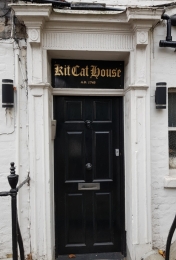
When walking in Hampstead Village recently, we saw something I had never noticed before during at least 60 years of visiting the area. It was wording above the doorway of a house on the corner of Heath Street and the much narrower Holly Bush Steps. The words are: “Kit Cat House” and (below them) “A.D. 1745”. Above one of the ground floor windows, that which is nearest to Heath Street but on the wall facing Holly Bush Steps, there are some painted letters, which I will discuss later.

The Kit Cat Club (also sometimes spelled as ‘Kit Kat’) was an 18th century club whose members were of the Whig political persuasion. Members included  literary men such as William Congreve, John Locke, Sir John Vanbrugh, and Joseph Addison; and politicians including Duke of Somerset, the Earl of Burlington, Duke of Newcastle-upon-Tyne, The Earl of Stanhope, Viscount Cobham, Abraham Stanyan and Sir Robert Walpole, who was Prime Minister between 1721 and 1742. The painter Sir Godfrey Kneller (1646-1723) was yet another member. He painted portraits of 48 members of the club, which are now kept in the National portrait Gallery.

The club is commonly believed to be named after Christopher Catling and his mutton pies, but this is not known for certain. The club’s meetings were held at first in Catling’s tavern in Shire Lane (which no longer exists). Then, they were held at the Fountain Tavern on the Strand, which stood where today stands Simpsons on the Strand, and then later at purpose-built premises at Barn Elms (between Barnes and Fulham). In summer, the members met at the Upper Flask in Hampstead.

The Upper Flask, which was demolished long ago, was a pub located on the corner of East Heath Road and Heath Mount, that is on the south corner of East Heath Road and Heath Street, about 190 yards north of the present Kit Cat House on Holly Bush Steps. It was on the site of the now closed Queen Mary’s Maternity Home that received patients between 1919 and 1975.

Edward Walford, writing in his encyclopaedic “Old and New London” (volume 5, published in 1878), noted:

“The ‘Upper Flask’ was at one time called ‘Upper Bowling-green House,’ from its possessing a very good bowling green …  when the Kit-Kat Club was in its glory, its members were accustomed to transfer their meetings in summer time to this tavern, whose walls – if walls have ears – must have listened to some rare and racy conversations … Mr Howitt in his ‘Northern Heights of London’ gives a view of the house as it appeared when that work was published (1869). The author states that the members of the Kit-Kat Club used ‘to sip their ale under the old mulberry tree, which still flourishes, though now bound together by iron bands, and showing signs of great age…’”

During the later year’s of the Club’s existence, in the first quarter of the 18th century, some of those members who sipped ale under this tree included the poets Shelley and Keats, who lived in Hampstead. Another member, who enjoyed meetings at the Upper Flask, the poet and physician Richard Blackmore (1654-1729), penned these lines about them in his poem “The Kit-Kats” (published in 1708):

“Or when, Apollo-like, thou’st pleased to lead

Thy sons to feast on Hampstead’s airy head:

Hampstead, that, towering in superior sky,

Now with Parnassus does in honour vie.”

So, the Kit Cat Club had an association with Hampstead, but was there any connection between the Club and the house on Holly Bush Steps, which bears the date 1745? The house was built in about 1800 (https://historicengland.org.uk/images-books/photos/item/IOE01/15805/21), which is after the period between 1696 and 1720, when the Club was active (https://doi.org/10.1093/ref:odnb/73609). It is also after the date above the door, ‘1745’.

An old postcard, published sometime between 1903 and 1930, reveals that the house was once a shop belonging to ‘Francis’. This was J Francis of number 1 Holly Bush Steps. What J Francis sold is not certain but above the whitewash that covers the wall of the ground floor, the remains of an old painted sign can be seen on the brickwork. It reads:

“Libraries” and also “S ?? D”, the two question marks represent letters that have disappeared.  Other letters below the word ‘libraries’ have also gone. I wonder whether it once read ‘Libraries bought and sold’. Interesting as this is, it does not explain to me why the house is so named or the significance of the date 1745. So far, and this might be purely coincidental, the only connection I have found is that Robert Walpole, a member of the Kit Cat Club, died in 1745. However, I am not at all sure that this is why the date appears below the name above the door of the house on Holly Bush Steps.

I enjoy chance findings like that which I noticed in Hampstead and investigating their histories. I am not sure that I am much the wiser about the naming on the house on Holly Bush Steps, but whilst trying to find out about it, I have learnt a little more about the history of Hampstead, a part of London that was important to me during my childhood and which I continue to enjoy visiting. And as for Kit Kats, I would prefer that you offer me the chocolate version, rather than the mutton one.

Maxim and Ivy: to Russia with love

MEIR HENOCH WALLACH-FINKELSTEIN (1876-1951) is better known as Maxim Maximovich Litvinov. A Bolshevik revolutionary, he became an important Soviet diplomat. In 1930, Stalin appointed him People’s Commissar for Foreign Affairs. Earlier on, shortly after the 1917 Russian Revolution, Maxim was sent to London as the Soviet government’s plenipotentiary representative in Great Britain. While in London, he met and married the writer Ivy (née Low; 1889-1977). I have recently discovered that their lives partially overlapped with mine, not temporally but geographically.

BLOG IVY 5

Ivy was living in London’s Hampstead when she and Maxim were courting. They had met in about 1918 at the home of Dr David Eder (1865-1936), a Zionist socialist and a pioneer of psychoanalysis in Britain. David, whom Ivy regarded as a father figure, and his family lived in Golders Green (actually, in Hampstead Garden Suburb at 103 Hampstead Way, not far from our family home).  According to Ivy’s biographer John Carswell (in his book “The Exile: Ivy Litvinov”):

“Over tea in the Express Dairy in Heath Street where they often met, Ivy helped Maxim to improve his English – throughout her life she adored improving people’s English – and she did more: she guided him in reading English literature.”

Today, the building that used to house the Express Dairy in Heath Street is a branch of the Tesco supermarket empire. However, the building still bears the name ‘Express Dairy’ and the date 1889, the year that Ivy was born.

Ivy’s biographer John Carswell (1918-1997) was the son of one of Ivy’s closest friends, the writer and journalist Catherine Carswell (1879-1946). Ivy met Catherine, a close friend of the writer DH Lawrence who lived in Hampstead, after she had written a favourable review of Ivy’s novel “Growing Pains”, which was published in 1913. Catherine lived in Hampstead at Holly Mount. To be close to her friend, Ivy moved to Hampstead. John, who was born at Hollybush House in Holly Hill, met Ivy several times and has written a good account of her life. It reads well and is extremely informative not only about Ivy but also about her husband.

Ivy and Maxim moved to Russia with their two young children in about 1920 and lived there, with small occasional breaks, until the late 1950s. One of these breaks was when Maxim was appointed Soviet Ambassador to the USA between 1941 and 1943. Her stay in the USSR was also punctuated by short holidays abroad. Living in the USSR, Ivy continued her writing as well as teaching English. Long before he died, Maxim fell out of favour with Stalin and lived in fear of arrest and probable execution. However, he died of natural causes in 1951, just in time to miss Stalin’s last great, but unfulfilled, plan, the anti-Semitic ‘Doctors’ Plot’. On his deathbed, he said to Ivy:

“Englishwoman, go home”.

It was not until 1960 that Ivy did return to England.  But, in 1961, she returned to the USSR, where she remained a pensioned widow until July 1972, when she returned to the UK. She settled in Hove, where she lived the rest of her life. Until her dying day, Ivy wrote, published, and was actively involved with the literary world.

Long before her last visit to England, Ivy had made brief visits. In July 1930, Maxim was appointed People’s Commissar for Foreign Affairs. Soon after his promotion Ivy accompanied him to Geneva. That same winter, the Litvinovs paid a visit to London. John Carswell, then twelve years old, recalled:

“She took me to a Christmas show of which even the name now escapes me; but what is still vivid is the tall, dominating, fur-coated figure sweeping me across the wintry promenade outside the Golders Green Hippodrome, to a torrent of commentary.”

Reading about Carswell’s memory of Ivy taking him to a Christmas show at the Hippodrome reminded me of seeing pantomimes at this same theatre when I was about John’s age or maybe a year or two less. until the mid-1960s, the Hippodrome (built as a 3000-seat music hall in 1913) was a very active repertory theatre, where many plays that would eventually end up in the West End were premiered. In addition to plays, operas and Christmas pantomimes were staged there. In the 1960s, it became a BBC television studio, and lately it has become a venue for Islamic meetings. Like Carswell, I cannot remember what shows I saw there as a child, but I do remember being impressed by the size and fittings (seats arranged in galleries, boxes, and the vast stage) of the Hippodrome. It was as least as impressive as the grandest of West End theatres.

I enjoyed reading Carswell’s biography not only because it provided some insight into what life was like in the Soviet Union during Stalin’s rule but also because it introduced me to the life of an intriguing woman writer whose love for Maxim led her to spend a large part of her life in the USSR. Another thing that appealed to me is that Carswell provided me with new aspects of the history of Hampstead, a part of London which I know well and where I grew up. It is with some reluctance that I will return this enjoyable biography to our local public library.


The year 1889 and me

SOMETIMES, FAMILIARITY BREEDS contempt. In my case it was Hampstead. I lived close to this picturesque urban village in north London for the first thirty years of my life, visiting the place frequently and becoming very familiar with it.  During the following twenty-five years, although I did not regard it with great contempt, I ‘went off’ the place. Now, in my sixties, I have renewed my liking and appreciation of Hampstead’s uniqueness. My wife and I enjoy making excursions to Hampstead, often having coffee at Louis Hungarian Patisserie on Heath Street, where we went for our first ‘date’ back in about 1970.

BLOG ANNO date

Yesterday, after having been confined to our locality for three months by fairly strict ‘lockdown’, we drove to Hampstead, and enjoyed cups of coffee, maybe not London’s very best but quite acceptable, at a tiny outdoor table next to Louis. I looked across Heath Street from where we were sitting and stared at the Hampstead branch of Tesco’s. This run-of-the-mill supermarket is housed in a building with light red tiling and brickwork with stone window settings. Above Tesco’s, there is an old sign in bas-relief that reads “EXPRESS DAIRY COMPANY LTD” and next to that, there is a plaque with the date “AD 1889”.

The year 1889 has had a special significance for me since I attended the Hall School, a prestigious preparatory school for boys near Swiss Cottage, between the years 1960 and 1965. The Hall School was founded in 1889 and celebrated its 75th anniversary in 1964, while I was still studying there. I do not know why, but since that anniversary, the date 1889 has always had a special significance in my mind.

The founding of a preparatory school in 1889 is one insignificant reason to remember this year. More importantly it was the 100th anniversary of the French Revolution.  To celebrate the centenary of the storming of the Bastille in 1789, Paris hosted the Exposition Universelle in 1889. A souvenir of that grand fair still stands today in its full splendour: the Eiffel Tower. This well-known landmark of Paris was inaugurated on the 31st of March 1889. I learnt that Eiffel’s Tower was completed in 1889 long after I had learnt about the date when my preparatory school was founded.

The French brothers Édouard and André Michelin were also involved in revolution, but not the political sort. In 1889, they ran a rubber factory and within a short time they had invented the air-filled pneumatic tyre. Since those early days, the Michelin company has been a major manufacturer of objects that revolve – rubber tyres.

To encourage and assist motorists, Michelin began publishing both excellent road maps and useful guidebooks. Some of the guidebooks contain recommended restaurants and hotels and others (the ‘Green Guides’) provide useful sight-seeing information for tourists. The awarding of stars for culinary excellence by Michelin has made or broken restaurants in France and elsewhere. To lose a Michelin star is a life-changing disaster for some chefs.   

I have been collecting Michelin guidebooks since just after I left the Hall School. Some of my earliest specimens were published before WW1 when motoring was in its infancy. Immediately after WW1, Michelin published a series of about ten special guidebooks to areas that were affected badly during the war. I have a few of these. They contain much information including photographs of places taken before and after the War. Many of the post-war photographs show sights that resemble the ruins of central Hiroshima after the Atomic Bomb exploded. Heavy bombardment of buildings with ‘conventional’ weapons produced horrendous devastation.

When I began contemplating writing this piece, I knew about 1889 in connection with my old school, the centenary of the French Revolution, and the Eiffel Tower, but not about the foundation of Michelin. As for the former Express Dairy in Hampstead, the plaque with the date 1889 most likely refers to the year in which that branch of the Express Dairy Company was established.  The buildings on that particular stretch of Heath Street, which was built-up in the Victorian era, were constructed in the 1880s.

For many centuries, Hampstead has been the haunt of academics, artists, actors, politicians, and writers. So, it comes as no surprise that the former Express Dairy that I was staring at from my table at Louis has at least one interesting historical connection. In February 1916, the Bolshevik revolutionary Maxim Litvinov (1856-1951) proposed to Ivy Low, whom he married.  He proposed and she accepted inside the Express Dairy in Hampstead’s Heath Street (see: https://prod.lrb.co.uk/the-paper/v06/n04/gabriele-annan/ivy-s-feelings). I doubt that I would have ever known that had it not been for the Hall School instilling in me a certain interest in the year 1889.


A road through my childhood

IT IS BECOMING AN ADDICTION: I must write something every day. It is probably a harmless compulsion, but it gives me great pleasure. Today, I will write about a road that did not exist until 1835. It runs northwards from the centre of London. It was built to bypass the hills on which Hampstead perches. The old route to Finchley and Hendon from central London passed across these hills before Finchley Road, originally a toll road, was constructed. Part of Finchley Road connects the suburb of Golders Green with Swiss Cottage. For five long years I travelled along this stretch.

HALL BLOG

Swiss Cottage is named after a pub, Ye Olde Swiss Cottage, which still resembles many people’s idea of what a Swiss chalet should look like. The pub is a descendant of the Swiss Tavern, built like a Swiss chalet. Opened in 1804, it stood on the same spot as its most recent avatar. It stood on the site near one of the toll booths built for collecting money from people using Finchley Road in earlier times.

There was another toll collecting place at Childs Hill, between Golders Green and Swiss Cottage. This toll gate was next to the now demolished Castle pub. For five years, I passed through Childs Hill on my way to the Hall School near Swiss Cottage.

I attended The Hall between 1960 and 1965. The Hall, founded in 1889 (the year the Eiffel Tower was built) was a private school for boys preparing boys for entry into private secondary schools, misleadingly called ‘public schools’.

During my time at the Hall, several bus routes plied between Golders Green and Swiss Cottage: 2, 2a, 2b, and 13. The fare was five pence (less than 2.5p) for children. I used to say to the conductor: “five-penny half, please”.

The bus journey to and from The Hall was tedious and slow. This was because Finchley Road was being widened. The roadworks began before I entered The Hall and continued after I left it five years later. To widen the road, which was lined by houses and shops all the way between Childs Hill and Swiss Cottage, every garden by the roadside had to be cut short. There was a garden centre in a long greenhouse near Finchley Road Underground station opposite the present O2 Centre.  More than three quarters of its length was demolished to permit road widening. All in all, the long section of road being ‘improved’ caused the rush hour traffic to move sluggishly. After 5 years of enduring this, I used to be able to recite from memory and in the correct geographical order the names of all the shops along Finchley Road. Today, hardly any of them exist. Even the large, still extant department store John Barnes has changed its name to John Lewis. Gone is the remains of the garden centre and the Edwardian Swiss Cottage public swimming pool. During my time at The Hall, this place closed when the then new Swiss Cottage Library and swimming pools opened close to the swiss style pub. Another of many disappearances is that of Cosmo, a restaurant that used to be popular with refugees from Central Europe and later with my wife, who loved the Hungarian cherry soup served there.

The Camden Arts Centre stands at the corner of Arkwright Road and Finchley Road.  The arts centre faces across the main road the start of Lymington Road, which soon runs along the side of a large grassy open space. This is where Hall School boys played football and cricket. We used to walk two by two with one of our teachers from the school to and from the field, a distance of at least a mile.

The Hall School was an ‘elite’ establishment. Almost all the pupils had parents who were listed in “Who’s Who”, or royalty, or were extremely wealthy. Several of my fellow pupils were sons of Greek shipping magnates. One of these used to be driven from the school to Lymington Road in his chauffeur driven Bentley, which he pronounced ‘bantly’. Occasionally, he used to offer teachers a lift in his luxurious vehicle.

The sports field in Lymington Road was opposite a small newsagent-cum-sweetshop. We were not supposed to enter this during school hours, which included time at the sports field. And, because we walked back to school after a sporting session, there was little chance to explore it, but somehow, we managed. The shop was amazingly well-stocked with cheap sweets. I discovered that if I walked from Swiss Cottage to Lymington Road, the fare from there to Golders Green was two pennies (there were 240 old pennies in one Pound) cheaper than from Swiss Cottage. This gave me two pennies on top of what I was given daily to buy snacks (in my case, read ‘sweets’) on the way home.

At Swiss Cottage, there was one sweet shop near my bus stop. It was a branch of Maynard’s inside the subterranean foyer of the Underground station. The sweets it sold were poor value: there was nothing for under three (old) pennies. In contrast, the shop on Lymington Road was full of sweets costing less than one (old) penny. For example, one penny bought four ‘blackjacks’ or a large chewy item called a ‘refresher’. And, for three pence, a ‘Sherbet Fountain’ (still available on the internet for 132 [old] pence or 55p). This used to consist of a paper cylinder containing a fizzy lemon flavoured white powder into which there was a black cylindrical straw made of liquorice (used to suck up the powder). The thing looked just like an unexploded firework. In short, It was worth walking about a mile to save on the bus fare and then to spend it in a place where my money had much better buying power.

At the end of the day, I disembarked at Golders Green near the Underground Station. There used to be many children from other schools mingling there on their journeys home. One incident at this place remains in my mind, but before relating it, you need to know what we wore at The Hall. The colour that predominated in the school uniform was pink, which was considered rather strange for a boys’ school. Blazers and peaked school caps also contained black trimmings. One of these, which was prominently sewn on to our caps and the outer breast pocket of our pink blazers trimmed with black, was a black Maltese cross. The way that the school’s emblem was drawn was closer to the shape of the German Iron Cross than to the real Maltese cross. By the time I was attending The Hall, I had already become interested in the Holocaust (the Shoah). Golders Green had many Jewish people living there and several shelves of its public library were filled with books about the deeds of Hitler and his followers. I borrowed and read many of them. Therefore, I was horrified when I stepped off the bus at Golders Green one afternoon, and then some schoolboys from another school shouted at my friend and me:

“Look, the Nazis have arrived.”

Is it not strange what one cannot forget?


Picture from https://www.uniform4kids.com/ 

.

Eating out remembered

SEEING A PHOTO TAKEN  of La Cage Imaginaire, a restaurant in Hampstead has whet my appetite for writing about some memories of eating in this picturesque part of London long before the current restrictions on individuals’ movements and public gatherings.

COLIN BLOG

My parents used to like dining out at a ‘bistro’ in Church Row, a street lined with lovely old houses. The Cellier du Midi, as its name suggests was in a basement. Long before my mother died in 1980, they dined there often. My sister and I were never taken there. This made me curious about the place and for many years after they stopped going there, I thought it would be fun to try it out. It was only at the beginning of the 21st century that I did. My father’s teacher at the University of Cape Town, and later his colleague at the London School of Economics, Professor William Baxter (1906-2006) and his wife invited my wife and me to have dinner at the Cellier. It was Baxter, who in 1938 encouraged my father’s family to send him to England to continue his studies. I was excited about the prospect of eating in this restaurant at long last. Sadly, by the time we were invited there, the food was far from exceptional. It was far below the quality that would have been acceptable to my late mother, a discerning eater.

My parents ate Indian food occasionally. Their favourite Indian restaurant was the Shahbag in Rosslyn Hill, the continuation of Hampstead High Street. I ate enjoyably there once or twice with friends in the early 1970s but did not return for over 30 years. One evening, we drove up to Hampstead to attend a concert in a church on Rosslyn Hill. We arrived just before the performance was scheduled to start. I was driving. I dropped my wife and a friend at the venue, and then looked for somewhere to park. It took so long for me to find somewhere that I had to miss much of the concert. As the concert was near to the Shahbag and I was also hungry, I decided to miss the music and make a nostalgic trip to the Indian restaurant. I sat down and placed an order. Then, I waited and waited. While I was waiting, I looked at the food being delivered to customers on neighbouring tables. It did not look too appetising; by now, having visited India many times and eaten Indian food cooked in many Indians’ homes, I could distinguish between well and poorly prepared dishes. My appetite diminished. I looked at the time. It was nearly time to collect the rest of my party from the concert. I summoned the waiter and told him that as I was not prepared to wait any longer, he must cancel the order, which he did. I was disappointed that this experience had shattered my nostalgic illusions about this venerable establishment.

After my mother died, I began practising dentistry in a village near Gillingham in Kent. I lived down there during the week and visited my father most weekends. On Sundays, my father and I usually ate lunch out, often in Hampstead. One of our favoured places was the Cage Imaginaire, a tiny French restaurant at the end of Flask Walk furthest from Hampstead High Street. I always associate this restaurant’s name with that of a humorous film, “La Cage aux Folles”, which appeared in 1978. However, the restaurant was/still is a serious eating place. On one occasion when the waiter brought the cheese trolley to our table, I cheekily asked him to point out the cheese whose odour most resembled that of smelly socks. Without batting an eyelid or showing any disdain, he singled out a satisfyingly pungent French cheese.

Gradually, my father and I shifted our allegiance to an Italian restaurant, the Villa Bianca in Perrins Court. Although pricey, the food at this eatery never failed to satisfy. My father, whose mastery of the Italian language is good, enjoyed chatting with the Italian owner and his staff.

During my student days, all twelve years of them, I lived at my family home north of Hampstead, but visited it often. One place in which my parents would never have set foot but was popular with my friends and I was Maxwell’s on Heath Street.  This was Hampstead’s take on the American eating experience. Just up the street from the Pizza Express, Maxwell’s sold good hamburgers and milkshakes. Popular with more than one generation of northwest London’s younger set, this place opened in the 1970s and closed more than 40 years later. Incidentally, Maxwell’s pre-dated the arrival of McDonalds in London.

Almost across the road from Maxwell’s there was and still is a good Japanese restaurant, Jin Kichi, at which I ate several times more than 20 years ago. This was the first place I ever ate sukiyaki, a dish that involves cooking raw meat on a hot plate on the dining table.  Writing about this brings to mind another place, which was not strictly in Hampstead but close by in Swiss Cottage: Benihana.

I have only eaten at a Benihana restaurant once and that was long ago when the girl, who is now my wife, celebrated her birthday at the Swiss Cottage branch. We sat at counters surrounding an open space where our chef cooked, or rather performed, our meal. The chef would pick up a prawn, place it on a hot grill, and then toss it high up in the air, catch it, before placing it back on the grill. This performance of flinging food items up into the air and putting them on and off the grill was impressive in terms of juggling skills but disappointing as a gastronomic technique. By the time a much travelled, burnt, dead acrobatic prawn arrived on my plate, it had lost any appeal for me. However, a good time was had by all, except the prawns and other fragments of food we were served.

Returning to Hampstead proper, there is one restaurant that has been in existence since 1962. This is La Gaffe, which is on the same side of Heath Street as Jin Kichi, but higher up the hill. Although I have passed this place countless numbers of times, I have never entered it.

Heath Street leads down to Hampstead Underground Station and the start of Hampstead High Street. Despite vociferous objections from many of Hampstead’s ‘snobbish’ and ‘cultured’ residents, McDonalds managed to open a branch of their famous fast-food operation a few feet away from the station. It took the company twelve years to fight the objections to their opening.  Although I enjoy ‘haute cuisine’, I have the occasional yearning for a meal at Mcdonalds. The Hampstead branch was perfectly acceptable. However, after 20 years business in Hampstead, the company closed its branch there in 2013. It has been replaced by a branch of another chain, Le Pain Quotidien. I preferred its predecessor.

The Coffee Cup in Hampstead Heath Street is almost as old as I am. It first opened in 1954. Both externally and internally, this has not changed in appearance since my early childhood. When I was at school in the 1960s, this was the place to ‘hang out’. Oddly, I never did. In those days, the café had an exciting reputation. Maybe, I was not exciting enough to pay it a visit. Recently, I have ventured into this relic of the coffee bar era of Hampstead. I enjoyed a satisfactory, but not top class, espresso in its quaint interior, which looks as if it retains the original decor that it had when it first opened. I did not eat anything there, but I watched delicious looking pastries and English Breakfasts being served to other customers. Oozing with nostalgia, this place is as popular now as it was long ago.

Walk up either Perrins Court or Perrins Lane, and you will reach the southern part of Heath Street just before it continues to become Fitzjohns Avenue. On that short stretch of road, stands Louis Hungarian Patisserie. It was opened in 1963 by a Hungarian called Louis Permayer. Like the Coffee Cup, Louis has retained its original appearance. However, although it began as a place purveying Hungarian pastries and cakes, its current owners provide similar items, but not quite as tasty as what the former owner sold. That said, it is a quaint place to sit and chat over a hot beverage and a snack.

Louis has a special place in my memory. When I was an undergraduate in the early 1970s, I met one of my fellow students for a date one afternoon at Louis. My female friend liked the place and we have visited often since she became my wife some years after that afternoon. She recalls that in those long off days when we first met, Louis served coffee with a separate small bowl of whipped cream. Sadly, that tradition has disappeared and the charming Eastern European waitresses now working at the café look uncomprehendingly when you try to get a bowl of this with your coffee.

As soon as it is safe to roam around without risking one’s health excessively, we will head to Hampstead for a not brilliant but romantically nostalgic coffee at Louis, provided it has weathered the pandemic.


Photo of La Cage Imaginaire by Colin Hill


New End new beginning

HAMPS 23 Former New End Hospital BLOG


NEW END HOSPITAL in Hampstead village closed in 1986 and converted into luxury flats. It was opened in 1869 as a workhouse for impoverished folk and in 1931 it became a hospital specialising in endocrine diseases. In that year, a clinic devoted to treating thyroid disorders was established.

On Tuesday afternoons during the years 1968-1970, when I was preparing for university entrance examinations, I helped out in the thyroid department laboratories at New End Hospital.

The labs occupied the dank basement under the Victorian hospital. The outfit was directed by a formidably bright lady scientist. She was assisted by a small friendly team of scientists and technicians.

The first task assigned to me was to make the afternoon tea. I had never made tea before without using a tea bag and with the addition of milk (at home we drank tea without milk). What I served was universally abhorred. That first afternoon, I was given a lesson of how to prepare tea ‘properly’.

The lab I worked in was dedicated to diagnosing and treating thyroid patients with radioactive isotopes of Iodine. Patients were given radioactive iodine to ingest in the ward. Then, they were brought to what looked like a dental chair in our basement. A technician applied a Geiger counter probe to different parts of the patient’s body to determine the distribution of the iodine. From this, diagnostic information could be derived. Today, this manual technique has been replaced with automatic electronic body scanners.

After scanning, the by now radioactive patients were sent back to the ward. There, they waited for their radioactivity levels to drop to safe values or to await further administration of the isotope for therapeutic reasons. In both cases, these patients had to wait until they were no longer emitting harmful rays.

To assess the levels of radioactivity in the patients’ bodies, their urine was collected regularly and stored in brown glass Winchester bottles. These were brought down to be stored in the basement. Each bottle was regularly inserted into a lead covered cylindrical container containing Geiger counters. Apart from white lab coats, we wore no other protective garments.  Often, I helped with this activity. Thinking back, I doubt modern Health and Safety would have sanctioned our working practices in that basement.

At school, I was learning computer programming, and enjoying it. We learnt the principles of programming and how to use them in the recently designed Basic computer language. When the thyroid laboratory bought a programmable desktop Olivetti calculating/computing machine, I was the first person in the lab who knew how to make it work, to programme it.

The lab needed to communicate with the matron in charge of the thyroid ward, but everyone feared her. So, whenever possible if the lab needed to send something to her, they waited for me to arrive on Tuesday afternoons. By some kind of luck, the terrifying matron treated me kindly. I found her to be agreeable but realised that she needed to be treated with ‘kid gloves’.

My experiences at the laboratory under New End Hospital were both fascinating and enjoyable. They were also influential because they instilled in me an interest in physiology, and particularly endocrinology. I am certain that had it not been for those Tuesday afternoons at New End, I might not have gone on to making a new beginning at University College London, studying physiology.


Picture shows the former New End Hospital

Foolish on foot

Taxi!_240


Years ago, I had friends who lived south of Hampstead Heath in South End Green, near where the writer George Orwell lived during the 1930s. I often visited my friends there and usually stayed with them until long after public transport ceased working late at night – those were the days long before 24 hour bus services. In those days, I was a student with limited means. Taxi and minicab rides to my home in Hampstead Garden Suburb to the north of Hampstead Heath were costly and if used too often would eat too deeply into my meagre funds.

So, often I used to walk through the darkness to my home, a distance of well over 2 miles. Most of this walk was across the wooded stretches of Hampstead Heath. Even back in the 1970s, this vast expanse of urban woodland was far from safe. Murders and attacks were not unknown. My parents and others would have been horrified to learn that I was risking my life to save paying a cab fare. Was I scared? The answer was both yes and no. I was concerned because of the news stories I had read. Yet, on the other hand I was not so afraid.

I felt that anyone encountering me on my nocturnal wandering deep in the secluded heart of Hampstead Heath might have had one of two reactions. Either he or she might have imagined that I was up to no good and possibly on the prowl for victims and would therefore steer clear of me, or that the person  whom I encountered was up to no good. If he or she was ill-intentioned, the person would have still had to be a little bit cautious because I might have turned out to be more than a match for him or her. This reasoning would have done me no good had the person I met been severely evil. 

Fortunately, luck was on my side. I never encountered anyone, innocent or evil, on my nocturnal strolls. However, I would never even dream of making this kind of journey across Hampstead Heath again, and would not advise anyone else to attempt it because London has become more dangerous than it was in the 1970s and before.