Taramosalata and going Greek in London’s Charlotte Street

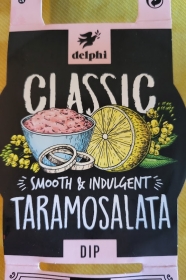
WE OFTEN BUY taramosalata (taramasalata) from the Athenian Grocery in London’s Bayswater district. They sell a brand called Delphi. It comes in a small plastic tub surrounded by a cardboard sleeve. Within the sleeve, there is a brief history of the company. The story begins as follows:

“It all started when our dad Tony started working in his family fruit and veg store on Goodge Street, London…”

Reading this brought back memories of shopping with my mother in the early 1960s. Being keen on Mediterranean dishes, we used to visit the shop in Goodge Street, mentioned above. Round the corner from this store, there was another Greek food shop, Hellenic Stores, in Charlotte Street. My mother preferred this shop, and only went to the one in Goodge Street if what she wanted was unavailable in Charlotte Street. It was close to the now long-since closed Schmidt’s German restaurant. Neither of these shops exists anymore.

Back in the 1960s and while I was at University College (until 1982), there were several Greek restaurants in Charlotte Street. These included Anemos, which was famous for its lively party atmosphere; Andreas, which I never visited, and is now called Ousia; the White Tower, which opened in 1938, and was highly regarded for its food, but is now closed; and Venus. My uncle, who worked in Bloomsbury, was fond of lunching there, and invited me to join him ther occasionally. It was less frenetic than Anemos, but pleasanter.
The reason that there were, and still are, many Greek or Greek Cypriot restaurants in and around Charlotte Street is more likely related to the huge demand for eateries in the busy area than to where Greek communities live in London. In London, the highest concentrations of Greeks (not Cypriots) is in Hyde Park, Regent’s Park, Chelsea and Kensington census districts. As for Greek Cypriots in London, some of whom run Greek restaurants, they are mostly living in Enfield, Haringey, Barnet and Hackney. In particular, they often live in Southgate, Palmers Green, Upper Edmonton, Cockfosters, Lower Edmonton, Tottenham North and Tottenham South. The Greek restaurants in the Charlotte Street area cater for the large numbers of students and office workers in the districr.

Returning to the story of the Taramosalata maker, Delphi, Tony decided to manufacture Greek food products. So, in 1984, he founded Delphi, which (according to the cardboard sleeve):

“Delphi is proud to be among the first UK producers of authentic houmous, taramosalata and many flavourful dips and salads …”

And the taramosalata they make is truly delicious.

A shared taxi and Greeks buried in Kolkata (Calcutta)

Having visited the Jewish cemetery in Kolkata, we hailed an autorickshaw to carry us to College Street. There was already one passenger in the three-wheeler that stopped for us. He moved from his seat in the rear of the vehicle to make room for us, and then sat next to the driver on his seat. After going a short distance, our driver stopped to pick up another passenger, who squeezed into the seat alongside us. She disembarked after we had driven a few blocks further, and handed the driver a few rupees. After we left the autorickshaw and paid the driver a modest fee, the other passenger continued his journey in the vehicle. Like most autorickshaws in Kolkata, the one we had just taken was a shared cab that ran on a pre-determined route.

On the way, our autorickshaw rushed past a gateway on Narkeldanga Main Road, which I noticed was marked “Greek Cemetery”. Established in 1777, it is India’s only Greek cemetery. In Henry Cotton’s encyclopaedic “Calcutta Old and New” (published in 1907), he noted that the first “eminent” Greek settler in Kolkata was Hadjee Alexios Argyree, who arrived in Bengal in 1750, and worked as an interpreter. Other Greeks in Kolkata were involved in trade and commerce. The city’s only Greek church was erected in 1780, and still stands near Kalighat on Shyama Prasad Mukherjee Road, along which we often travel between central Kolkata and Tollygunge to the south of it. The well-maintained building is neo-classical in style, and Greek Orthodox services are held there regularly.  Today, there are few if any Greeks left in Kolkata, and the cemetery in Narkeldanga, home to about 300 graves, is in a sad state of disrepair (according to a report in the online Times of India, dated March 2018).

A VILLAGE ON THE BOSPHORUS WAS ONCE HOME TO A JEWISH COMMUNITY

LONDON HAS ITS Hampstead. Budapest has its Szentendre. Paris has its Montmartre, and Athens has its Plaka. Like these cities, Istanbul also has an area where the city’s citizens meet to relax – Kuzuncuk. This is a village-like settlement on the Asian shore of the Bosphorus in the northeast corner of Üskudar.

We visited Kuzguncuk on a sunny Sunday morning, having walked along the coastal road that leads away from the centre of Üsküdar. As we walked, we watched competitors in a running event, struggling up and down the undulating road from which traffic had been temporarily excluded.

Kuzguncuk

The streets of Kuzguncuk run up hill away from the shore. They are lined with small houses, many of which are picturesque with their timber cladding, small balconies, and other ornamentation. Tables and chairs of cafés, snack bars, and other eateries occupy the pavements. Many of them had customers, who were eating tasty looking breakfast platters, cakes, and other snacks.

As far as we could tell, most of the visitors to Kuzguncuk are Turks. This has not always been the case. Jewish people, who had been expelled from Spain and Portugal, began settling on the village in the 16th century. The earliest tombstone in Kuzuncuk’s Jewish cemetery is dated 1562. The Jewish inhabitants of Kuzguncuk have mostly left – many in 1948. There are two synagogues – one heavily guarded by the police, and the other one more lightly guarded – in the village. Both were locked up.

Armenians began settling in Kuzguncuk in the 18th century. We spotted one of their churches, but it was locked up the service having finished. Following disturbances in 1955, most of the Armenians and Greeks, who lived in Kuzuncuk, left. We passed a couple of Greek Orthodox churches, both locked up. One of them located next door to the heavily guarded synagogue is still in use on Sundays, but we were too late to enter it.

The centre of Kuzguncuk did not have a mosque until 1952. Then, one was built in the courtyard of the Armenian Church of Surp Krikor Lusavoriç. The Armenian community contributed funds towards the construction of this mosque.

When the Greeks, Jews, and Armenians left Kuzguncuk, many of their homes were acquired by migrants from Anatolia.

After spending an extremely pleasant couple of hours in Kuzguncuk, we climbed up the vertiginously steep lanes behind the village, and eventually reached a long main road that led gently downwards to the centre of Üsküdar. As we struggled up a lane, a lady in her garden said to us “Yavaş yavaş” (loosely translated as ‘take it slowly’).

If you wish to escape the crowds of tourists in Sultanahmet and other well-known historic parts of Fatih (the older part of Istanbul in Europe), then head for Kuzguncuk for something delightfully different.

Mosaics and Greeks in Moscow Road

THE SYNAGOGUE IN Bayswater’s St Petersburg Place, a gothic revival edifice, looks no more exotic or out of place than the Victorian gothic Church of St Matthew built 1881-82 on the same street. In fact, it is another building to the north of these two that is unashamedly exotic in appearance: Aghia Sofia (Saint Sophia), the Greek Orthodox cathedral on Moscow Road. This domed building constructed for a community of prosperous Greek merchants was designed by John Oldrid Scott (1841-1913 and completed in 1877.

The first Greeks began arriving in London at the end of the 17th century. By the late 19th century (according to the website http://www.stsophia.org.uk), members of the Greek community in London:

“… were distinguished for their industry and their business acumen, and … soon became for the most part financially independent. They now wished to enjoy a more comfortable life, both for themselves and their families. They kept their offices in the City, but took up their private residences in other parts of London. The favourite districts were Lancaster Gate and Bayswater. These districts, which today are almost in the centre of the unending metropolis, were then only on its fringe, and to go from the City to Hyde Park, for instance, was considered a long excursion, which was undertaken, normally, only on holidays, as a relaxation and in order to enjoy the fresh country air.

After three decades had passed from the founding of the Church of Our Saviour [in the City near London Wall], no one any longer had his private residence in the City; and whereas previously all had lived within a very short distance of the Church, now five whole miles divided the Church from the residential district of the faithful.

For the men, in particular, who had every day to make the journey to the City, a tiring one with the means of transport then available, it was hard to undergo the same fatigue on Sundays also, when they were supposed not only to perform their religious duties, but also to rest from the labours of the week. Moreover, the number of the Greeks had greatly increased, and there was scarcely room for them all in the Church then existing. These various difficulties made it imperatively necessary to build a new larger Church, situated closer to the residences of the Brothers.”

Just as the Jewish people, who had also settled in Bayswater, far from the older synagogues in the City and established a new one near their new homes, the Greeks did the same. Moscow Road’s St Sophia’s church interior is filled with icons and other religious paintings is colourful and attractive. Instead of frescos on the walls, which were believed to be at risk of damage from London’s damp climate, the church’s interior is lined with mosaics. Some of the earliest of these were designed by Arthur George Walker (1861-1939). In 1926, the Russian born mosaic artist Boris Vasilyevich Anrep (1883-1969) created some more mosaics for the cathedral. The marble floor of the edifice is also attractive.

Two heads, two cities


Ever since my interest in Albania began in the 1960s, I have had a fascination with the use of the double-headed eagle as a symbol. It appears in many places including the Albanian flag. Far less commonly used than single-headed eagle, the symbol has been found on ancient Babylonian archaeological remains dating from roughly 3000 to 2000 BC.

A few days ago, while I was visiting an exhibion (of works by Ruskin) in London, I spotted a man carrying a bag with the badge and letters in the photo above. I suspected that the letters above the double-headed eagle were Greek, but I did not know what they stood for. I asked the man, who turned out to be a Greek from Thessaloniki (Salonika). He told me that the badge and letters were the logo of a football team based in Thessaloniki.

PAOK stands for ‘Panthessaloníkios Athlitikós Ómilos Konstantinopolitón ‘, which means ‘Pan-Thessalonian  Athletic Club of Constantinopolitans’.   The club was founded  in 1926 by Greeks who had fled from Istanbul (Constaninople) following the tragic population exchange that began in 1923 after the Greco-Turkish War (1919-22). During this exchange, Turks living in Greece were deported to Turkey, and Greeks living in Turkey were deported to Greece. Over 160,000 ethnic Greeks from Turkey were resettled in Thessaloniki.

Some of the Greeks who had been evacuated from Istanbul established the PAOK in 1926. The team has two nicknames, translated as ‘The Black-Whites’ and ‘The double-headed eagle of the North’. Why did PAOK choose the double-headed eagle? The answer might lie in the fact that since the early Middle Ages this symbol was used occasionally by the Byzantine Empire, which had its headquarters in Constantinople, from where the founders of the team originated.