THE NEWPORT STREET Gallery near Lambeth Bridge on the south side of the River Thames was founded by the artist Damien Hirst as a place to show items from his extensive collection of contemporary artworks and sometimes his own work to members of the public. Every few months, a different selection of the works in his collection are tastefully exhibited in the gallery. The gallery is housed in converted industrial buildings, described in Newport Street’s website as follows:
“The construction of Newport Street Gallery involved the conversion of three listed buildings, which were purpose-built in 1913 to serve as scenery painting studios for the booming Victorian theatre industry in London’s West End. With the addition of two new buildings, the gallery now spans half the length of the street.”
We visit it regularly, and usually enjoy what is being shown and the way it is displayed.
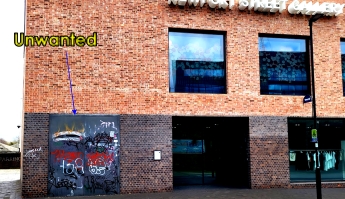
Today (25 March 2026), we visited the gallery again. Before we entered, we noticed two outer doors covered with spray-painted graffiti, and part of the entrance disfigured in the same way. We asked a woman at the reception desk if the graffiti was an artwork sanctioned by the gallery, and were told that it was not. I said that although unwanted, the graffiti was in the spirit of many things that are often exhibited within the gallery. She laughed, clearly understanding what I was getting at.
BRICK LANE HAS become very ‘trendy’ (‘arty’ ?). When walking across the railway bridge along which Brick Lane runs, I noticed that the wall of the bridge had a surprising decorative feature.
The wall was covered with a mosaic-like pattern of electrical socket facings. These had been painted over or sprayed to create patterned graffiti such is found all along the northern half of brick Lane.
I have yet to discover who came up with the idea with using sockets as a wall covering.
LITLINGTON IS A SMALL village in the south of Cambridgeshire. Its parish church, St Catherine’s, dates from about 1150. Between then and the 15th century, it underwent many modifications. As in many old buildings, people have inscribed graffiti into the church’s stone walls. One stone in one of the south windows has some especially interesting graffiti.
The neatly carved inscription (in Latin), which refers to the great sailor Sir Francis Drake (c1540 – 1596) reads:
“Francis Drake, knight, about to set sail in the thirty-seventh year of the reign of the most august and serene princess Elizabeth, by the grace of God Queen of England, France and Ireland, defender of the faith. 1595. Always the same. The same always. John Sherman, April the tenth.”
The date refers to the year of Drake’s final voyage, from which he never returned (he was ‘buried’ at sea near Portobelo (now in Panama)). Drake had set out from Plymouth in September 1595 to carry out activities against the Spanish in Puerto Rico and other places in and around the Caribbean.
John Sherman lived in Litlington, as did his son-in-law, Robert Bownest, who died during Drake’s final voyage. In “A History of the County of Cambridge and the Isle of Ely: Volume 8” (published in 1982), we can read:
“John Sherman died in 1599, having transferred his manor and other purchased lands in 1597 to his eldest son William”
John’s father, William, was a wealthy landowner in Litlington. What is not clear is whether this John Sherman wrote the inscription and if he participated in in Drake’s ill-fated expedition of 1595, as did his son-in-law.
Tiny details such as the inscription I have described help to make visits to places in England really interesting, and, in a way, help to give vitality to what are otherwise simply historical events.
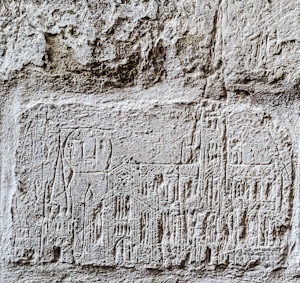
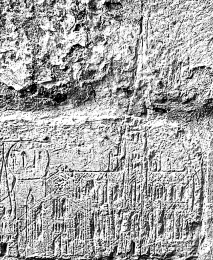
I HAVE WRITTEN ABOUT this before, but because I found it so interesting I will write about it again. In August 2024, we revisited the picturesque village of Ashwell in Hertfordshire on our way between London and Cambridge. Apart from being an extremely attractive place, its parish church of St Mary ccontains an intriguing image scratched into the internal surface of the north wall of the bell tower.
The image is a drawing of London’s old St Paul’s Cathedral, which was destroyed during the Great Fire of London (1666). By comparing this picture with other pre-1666 drawings of the old cathedral, it can be seen to be an accurate depiction of the long since destroyed edifice. It is likely that the drawing in Ashwell was scratched into the wall sometime before 1930s, when the old cathedral was modified by Inigo Jones.
Above the image of the old cathedral, there are some inscriptions recoding plagues that occurred during the 14th century, including what is known as the Black Death.
Apart from the drawing and the inscriptions described above, the church contains a few other inscriptions, which have been partially deciphered.
For the information of those visiting the church, it is near to Day’s bakery, where delicious snacks can be purchased. The village also contains a small museum, part of which is housed in a half-timbered building. However, for me, the highlight of the village is the drawing of old St Paul’s Cathedral in the church.
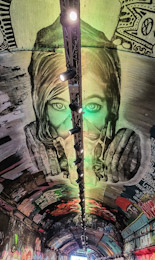
LEAKE STREET RUNS beneath the platforms and tracks of London’s Waterloo Station. It is 300 yards long and its walls and ceiling are covered with colourful graffiti created with cans of paint spray. The artwork creation in this street that runs in a tunnel was inaugurated in May 2008 during the Cans Festival, which was organised by the artist known as Banksy.
Unlike many public places in London, painting the walls in Leake Street is legal. Walking along this highly decorated street is a magnificent experience, which you can repeat often because the images on the wall are frequently changed. If you are lucky, you can watch the artists in action.
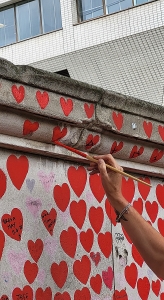
A LONG WALL on the south bank of the River Thames faces the Houses of Parliament. It is literally covered with hearts painted in red. Each heart is supposed to commemorate one of the more than 220,000 people who died of covid19 in Britain. Families and friends of the victims can write the names of their lost ones on the hearts on this wall – the National Covid Memorial Wall. For those who work in the Houses of Parliament and those who walk past it, this heart covered wall is a chilling and moving reminder of a terrible period during the recent history of Britain as well as the rest of the world.
A group of volunteers:
“… repaint faded hearts, re-write dedications that are being absorbed into the Wall, remove graffiti, and look after the Wall to ensure that those lost to Covid19 in the UK are remembered as people, not as a statistics.” (www.nationalcovidmemorialwall.org/)
Recently, we watched some of these generous people, some of them mounted on ladders, working with their paint brushes. As we walked alongside the wall, reading some of the names of people who were killed by the covid virus, we noted that not all of the inscriptions were dedicated to remembering the dead. Some of them, it is sad to relate, were tasteless graffiti and statements such as “X loves Y”. It is these thoughtless additions to a wall of sorrow that the dedicated volunteers work to eradicate. Seeing these irreverent and irrelevant ‘blots’ on the wall made me think “is nothing sacred?”
MANY ENGLISH CHURCHES REMAIN closed much of the day since the outbreak of the covid19 pandemic. During our recent roving around the countryside, we have found this to be the case and as a result have not been able to enjoy exploring the often interesting historic and architectural features within country (and urban) churches.
Drawing of Old St Pauls Cathedral in the church at Ashwell
When we arrived in the attractive Hertfordshire village of Ashwell near the town of Baldock that lies between London and Cambridge, we were pleased to discover that the Church of St Mary’s (Ashwell) was open. Despite the dustiness created by building works that were in progress, this church contains much of interest. In fact, the builders have uncovered remains of structures that existed possibly prior to the present church’s construction in the 14th century. These remains were revealed to us by a kindly lady, ‘M’, who helps run the church’s administration. She pulled aside some heavy plastic sheets to reveal where the builders had dug beneath the floor.
After viewing the excavations, M drew our attention to the west end of the nave, beneath the bell tower. The north wall of this section of the church has graffiti scratched into its wall. This is not the work of modern vandals but that of people living as long ago as the 14th century, a time of plague, pestilence, and much mortality (the so-called Black Death was at its peak from 1347 to 1351).
Some of the graffiti is in the form of inscriptions in Latin. According to a useful booklet, which we bought at the church, “Ashwell Church. Mediaeval drawings and writings. A Guide” by David Sherlock (publ. 1978), the inscriptions when translated include the following (to quote but a few):
“Just the first plague was in 1349”
“In 1349 there was plague and in ‘50”
“1000, three times 100, five times 10 [i.e. 1350], a pitiable, fierce violeny (plague departed); a wretched populace survives to witness (to the plague) and in the end a mighty wind, Maurus, thunders this year in the world 1361.”
Maurus refers to St Maur (512- c584), a disciple of St Benedict of Nursia. St Maur’s feast day was the 15th of January before 1969 and is now the 22nd of November. According to an article in the Irish Times (16th of January 1998):
“The late 1300s in Ireland were remarkable for the abundant rainfall, and also for a succession of fierce storms which caused frequent and widespread devastation in countryside. One of the worst of these, St Maury’s Wind, occurred on January 15th, 1362, and caused great damage, particularly in Dublin.”
These storms were most likely to have been the same as those recorded on the wall of Ashworth Church.
Fascinating as the inscriptions are, even more interesting is a drawing incised in the wall close to them. Although it is not known when it was drawn, it was probably before 1630. It is a detailed sketch of the old (pre 1666, Fire of London) Gothic St Pauls Cathedral in London. It depicts the old church before Inigo Jones re-faced it in 1630. The drawing includes the spire, which was destroyed by lightning in 1561. One authority has suggested (tentatively) that the drawing might have depicted Westminster Abbey, but this is unlikely even though Ashwell Church was under the control of the Abbott of Westminster until The Dissolution of the Monasteries in 1540. The drawing in Ashwell has many resemblances to illustrations of the old St Pauls made in about 1550 by the Flemish Anton Van den Wynegaerde (1525-1571), and in 1616 by the British artist John Gipkyn (active 1594-1629). It is unlikely that whoever drew the image in Ashwell would have seen either of these pictures.
In addition to the image of St Pauls and the plague inscriptions, there are many other examples of mediaeval graffiti in the church at Ashwell. If our cousins in Baldock had not recommended us to visit nearby Ashwell, we might never have seen the fascinating graffiti described above. It was particularly poignant to see the souvenirs of plague that occurred so long ago during the current era of plague that is disturbing our lives so much.




 yamey
yamey 