A disused passageway in north London’s Golders Green

DURING MY CHILDHOOD and teenage years, there used to be two entrances to Golders Green’s tube (Underground) station, which is on the Edgware Branch of the Northern Line. One of these entrances, which is the only one in use today, is from the bus station (bus yard) next to the old Hippodrome Theatre and opposite the clock tower.

The other entrance, which has been closed for several decades, was beneath the bridge that carries the railway tracks over Finchley Road. The canopy at this entrance is still standing. Passengers used to walk beneath this canopy and then along a long walkway covered by a wooden canopy supported by timber pillars with simply ornamented capitals. . This passageway , which still exists, led to a ticket hall. Neither the ticket hall nor the passageway are accessible to the public.

You can discover much more about Golders Green, its past and present, in my book, which is available from Amazon, e.g.:

The Golders Green Complex in Calcutta  (Kolkata)

DURING THE LONG taxi ride from Kolkata’s airport to the city centre, I noticed an intriguing sign on a building we passed. It read: “Golders Green Complex”. The reason that this interested me was that I was brought up in a northwest London’s suburb called Golders Green.

I have no idea if the proprietors of Kolkata’s Golders Green Complex know of the existence of my childhood haunt in northwest London. The idea that someone might suffer from a malady named the Golders Green complex flashed through my mind. How this would manifest itself, I will leave to your imagination. In my case, the lasting effect of a childhood in Golders Green led me to write a book about the place (https://www.amazon.co.uk/GOLDERS-GREEN-HAMPSTEAD-GARDEN-SUBURB/dp/B0BHG873FB/  )

Memories of Gujarat (India) at a park in north London’s Golders Green

GOLDERS HILL PARK lies halfway between Golders Green and Hampstead – both in north London. It occupies what used to be the extensive grounds of a former country house that was built in the 18th century and destroyed during WW2 (in 1940). Its fine landscaping was influenced by the great garden designer Humphry Repton (1752-1818). I have been visiting the park since my early childhood in the 1950s, when, if I remember correctly, my parents used to play tennis on the still existing tennis courts. The park has many attractions including a pond with an attractive stone bridge; a walled garden; many fine old trees; plenty of shrubs and flowers; a bandstand, which was certainly in use during my childhood; a good café-cum-restaurant; a wooded area; a stumpery; a deer enclosure; and a small zoo. The deer enclosure and the zoo were in existence when I was a young child. Today’s visitors can watch the deer and view animals such as wallabies; ring tailed lemurs; at least one kookaburra; donkeys; and a variety of exotic birds. The pond mentioned above is often visited by ducks.

Today (the 3rd of March 2024), we visited the park on a crisp, cold, sunny morning. The dew-covered lawns were full of blooming crocuses, and some of the bushes had burst into flower. Most of the trees, being deciduous, were devoid of leaves. By chance, I looked up at one of these leafless trees and saw a children’s kite caught up in its branches. Seeing this, my thoughts shifted 5000 miles from Golders Hill to Gujarat (in western India).

Wherever you go in Gujarat, you are likely to see kites caught up in the branches of trees. Unlike the kite I saw today, those in Gujarat are not the toys of small children, but part of a festival celebrated once a year, The Hindu festival, which celebrates the increase of day length a month after the winter solstice is known as ‘Uttarayan’ in Gujarat. The occasion is celebrated by kite flying. During this period of kite flying, riders of bicycles, motorcycles, and other two-wheelers face a real but, to the outsider, unusual hazard that could result in serious injury, if not death. I have described this festival and its hazards in some detail in my anthology of 101 vignettes of life and travel in India –“The Hitler Lock and Other Tales of India”.

Seeing the kite in Golders Hill Park reminded me of what I have seen in Gujarat during my several visits to that Indian state. However, although this year Uttarayan began on the 15th of January – not so long ago – I find it hard to believe that the kite I saw in the park was stranded in the tree during celebration of that festival.

[The book (& Kindle) is available from Amazon:

Trains, buses, and Bar Linda in London’s Golders Green

MUCH HAS CHANGED IN Golders Green since I was a small child in the 1950s. However, a few things have remained more or less the same. My earliest memories of Golders Green Underground station and its neighbouring open-air bus terminus date back to about 1960, when I began travelling by bus to school in Swiss Cottage.

The Underground station used to have two entrances. One, which faces the bus yard, is still in use. The other, which was approached by a long, covered walkway from beneath the bridge crossing Finchley Road, was closed to the public many years ago, but the passageway still exists. It was this entrance that my family used when using the train to travel into central London. There was also a covered staircase situated between these two entrances – this, now disused, was opened during rush hours. It led to the small parking area where the H2 bus, which serves Hampstead Garden Suburb, begins its journey. During my childhood, there was no public transport in the Suburb. Every day, I used to make the 10-minute walk to Golders Green station, passing the crematorium and the Jewish cemetery on my way.

Overlooking the eastern edge of the bus yard, is what was once the Hippodrome Theatre. When I was a lad, this was a flourishing theatre showing plays and pantomimes. Later, it was taken over by the BBC. After they left it, various religious organisations have used it for their meetings. Built in 1913, six years after the Underground was extended from Hampstead to Golders Green, this building’s exterior looks much as it did when I first remember seeing it.

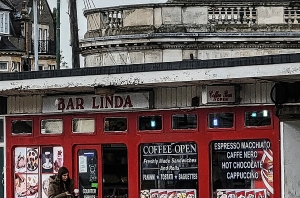
The western edge of the bus yard has always been lined with a row of single storey sheds. Most of these have been used as shops and offices for London Transport. One of them houses a small café called Bar Linda. This was not in existence when I first used to visit the station, but I believe that it opened in the 1960s. Although this friendly little place has been serving customers for many decades, the first time I ventured inside it was in about 2017 when I was about to walk around Golders Green to take photographs for a blog article I was planning to write. I have re-visited it several times since then.

Although Golders Green might not be as aesthetically pleasing as its neighbours, Hampstead and Hampstead Garden Suburb, it is an area full of interest. Much has happened there since 1907 when it began growing from a rural hamlet into a leafy suburb. You can discover much more about Golders Green – its past, my memories of it, and its vibrant present – by reading my book “GOLDERS GREEN & HAMPSTEAD GARDEN SUBURB: VISIONS OF ARCADIA”, which is available (paperback and/or Kindle, from Amazon websites, such as:

Having lunch with my father at the White House

AFTER MY MOTHER DIED in 1980, I began practising dentistry in Kent. Almost every weekend, I used to spend Saturday nights at my father’s house in Hampstead Garden Suburb. We used to have Sunday lunch together in one of his several favourite restaurants in Golders Green and Hampstead. Many of these restaurants no longer exist.

There were a few Chinese restaurants, which my father liked, in the Golders Green area. One of them was in Temple Fortune near the branch of Waitrose, which has been in existence since I was a child in the 1960s. The Chinese restaurant, which served a wonderful hors d’oeuvre that included a scallop in its shell, has long since closed.

In Golders Green Road, there were two more Chinese restaurants, both now gone. In one of them, my father was always greeted by the friendly manager (or, maybe he was the owner) with the words:

“Hallo Professor. How are you, professor?”

The food was well-prepared and tasty in both of them, just as it was in the Temple Fortune eatery.

Almost opposite the Hippodrome theatre, on the corner of North End Road and West Heath Drive, there was an Italian restaurant. Here, my father and I always received a warm welcome and enjoyed reasonably good Italian food. Currently, the site is occupied by a Turkish restaurant, which I have not yet tried.

Some weekends, we travelled up to Hampstead village. One of the two restaurants we visited occasionally was La Cage imaginaire, which still exists at its original location at the lower end of Back Lane, where it meets Flask Walk. Back in the 1980s, this place served classic French cuisine prepared to a high standard. I remember the cheese trolly which was richly supplied with ripe French cheeses. We revisited the place in about 2021 for ‘old times sake’. The management had changed and the food was nothing to write home about.

Today, the 3rd of November 2023, we ate at Mani’s in Hampstead’s Perrins Court. It was our third visit there, and the quality of the food in this busy eatery is highly satisfactory. Near the corner of Perrins Court and Hampstead High Street, there stands the Villa Bianca (‘white house’). This Italian restaurant must have first opened its doors to customers sometime in the 1980s. Never cheap, this restaurant was one of my father’s favourites in northwest London. Being a regular diner there, he was always welcomed like an old friend. Unlike many of the places where my father and I ate Sunday lunches in the 1980s and early 1990s, The Villa Bianca still exists, and is popular. Today, I looked at the menu. Although not suitable for those on a tight budget, many of the dishes did not seem much more costly than those served in far less fancy looking establishments.

DISCOVER MUCH MORE ABOUT HAMPSTEAD BY READING MY BOOK AVAILABLE FROM AMAZON, e.g., :https://www.amazon.co.uk/BENEATH-WIDE-SKY-HAMPSTEAD-ENVIRONS/dp/B09R2WRK92/

It is always gratifying if any of my books are reviewed

IN EARLY OCTOBER 2022. I published a book about London’s Golders Green and its neighbour Hampstead Garden Suburb. It was the part of northwest London where I spent my childhood and early adult life.  I wrote about areas’ past and present, and my memories of living there. The book sells reasonably well by my modest standards, but was not reviewed until early September 2023. Then someone in Germany awarded the book 5 stars (out of 5 stars), and reviewed it on Amazon as follows:

“A very informative and often funny book! I immensely enjoyed reading it.”

Brief as it is, this reviewer encapsulated what I was aiming to do when writing my book. That was, to write something that was both elucidating and amusing.

I am always happy when someone takes the trouble to review one of my books. Naturally, I would prefer a favourable review, but a critical one is also welcome. That a reader bothers to post a review shows that he or she has read the book and reflected on its contents. I find that very gratifying.

The book about which I have been writing is called “GOLDERS GREEN & HAMPSTEAD GARDEN SUBURB: VISIONS OF ARCADIA” and is available as both a paperback and a Kindle from Amazon websites, such as:

A tiny stream feeding the River Thames

NORTH LONDON IS riddled with rivers, rivulets, and streams. Some of them have been covered over and built upon, and others are still visible. One of these is Mutton Brook, which rises near East Finchley, flows through Hampstead Garden Suburb, and then merges with another watercourse – Dollis Brook – to become the River Brent. The Brent flows from near Golders Green through northwest and then west London to its mouth at Brentford, where its waters flow into the Thames.Although I did not know it when I played beside the stream as a child, the tiny Mutton Brook helps feed the mighty Thames with water.Minute as it is, as far as watercourses are concerned, it made a large impression on me in my childhood.

For much of its course, Mutton Brook flows through open spaces, such as Lyttleton Playing Fields, Fletcher’s Gardens, Northway Gardens, and a long stretch of parkland flanking the south side of the North Circular Road. Despite being fringed by suburbia and busy roads, the Brook is well separated from them by nicely planted green spaces along which walkers can enjoy the feeling of being in the country despite being in the heart of northwest London.

Until 1907, Mutton Brook would have flowed through what was then rural Middlesex countryside – fields, meadows, and woods. From then onwards, Hampstead Garden Suburb was established, and its neighbour Golders Green grew from being a small hamlet to become a large, mainly residential urban area. My recent book (see: https://www.amazon.co.uk/GOLDERS-GREEN-HAMPSTEAD-GARDEN-SUBURB/dp/B0BHG873FB/)  describes Mutton Brook in detail. It also as provides an informative description of life in Golders Green and Hampstead Garden Suburb past and present. These are places I know well because I was brought up in them, and lived there until I was thirty. My book also contains reminiscences of my life there as a child and a young man. I still visit the area frequently because some of my friends and family live there.

A railway station far below the surface at Hampstead

HAMPSTEAD UNDERGROUND STATION, which was designed by Leslie W Green (1875-1908), was opened for passengers in June 1907. Green was responsible for the use of blood red, glazed terracotta tiling on many of London’s Underground stations. The station facades and interiors which he designed, including those at Hampstead, feature many aspects of the British Art Nouveau style. Examples of this style can be seen on Hampstead’s facade, interior tiling, and the ticket office counters.

While I was researching my latest book, “Golders Green & Hampstead Garden Suburb: Visions of Arcadia” (available from Amazon), I came across an interesting diagram in a book by FC Howkins (published in 1923). It shows how the Northern Line tracks rise gradually from several feet below sea level at Embankment (formerly Charing Cross) station to 192 feet above sea level at Hampstead station. However, Hampstead station’s ticket office is about 360 feet above sea level, which is 168 feet above the tracks and platforms (Wikipedia stated that the platforms are 192 feet below the surface). High speed lifts convey passengers between the platform entrances and the ticket office. Originally, these were slow lifts which were entered though brown sliding wooden doors with Art Nouveau inspired cut-outs for ventilation purposes. These old lifts still existed when I was at school in the 1960s, but the newer high-speed lifts with metal concertina doors were the main method of moving between the surface and the trains. Currently, newer lifts have replaced those which were in use between the 1960s (or maybe earlier) and 2014.

If you have a long wait before your train arrives at Hampstead, it is worth wandering to the end of the platform, where you will find the station’s original name, ‘Heath Street’, still on the wall. Today, I disembarked at Warren Street, and noticed that its old name ‘Euston Road’, is still clearly visible at the end of the southbound platform next to its exit.

By 1907, the Northern Line had been extended northward to Golders Green, whose station was opened for passenger use in 1907. It is a long journey between Hampstead and Golders Green stations. An intermediate station near the Bull and Bush pub (on North End Road) was planned. Although the platforms were constructed, they have never been used by passengers, and there is only a small hut on the surface (on Hampstead Way), which contains the entrance to shafts leading down them. Opposition by the founders of Hampstead Garden Suburb and later its residents ensured that the planned ‘North End’ station was never completed.

The Art Nouveau ticket counters at Hampstead station are no longer in use, but they have been beautifully preserved. In each of them, there are information panels detailing the aspects of the station’s history. Other decorative features have been maintained but much of the space in the ticket hall is occupied by the automatic ticket-checking entrance and exit portals. Perched at the top of the High Street, at the point where it meets Heath Street, Hampstead station is an important meeting point and a hard to miss landmark.

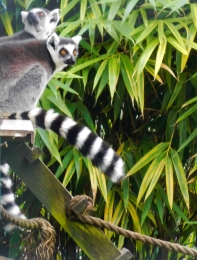
Seen in the park

Black and white stripes

Adorn their long furry tails

Two lemurs in a cage

These two lemurs live in a cage in Golders Hill Park in northwest London. You can discover more about Golders Green and its wonderful park in my new book: https://www.amazon.co.uk/gp/product/B0BHG873FB/

Transported back to childhood on the Isle of Wight

IN THE EARLY 1970s, I used to travel on the London Underground’s line from Golders Green to Euston or Warren Street, both stations being near University College London, where I was a student. Back in those days, smoking was permitted on the Underground. Each Northern line tube train had two carriages for smokers. I have never smoked, but I used to travel in the smokers’ carriages because they were usually emptier than the other ones in which smoking was forbidden. Thinking back on this, I suppose that I must have been passively smoking on the Underground. On the other hand, because there were fewer people in the smoking carriages, my chances of catching other people’s airborne germs must have been reduced.

From an early age, before I became a daily commuter, I liked travelling in the rear carriages of the Northern Line tubes. These carriages contained control panels, which the train’s guards operated to open and close the doors and to inform the driver when the train was ready to leave. As a child, I was fascinated by watching the guard at work. Actually, there was little else to watch after the tube entered the tunnel after leaving Golders Green. Incidentally, what was the rear carriage, was also the front carriage when the train changed direction on reaching the end of a line.

The Northern Line trains I have been describing were built by Metro-Cammell in 1938. By the end of the 1980s, the trains were taken out of service and newer units began operating on the Northern Line. The 1938 trains were shipped out to the Isle of Wight, where they carried passengers on the Island Line. After many years of service on the island, the sea air caused these venerable trains to corrode and deteriorate. In the early years of the 21st century, they were taken out of service.

In late October 2022, we visited the train museum at Havenstreet on the Isle of Wight. One of the exhibits is a collection of old train carriages and engines in a large shed. Amongst these exhibits is one of the former Northern Line carriages built in 1938. Visitors are permitted to enter it. I was delighted to find that the example on display was one of the rear carriages containing the guard’s control panels. Seeing these again after so many years was a curiously moving experience. I felt for a moment that I had been transported back to my childhood days, when travelling in these trains used to fill me with wonder.