Now you see it, now you don’t and Samuel Johnson

THE GROUNDS OF KENWOOD House in north London are delightful at any time of the year. Here you can enjoy the marvels of a fine country house in magnificently landscaped grounds, rivalling rural spots like, for example, Stourhead, Blenhheim, and Compton Verney, without leaving the metropolis. Amongst Kenwood’s many horticultural attractions are the superb flowering bushes such as camellias, azaleas, and rhododendrons.

Kenwood House

Kenwood was within about half an hour’s brisk walk from my family home in Hampstead Garden Suburb and even nearer Highgate School, which I attended between 1965 and 1970. In amongst the flowering bushes, I remember that there used to be an open-fronted, small round hut with a conical roof.  Inside it, there were benches that served as seats. This edifice was labelled ‘Dr Johnson’s Summerhouse’. The Dr Johnson to which this referred was one of Britain’s greatest literary figures, the writer and lexicographer Samuel Johnson (1709-1784). When I used to see this hut during visits to Kenwood in the late 1960s and the 1970s, I used to try to imagine the great Johnson sitting, resting and enjoying the view of the lawns and trees, some of which we can still see today. But, in those days, I was unaware that he never did enjoy these views from this spot.

It turns out that Dr Johnson used his summerhouse not in Kenwood but far away at Streatham Place in what used to be countryside south of London during Johnson’s lifetime. Shaun Traynor wrote:

“Streatham Place, the grand country house of the brewer Henry Thrale and his wife Hester, became for a time in the mid to late 18th century a setting for some very distinguished literary and artistic company. To this house, then sitting amid extensive grounds in the countryside south of London, came leading figures of the day: Edmund Burke, David Garrick, Sir Joshua Reynolds (who was to paint the Thrales), Oliver Goldsmith and – most significantly – Dr Johnson.” (https://www.johnsonsocietyoflondon.org/resources/Documents/Dr%20J’s%20Summerhouse%20-%20Shaun%20Traynor/Sam%20J%20summerhouse%20Shaun%20Traynor.pdf).

He added that the grounds of Thrale’s home contained a secluded summerhouse in which Johnson used to read and write. When Henry Thrale (born between 1724 and 1730) died in 1781, his widow Hester remarried, and the Streatham Place with its summerhouse were sold. Thrale’s daughter Susannah, who had been fond of Johnson, moved the hut to her home in Knockholt, Kent in 1826.  According to Traynor:

“She erected it on rising ground in the very centre of the grove making all paths lead to it, and making the grove a kind of shrine to Dr Johnson’s memory.”

The years passed, and the summerhouse fell into disrepair. In 1962, a local man, who had great feelings for its historical significance, bought it and then presented it to London County Council (‘LCC’) so that it could be displayed to the public. After restoring it, it was placed in Kenwood at the spot where I recall seeing it, in 1968 (http://www.thrale.com/samuel_johnsons_summer_house). Although it is not inconceivable that Johnson might have visited Kenwood, it is not at all likely that he passed much if any of his spare time in a summerhouse in that garden.

In about 2017, after not having visited Kenwood for two or more decades, I paid it a visit. One of the first things I looked for was Dr Johnson’s summerhouse. I knew exactly where to look, but it was no longer there. After peering in amongst the large clumps of bushes in the spot where I remember that it used to stand, I found an octagonal concrete base. I wondered whether the summerhouse had once stood there. On enquiring at the information desk within Kenwood House, I learnt that the base was all that remained of what I had remembered seeing. I was told that the summerhouse had been destroyed by fire. This fire occurred sometime after 1984, probably 1991 (www.moruslondinium.org/research/dr-johnsons-streatham-park-mulberries). I was saddened to learn of this.

However, all is not lost. Alan Byrne, an artist who used to love sitting in the original Johnsonian summerhouse in Kenwood, has created an accurate replica of the refuge that the great writer used to enjoy. Using detailed plans of the original and other records, he produced an accurate reconstruction during the years 1997 to 1999 (https://www.johnsonsocietyoflondon.org/Dr-Johnson-summerhouse-photos-and-narrative). It stands in his garden in Islington.

Even without Dr Johnson’s summerhouse, Kenwood is well-worth visiting. The gardens alone are splendid, but when it is open, Kenwood House is a ‘must-see’. It contains some fine rooms decorated by Dr Johnson’s contemporary, the architect Robert Adam (1728-1792) as well as a collection of fine-art paintings that is, after the National Gallery, one of the best in London. When you feel that you have seen enough of Kenwood, then treat yourself to a stroll through its grounds and the contiguous Hampstead Heath to historic Hampstead, a place which offers a great range of eateries and pubs. And, incidentally, Samuel Johnson was no stranger to the place as the historian Thomas Barratt revealed:

“‘Mrs. Johnson for the sake of the country air,’ writes Boswell, ‘had lodgings at Hampstead, to which Johnson occasionally resorted. ‘For his own part, Johnson would doubtless have preferred Fleet Street; but he was fond of his wife, and felt in duty bound to minister to her pleasures as far as his limited means admitted.”

I can sympathise with Mrs Samuel Johnson. I much prefer Hampstead to Fleet Street, even if the former has less countrified air than it did in the 18th century.

Fire! Fire!

WALKING ALONG THE ALBERT Embankment upstream from Lambeth Bridge, most people’s eyes will probably be focussed on the River Thames and the lovely views of the Houses of Parliament, Millbank Tower, and the Tate Britain. However, it is worth turning your eyes inland in order not to miss a wonderful example of, in my uninformed opinion, art-deco or, if you are fussy about distinctions, art-moderne architecture, whose decorative façade faces the river. Just in case you were wondering how these styles of architecture from the same time period differ, deco lays emphasis on ‘verticality’ and moderne on ‘horizontality’ (http://theantiquesalmanac.com/chicvssleek.htm). Important as this distinction might be to connoisseurs, the building on Albert Embankment is worth at least a few minutes’ examination.

The building in question is the former London Fire Brigade Headquarters, still a functioning fire station. The structure is built of bands of bricks separated by thin horizontal lines of white stone that form the top and bottom frames of the lines of windows, each consisting of lattices of rectangular windowpanes which are wider than they are tall. These design features help define the building’s horizontal sleekness, which is why it is considered by at least one authority (https://historicengland.org.uk/listing/the-list/list-entry/1392337)  to be ‘moderne’ rather than ‘deco’.  However, it was not this that first attracted us to the building but its decorative panels at various levels and dramatic doorways at ground level.

The doorways, which are wide enough to admit the passage of vehicles are closed with sets of folding doors, consisting of four panels, each of which has a brass window covering (grille) with a geometric design. Some of the building’s decorative panels depict firefighters at work. These are in bas-relief and made of a white coloured stone. These were made by Nicholas Babb (probably Stanley Nicholson Babb; 1873-1957). Other panels, at a higher level, adorn the central section of the façade. These are also bas-relief in white stone but  have backgrounds formed of gold coloured mosaic tiles.  Created by Gilbert Bayes (1872-1953), who studied alongside Babb at the Royal Academy, their subject matter is borrowed from ancient mythology.

The building itself was designed by EP Wheeler, architect to the London County Council. He was assisted by G Weald. Wheeler also designed the ‘horizontalist’ building on Charing Cross Road in 1939, which was the former home of St Martins School of Art (www.designcurial.com/news/foyles-war-4354398), where my mother worked as a sculptor during the 1960s. The Fire Brigade building was opened by King George VI and his wife on the 21st of July 1937, not a moment too soon, given what was in store for London soon afterwards: the WW2 Blitz, which put great strain on the Fire Brigade.

To the left of the façade, there is a yard in which stands a tall brick tower. This is the so-called ‘drill tower’, used for training firefighters. The building, in addition to having been the Brigade’s headquarters, was also a training centre. The rear of the building, which I have not yet seen, has three layers of balconies, from which members of the public used to be able to observe parades and displays of firefighting skills. Today, the edifice is still used as a fire station but not as the HQ of the Brigade, which is now in Union Street, Southwark.

I enjoy seeing art-deco (and ‘moderne’) architecture. While there are plenty of examples of this in London, which you can spot if you keep your ‘eyes peeled’, the greatest concentration of this style of building that I have seen is in central Bombay in India. Both the Marine Drive and the Oval Maidan in south Bombay are treasure troves for lovers of this style. So, as a lover of this style that broke away from traditional architectural styles in the 1920s and 1930s, I was delighted to have stumbled across the wonderful Brigade building on the Albert Embankment.           

Friday the 13th is unlucky for some

MUCH OF MOTCOMB Street in London’s Belgravia is now pedestrianised. It is lined with nineteenth century buildings that house shops and food outlets, mostly aimed at wealthy customers. Here, you can find the shops of Christian Loubertin, Ottolenghi, Nicola Donati, Marie Chantal, Maison Corthay, to mention but a few you might know. It is probably safe to say that this is not much of a street for bargain hunters, but to be fair, it does boast a newsagent and a large branch of the Waitrose supermarket chain.

Motcomb Street first appears on a map in 1830, when it was briefly known as ‘Kinnerton Mews’. By 1854, many of the houses along it became shops and places where cows were kept. A publication (http://www.grosvenorlondon.com/GrosvenorLondon/media/GrosvenorLondon/WALKING-IN-BELGRAVIA.pdf) produced by the Grosvenor Estate details the shops:

“… a cow-keeper, a saddler, two tailors, a plumber, a wheelwright, a grocer and two sellers of asses’ milk (thought to be beneficial to health and used in nearby hospitals).”

The ‘Alfred Tennyson’ pub stands on the corner of Motcomb and Kinnerton Streets. It was formerly known as ‘The Pantechnicon’. The reason for its earlier name becomes obvious if you walk away from it westwards along Motcomb Street. Opposite Waitrose and by far the most imposing building in the street is a neo-classical façade supported by ten sturdy pillars with Doric capitals. As impressive as many of the great neoclassical façades in central London,  such as that of the National Gallery, these pillars support a slab on which the word ‘PANTECHNICON’ is boldly displayed.

The Pantechnicon was built as commercial premises in about 1830-34 (https://historicengland.org.uk/listing/the-list/list-entry/1223569) for the property developer Seth Smith (1791-1860), most probably designed by the architect and civil engineer Joseph Jopling (1788-1867; http://farnham.attfield.de/fam1012.html). The Pantechnicon was enormous. Covering two acres, it stretched backwards (north) from Motcomb street and was surrounded by the backs of many of the houses lining the east side of Lowndes Square and the west side of Kinnerton Street. When it was completed, it was originally:

“… a bazaar, and was established principally for the sale of carriages and household furniture. There was also a ‘wine department’, consisting of a range of dry vaults for the reception and display of wines; and the bazaar contained likewise a ‘toy department.’” (www.british-history.ac.uk/old-new-london/vol5/pp1-14).

By 1850, when Peter Cunningham published his “Handbook of London”, things had changed. It had become a repository, where you:

“… may send the whole contents of an extensive house – furniture, wine, pictures, even jewellery; and the utmost care will be taken of them, at a comparatively reasonable charge …”

Cunningham lists these charges in detail and later added reassuringly:

“The building is well ventilated, and considered fireproof; but the risk (if any) of accidents by fire, civil commotion, or otherwise, will attach to the owners of the property sent to the Pantechnicon to be warehoused.”

Incidentally, the owners of the Pantechnicon designed a new form of removal van. Its innovation was a movable rear ramp that aided the loading of heavy or bulky objects. Originally, horse-drawn, these became known as ‘Pantechnicons’, a word often applied to motorised removal trucks in use today. And just in case you are wondering, the word ‘pantechnicon’ is derived from two Greek words, ‘pan’ and ‘techne’, meaning ‘all arts’, and was coined to describe wide range of goods that were available to buy in the bazaar in Motcomb Street.

Disaster struck on Friday, the 13th of February 1874 at about 4 pm. The fireproof Pantechnicon burst into flames. By 7 pm, the roof had collapsed. Karen Odden, who has written an interesting article about this conflagration (https://englishhistoryauthors.blogspot.com/2020/01/the-pantechnicon-fire-of-1874.html), noted:

“ …the event was perhaps the single largest episode of destruction of art and furnishings in the Victorian era … It is difficult to assess the value of the objects lost. Because people had such faith in the Pantechnicon, they under-insured their valuables—or found ways to avoid insuring them altogether. For example, one family hid their jewels in their furniture. The cost of insuring a headboard was significantly less than insuring jewels—but jewels hidden inside were (ostensibly) safe all the same. (Tricky!) However, it is known for certain that the fire destroyed the MP Sir Richard Wallace’s painting collection, worth £150,000; and the MP Sir Seymour Fitzgerald’s art collection, worth £200,000, which included many portraits by Sir Joshua Reynolds and paintings by other masters including J.M.W. Turner. Contemporary accounts estimated the total value upon the destroyed items at £2,000,000 (approximately £220,000,000 or $280,000,000 today).”

Luckily for us, many of Wallace’s works were not involved in the fire as can be seen by visiting the Wallace Collection in his former home in Manchester Square.

Today, only the façade of the Pantechnicon remains standing. Located opposite a modern ‘bazaar’, Waitrose, it conceals a lovely public space behind it, which contains benches and a few artworks, and is lined by Halkins Arcade. A modern building attached to the old façade houses restaurants, bars and other businesses, some of which can be entered from the Arcade.

It worth making a visit to Motcomb Street not only to see the impressive remnant of the Pantechnicon but also because the short pedestrian-friendly street has become a particularly pleasant place to linger.

Fear of flames

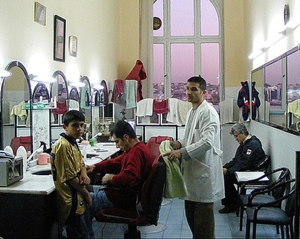
Coiffure_500

” I have always been filled with fear at the prospect of any physical intervention on my body. This may come as a surprise to anyone who knows that I am a dentist, who makes a livelihood from trying to assist people who fear my interventions, but this is the case.

For example, from an early age, I have feared going to the barber, an experience that most people enjoy. I am not certain whether this fear of having my hair cut originated from hearing the tale of the barber of Fleet Street, who used to deliver his unsuspecting customers to the basement of the butcher next door, in order for them to be turned into sausage meat. I still cling onto the armrests of the barber’s chair, just in case… Or, did my fear arise from the worry that I might be injured or infected by the scissors or the cut-throat razors, which are still used today?

There is yet another possible source of my ‘pre-barber angst’. This dates back to the 1950s, when I was less than ten years old. In those days, I used to be taken to a large hairdressing salon in Golders Green Road, where Mr Pearce attended to my coiffure. The salon was filled with a nauseous odour, that of people having the split ends of their hair singed with the flame of a lighted taper. What, I wondered, would have happened had Mr Pearce begun to singe my hair? Would my head have erupted into a fiery ball? Well, this never happened. My beloved, but neurotic, mother would never have allowed anyone to approach my hair with a flaming taper. Indeed, as a child, I was never allowed to hold a box of matches, even safety matches, because, my mother was concerned that it might have spontaneously burst into flames. She should have known better. Her grandfather manufactured matches in South Africa. “


This is a short extract from my book “Going without the Flow“, which is about the fear of surgery. It is available on Amazon, Bookdepository.com, Lulu.com, and Kindle

Fire plug


The first time I encountered the term ‘fire plug’ was when I was researching the life of my great grandfather Franz Ginsberg, who died in 1936. As an 18 year old, he went from his home in the German Empire to the South African town of King Williams Town in 1880.  By 1885, he had established a factory for making matches. Such factories are full of raw materials that are prone to catching fire. As his business grew, so did his need for a reliable water supply for dealing with fires. 

Water in the Eastern Cape was expensive in the late 19th century. Franz had to apply to the town council for permission to increase the supply of water to his factory. He also needed permission to install more fire plugs. In my published biography of my great grandfather, I wrote:

“Almost a decade later, in 1898, Franz and his brother-in-law Mr Siegfried Salomon (who married Franz’s sister Ida and was a Town Councillor for a while) both applied to the Town Council to have ‘fireplugs’  placed on their premises. This was allowed on condition that the applicants paid the expense of placing them there; and that they would be liable to other charges including a fine of £25 if they used the water from these for any purpose other than the extinction of fire.”

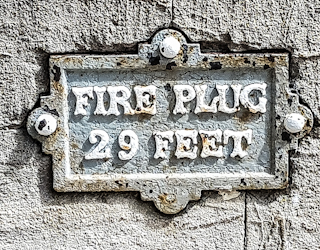
Recently, I visited Windsor Castle, where I saw several signs such as is shown in the illustration to this blog article. They indicate the locations of fire plugs in the castle. Had I not seen the term ‘fire plug’ before while writing about my ancestor, I might not have noticed these small old-fashioned signs.

So, what, you might be wondering, is or was a fire plug? The modern term for them is ‘fire hydrant’. The fire plugs, which were precursors of fire hydrants were simply holes made in the water mains pipe, which were blocked with a plug. The plug could be removed when water was required to extinguish fires.

I suspect that you are by now asking yourself if Franz ever had to make use of the plugs he had requested. Well, he did occasionally:

In February 1893, the Cape Mercury newspaper published a long article about Franz’s match factory. It begins with a spark of humour:

In December last an unusual illumination made a “King” industry more widely known than before. A fire broke out in, and consumed the drying shed at Messrs. Ginsberg & Co.’s Lucifer Match Factory, which is situated in Victoria Street. The loss was not great, but the advertisement was extensive – and cheap – for it was gratuitous.’”


If you want to know more about my ancestor who went to South Africa in search of prosperity and later became a senator in that country, please read:

Soap to Senate: A German Jew at the dawn of apartheid

by Adam Yamey.

It is available from: lulu.com, Amazon, bookdepository.com  and Kindle


Paris

Wallace ladies_500


The recent tragic conflagration of the cathedral of Notre Dame in Paris and its resultant degradation of one of the world’s best-known buildings evoked a sensation that I had not experienced since 1976. In that year, there was a devastating earthquake in the Friuli area of north-east Italy. 

We had good friends living in that area. They had taken us to see many  unique masterpieces of Longobard art and architecture that existed in the area. When we first heard the news, we were extremely worried about the fate of our friends, who, luckily, all survived. We were also concerned about the works of art and architecture we had grown to love.  Fortunately, most of these were restored eventually.

Ten years before the earthquake in Friuli, there was a terrible flood in Florence in November 1966. About 100 people were killed, and many, many valuable works of art perished in the oil-filled flood waters. Our family was extremely upset because we used to visit the Tuscan city every year to see old friends and to enjoy its rich artistic heritage.

We did not visit Florence the following year because of the damage, but recommenced our annual visits in 1968. For years after the flood, the height of the flood water levels was visible on the walls of buildings where central heating oil from the city’s boilers and tanks had mixed with the water and made indelible stains.

The fire in Paris brought back feelings of horror and disbelief that i had experienced in 1966 and ten years later. 

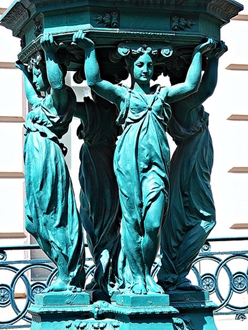
The picture illustrating this blog piece is a reminder of another tragedy that hit Paris: The Siege of Paris (1871) and the Commune. During those difficult times, there were great water supply problems. The English philanthropist Richard Wallace (1818-1890) built a number of drinking fountains for the people of Paris. Each was decorated with the four sculpted ladies shown in my illustration.

Already, many people are offering to donate money to help restore Notre Dame to its former glory. Had he been alive, i am sure Richard wallace would have been a willing contributor.

The Old year in flames

The ending of the old year and beginning of the new one is celebrated all over the world in a variety of ways and at different times of the modern calendar. For example, the Chinese, the Gujaratis, the Parsis, the Jewish people, and the Russian Orthodox all celebrate the start of a new year on different dates. People, whatever their personal beliefs, also celebrate the end of the year on the 31st of December.

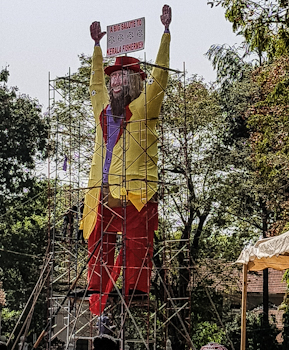
Cochin, which is a historic port in the southern Indian state of Kerala, was a Portuguese colony for a while in the 16th and 17th centuries. The Papaanji (spelling varies!) is named after a Portuguese word meaning ‘old man’.

Every year, a giant Papaanji is erected in a centrally located open space in historic Fort Cochin. During the afternoon of New Year’s Eve, the Papaanji is stuffed full of dry straw and fireworks. The roads around the open space are closed to motorised traffic. Despite this, a few youths on motor bikes manage to enter illegally.

After sunset and during the evening of the 31st of December, the area around the Papaanji fills with vendors and ever increasing numbers of people. Some of these merrymakers wear masks and others wear glowing red devil’s horns.

During the few minutes before midnight on the 31st, unbelievable numbers of people gather. The strong tide of people resembles a powerful surge of water such as you might expect if a large dam has just been breached. The crowd adds much noise to the cacophony of sound being relayed over various loudspeakers. Several times, I was almost knocked over by this human tsunami.

At midnight, the crowd became even noisier when flames began leaping from the ignited Papaanji. First, I could only see billowing clouds of smoke. Soon, frightening flames became visible. Then, bursts of stars appeared as the fireworks exploded.

Within minutes, the conflagration and fireworks ended. The old year, represented by the Papaanji, had been burnt out to make way for the new one. The crowds began to thin out a little, but despite that, it was quite hazardous trying to leave the area.

For an hour or two after midnight, boisterous revellers created much noise in the streets. The whole affair seemed to be generally good natured.

I am glad that I have seen the Papaanji aflame, but once in a lifetime is enough for me.