A WOMAN FROM GUJARAT AT AN INDUSTRIAL DISPUTE IN LONDON’S WILLESDEN

WHAT IS YOUR EARLIEST memory of a news item? In my case, I remember my parents discussing something about Cuba. This was The Cuban Missile Crisis of October 1962. I had little or no idea about it, but later I learned that US President John F Kennedy was involved in its resolution. A year later, when we were staying in the USA, we were there when he was assassinated. I well recall that and my feelings about it at the time. That remains in the forefront of my memory, but far back in the fleshy recesses of my grey matter, the name Grunwick resides. While visiting an exhibition at the Tate Britain recently, I saw several photographs that brought this vague memory back into my consciousness.

Grunwick Film Processing Laboratories (‘Grunwick’), located at Willesden in northwest London, processed photographic films and produced finished prints from them. Photographers (mostly amateurs) put their undeveloped exposed films into an envelope along with payment, and sent them to Grunwick, who later returned the developed film and the prints made from it. In 1973, some workers at Grunwick joined a trade union and were subsequently laid-off by the company. The company employed many workers of Asian heritage – including a substantial number of ladies. As the then Labour politician Shirley Williams pointed out, the Asian ladies were being paid very much less than the average wage, and conditions were bad – hours were long, overtime was compulsory (and often required without the employer giving prior notice).

On the 20th of August 1976, Grunwick sacked Devshi Bhudia for working too slowly. That day, three other workers walked out in support of Devshi. Just before 7 pm that day, Jayaben Desai (1933-2010) began walking out of the factory. As she was doing so, she was called into the office and dismissed for leaving early. When she was in the office, Jayaben said (see guardian.com, 20th of January 2010):

“What you are running here is not a factory, it is a zoo. In a zoo, there are many types of animals. Some are monkeys who dance on your fingertips, others are lions who can bite your head off. We are those lions, Mr Manager.”

Thus began a two-year long strike, which was supported not only by the company’s workers but also by many politicians and trade unions, including, for a short time, the Union of Post Office Workers, who refused to cross the Grunswick picket lines.

Jayaben was born in Dharmaj, now in the Anand district of the Indian state of Gujarat. Soon after marrying, she and her husband migrated to what is now Tanzania. Just before the Commonwealth Immigrants Act (1968) made it difficult for Commonwealth citizens to settle in the UK, the couple moved to England. There, she was obliged to take up poorly paid work, first as a sewing machinist, and then as a worker at Grunwick.

Not only did Jayaben initiate the strike, but she helped keep it going until the dispute was resolved. In November 1976, when the Post Office workers stopped supporting the strike, she told an assembly of  Grunwick’s workers:

“We must not give up. Would Gandhi give up? Never!”

Later, like Gandhi, she employed his tactic – the hunger strike – outside the Trade Union Congress in November 1977. During the court of enquiry led by Lord Justice Scarman, she gave powerful evidence against her erstwhile employer. When the strike was over, she went back to sewing, and then later became a teacher of sewing at Harrow College. After passing her driving test at the age of 60, she encouraged other women to do so to increase their freedom.  After her death, some of her ashes were deposited in the Thames, and the rest in the Ganges.

The reason that Grunwick came to mind at Tate Britain was that its current exhibition “Women in Revolt! Art and Activism in the UK 1970-1990” (ends 7th of April 2024) includes several photographs taken at Grunwick during the strike. Three of them include portraits of Jayaben in action.

As I wrote earlier, I had heard of Grunwick, but I could not recall why until I saw the exhibition. As for the remarkable Jayaben Desai, I am happy that I have become aware of her and her amazing achievements.

PHOTOGRAPHY, POLITICS, AND FEMINIST PROTEST IN PECKHAM

PHOTOGRAPHY HAS LONG been an artistic medium for expressing protest. This is well exemplified by photographic images on display at the excellent “Women in Revolt” exhibition, which is on at London’s Tate Britain until the 7th of April 2024, and is well worth seeing. Running concurrently with this. is an exhibition at the South London Gallery (in Peckham) – “Acts of resistance: photography, feminisms and the art of protest”, which is on until the 9th of June 2024.

As its title suggests, the show at Peckham consists mainly of exhibits that make use of photography. There are also several digital items.  The subject matter deals with matters that concern feminists (and ought to concern everyone) including rape, abortion, genital mutilation, other forms of violence against women, and so on. Unlike the exhibition at Tate Britain, which deals mainly with feminist activities in Britain during the 1960s to 1980s, this show was to coin a phrase ‘art sans frontières”, and bang up to date. The exhibition has as its inspiration the words that the artist Barbara Kruger used in 1989:

“Your body is a battleground”.

Incidentally, there is an exciting exhibition of Kruger’s work at the Serpentine South Gallery (in Kensington Gardens) until the 17th of March.

The exhibition at Peckham (to quote the gallery’s website):

“… explores feminism and activism from an international and contemporary perspective. Looking at different approaches to feminism from the past 10 years, the show highlights shared concerns including intersectionality, transnational solidarity, and the use of social media and digital technology as a tool for change.”

It includes works by at least 20 artists, some of them working as collaborators. Their creations are displayed well both in the gallery and its annexe nearby in a disused fire station. Put simply, the works on display at Peckham have a far more visceral impact than those being shown at Tate Britain, which in many cases appeal more to the brain than to the heart. Even if you ignore the messaging conveyed by the artists in the works at Peckham – and this is not easy to do – their visual impact is magnificent. They are works of art as well as being tools of protest. This is an exhibition well worth making the trek out to Peckham!

WOMEN AS DEPICTED BOTH BY A MAN AND BY THEMSELVES AT TATE BRITAIN

I DO NOT KNOW whether it was deliberate or accidental that currently (until the 7th of April 2024) there are two contrasting (or, maybe, complementary) exhibitions on in the galleries of London’s Tate Britain.

On the first floor, there is an exhibition called “Sargent and Fashion”. It is a collection of paintings by the American-born artist John Singer Sargent (1856-1925), who was born in Florence (Italy) and died in London (UK). The aim of the show is, according to the Tate’s website, to show:

“… how this remarkable painter used fashion to create portraits of the time, which still captivate today.”

The exhibition includes some of Sargent’s portraits alongside a few of the items of clothing that his subjects wore whilst he was creating their portraits. In this well laid out show, the viewer gets to see that Sargent was an excellent painter, whose portraits manage to radiate the natures of the sitters’ personalities. I doubt that most of Sargent’s subjects would have been disappointed with the pictures he produced for them. Many of the paintings are portraits of women. Almost all of them were depicted wearing elegant clothes, and are superbly executed conventional portraits. They celebrate aspects of the ‘respectable’ (i.e., wealthy) society of his times.  

Beneath the Sargent exhibition, on the ground floor of Tate Britain, there is an exhibition showing how women in Britain broke out of their conventional male-dominated lifestyle during the 1970s and 1980s. Called “WOMEN IN REVOLT Art, Activism and the Women’s movement in the UK 1970–1990”, it is according to the Tate’s website, it is:

“… a wide-ranging exploration of feminist art by over 100 women artists working in the UK. It shines a spotlight on how networks of women used radical ideas and rebellious methods to make an invaluable contribution to British culture. Their art helped fuel the women’s liberation movement during a period of significant social, economic and political change.”

During a long part of the period covered by the show, Britain had its first female Prime Minister, Margaret Thatcher (in office from 1979-1990). Although she fought her way through hitherto male bastions to emerge as the country’s first lady Prime Minister and showed what women were capable of doing in the world of politics, she was not a feminist icon, as Natasha Walter wrote in The Guardian (online 5th of January 2012):

“Obviously Thatcher was no feminist: she had no interest in social equality, she knew nothing of female solidarity … We should never forget her destructive policies or sanitise her corrosive legacy. But nor should we deny the fact that as the outsider who pushed her way inside, as the woman in a man’s world, she was a towering rebuke to those who believe women are unsuited to the pursuit and enjoyment of power. Girls who grew up when she was running the country were able to imagine leadership as a female quality in a way that girls today struggle to do. And for that reason she is still a figure that feminists would be unwise to dismiss.”

However, as Baroness Burt of Solihull said in the House of Lords on the 5th of February 2018:

“… my next figure is 1979, which, of course, was the date when we got our first female Prime Minister. Personally, I would feel more inclined to celebrate this milestone if she had encouraged other women to come forward, to use some of the talented women that she had at her disposal. But, sadly, she got to the top and pulled the ladder up behind her, which is a great shame, because the whole point of having representation from all parts of society is to make for better government.”

As several exhibits on display at the Tate (until the show ends on the 7th of April 2024), Mrs Thatcher was intensely disliked by artists encouraging ‘female liberation’.

Before entering the exhibition, I was a little worried that all I would see was propaganda and other polemic material. Well, there was plenty of that kind of thing, and much of it was both interesting and often visually intriguing – sometimes quite witty. The exhibition, which is excellently curated, also includes many paintings, sculptures, videos, and other artistic items. These have mostly been created by female artists with whom I am not familiar. And all of them are both visually engaging and satisfying.   Several of these were of Indian heritage, and others have ‘black’ African heritage. There are also cases containing printed material that propagated feminist ideas. Included amongst these were a few copies of the magazine Spare Rib, which I remember seeing at friends’ houses many years ago. My future wife was one its readers. Published between 1973 and 1993, its aim was to challenge the traditional roles of females (of all ages) and to explore new ways in which they could engage in society. In fact, this was the aim of many – if not all – of the works in the exhibition.

We visited both exhibitions today (the 28th of February 2024), to experience the contrast between them. Both are excellent in their own ways and achieve what the curators intended. They are both well worth visiting. However, to my taste, the exhibition on the ground floor was far more exhilarating and inspiring, that the more conventional show on the floor above it.

Ticket to Sofia

BULG 1 sofia church

A church in Sofia, 1983

I decided to travel to Bulgaria in Easter 1983; it was close to Yugoslavia and I had not been there before. I wanted to travel by train rather than air, and to visit friends on the way. I planned to start my journey from Rainham, the village in Kent where I had been practising dentistry for just over a year.


I went to the local station and asked about buying a return ticket from Rainham to Sofia. I was told that as this was not a commonly made journey I needed to go to a special office at London’s Victoria Station to get this prepared. I did as I was instructed, paid the fare, and was informed that my ticket would be ready for collection a week later. Armed with this bespoke ticket and a Bulgarian visa, I left Rainham for Dover, crossed the English Channel by steamer, and then boarded a train bound for Milan.

BULG 4 Sofia outskirts

A factory on the outskirts of Sofia, 1983

My future wife, Lopa, was living in Milan, where the company for whom she worked as a management consultant was based. During the few days that I stayed with her, I met Dijana (from Belgrade) and her then boyfriend quite by chance in the Piazza del Duomo, the huge square in front of the cathedral. They came to eat with us at Lopa’s flat, where her mother was also staying during a long visit from India. Dijana, whose interests in feminism were developing rapidly at the time, was impressed that Lopa’s mother was a doctor, a gynaecologist. She held female professionals in much higher regard than male ones.

After dinner, Dijana and her friend washed the dishes. I remember that when her unshaven boyfriend, who was desperately attempting to empathise with her burgeoning feminism, was washing a pan, he pointed out that he was washing the outside of the pan as well as the inside. He claimed vociferously and self-righteously that most men ignored the outsides of cooking pans, whereas women always washed them. I believe that his close relationship with Dijana was short-lived.

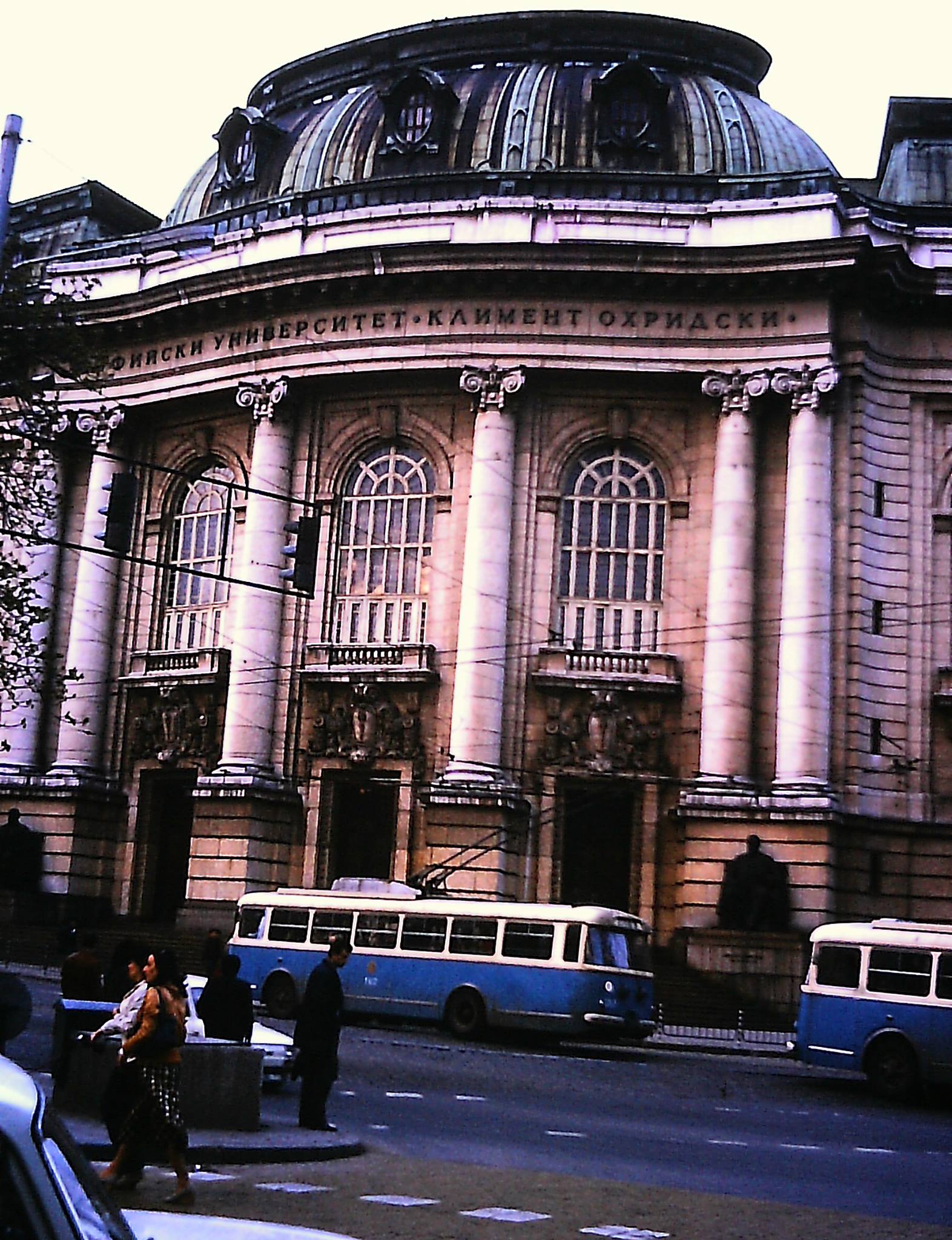
BULG 3 Sofia univ

University of Sofia, 1983

I continued my rail journey to Belgrade, where I stayed, as usual, with Raša. I learned that disaster had struck: there was a grave shortage of coffee in the city. This was truly a tragedy amongst its citizens, most of whom drank vast quantities of the stuff. I promised Raša that if I saw coffee for sale in Bulgaria, I would bring him some on my return. A few days later, I met my friend Shabnam at Belgrade’s railway station. She had arrived from London, and was joining me on the trip toBulgaria.

When our train had crossed the border and entered Bulgarian territory, a Bulgarian immigration official came into our compartment and examined our passports. After handing them back to us, he sat down and asked us where we were going. When we said that we were visiting Bulgaria and going no further, he smiled. It was, I felt, an expression of genuine joy. He was so pleased that we were taking the trouble to visit his country rather than simply using it as a corridor, as most travellers did on their way to Turkey.

BULG 1a Sofia Station

A railway station in Sofia, 1983

At the main railway station in Sofia we exchanged some of our Sterling for Bulgarian Lev at an official bureau-de-change. I had read that it was best to avoid black market currency exchanges because, even though a highly favourable rate of exchange could be expected, there were serious penalties for foreigners who used unofficial money-changers. Even at the official rate of exchange, we found everything in Bulgaria to be ridiculously cheap by our standards.

The station was quite far from the city centre. We hired a taxi to take us there. When we reached the destination, I asked how much we needed to pay. I spoke in my primitive Serbo-Croatian which was useful for making me understood in Bulgaria. This was not surprising as Bulgarian and Serbo-Croatian are quite closely related on the family tree of languages. The driver replied,“One Pound, one Dollar, one Deutschmark, one Swiss Franc…” “But we have Lev,” I interrupted, waving some Bulgarian currency notes at him. The driver stuck his nose into the air contemptuously, and said, “Two.” I pointed at the meter, which indicated a fare of one Lev, and said, “It says ‘one’.” He turned around and pointed at the two of us, and said, “Two, you are two people.” I gave up and paid. After all, 2 Lev was worth about 3 pence in those days.

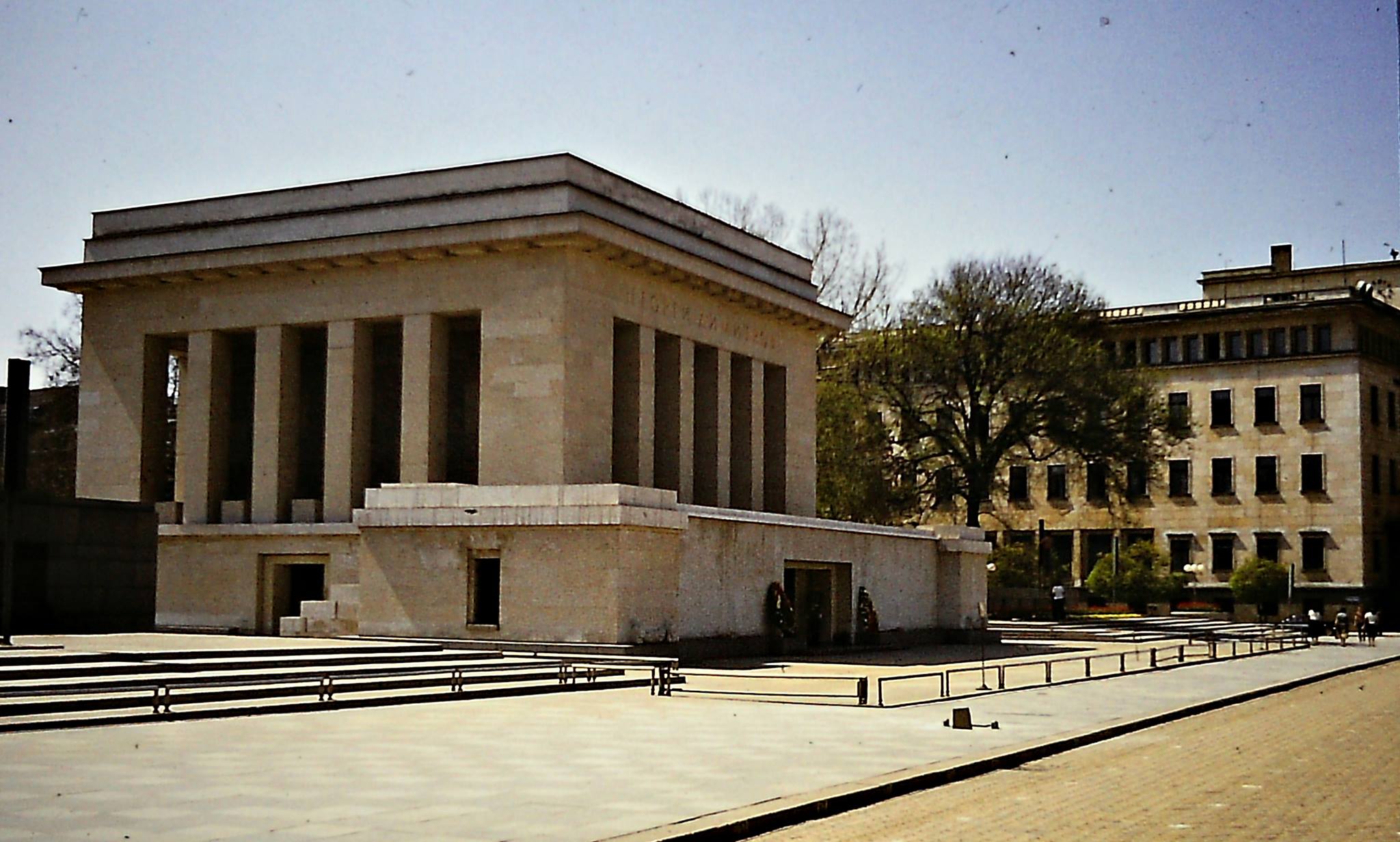
BULG 5 Sofia dimitrov

Mausoleum of Bulgarian Communist politician Georgi Dimitrov[1882-1949] in Sofia, 1983

A lady at the tourist office arranged for us to stay in some private accommodation, and then explained how we should reach the place. I asked her to repeat the information as I had not heard it properly. She looked at me sternly, and said in English, “You need to concentrate better.”


This is an excerpt from my book “Scrabble with Slivovitz”, which is available on Amazon and bookdepository.com

BULG 0 Scrabble