
Reading about a place sometimes makes one want to visit it. Such was the case with a picturesque valley in northern Greece, about which I had read in one of the travel journals written by Edward Lear (1812-1888). Here is what I wrote about the place that Lear had described when I visited it in the early 1970s with my PhD supervisor Robert Harkness and his wife Margaret. What follows is a slightly modified excerpt from my book “Between Olympus and Aegean”.
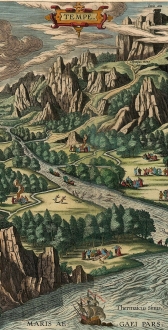
Halfway between Larissa and Platamon – both in northern Greece – the main road winds high above a deep gorge between the slopes of Mount Olympus and Mount Ossa. Passing through this place, the Vale of Tempe, our Land Rover laden with terracotta urns recently purchased in Larissa, brings to mind John Keats’ poem “Ode on a Grecian Urn”, which he wrote in 1819 and includes the words:
“What leaf-fring’d legend haunts about thy shape
Of deities or mortals, or of both,
In Tempe or the dales of Arcady?”
It was not through Keats’ words that I first heard of this place, but it was those of Edward Lear. In his “Journal of a Landscape Painter in Greece and Albania”, published in 1851, he wrote in his entry for the 9th of September 1848:
“To see the classic vale of Tempe, the sacred mountain of Athos and the romantic Yannina have always been among my wishes; and I had long ago determined on making, previously to returning to England, a large collection of sketches illustrative of the landscape of Greece.”
And so, it also became my wish to see the vale. I was already familiar with Lear’s sketches that I had seen in a huge album in one of the libraries at University College London. My friends, Robert and Margaret, with whom I was travelling in Greece, gave me a 19th century engraving based on one of his Balkan sketches for my 21st birthday. Lear’s drawings are at least as good as his nonsense rhymes, for which he is well known.
The main road between Larissa and Platamon ran high above Tempe. Even from its edge one could see little or nothing of the gorge far below it, and certainly not what Lear would have been able to see when he visited it. One afternoon, Robert and Margaret kindly drove me to the southern end of the Vale of Tempe, and left me by the roadside. Then, they drove to its northern end, where they said that they would wait for me as I tried to retrace Lear’s footsteps along the depths of the gorge.
When my friends drove away, I looked around to see whether I could find a track or path that ran along the base of the gorge. I saw two rustic looking men sitting high on a slope above me. I climbed up to them and with a combination of miming, which involved pointing at my feet, and repeating the word ‘Tempe’ I managed to make them understand that I wanted to walk along the gorge. They pointed up at the railway track high above us, and I understood that I was to walk along this.
Soon after I reached the single tracked railway, I heard a train approaching me from the south. I stepped aside to allow the Athens to Munich Express to rumble past me. When this long train had sped ahead, I followed it at my own pace. After a short distance the track entered a cutting between two walls of rock. When I was halfway along this, a diesel engine came hurtling towards me. In the nick of time, I flattened myself against the rocky wall to avoid being mowed down. I continued forward, somewhat shaken. Soon after the track emerged from the cutting, I saw the entrance to a tunnel not far ahead of me. It was dark; its far end was not visible. After my near miss in the cutting, I decided that I would not enter the tunnel.
I stood on the track near to the tunnel’s entrance and looked around. To one side there was a steep slope leading upwards. On the other, there was a slightly less steeply inclined slope leading towards the narrow base of the gorge. Cautiously I made my way down the slippery slope, grabbing hold of shrubs to slow down my descent. Soon, I reached a level path running just above a stream that ran along the base of the gorge. It was, I realised, the bed of a long since demolished railway track. This was the railway that my informants had intended that I follow. The railway track that I had been following was its modern replacement. Suddenly I was walking in an idyllic landscape that must have hardly changed since Lear visited it.
After a while, I reached what must have once been a railway station, but was now a place, maybe with religious connections, where visitors were able to obtain refreshments and to drink from a spring that issued nearby. I have since learnt that this place was called Agia Paraskevi and that the old railway station was opened in 1910. The suspension bridge close to this, which I crossed, was built in about 1960, and was replaced a few years ago.
Soon after leaving this delightful place, I reached the car park at the northern end of the gorge, where Robert and Margaret were waiting for me. They listened with great interest as I related my adventures including my narrow escape in the railway cutting.
[My book “Between Olympus and Aegean” is available from Amazon: https://www.amazon.co.uk/Between-Olympus-Aegean-Adam-Yamey/dp/1291882685/ ]. About the book:
Ants, bacon, collagen, and chlorine. These are not the first words that usually spring to mind when thinking about summers in Greece. The holidays that Adam Yamey spent in this country in the 1970s and 1980s with the professor and his wife were far from ordinary. This book provides an affectionate portrait of two remarkable people with whom the author spent many unconventional vacations. It also describes how the author travelled with them through a Europe which has undergone many transformations since these trips were made. Adam’s book is richly illustrated with his own photographs, many of them showing places that time has changed beyond recognition.

