Do not let this drama deter you from eating meat

THE PARK THEATRE in London’s Finsbury Park was opened in 2013. We have seen many productions there and they have all been good to excellent. “The Meat Kings! (Inc.) of Brooklyn Heights”, written by Hannah Doran, is showing until 29 November 2025, is no exception, as we discovered after watching it last night (1 November 2025). A word of warning is owed to vegetarians and vegans: the play is set in the meat cutting room of a family butcher’s shop somewhere in New York City. But do not let this deter you because the main points of the play are not about carving and slicing meat.

In the play, Paula Caffarelli is the owner of Cafarelli & Sons. Her great grandfather, an immigrant from Sicily, founded the firm 100 years ago. She tends to hire people released from prison to work in her cutting room. Three of her employees are ex-convicts and the fourth is an immigrant from Mexico. One of the ex-prisoners, Billy (acted brilliantly by Ash Hunter), must earn to pay his mother’s exorbitant medical fees. David, who used to make a fortune on Wall Street but has fallen on hard times, Is Paula’s senior meat cutter. JD is the Mexican. During the play, Paula takes on a new cutter, T, also recently released from prison. At the beginning of the play, Paula’s staff fool around and take life easily. However, it is not long before Paula’s business begins to suffer economically, and her staff members reveal their personal problems. Things reach a stage where Paula needs to reduce the number of her staff, and some of her cutters begin plotting against the others.

This well-acted, superb play is both entertaining and disturbing, but never uninteresting. As the theatre’s website explained, the play:

“… carves into the dark underbelly of America’s anti-immigration policies and the brutal sacrifices that drive the pursuit of prosperity.”

It adds a note of warning:

This production contains butchery; references to prison, suicide and illness; discussions of racism & xenophobia. Also contains strong language and references of a sexual nature. Please note, this production does not use real meat.”

The play comes to a tragic end as the characters, to use an appropriate phrase, knife each other in the back. I enjoyed the play, and believe that seeing it would not disturb those who avoid eating meat. However, it might put you off crossing the Atlantic from east to west.

Tagore and the oppression of women in traditional families in Bengal

THE BENGALI POLYMATH Rabindranath Tagore (1861-1941) is modern India’s most important cultural figure. In 1913, he was awarded the Nobel Prize for literature, and in 1915 he was honoured with a knighthood by King George V. Following the massacre at Jallianwala Bagh in 1919, which was instigated by a British military commander, he renounced the knighthood. Five years before this, Tagore, who did not tolerate injustice, wrote “Streer Patra” (‘A Wife’s Letter’), a short story that highlighted and questioned the domination of women by men in 19th and early 20th century families. Kolkata’s leading English language actress and two colleagues have created a play “I am Mrinal”, which is based on Tagore’s short story.

Piali Ray on stage

On the 9th of September 2025, I watched a performance of this play at London’s Nehru Centre. Piali Ray skilfully and convincingly acted all the roles in the play. These were: Mrinal, the wife of the second eldest son in the family; Bindu, an orphaned child, related to one of Mrinal’s in-laws; Mrinal’s brother-in-law’s wife; and Mrinal’s husband. Against everyone except Mrinal’s wishes, Bindu was accepted into the household.  Mrinal’s husband disapproves of Bindu’s presence in the joint family home, but childless Mrinal treasures this young girl’s presence. Mrinal’s husband is keen to evict Bindu, and eventually decides to marry her off to an insane man. In desperation, Bindu sets herself alight, and she dies. Then, Mrinal flees from Kolkata to Puri, where, at the end of the play, she writes a letter to her husband, explaining that she will never return to the domestic bondage that she had to endure for 15 years as his wife. Tagore’s story vividly illustrates the oppression of women in conventional Bengali families, and his feeling that this injustice needed to be combatted. It was written in 1914, the year the First World War commenced. It might not have been “the war to end all wars”, but after it was over, women in many parts of the world began to question their roles in society, and to improve their status.

During Piali’s performance, she switched roles effortlessly, and one was never in doubt as to whom she was portraying at any given moment. Even when she was playing the role of the husband, one forgot that she was not actually a man playing this part. She used a different tone of voice and set of gestures for each of the characters. Throughout the performance, there was music playing in the background. It impressed me that Piali’s movements on stage seemed to harmonize with the music. Her performance was not simply dramatic but also balletic.

It was fascinating watching this play not only because it gave an insight into the oppressive conditions experienced by women in traditional bourgeois Bengali joint families in the early 20th century, but also because it gave me a chance to watch a skilled actress conveying the story so beautifully.

Adam Yamey is the author of “88 Days in India: A Journey of Memory and Discovery” [https://www.amazon.co.uk/dp/B0FKTFBFM2],  and several other books about Indian topics.

Some mouthwatering experiences on the stages of theatres in London

OVER THE YEARS, we have watched several plays, which are best seen after eating rather than when hungry. In all of these, the actors have prepared and even cooked food on the stage. Many years ago, we watched a play about the artist Van Gogh’s stay in London. The stage set for this drama, which we saw over 20 years ago, included a kitchen. During the show, a roast meal complete with meat and vegetables was prepared in front of the audience. It smelled great, but we were not invited to eat any of it.

More recently we saw a play called “The Arab-Israeli Cookbook” on the small stage of the tiny Gate Theatre, which is above a pub in Notting Hill Gate. The audience was seated only a few feet away from two ladies, one of whom was preparing Israeli dishes, and the other Palestinian food. The drama explored the ongoing conflict in that country beset by conflict and tragedy: Israel. What was being prepared on stage was delicious. I am pleased that we had eaten before watching the preparation of mouthwatering food, which we were not offered.

Today, the 21st of September 2024, we watched a play, “My English Persian Kitchen”, written by Hannah Khalil. Starring only one actor, Isabella Nefar, it is showing at the Soho Theatre in Dean Street until the 5th of October 2024. Throughout the 70 minutes of this one act play, Ms Nefar prepares an Iranian herb and noodle soup, Ash-e-Reshteh, on a kitchen unit placed in the middle of the stage. While she tells us the secrets of making this soup, she also relates the problems of being a married woman in Iran and how she fled from the country and her husband. She also describes her arrival in London and how she reacted to life there, and how others reacted to her. Every now and then, she has flashbacks to her difficult marital experiences back in Iran. As the play comes to an end, her soup becomes ready to eat. She invites the audience on the stage to taste what she had prepared while we were watching. All in all, it was a great piece of drama. My wife tried the soup, and said it tasted good. I did not try it because it contains beans and lentils, neither of which I particularly enjoy.

I went to Soho Theatre after having a lighter than usual lunch. As the actress prepared the dish, the cooking smells did increase my feelings of hunger. I should have eaten more before reaching the theatre.

A trade union for actors and actresses

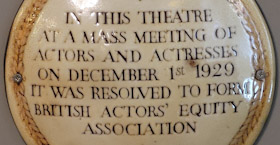
WHILE DRINKING IN the first-floor bar of the Duke of York’s Theatre (‘DOY’) in London’s St Martin’s Lane, I noticed an interesting small commemoration plaque. But before discussing that, first a few words about the theatre.

The DOY was opened in 1892 with the name ‘The Trafalgar Square Theatre’. Later, it was given its present name in honour of the Duke of York, who later became King George V. It was designed by the leading theatre and music hall architect Walter Emden (1847-1913). Amongst the many plays performed in this beautiful fin-de-siecle theatre where JM Barrie’s play, the precursor of his book, “Peter Pan, or The Boy Who Wouldn’t Grow Up” which was premiered in late 1904. The theatre was bought by the Ambassador Theatre Group (ATG) in 1992. Since its opening, many successful plays have been performed in it. The play we watched in mid-November 2022 was “The Doctor” by Robert Icke. It was a lively and engaging play that was crammed a bit too full of dilemmas that trouble us today.

The plaque, which I noticed whilst waiting to enter the auditorium was put on the wall of the bar to celebrate that on the 1st of December 1929, a mass meeting of actors and actresses was held in the theatre. Those assembled resolved to form the ‘British Actors Equity Association’. Above this plaque, there is a framed document with many signatures below the words:
“We the undersigned, hereby pledge ourselves that we will not enter into any engagements with Theatre Managers on conditions which would deny our right to refuse to work with non-members of Equity.”


Amongst the signatures on this undated document, I was able to read those of Flora Robson, Hermine Baddeley, Violet and Irene Vanburgh, Marie Burke, Reginald Backs, Robert Donat, Sybil Thorndyke, Leslie Henson, Godfrey Searle, and many others.


This document marked the birth of the actors’ union known as Equity. As the document suggested, and like many other British trade unions, Equity adopted the closed-shop policy. When this was made illegal by Margaret Thatcher’s government in the 1980s, joining the union required evidence of having experience of a sufficient amount of paid professional work.

I must admit that I am not sure whether seeing the memorial to the foundation of Equity was not more exciting for me than watching the play I had come to see.

Leopoldstadt by Tom Stoppard

Wyndhams Theatre, London

I HAVE WATCHED AND GREATLY enjoyed many plays by Tom Stoppard. So, it was with high expectations and great excitement that I booked good tickets for his latest play, “Leopoldstadt”, which is about a tragic period during Austria’s history, a time that interests me greatly. The play follows the history of a Jewish family living in Vienna between the late 19th century and about 1955. Like many Jewish families living in Germany and Austria, they were determined to appear increaslingly less Jewish and ever more like their gentile neighbours, a process known as ‘assimilation’. As Amos Elon demonstrates in his wonderful book, “The Pity of it All”, the more assimilated the Jewish people became, the less they were tolerated by their mostly anti-Semitic neighbours. Stoppard’s play attempts to portray this sad state of affairs in “Leopoldstadt”. His play was more like a history lesson than a compelling work of drama.

“Leopoldstadt” was being performed in London’s magnificent Wyndhams Theatre. Frankly, although there were a few wonderful scenes in the play, I was mostly disappointed. Although it was clearly a heartfelt and moving exploration of part of his family’s history, Stoppard has written far better and subtler plays in the past.

Back to the theatre

BACK TO THE NATIONAL THEATRE

THE DORFMAN IS one of the three auditoria that make up the National Theatre complex on London’s South Bank. The Dorfman, which opened in 2014, is a completely redesigned version of The Cottesloe that used to stand in the same place. On our first ever visit to The Dorfman, today, the 6th of October 2021, we noted that it was a great improvement over its predecessor: better seating and sight lines than at the former Cottesloe.

Stage at the Dorfman

The play that we watched, “Rockets and Blue Lights” by Winsome Pinnock (born 1961), was inspired by a painting by JMW Turner. Originally named “Slavers Throwing overboard the Dead and Dying—Typhon coming on”, it is now named “The Slave Ship”. Painted in 1840, it now hangs in the Museum of Fine Arts in Boston, USA. Close examination of this wonderful painting reveals the wild sea near a sailing ship is full of hands reaching out from the waves, the hands of Africans sinking after being tossed overboard. Turner, a sympathiser of slave trade abolitionists, might have painted this in response to the tragic story of British slave ship “Zong” on which about 130 enslaved Africans were killed in 1781 when drinking water supplies on-board ran low.

The play explores the possible back stories of those tossed overboard from the ship depicted in Turner’s painting. The drama alternates between the present and the dark past when slavery was still flourishing in the Americas. At first a little confusing, it does not take long before the constant changes in period begin to make sense. The scenes set in the present relate to the making of a film about Turner and those set in the past try to recreate the story that led to the disaster painted by Turner. The ideas behind this play are not without great interest but at times I felt that a bit of editing (i.e., abbreviating) would have made the drama punchier. Understandably, the playwright wanted to make the horrors and inhumanities of slavery abundantly clear to the audience, which she did very well. I am glad to have seen this play, but do not rate it amongst the best I have seen during many decades of watching drama on the stages of the National Theatre.

Our visit to the Dorfman was the first to the National Theatre since the day before the first covid 19 ‘lockdown’ commenced in March 2020. On that day before everything closed down for months, we sat for seven hours in the National Theatre’s Littleton auditorium to watch a truly excellent play, “The Seven Streams of the River Ota” by Robert Lepage, the National Theatre at its very best. Even though the play we have just seen at The Dorfman was not nearly as good as the play by Lepage, it was lovely to return to the National Theatre. That said, the South Bank felt eerily underpopulated compared to before the pandemic, probably because of the paucity of tourists from abroad. Walking in the sunshine along what used to be a crowded, joyful recreation area, I wondered whether we will ever experience the ‘normal’ we enjoyed before covid19 changed the world.

In the shadow of the Hilton Hotel

BBC RADIO ONE began broadcasting on the 30th of September 1967. Before then, if you wanted to listen to popular music on the radio in the UK, you would have to tune your radio to pick up Radio Luxembourg, whose broadcasts from Luxembourg came over the airwaves loud and clear. Some of its presenters, for example Dave Cash, Noel Edmonds, and Kenny Everett, later hosted programmes on the new radio stations that began to broadcast after Radio One and various new commercial stations began transmitting. Unlike the BBC, Radio Luxembourg was commercial and broadcast advertisements relevant to British listeners. Several programmes were sponsored by two football pools companies, Littlewoods and Vernons. The station continued transmitting for UK audiences until December 1992.

I had not thought about Radio Luxembourg much until mid-September 2020 when we were walking along Hertford Street in a part of London’s Mayfair under the shadow of the tall Hilton Hotel on Park Lane. This short street runs east from Park Lane (just next to the Hilton) for about 630 feet and then makes a right angle turn and heads north through Shepherd Market and ends up at Curzon Street, which I have written about elsewhere (https://londonadam.travellerspoint.com/20/). Next to the front door of number 38 Hertford Street, a tall narrow house built in the 18th century (or not much later), a commemorative plaque informs:

“This was the HQ of Radio Luxembourg, Broadcasting from the Grand Duchy 1933-1991”

This building was not only the headquarters of the extra-territorial radio station but also contained recording studios where seemingly ‘live’ programmes could be recorded for broadcasting later from Luxembourg. Listeners were not informed where programmes had been recorded and were left with the impression that everything was being produced in the Grand Duchy.

Number 10 Hertford Street is just across the road from the former Radio Luxembourg HQ. This elegant terraced building, whose front entrance is flanked by two metal lampstands complete with inverted cones for extinguishing flaming torches, was home to two famous people, as recorded by plaques affixed to the house.  One of its former occupants was General John Burgoyne (1722-1792), who lived and died here and Richard Brinsley Sheridan (1751-1816), who lived here from 1795-1802. Prior to these celebrated occupants, the house was occupied by John Montagu, 4th  Earl of Sandwich (1718-1792), who was famous for his musical parties (www.british-history.ac.uk/old-new-london/vol4/pp345-359) and for giving his name to a popular food item.

General Burgoyne was, according to Wikipedia:

“… a British army officer, dramatist and politician who sat in the House of Commons from 1761 to 1792.”

His military achievements during the American War of Independence were dismal. His attempt to disrupt the American forces came to nought and ended with him surrendering his army of over 6000 men in October 1777 at Saratoga. His dramatic works were popular and included “The Maid of the Oaks” (1774) and “The Heiress” (1786). He assisted in the writing and production of “The Camp: A musical Entertainment” (1778), principally written by another occupant of Number 10 Hertford Street, Richard Sheridan. The General also worked on the libretti of several operas. Had he stuck to the stage, and kept away from the battlefield, Burgoyne might have been remembered as a dramatist rather than a failed military man. Politically, he began by supporting the Tories, but later switched to the Whigs. Near the end of his political career, he was involved in Parliament’s attempted impeachment of Warren Hastings at the end of the 18th century. Hastings, the first Governor General of Bengal had been accused of misconduct in Calcutta but was eventually acquitted.

Another occupant of number 10 was also involved in the theatre but to a greater extent than Burgoyne. Richard Sheridan, born in Dublin, was a playwright and poet as well as being the owner of the London Theatre Royal in Drury Lane.  He is best known for his still popular plays “School for Scandal” (1777) and “The Rivals” (1775).What I did not know until I began writing this was that Sheridan had been a Member of Parliament (a Whig supporter). In 1777 during a Parliamentary session, he had demanded the impeachment of Warren Hastings. His speech on the subject made on the 7th of February 1787 lasted five and three-quarters hours. His oration:

“… commanded the most profound attention and admiration of the House. His matchless oration united the most solid argument with the most persuasive eloquence. His sound reasoning giving additional  energy to truth, and his logical perspicuity, and unerring judgment, throwing a light upon, and pervading the obscurity, of the most involved and complicated subject.” (https://quod.lib.umich.edu/e/ecco/004858403.0001.000/1:3?rgn=div1;view=fulltext).

Clearly, Sheridan was eloquent both in life and creatively on the stage.

This home of playwrights was built between 1768 and 1770 by the builder Henry Holland the elder (1745-1806). On arrival at this address in 1769, Burgoyne commissioned his friend, the architect Robert Adam (1728-1792), to design and execute some of the interior decoration (http://collections.soane.org/SCHEME1106).  After the General’s death in 1792, Sheridan purchased it.

Moving on, we enter the short Down Street that leads south from Hertford Street to Piccadilly. Although the street slopes downwards to Piccadilly, I am not sure that this is the reason for its name. “The London Encyclopaedia” (edited by B Weinreb and C Hibbert) noted that it was was laid out in the 1720s by the bricklayer John Downes, who was involved in much building work in Westminster (www.british-history.ac.uk/survey-london/vols29-30/pt1/pp77-83). Maybe, that is the origin of its name.

Two buildings caught my attention on Down Street. Nearer Hertford Street, on the corner of Brick and Down Streets, stands a Victorian gothic church, Christ Church Mayfair. Constructed in 1865, this protestant church was designed by F & H Francis (they were brothers) and enlarged in 1868. After a fire in 1906, it was rebuilt considerably. It was closed when we passed it, but I have read that it contains some art nouveau features.

South of the church on the west side of Down Street, there is a terracotta coloured tiled façade that looks like a typical Underground station, which is what it was between 1907 and 1932, when it was closed. This now disused station was ‘Down Street’ station on the Piccadilly Line. It lies between Hyde Park Corner and Green Park Stations, no more than about 500 yards from each of them. It was closed because it was never busy enough to keep open. Most of the inhabitants around it were and still are wealthy enough not to need or use public transport. During WW2, it was used as a bunker by Winston Churchill and his staff before the Cabinet War Rooms were ready for use.

By retracing our steps, we can return to Shepherds Market for refreshment, be it a drink or something more substantial. After passing the former Radio Luxembourg HQ and entering the section of Hertford Street that runs towards Curzon Street, you will come face to face with a pub (currently closed) called ‘Shepherds Tavern’. This hostelry was first built in 1735 as part of the development of the area by the developer and architect Edward Shepherd (died 1747). Its customers are said to have included the actress Elizabeth Taylor and Antony Armstrong Jones, who was once married to Princess Margaret.  The actress Wendy Richard (1943-2009) lived in the pub from 1948 to 1953, when her parents were its publicans.

As you enjoy a pint of beer or a glass of sherry or maybe a cortado or a ‘latte’ in Shepherds Market, you can marvel at how much history is packed into two short streets overshadowed by the 331 foot high, 28 storey Hilton Hotel on Park Lane, which first opened in 1963. And fully refreshed, you can resume exploring Mayfair sure in the knowledge that you will be treading in the steps of many now famous people who have haunted the area since it was laid out in the early 18th century.

Death of a theatre

ON SATURDAY THE 17th MAY 2020, an act of cultural barbarism was performed in Tirana, the capital of Albania. The National Theatre of Albania in the heart of the city was demolished. It is unclear who ordered this demolition of a much-loved cultural monument located in a part of the city where property prices are high. The theatre was built in 1939 during the period that the Italians, under Mussolini, were ruling Albania. It was originally a cinema designed by the architect Giulio Berte, but later its screen was replaced by a stage.

TIR 4 BLOG

In 2016, my wife and I visited Tirana and attended a dramatic performance at the National Theatre. I have described this in my book “Rediscovering Albania”:

“…we visited the National Theatre, a building that dates back to before Communist times. A Pirandello play (Play without a Script) was to be performed in Albanian that evening. The charming ladies clustered around the ticket desk assured us that we would enjoy it because it was going to be full of song and dance. We bought a couple of tickets … The rectangular auditorium of the National Theatre was delightfully old-fashioned, with many drapes and an upper gallery that extended around three sides of it. Everything was red including the plush upholstery of the comfortable seats. Although we did not understand a word of it, the Pirandello play was acted beautifully. The expressive acting was so good that we were able to get a rough idea of what was going on. Some years earlier in London, Lopa and I once attended a performance of Gogol’s Government Inspector acted by a Hungarian troupe entirely in Hungarian, and on another occasion a play from Kosovo in Albanian, during the course of which one of the actors threw a fake chicken at me! On both of those occasions and also in Tirana, great acting compensated for our inability to understand the words. If the actions of actors move me more than their words, I feel this is a sign of truly skilful acting. As the great Constantin Stanislavski said: “The language of the body is the key that can unlock the soul”. This is exactly what the actors in Tirana achieved. The audience was appreciative, and, unlike at the opera, hardly anyone used their mobile ‘phones during the show.”

That has now disappeared. So, has also the unusually attractive appearance of Tirana as it was when I first visited it in 1984 during the dictatorship of the faithful follower of Joseph Stalin, Enver Hoxha. In those repressive times, Tirana was a quiet city with only one high-rise building, the 12-storey Hotel Tirana. Of course, back in 1984, times were tough for the average Albanian citizen. They remained quite difficult during the decade following the ending of Communist rule in 1991. Even now, many Albanians prefer to increase their prosperity by seeking work abroad.

When we visited Tirana in 2016, I found it to be a far busier place than it was in 1984. The traffic was busy – a sign that motoring, an option not available to most Albanians during the dictatorship, had become popular and also affordable. Some of the charm of pre-1991 Tirana remained, but many picturesque old buildings, examples of traditional Turkish and Balkan vernacular architecture, had disappeared (or were about to). In their place, there were many high-rise buildings of little or no architectural merit. I suspect that whoever ordered the demolition of Tirana’s historic, much-loved National Theatre has in mind to construct yet another aesthetically unpleasing edifice.

If as Shakespeare said, “All the world is a stage”, then the demolition of this theatre in Tirana is yet another tragedy enacted on that stage.

Seven streams

Seven

At first, I was daunted at the prospect of watching a seven hour drama at London’s National Theatre. Then, remembering that I had endured an eleven hour bus journey in Gujarat and several long intercontinental flights, I decided that sitting comfortably at the theatre for seven hours including intervals would not be too bad, and I was right.

The play we watched, “The Seven Streams of the River Ota”, by Canadian playwright Robert Lepage (born 1957 in Quebec,), is divided into seven acts or installments. I found five of those installments to be highly enjoyable. The other two were less good in my humble opinion.

The River Ota runs through the Japanese city of Hiroshima, unfortunately famous for being the first civilian target of an atomic bomb in 1945. One of the main characters in the play by Lepage is a woman who was blinded, as a small child, by the atomic bomb blast’s flash. Each of the seven acts of the drama is linked to her or to characters connected with her directly or indirectly. Therefore, although the play’s plot is quite complicated, there is an easily discernible thread that runs through it.

At times the drama is witty and humorous and at others tragic. However, throughout the performance, the subject matter is both sensitive and moving. The ingeniously crafted play touches on all kinds of important historical events that affected Japan and the Japanese between 1945 and the late 1990s when the play was written. It also makes reference to Theresienstadt, one of the Nazi concentration camps. At first, I was not sure of the relevance of this scene set in the camp, but afterwards it dawned on me. It was an important background to one of the characters, who plays a major role in the latter parts of the play.

Another of the play’s myriad of topics reflects the playwright’s origin, Quebec. There are some very entertaining scenes in which the characters speak in Canadian French (with its particular accent) such as would be heard in Quebec. At times, Lepage makes use of the play to poke fun at cultural rivalry between the Canadian French and the French in France. He also makes reference to Canada’s objection to French nuclear tests that were being carried out in the Pacific between 1966 and 1996. And, nuclear tests relate directly to the main theme of the play, the atomic bomb exploded at Hiroshima.

Without going into detail about the very complicated plot, let me say that this play was highly fascinating, well acted by members of Lepage’s theatre ensemble Ex Machina, and the sets were superb. Sadly, this long play is only being given a short run at the National Theatre. Its final performance, viral microbes permitting, will be on the 22nd March 2020.

As for my initial fears about sitting for seven hours in the theatre, these were unrealised. The time shot past, so intriguing was the play. Lepage’s play was for me as exciting as at least two other epic length dramas I have enjoyed: “Angels in America” by Tony Kushner, and “The Coast of Utopia” by Tom Stoppard.