
Piles of granite
Standing proud high up on Dartmoor
A majestic sight

Piles of granite
Standing proud high up on Dartmoor
A majestic sight
DESPISED BY MARINERS whose boats are fouled by these creatures that attach themselves firmly to the hulls of vessels, they are important in the seawater eco-systems. I am referring to barnacles, which are arthropods of the subclass Cirripedia. The mature barnacle attaches itself to surfaces including boats, seashells, sea creatures including whales, and rocks, using an incredibly strong glue that they secrete. Once stuck in place, they feed by filtering the water through their bodies, extracting plankton from it. Thus, barnacles assist in the purification of seawater. For those who are concerned with ecological matters, barnacles are a useful indicator of water quality in coastal environments.

Our daughter, who is the curator at UP Projects, an organisation that commissions and executes public art works, has been involved in producing a sculpture, “I travelled 66 million years to be with you and then you came”, created by the artist Anne Duk Hee Jordan. It was unveiled on 4 June 2025. The sculpture is a depiction of the bodies of barnacles, greatly enlarged, perched on a pile of slate stones on which shapes of fossils have been carved. The barnacles are sculpted in porous materials that, like real barnacles, filter and purify water that passes through them. As UP’s website explained, the barnacle forms:
“… are made from materials with water-filtering properties, including Roman concrete, a plant-based version of activated charcoal known as biochar, shell fragments, zeolite minerals and iron oxide …”
By using these materials, the barnacle sculptures not only resemble the creatures’ forms but also their filtration functions.
The sculpture is being displayed in the garden of A La Ronde, a curious eighteenth-century house near Exmouth in Devon for a few months. Maintained by the National Trust, this (almost circular) building has sixteen sides and a central octagonal lightwell. It was built in 1796 by two cousins, Jane and Mary Parminter. With fine views of the River Exe and its estuary, the eccentrically designed house is filled with curiosities collected by the Parminters. These objects include many natural items such as seashells, bird feathers, fossils, bones, and rocks. No doubt some of these specimens have the shells of dead barnacles attached to them.
It is quite appropriate that Duk Hee’s modern sculpture, which simultaneously celebrates the importance of barnacles and purifies water falling on it, has been placed in the garden of a house once owned by two ladies who, judging by their extensive collection of seashells and other natural objects, had a great interest in the environment in which they lived. The artist’s creation serves as an object on which to concentrate while contemplating the importance and fragility of the eco-system that supports life as we know it.

Night falls in Torquay
Lights all around the small harbour
A town at peace
COMPTON CASTLE IN DEVON is deep in the countryside near to Torquay. It is a fortified manor house that dates back to 1520, and before the fortifications were added in that year, it was already a manor house by the mid fourteenth century.

For many centuries, Compton Castle was home to the Gilbert family. In 1785, the estate was sold. However, in 1931, and American descendant of the family purchased the estate and restored the castle. In 1951, the estate became part of the National Trust on condition that the family could continue to live in a part of it. Today, one wing of the castle is the private home of some members of the Gilbert family.
The most famous member of the family is Sir Humphrey Gilbert (c1539-1583). He is best known for establishing a British colony in Newfoundland – the first British colony in America. And it was the first ever British colony in the world. It can be said that by founding this colony, he was the founder of the British Empire.
Sir Humphrey died at sea while travelling on an English ship, the Squirrel. In many places within Compton Castle there are images and sculptures of squirrels in memory of this ship.
Compton Castle is well worth visiting. Not only is the castle magnificent, but also the rose garden next to it.
IT WAS UNUSUAL for my parents to take us on holidays at the seaside during my childhood. Mostly we went to cities, such as Bruges, Florence, and Delft, where there were plenty of artistic treasures to be viewed. Yet, one year when I was less than 10 years old, we spent a holiday at a hotel in a small place, Maidencombe, which is a few miles east of Torquay in Devon. All I can recall of this trip was staying in a country house hotel that had a beautiful flower-filled garden.
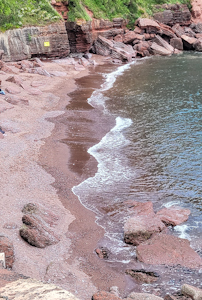
Yesterday (4 June 2025), my wife and I stopped at Maidencombe. I could not recognise anything, and I believe that the hotel where we stayed over 60 years ago has disappeared.
We followed signs to the Café Rio, which is reached down a winding staircase that clings to the slopes of a hillside overlooking a secluded cove surrounded by striated red rocks. The hillside is covered with luxuriant vegetation. The café is on a terrace above a small beach, where intrepid swimmers were enjoying the sea. We ate a light lunch on this terrace, and enjoyed the view.
I am pleased we visited Maidencombe but I can not stop wondering why my parents chose to go there instead of one of our usual culturally rich destinations. What or who influenced them to select Maidencombe? I will most probably never know.
NO ONE KNOWS exactly where the Explorer and naval commander Sir Francis Drake (c1540 – 1596) was ‘buried’ at sea. What is known is that his corpse clad in armour was put into a lead coffin, and then dropped into the sea somewhere near Portobelo (now in Panama).

On the 400th anniversary of his death, a stained glass window which is part of a sundial was installed at the Drake family home in Devon: Buckland Abbey. The window depicts a chart of the Atlantic Ocean on which a small cross has been marked in the approximate location of Drake’s burial. The window/sundial was designed by Christopher Daniel.
TAVISTOCK IS A SMALL town just west of the Dartmoor National Park. Between the year 974 and 1539, when it was closed by King Henry VIII, there was a vast abbey in the centre of the town. A few remnants of the abbey buildings can be seen today, but most of the complex has disappeared. The Guildhall, built in 1848, stands upon land where the abbey once stood. Today, this edifice houses a well organised museum, which illustrates various aspects of the town’s history. Visitors can see the courtroom and the old prison cells beneath it.
Within the courtroom, there is an intriguing exhibit: a judge’s wig in a glass case. This wig was discovered recently when the Guildhall was being restored a few years ago. It is the kind of wig worn by judges in the 1840s. The wig contained its owner’s name: Mr JW de Longueville Giffard.

The researchers connected with the museum discovered that Mr Giffard attended court one day in October 1888. He had been presiding at Okehampton the week before, and had fallen ill. Unwilling to cancel his session at Tavistock, the conscientious judge attended the court on that October day, feeling extremely unwell. He died the following day. Because he was in such a bad state on the day before his death, he must have forgotten to take his wig back home with him.
130 years later, the unfortunate judge’s wig was found in a cupboard in what had once been the judges’ robing room.
WHENEVER WE DRIVE to Cornwall, we make sure that we cross Dartmoor. Even if it means taking a detour along the narrow, challenging lanes of Devon, we always visit Combestone Tor. This geological formation, perched on the side of a hill commanding a panoramic view of well over 180 degrees, consists of several piles of enormous, weathered slabs of granite. Each pile has a few of these gigantic slabs piled one above the next. I have described how these impressive piles were formed in something I wrote a few years ago (https://adam-yamey-writes.com/2020/10/04/sculpted-by-nature/).

I cannot say why we find visiting Combestone Tor so satisfying. Is it the fine views over the moor and the countryside abutting it? Or is it the sculptural qualities of the rock formations? Could it be the peacefulness of the place? Even if there are other visitors at the Tor, one does not feel disturbed by them. Or is it the joy of seeing horses, sheep and cattle grazing near the stones? It is probably a combination of all of these, and other factors which affect one’s emotions, but are difficult to define. We have seen the Tor in appalling wind and rain and bright sunshine, and always feel glad that we have made the effort to reach the place.
DURING THE 1890S, construction of new concrete naval structures commenced at Plymouth naval dockyard. The nearest source of gravel suitable for incorporating in concrete was in Start Bay on the south coast of Devon (just west of Dartmouth). Dredgers, which were able to suck up vast amounts of gravel from the seafloor, were sent to Start Bay. Every day, enormous amounts of gravel were removed from the Bay.

The inhabitants of the tiny fishing village of Hallsands, whose location was between Beesands and Start Point, noticed that as the gravel was being removed, the level of the sea was gradually lowering. This began to become serious because the gravel that was being removed in vast quantities had formerly protected the village (and others nearby) from being washed away by the action of the sea’s waves. When the authorities became aware of the damage being caused, gravel extraction was ended. But this was too late.
A huge storm in 1917 caused most of Hallsands to be washed into the sea, leaving only a couple of houses standing, albeing precariously. Had the gravel not been removed, the damage might have been considerably less, and more of the village might have survived.
Until recently, the precarious remains of Hallsands could be seen from a viewing platform high above the site. However, during the last year or two, further damage has made the path leading to the platform too dangerous to be used, and it has been fenced off.
Neighbouring coastal villages such as Beesands and Tor Cross, have also suffered damage from the sea because of the gravel extraction, but high thick concrete seawalls were constructed and barriers of huge rocks have been placed, and so far the villages’ integrity has been protected.
Old photographs show what Hallsands looked like before it disappeared. They reveal that its buildings resembled those still standing at Beesands. Whereas this village stands on level ground, the buildings in Hallsands used to line a steeply sloping main street that ran downhill to a small fishing harbour.
Although the tragic consequences of gravel extraction were predicted early enough, cessation of the removal of this protective material did not occur until it was far too late to prevent disaster. The villagers who lost their homes and livelihoods had to wait many years before they received any compensation.
Start Bay is a beautiful place to visit. Had our friends Tim and Christine not taken us there, it is quite possible that we would not have become aware of its tragic recent history.
THE NATIONAL SYMBOL of Russia, both before and after the Communist era, is a bird with two heads, two necks, and a single body – the double-headed eagle (‘DHE’). I have long been interested in this imagined creature because it appears on the flag of Albania, a place that has interested me for many years.

While walking along the riverfront in Dartmouth (Devon), our friend pointed out a historic cannon positioned with its barrel pointing towards the water. On the top of the barrel there is a small bas-relief depicting a DHE.
The cannon was manufactured in the Russian city of Briansk in 1826. It was captured from the Russians in the Crimean War (1854-1856) and is one of several Russian cannons brought to England after or during that conflict.
We have visited Dartmouth many times before, but barely noticed the old cannon. Had our friend not told us of the origin of that cannon, one of many disused artillery pieces that can be found serving as ornaments all over England, I would have been unaware of this example of a double-headed eagle in Dartmouth.
 yamey
yamey 