
Tied and dyed in Kutch (Gujarat)

BANDHANI IS A METHOD of tie-dyeing that is frequently used by textile workers in the Kutch (Kachchh) district of the Indian state of Gujarat. Knots are tied in the piece of material that is to be dyed, and then the knotted fabric is dipped into a vat of dye. The dye colours all of the material except the parts tied within the knots.


To go into a bit more detail,  let me try to explain the procedure.  Starting with the ‘raw’ cloth that is usually whitish in colour,  craftworkers gather small amounts of the material using their fingertips,  and tie these small bundles with thread. The bundles are tied according to a predetermined pattern drawn on the cloth.  The tied cloth is then dipped into a dye. When the dyeing is completed and dried, a new set of knots is tied on the already knotted cloth. The cloth is then dipped into a different  coloured dye. A new set of knots is sometimes then tied according to the kind of design that has been planned, and the cloth is then dipped into yet another colour dye.


This process of tying and dyeing can be repeated several times. After the several cycles of tying and dying are completed, the cloth is stretched, the knots undo, and a textile with a fascinatingly complex and beautiful pattern is revealed.


The bandhani process is complicated and very demanding. Consequently, the bandhani fabrics are quite highly priced.


On several visits to Mandvi in Kutch, we have stopped at an old shop where bandhani fabrics are made and sold. Its current owner, Mr Ashraf Katri, always remembers us when we stop at his shop. He told us that the business has been in existence for at least 150 years. That means the present generation of the family working in the establishment is the fourth or fifth since it first opened.


On a couple of occasions, Mr Katri has shown us some bandhani cloth that was made over 100 years ago. The patterning on this old cloth is far more intricate and finely detailed than any bandhani produced today. Mr Katri explained that it must have been made by someone with very tiny fingers, possibly a young child, because only someone with such small fingers would have been able to tie the minute knots needed to create such an exquisitely detailed pattern.


Although there are many organised tours offered to show tourists craftspeople at work, they are unnecessary if you are prepared to wander around the bazaar areas and small lanes in places like Mandvi and Bhuj.  By doing so you will spot numerous people creating traditional items in their shops, and most of them are happy to let you watch them at work.
Made of paper in the north  of India

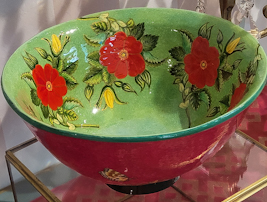
A naqashi bowl

NAQASHI is a traditional handicraft practised in Jammu & Kashmir.  It is papier-maché hand painted with Mughal inspired motifs. The objects created with this technique are lacquered  to produce a shiny finished surface.

[The word ‘naqashi’ means ‘painting’]

Kumihimo in Kensington

THE JAPAN HOUSE in London’s High Street Kensington first opened in 2018, and its aim is to increase people’s awareness and knowledge of Japan, the Japanese, and their culture. Until the 11th of June 2023, the Japan House is host to a superbly laid-out exhibition of Kumihimo – Japanese silk braiding. The braiding is a complex form of plaiting, using dyed silk threads. When, for example, hair is plaited or braided, three or more strands of hair are intertwined to form a plait. Practitioners of Kumihimo plait great numbers of often different coloured threads to create braids with beautiful repeating patterns. The most expert craftsmen and craftswomen can braid patterns using up to 140 different threads.

The exhibition shows how the threads are dyed, then spun into bobbins before finally being woven into braids. The braider uses a stand that holds the reels of thread. The threads are then plaited over each other in a repeating sequence to produce a patterned braid. Great concentration is required to maintain the sequence without making errors. A weight is hung onto the braid to hold it straight and taut whilst it is being created. In addition to examples of the various types of braiding stands, there are well-made videos illustrating braiders at work. There are many examples of finished products, including belts, fashion items, armour plating, and modern artworks. All of them are intricately patterned and incredibly beautiful.

The exhibition was set up by a Tokyo-based company, Domyo, which has been producing braided silk cords since 1652 AD. Kumihimo was a technique imported into Japan between 538 and 794 AD from the Asian mainland, and then refined and developed in Japan

When I learned that I was to visit an exhibition of braiding, I was not filled with enthusiasm. However, as soon as I entered the basement exhibition area, I realised that I was about to see a fine and most interesting display. Not only is there great beauty in the exquisitely detailed braiding, but this was also the case for the way the exhibits have been arranged. To summarise, see this exhibition if you can!

The lawyer and the cobblers

DR BR AMBEDKAR (1891-1956) was a lawyer, who drafted the Constitution of India after the country became independent. He was also a champion of the rights of dalits (‘untouchables’ or ‘harijans’ as Mahatma Gandhi called them). The dalits were excluded from the four caste Varna system of Hinduism, and considered by many Hindus as the lowest of the low, fit only for menial tasks that members of other castes would not deign to consider doing. Ambedkar campaigned actively for the ending of social discrimination against this class of people.

Mochis (cobblers/shoe repairers), who handle leather, are often dalits. The best place to find a mochi is on the pavement beside a road. Sometimes, they sit on the ground surrounded by their tools and footwear awaiting repair. In other cases, they work from little stalls that can be locked up when they are not at work. These stalls often bear images of Ambedkar in honour of the man who did much to improve the social status of the dalits.

(Image shows Ambedkar depicted on a mochi’s closed stall.)