From deepest Cornwall to southwest China

YOU NEVER KNOW WHAT you might discover when you stop in a small English town or village. And wherever you halt, you are highly likely to find something intriguing. Camelford in Cornwall is no exception to this. We stopped there to buy meat from Steve Heard Quality Butchers, and their meat is so excellent that we have shopped there twice in the last few days. After our second visit to the shop, we strolled around Camelford and soon came across the Methodist Free Church, which is housed in a rather plain grey stone edifice. A small sign near its entrance advertised that there was an exhibition inside its entrance lobby. Luckily, the church was open, and we were able to discover something about Camelford’s missionary in China.

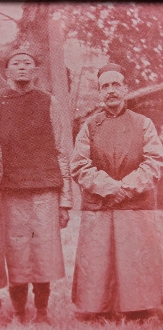
Samuel Pollard (1864-1915), the son of a Bible Christian Church preacher, was born in Camelford. After commencing a career in the British Civil Service, working in the Post Office Savings Bank in London’s Clapham, he was appointed a missionary to China in 1886. His change of career was prompted by his having attended a conference (The Southsea Methodist conference). In 1887, he set off for southwest China, where he became a Christian missionary amongst the Miao people. In 1891, he was posted to a newly opened Bible Christian mission station in Zhaotong. It was there that he began establishing a Christian movement amongst the Big Flowery Miao (aka ‘A-Hmao’) people, who live in the cold, rugged, mountainous areas of southwest China. In Zhaotong, Samuel married Emma Hainge, and they had four sons.

During the last 10 years of his life, Samuel converted 80% of the 400,000 Big Flowery Miao to Christianity. According to a Methodist website (www.myunitedmethodists.org.uk/content/people/ministers/sam-pollard):

“Sam Pollard worked from a missionary base in Zhaotong but travelled extensively around the province of Yunnan sometimes alone but usually with other missionaries or with Christian converts. From 1897 to 1904 Sam’s missionary efforts was focused on anyone who would listen. He and his colleagues held services which were often in the open air in a town centre or village market place. To gain attention he started off either banging a gong or attempting to play a concertina. Then, in order to have more effect, he blew a trumpet but he always maintained that he had little or no musical ability.  As his reputation spread there was less need for this noisy introduction and simply standing up in a crowded place or advertising a meeting by word of mouth was enough. Sometimes many hundreds of people would attend and occasionally up to 3000!”

Apart from many adventures whilst living in, and travelling around, China, Pollard, who learned Mandarin at China Inland Mission training school at Ganking, is best known for a linguistic achievement. Along with several colleagues, he developed a script for the language spoken by the Big Flowery Miao. It has become known as ‘Pollard Script’. The Methodist website explained:

“‘Pollard Script’ was developed by Sam and several of his colleagues to help the A-Hmao to read in their own language. This proved a difficult task because many of the words use different tones rather than phonetics. He took inspiration from a script that had been developed by a Methodist Missionary working with North American Indians and also adapted Pitmans shorthand to indicate the level of the voice tones. Sam managed to translate much of the New Testament into this script before he died and there have been some improvements since, but it is still known as ‘Pollard Script’ and is also used by several other ethnic groups such as those that speak Tibeto-Burman languages.”

Samuel died of typhoid whilst trying to help a Chinese child suffering from that illness. Returning to the website already mentioned:

“The A-Hmao, Big Flowery Miaos still venerate Samuel Pollard as their spiritual leader. Their deep respect has survived Communism and the extremes of the Cultural Revolution right through to today. And it all started with Sam’s birth in the Bible Christian Manse in Victoria Road 150 years ago in Camelford in Cornwall!”

A recent President of China (‘reigned’ from 2003 to 2013), Hu Jintao, restored Pollard’s grave (at Weining Yi in Miao Autonomous County). He is said to have asked his officials to be like Pollard and support the poor.

Had it not been for the excellence of the butcher in Camelford, we would not have returned to the town. Because the town centre is quite picturesque, we spent some time looking around, and, as luck would have it, we stumbled across an exhibition about a remarkable man, of whom I had never heard.

Sleeping tightly in Cornwall and India

DURING A WANDER through the rooms of Trerice House in Cornwall, which was constructed in the 15th and 16th centuries, we came across a 16th century four-poster bed in one of the bedrooms. Unlike most four-poster beds, which can be seen in many National Trust properties, this one was missing its mattress. What could be seen is a rope threaded through holes drilled around the rectangular base of the bed. A long single rope was threaded through the holes so that a lattice of ropes formed a set of adjoining squares – a grid. The mattress would have been supported on the rope lattice. From time to time, the lattice would have become loose, -and the mattress would have sagged. The solution was to untie a knot at one end of the rope, and tighten the latticework before re-tying the rope.

My wife pointed out that this latticework arrangement resembled what is commonly seen in India: charpoys. A charpoy looks like a bed frame with four legs, but without a mattress. Ropes or strips of plastic are tied to the frame to produce a latticework very much like what we saw at Trerice. In India, charpoys are used to rest upon. Mattresses are not usually used.

A lady volunteer in the room at Trerice told us that the phrase “sleep tight” originated from the process of tightening the rope that supported mattresses on beds made long ago. This is the most common explanation of the expression. However, there is another (www.straightdope.com/21342710/what-s-the-origin-of-the-expression-sleep-tight), which is based on a definition in the Oxford English Dictionary:

“… what they say: ‘It seems that tight in this expression is the equivalent of the only surviving use of the adverb tightly meaning ‘soundly, properly, well, effectively.!’”

So, it is up to you to decide which of these two explanations sound most likely to you. Or, perhaps, you know of another.

Shifting to the west country

HERE WE ARE in England’s West Country once again. Apart from coming to enjoy the scenic delights of Somerset, Devon, and Cornwall, we have another reason for visiting the area. That reason is socialising. During the last few years, many of our good friends who used to live in London, or not far from it, have moved westwards.

Some old friends, who lived near Windsor for several decades have sold up and now live in Dorset, which is on the way from London to the West Country. Long before the 1980s, my good friend (and fourth cousin) Peter Bunyard shifted to a very remote spot in the heart of Cornwall. More recently, another cousin shifted to the Clifton district of Bristol. Also, living not far from Bristol are two friends, who used to live in Ealing. Another couple, who had homes near Reading and in Kensington have moved to Topsham on the River Exe. Not far from them, living in Sidmouth, are some other close friends who lived in Hertfordshire. A dentist with whom I used to work in a practice in Rainham, Kent, and her husband have just moved from their home near Maidstone (Kent) to the city of Bath.  And only a couple of days ago, I received a text message from another of my former colleagues, who is moving from Acton (in west London) to the North Devon coast.

In addition to those who have drifted west, we have other friends who have lived in the West Country seemingly forever. One couple lives in Cornwall close to the River Tamar. The other couple live in a house overlooking the River Dart in Dartmouth. An yet another couple live in Torquay.

All these people are good friends with whom we have a great deal in common, and enjoy seeing. However, now they have drifted west, and not all of them visit London much, if at all. So, we like to make an annual – and always enjoyable – trip to the west to see some, if not all, of them. They seem to enjoy seeing us, so I do not think they moved away from London to avoid meeting us! If more of our friends shift westwards, we might even begin to think of following them.

A numerical oddity in Cornwall

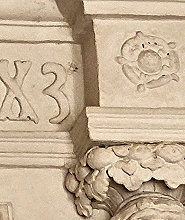
TRERICE HOUSE IN Cornwall was built mainly between 1570 and 1573. It is one of the loveliest National Trust (‘NT’) properties in the county and one of my top ten. In one of the upper rooms there is an ornate bas-relief above the fireplace. The top of this bears the following:

“ANNO: DOMINI: M : CCCCC : LXX3”

It is clearly a date in mostly Roman numerals, (i.e., 1573). However, this date has several odd features.

‘CCCCC’ is 500, but usually abbreviated to ‘D’ in Roman numerals. There is a surplus of colons (‘:’) and instead of ending in a Roman numeral, there is the Arabic numeral ‘3’.  Or is it the symbol for a serpent, rather than a ‘3’? It is a curiously shaped 3: it is widest at the top and tapers towards its lower end.

The NT volunteer offering information in the room with this curious date suggested three possible explanations for this peculiar form of the date above the fireplace. One is that the creator of this date miscalculated the amount of space, and instead of ending the date in ‘: III’, used the Arabic ‘3’ to fit in the last part of the date. Had he used ‘D’ instead of the unusual ‘CCCCC’, there would have been plenty of space to fit in the entire date using only Roman numerals. Another explanation offered is that the ‘3’ is really a stylised serpent, a symbol of wisdom often associated with Queen Elizabeth I, during whose reign the house was built.

3 or a serpent?

The last explanation was provided by a builder, who had visited Trerice some weeks before us. He suggested that the ‘3’ was added to indicate that the building works were supposed to have been completed in 1570, but had finished 3 years later than expected; the builders were running behind schedule.

Whatever the explanation of the curiously written date, and you might have another theory, Trerice is well worth a visit.

Missing on a flight over the Atlantic

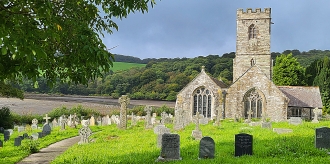
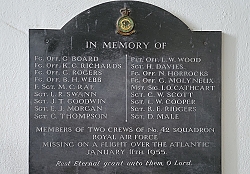
ST COULOMB MAJOR is a small town in north central Cornwall. It has a beautiful gothic parish church, St Columba, which dates to the 13th to 15th centuries. Inside, on the north wall of the church, there is a memorial plaque that caught my eye and roused my curiosity. It lists 18 people, members of the Royal Air Force (‘RAF’) along with their ranks. The plaque was place in memory of:

“Members of two crews of No. 42 Squadron Royal Air Force missing on a flight over the Atlantic. January 11th 1955.”

I was both horrified and intrigued by this.

Both ‘planes that were lost were Shackletons. At 10.14 am, Shackleton WG531 took off from RAF St Eval to commence a routine 15-hour patrol over a part of the Atlantic. At 10.20, Shackleton WL743 took off from the same airfield to join WG 531 on patrol in the same area. At 20.00, the two planes were 85 miles apart. At 20.58, a ground-based radio operator tried to make contact with WL 743, but was unable to do so. This was not cause for alarm because contact was often difficult when planes were at normal operating altitude.

After both aircraft failed to return at the expected time, a search and rescue operation was launched. An extensive search failed to discover either of the aircraft or any bodies of the crew members. In July 1966, one of the engines of WL 743 was caught up in a trawler’s net. Despite a thorough board of inquiry, no plausible explanation of the planes’ disappearances was provided.

St Coulomb Major is 4 miles southeast of RAF St Eval (as the crow flies). There is a church, St Mawgan, between these two places, but that in St Columb Major is larger. Maybe, that is why the memorial to the airmen is where it is. Apart from the RAF plaque, the church contains many other items of interest including its font (c. 1300), which has several faces carved on it.

Red and Blue in Truro Cathedral

THERE IS A COPY of an icon, originally painted in Constantinople, in Truro Cathedral. This well-executed replica stands near the west end of the chancel. It depicts the Holy Child, Jesus, being held by the Virgin Mary. It exemplifies what we were told several years ago whilst being shown around a collection of icons in the Sicilian town of Piana degli Albanese, whose population is descended from Albanians who fled from the Ottomans in the late 15th century. These folk speak not only Italian but also a dialect of Albanian, known as Arberesh.

The icon in Truro shows the Virgin Mary dressed in dark blue and Jesus dressed in red. Our guide in Piana had shown us that in all the icons, the same thing can be seen. Conventionally, in Byzantine icons, Jesus is almost always dressed in red and the Virgin Mary in blue. The copy of the icon on display in Truro Cathedral is no exception to this tradition.

A poorly placed direction signpost

I FIRST BECAME AWARE of fingerposts when I was in Ootacamund (‘Ooty’) in South India in 1994. One of the places in the spread out town is called Fingerpost because there is a fingerpost in the centre of the so named district.


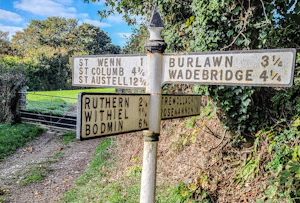
Where we are staying in Cornwall this October (2022) there is a finger post at a T-junction where one road meets another slightly larger one. The fingerpost at this junction ought to have three arms, one pointing along the road that ends here, and two for the larger road. However, the sign has four arms. One of them, pointing to Trewollack and Rosenannon appears to point where there is no road but the entrance to a farmer’s field without even a footpath crossing it.


This sign puzzled us for several days. Then, we spotted a small side road located about 100 yards downhill from the sign and the T-junction. This road leads to Trewollack and Rosenannon, but has no sign indicating this near where the lane begins. The four armed fingerpost is supposed to direct travellers along this road but is nowhere near enough to it to be helpful.

A station, a friend, a cousin

BEFORE I LEARNED TO drive, I began visiting a friend who lives in the heart of the Cornish countryside, a few miles away from Bodmin. I used to travel by train from London’s Paddington to Bodmin Parkway station, which is a short distance away from the town of Bodmin. My friend, Peter, used to collect me from this small station and drive me to his family’s smallholding deep in the countryside. After passing my driving test in 1982, I began driving to Cornwall. Today, the 10th of October 2022, we dropped off our daughter at Bodmin Parkway station to catch a train to London. This was my first visit to the small station since the early 1980s. It brought back memories of my early visits to see Peter and his family.

Bodmin Parkway station

I met Peter through mutual friends. We clicked. In the years following our first meeting, we saw each other regularly, considering how the great the distance is between our homes. On one visit to Peter’s home, I spotted a photograph of his mother, and remarked that her appearance reminded me of my mother. We thought nothing of this at the time.

In the late 1990s, I began researching the history of my parents’ families. An enquiry to a relative, who lived in Zimbabwe led me to contacting another relative, who worked for New Zealand’s diplomatic service. He got in touch with me and was able to supply information that was missing on one of the family trees connected to my mother’s family. I looked at what he had sent me, and my eyes nearly popped out of my head. For, amongst the people listed in that branch of the family tree were Peter and his children. It turns out that Peter is both my fourth and fifth cousin. The reason for this double relationship is that my mother’s parents were second cousins once removed; they shared a common ancestor. So, it turns out that not only is Peter a good friend but also a cousin. It is interesting that although Peter and I were already good friends, knowing that we are related has enhanced our relationship. Standing on the platform at Bodmin Parkway, waiting for our daughter’s train to arrive, brought back memories of my first encounters with Cornwall, a good friend and his mother’s photograph, and my discovery that he is part of my family.

Cattle in Cornwall and Denmark

THE EARLY MORNING sun was shining over the hills surrounding our holiday cottage near Wadebridge in Cornwall, and we decided to take a stroll along the narrow country lanes nearby. The air was crystal clear, and we could see far-off grassy fields dotted with grazing sheep. Wind turbines with slowly turning blades punctuated the northern horizon. After crossing a small, fast-flowing stream, we ascended a steep hill. Every now and then, gaps in the walls bordering the roadway afforded us with splendid views. We reached the entrance to a field, I was reminded of a holiday I enjoyed in 1962 when I was ten years old.

Cows in Cornwall

Early in 1962, I underwent surgery to have my inflamed appendix removed. A few weeks after this, we set off for Denmark in our family Fiat 1100. It was just before Easter and the weather was cold. After traversing West Germany, we crossed into Denmark and headed for our destination, a farm near Toftlund in Jutland. The farm was owned by Lis, one of our former au-pair girls, and her husband. One thing I remember about Toftlund was something pointed out to me by Lis’s father. He showed me that each house had two different numbers: one was on a red background, and the other on blue. I cannot remember which was which, but one numbering system was that of the Danish authorities, and the other was that of the Germans, who had formerly occupied this part of Denmark.

The most memorable and enjoyable aspect of our weeklong stay on the farm was being able to mingle with the farm animals. The cattle and pigs were housed in sheds because it was too cold for them to graze outside. All day my sister and I enjoyed watching and stroking the animals. I think that the time we spent on the farm was so much fun because it was far more ‘child friendly’ than most of our other family holidays, which were centred around my parents’ fascination with artworks in Italian churches and museums.

Some of the cattle had horns. There is nothing unusual about that. However, my mother, who worried about most things and saw potential danger everywhere, was extremely concerned about these horns. What made her anxious was the possibility that one of the creatures might gore me and thereby cause my appendicectomy scar to burst open. Luckily, I survived to tell this story.

Returning to our walk in Cornwall, you will recall that we had reached an entrance to a field that sparked off my memories of Denmark more than 60 years ago. The gate to the field was the entrance to a small pen, The pen contained several cows waiting to be moved somewhere, or maybe to be milked. Seeing them staring at me staring at them reminded me of my wonderful holiday near Toftlund.