In the pie, or the core of the matter

RECENTLY WHEN WALKING in an an orchard in Hampshire, we found that the trees were literally groaning beneath the weight of apples growing upon them. Seeing all of these ripe fruits brought back memories of visiting family friends, who lived in Kent, during my early childhood.

Whenever we went to their home, we were given a lavish lunch. The dessert was always apple pie. The apples were covered with a topping of pastry. What fascinated me was that the centre of this topping was always raised above the rest of it. Beneath this centrally located curved mound, – and this is what used to fascinate me – there would be a ceramic cup buried amongst the cooked apples. Discovering a cup buried in an apple pie tickled my imagination, and always puzzled me. I believe that it is normal practice to insert something to support the pastry topping, but when I was less than 10 years old, I did not know this. Our friend who used to cook this apple pie for us is, sadly, no more,

Incidentally, in recent years, some of the best apple pie I have tasted is that served at The Only Place in Museum Road, Bangalore (south India). Its recipe was introduced to the restaurant by the American wife of Haroon, who founded the restaurant many years ago.

Some mouthwatering experiences on the stages of theatres in London

OVER THE YEARS, we have watched several plays, which are best seen after eating rather than when hungry. In all of these, the actors have prepared and even cooked food on the stage. Many years ago, we watched a play about the artist Van Gogh’s stay in London. The stage set for this drama, which we saw over 20 years ago, included a kitchen. During the show, a roast meal complete with meat and vegetables was prepared in front of the audience. It smelled great, but we were not invited to eat any of it.

More recently we saw a play called “The Arab-Israeli Cookbook” on the small stage of the tiny Gate Theatre, which is above a pub in Notting Hill Gate. The audience was seated only a few feet away from two ladies, one of whom was preparing Israeli dishes, and the other Palestinian food. The drama explored the ongoing conflict in that country beset by conflict and tragedy: Israel. What was being prepared on stage was delicious. I am pleased that we had eaten before watching the preparation of mouthwatering food, which we were not offered.

Today, the 21st of September 2024, we watched a play, “My English Persian Kitchen”, written by Hannah Khalil. Starring only one actor, Isabella Nefar, it is showing at the Soho Theatre in Dean Street until the 5th of October 2024. Throughout the 70 minutes of this one act play, Ms Nefar prepares an Iranian herb and noodle soup, Ash-e-Reshteh, on a kitchen unit placed in the middle of the stage. While she tells us the secrets of making this soup, she also relates the problems of being a married woman in Iran and how she fled from the country and her husband. She also describes her arrival in London and how she reacted to life there, and how others reacted to her. Every now and then, she has flashbacks to her difficult marital experiences back in Iran. As the play comes to an end, her soup becomes ready to eat. She invites the audience on the stage to taste what she had prepared while we were watching. All in all, it was a great piece of drama. My wife tried the soup, and said it tasted good. I did not try it because it contains beans and lentils, neither of which I particularly enjoy.

I went to Soho Theatre after having a lighter than usual lunch. As the actress prepared the dish, the cooking smells did increase my feelings of hunger. I should have eaten more before reaching the theatre.

Blades and flames and other hazards in the kitchen

WHILE PREPARING A SAUCE for pasta today, my mind shot back to my mother in the kitchen during my childhood. Many people regarded her as being a competent cook. She was an enthusiastic follower of the recipes in cookbooks by Elizabeth David.  She bought only the best cooking utensils, and sourced many ingredients in the Mediterranean food stores that used to exist in Soho – a few remain, but many have gone. As a child, I was allowed in the kitchen to watch when my mother was cooking. The more I saw, the greater my desire to try to cook. However, this wish was not to be fulfilled while my mother was alive.

My birth and the first few months of my life were difficult as far as health was concerned. Consequently, my mother was highly protective of me, and then later also of my sibling. My mother saw danger everywhere, and not least in the kitchen. There were sharp knives, razor like tin can lids, and the risk of getting burnt either by the oven or the hot things prepared on it. We had electric hob rings because my mother was anxious about gas explosions and open flames. I was allowed to watch her cooking, but not to touch anything she was using. Curiously, even though knives were involved, I was often asked to wash the dishes, cutlery, and cooking utensils.

Sadly, my mother died at a young age. I was 28 when she went, and still residing in the family home along with my father, who had no interest in cooking. He enjoyed good food, but would have no part in preparing it. With my mother no longer around and a well-equipped kitchen, I began to experiment with cooking, and enjoyed the activity.

Over the years, I have done much cooking, and still enjoy doing it. I am not sure what made me think of my mother today as I prepared the pasta sauce, but it might have been the pan in which I was making it. For, that pan was one that my mother used often. She must have bought it back in the 1960s, and because she purchased only the best, it is still perfectly usable much more than 50 years later.

My wife is a good cook, but I do most of the day-to-day cooking. When she told a friend of ours that I do most of the cooking, the friend asked my wife:

“Don’t you feel diminished as a woman if Adam does most of the cooking?”

My wife, who is quite happy with the arrangement, replied with another question:

“Do I look like an idiot?”

Sometime later when our daughter was a toddler, she and my wife visited some friends. After a few minutes, our little one, used to seeing me cooking, came running out of the kitchen with wide open eyes, and said to my wife:

“Do you know, Mama, but the Mummy is doing the cooking in this house.”

My wife answered:

“Well, I never…”

Red coloured meat dish from Rajasthan

LAL MAS IS a traditional meat dish that originated in Rajasthan. Its name means ‘red meat’ and its colour comes from the use of mild, fragrant, fresh red chillies. The best sort to use are those grown at Mathania in Rajasthan, but if these are not available, Kashmiri chillies can be used but they are less satisfactory. Originally, lal mas used to be prepared to feed hunters after a day of hunting. The meat being game.

We have been staying at the Sharad Baug Palace homestay in Bhuj (Kutch, Gujarat), which is owned and run by members of the Royal family of Kutch. Several members of the family are great cooks. The food they have been preparing for our evening meals has been superbly tasty.

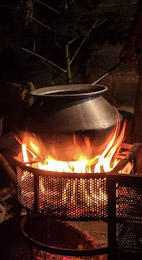
Last night, one of the family gave us a very special treat. While we watched, he prepared lal mas on a pot heated on a wood fired brazier in the garden. The smoke from the burning wood enhances the flavour of the dish.

Even if I knew the exact recipe for lal mas, it would be pointless giving it to you. This is because to achieve a good result, the person cooking it must be constantly tasting the sauce and adding ingredients as required, as well as checking the degree of tenderness of the meat. This is something that cannot be described in writing.

That said, this is, roughly speaking, how he prepared the lal mas. First, good quality cold-pressed mustard oil was heated to a high temperature. Then, he added whole spices including the Mathania chillies. Next, chopped onions, followed by pureed onions and pureed Mathania chillies. Following this, the goat meat was added. Later, chopped tomatoes followed by ginger and fresh green chillies – both minced. After a while at various stages, other ingredients including ground cumin, turmeric, coriander powder, fenugreek leaves (added at the end), hot red chilli powder, salt, and water were added to the stew. Throughout the cooking process, which took almost two hours, the stew has to be stirred often, and water added as required so as to maintain the sauce’s thick consistency and to prevent the spice mixture from burning.

I can say, without exaggeration, that the resulting dish was one of, if not, the very best Indian meat dishes I have ever eaten. It was fragrant, tasty, and not too piquant. It was without fault.

We are very grateful that our host took the time and care to produce this miracle of culinary art for us.

Feeding the faithful at a Hindu temple in Kutch (Gujarat)

THE DHRABUDI TRMPLE complex is near the sea about 5 miles east of the town of Mandvi (Kutch, Gujarat). It is located ated next a small Freshwater lake, where pilgrims can bathe. Our driver told us that baby boys are brought to be blessed at the temple when they reach their first birth anniversary. When we visited, we saw a group of people doing a puja in the open air. They were respecting the first death anniversary of one of their relatives.

While wandering around the temple compound, we saw a group of Rabari women seated in the shade, under a large banyan tree. The Rabari are nomadic cattle and camel herders, as well as shepherds. In India, they aremost frequently found in Gujarat, Punjab, and Rajasthan.

Worshippers come from far and wide to do pujas at the mandir. The temple offers free meals to pilgrims. These are served in a large dining hall. One wall of this is lined with numerous portraits of people who have died. We were told that diners pick up a thali and other eating utensils before lining up to be served food.

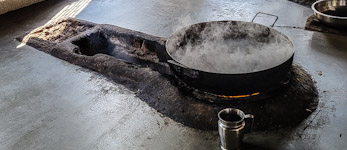
Pit containing glowing charcoal for cooking

The kitchen, which is next door to the dining hall is vast. It was spotlessly clean. I saw a few gas rings, but what really fascinated me was the other method by which food is heated up. I saw three or four pits sunk into the floor. Each one is shaped like a large spoon. Glowing charcoal is heaped in the bowl of the ‘spoon’, and can ve spread along the stem. Pots are placed above the charcoal. The arrangement reminded me of the Turkish ocakbaşı. I imagine that the cooking speed can be adjusted by varying the amounts of glowing charcoal beneath each of the enormous cooking pots.

We did not stay to join the pilgrims having lunch. Although the temple cooks kindly invited us, we had lunch awaiting us at my wife’s cousin’s home.

I always enjoy visiting place of worship. What made Dhrabudi special for me was being shown its wonderful kitchen.

Advertisements in a cookery book for Malaya

IT IS CURIOUS how some things, heard once long ago, stick in one’s memory. When I was a little boy, I remember my father telling me that there was a product called Klim. I thought he must be joking because Klim is ‘milk’ spelled backwards and my father did have a sense of humour. For example, when we used to visit Italy, he used to say “a penne for your sauce” (instead of ‘ a penny for your thoughts’).

A few years ago, some friends were clearing out some books and gave me a few of them. One of them was “Cookery Book of Malaya”. It was published in 1951 by the YWCA of Malaya and Singapore. Remember that Malaya only became known as ‘Malaysia’ in 1963.

It was only today (1st of September 2023) that I decided to have a look at this book. Edited by Mrs AE Llewellyn, the volume is packed with information about nutrition and recipes. The recipes include many western dishes as well as a selection of “Malay”, “Javanese”, “Chinese”, “Indo-Malayan”, and Indian, recipes. Most of the book is written in English but the section on “Methods of Cooking” is bilingual: English and Malay. I suppose this was so that the British housewives could instruct their Malay cooks.

The book has several pages of advertisements. Four of these are for milk – mainly the powdered variety. To my great delight, one of them is for Klim. The advert says:

“Take pure water, add Klim, stir, and you have safe, pure milk.”

Another part of the same advert says:

“Keep KLIM handy in your cupboard. Remember – it stays fresh – without refrigeration.”

Klim has been around a long time. According to Wikipedia:

“In 1920 Klim was a product of Merrell-Soule Company of Syracuse, New York which in 1907 had improved the spray-drying method patented by Robert Stauf in 1901 by starting with condensed milk instead of regular milk. In 1927 Borden acquired Merrell-Soule gaining the Klim brand and None Such Mincemeat, both already made popular worldwide.”

The Nestlé company acquired Klim from Borden in 1998. Although I have never noticed it in any of the many shops I have visited, it is still sold worldwide.

I am pleased that I finally got around to opening the old cookbook because it contained the advertisement that confirmed that by mentioning Klim my father was not simply pulling my leg.

A cook from Kutch in Norway

THE SHARAD BAUG HOMESTAY is in the extensive, luxuriant, verdant grounds of the Sharad Baug Palace. Badly damaged in the 2001 earthquake, the palace is a short walk from the excellent homestay. This accommodation is owned and run by members of the royal family of the former Kingdom of Kutch.

Close to the homestay in the middle of a field, there is another ruined edifice. This was formerly used as a guesthouse by important guests of the ruler, the Maharao. For some time, the poet Dara Shiko (1615-1659) hid from his brother (the future emperor Aurangzeb) in this building.

Near the ruined palace, there is a building, which was the last Maharao of Kutch’s sitting room and dining hall. Now, the building houses a small museum filled with exhibits relating to the royal Jadeja family. Amongst these, there are several items connected with the last ruler of independent Kutch when he spent some time in Norway.

After Kutch had joined India soon after 1947, its last Maharao, Madansinhji (1909-1991), was appointed India’s ambassador to Norway. There are photographs relating to his stay in Norway in the museum. There is also a Christmas card in Norwegian and a certificate issued by the Oslo Tennis Club. He served in Norway between 1957 and 1960.

While in Norway, Madansinhji was served by his chef from Bhuj, a member of the Yadav family. For many generations, the Yadavs have been chefs, specialising in non-veg food.

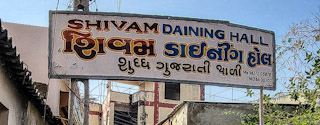
When we first visited Bhuj, in 2018, we were recommended to eat in a simple, small restaurant in the bazaar of Bhuj. Named Shivam Daining (sic), it serves very tasty pure vegetarian food. We returned to eat there several times during our recent (January 2023) stay in Bhuj. While chatting with its chef and his relatives, we learned that the man who produces the excellent food is a grandson of the Mr Yadav, who cooked for Madansinhji in Norway. Although the family have a tradition of cooking meat and fish, they do not offer it at Shivams because they rightly feel that there is little demand for non-veg food in the mainly vegetarian city of Bhuj.

Without knowing it when I booked the Sharad Baug homestay, it turned out that it and one of our favourite restaurants in Bhuj had at least one common connection, and that is Norway.

Cheese is nice … a true story

A POST ON FACEBOOK reminded me of something that happened about 27 years ago in a country east of France.

We were staying with a German lady, who used to become easily stressed. One day I was sitting in her living room whilst she was preparing a meal in the kitchen nearby. Something must have been going wrong because I heard her shouting “cheese is nice” in an angry voice. She repeated these words over and over again.

I like cheese, but could not understand why she was expressing a liking for cheese so angrily. And then the penny dropped. It dawned on me that she was not talking about cheese, but about Jesus Christ. In her perfect but Germanically pronounced English she was saying what sounded like “cheese is nice” but in reality she was cursing by saying “Cheesus Christ”

The posting on Facebook showed Joseph and Mary looking at Ababa doll in an opened Amazon delivery package. The caption to the picture was “Bloody hell, Alexa, I ordered baby cheeses”.

Cook books I use

BOOK blog


I ENJOY COOKING. Although I like to improvise on a recipe, I enjoy looking at cookbooks. In addition to learning about food and eating traditions, they are a good place to look when embarking on food preparation. Today, one needs only access the Internet to discover an ocean of recipes, often describing numerous slightly differing ways of making the same dish. These recipes are posted by everyone from totally inexperienced cooks to highly acclaimed professional chefs. Although these on-line recipes might possibly eventually replace printed cookbooks, I will continue to value the printed volumes, cookbooks filled with recipes written by experienced and knowledgeable cooks. Here are ten such books that appeal to me.

AN INVITATION TO INDIAN COOKING by the actress Madhur Jaffrey (first publ. 1973), which I bought in 1982, guided me through my first forays into cooking dishes that originated in the Indian subcontinent. My copy falls open at the recipe for ‘lamb do pyaza’ The recipes are easy to follow and the results have an authentic flavour that impresses people for whom this kind of food is not exotic. Now, I have less need for this book because I am married to a good cook, who was born and brought up in India. She guides me through my curry creations and prepares the vegetarian dishes characteristic of her western Indian (Kutchi and Gujarati) heritage. However, if you are not as fortunate as me in this respect, I can heartily recommend this book.

MIDDLE EASTERN EASTERN COOKERY by the Armenian Arto der Haroutunian (first publ. 1982) was recommended to me by my friend, the author, art historian and first-class cook, the late Michael Jacobs. From this book, I learned a good way to cook fluffy steamed rice. A bookmark on page 252 takes me to an Iranian recipe, ‘Morgh Shekumpour’, chicken stuffed with dried fruit, which I used to prepare for guests in my bachelor days. Nowadays, my wife reaches for Arto when she cooks ‘Imam Bayildi’ and ‘Moussaka’. For some years, this book was hard to obtain, but there is now a new imprint that was produced in 2008 and is available on Amazon.

KEN HOM’S CHINESE COOKERY (first publ. 1984) was presented to me as a birthday present by Don and Eunice McMillan when I was a dentist in the Medway Towns in Kent. They knew I enjoyed cooking. Their gift could not have been better chosen because this cookbook is one of the best I have ever used. In my copy, there is a bookmark on the page that has a recipe for stir-fried minced pork, and the page with the recipe for beef in oyster sauce is stained with liquids splashed whilst preparing this dish. If you follow Ken Hom’s clear instructions closely, you cannot fail to produce Chinese dishes that almost (but not quite) rival those obtainable in many Chinese restaurants. So, if you are stuck at home as we have been during the pandemic lockdown, this book will help satisfy your cravings for Chinese food in its rich variety.

REAL GOOD FOOD by Nigel Slater (first publ. 1993) was recommended by our close friends Brian and Catherine Wilson, two enthusiastic cooks, both now no longer living. Beautifully illustrated with photographs of etchings and engravings of food ingredients, Slater provides easy to follow recipes with interesting commentaries. We reach for this book whenever we want to cook ‘Coq au Vin’. Covering many tastes, Slater includes two practical recipes for making curries.

THE FOOD OF ITALY by Claudia Roden (first publ. 1989) was presented to us by my sister when she was the chef at a successful Italian restaurant, which she and her husband owned in a village in the Emilia-Romagna province of Italy. Ms Roden is the author of many cookbooks, all of which are well-written and filled with practical easy to follow recipes. Her Italian cookbook is no exception. Our copy falls open at one page with pasta recipes from Campania, such as ‘Spaghetti alla ‘putanesca’’ and, also, at another page with a recipe for ‘finocchi gratinate’ from Emilia-Romagna.

Our copy of FRENCH PROVINCIAL COOKING by Elizabeth David (first publ. 1960) has yellowing pages and is well-thumbed. No serious cookery bookshelf should be without this evergreen classic of food writing. This is the key to the doorway of French cooking. In addition to the moderately easy to follow recipes, Ms David provides a wealth of interesting background information about the cuisine of France. Our copy has a bookmark for the recipe of ‘noisettes de ‘porc aux pruneaux’ and another for ‘champignons à la Greque’. If you wish to prepare one of my favourite French delights, onion soup, you need to look up ‘tourin bordelais’ in the index, and please observe that this ‘guru’ of French cookery states that the soup “…requires no stock.”: restauranteurs, please take note!

THE CUISINE OF HUNGARY by George Lang (first published 1971) was also recommended to me by Michael Jacobs (see above). It is a treasure amongst our huge collection of cookbooks from all over the world. I love Hungarian food and my copy of this book is now falling to pieces. The book contains not only ‘user-friendly’ recipes but also an interesting scholarly history of Hungarian food and cooking. The chapter on “Traditional Stews” is well-used in my copy. Some of its pages are becoming detached from the book. If you study this chapter you will be able to prepare superb stews and, more importantly, to distinguish a gulyás from a pörkölt, a paprikás, and a tokány. You will never again make the mistake of adding soured cream to your pörkölt or flour to your gulyás. Each recipe is well explained and easy to execute and is often followed by suitable variations.

We have only visited the much-vaunted River Café once and were disappointed enough not to want to give it a second try. However, the RIVER CAFÉ COOK BOOK by Rose Gray and Ruth Rogers (first publ. 1995) is superb. It contains delicious recipes with clear instructions and mouth-watering photographs. The recipes for ‘spaghetti al Limone’ and ‘radicchio alla griglia’ are two of many good reasons to possess a copy of this book.

THE ART OF ASIAN COOKING (RECIPES FROM THE MUSEUM OF FINE ARTS, BOSTON) compiled by Janet Sears (first publ. 1990) contains practical recipes supplied by a long list of contributors. Our favourites from this book include ‘Bang-Bang Chicken’ and ‘Roast Leg of Lamb’. The latter is a good recipe for a dish known in India as ‘raan’ of lamb.

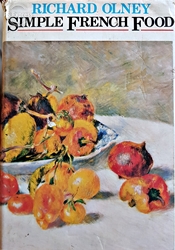
All the cookbooks described so far enable most people to cook exciting dishes without too much trouble or difficulty. My tenth book is not for the faint-hearted or even a reasonably experienced cook. Some of the recipes in the misleadingly named SIMPLE FRENCH FOOD, an erudite book by Richard Olney (first publ. 1974) are occasionally challenging. His recipe for hard-boiling eggs is half a page in length, for onion soup it is two pages, and ‘poule au pot’ four pages of fine print. But, this is nothing compared to Olney’s recipe for ‘bouillabaisse’ in his “A Provencal Table” (first publ. in 1995) that covers just over nine pages of print and has over thirty-three ingredients. But before you set out for the fishmonger, remember:

“Part of the bouillabaisse mystique resides in the persistent claim that no bouillabaisse is possible away from the Mediterranean coast …”

These ten books are but a mere drop in what is a vast sea of published cookbooks. They are vastly outnumbered by other cookbooks on our shelves: those that we have acquired over the years, but hardly ever look at. The ten books I have chosen are not necessarily to everybody’s taste, but they have satisfied us over the years.  I would love to learn of other books that readers have found to be useful in their kitchens.

Before ending this piece, I must mention the excellent recipe books by Josceline Dimbleby, published and sold by the Sainsbury food retailing company in the 1980s. Sadly, I have lost the few volumes of this series that I once owned. Lastly, here are a few other books of recipes that we consult when cooking:

“Traditional Cooking” by Caroline Conran

“Il Talismano dela felicita” by Ada Boni

“The Silver Palate Cookbook” by Rosso & Luckins

“Italian Cookery” by Elizabeth David

“The Classic Italian Cookbook” by Marcella Hazan

“A Book of Middle Eastern Food” by Claudia Roden

“Joy of Cooking” by Irma Rombauer