
From Lahore to London but he did not live long

THE WHITECHAPEL GALLERY in London’s Aldgate area often hosts exhibitions of adventurous art, and has been doing so for many decades. The current show “Hamad Butt: Apprehensions”, which is on until 7 September 2025, displays works by an artist Hamad Butt. He was born in Lahore (Pakistan) in 1962, and died of AIDS in London, aged only 32. His family brought him to London when he was 2 years old. He studied art at London’s Goldsmith College, Morley College, and Central Saint Martins.

Familiars 3

The ground floor of the Whitechapel Gallery contains three enormous sculptures. Together they form an art installation, which the gallery’s website described as follows:

“Familiars 1: Substance Sublimation Unit is a steel ladder made of glass rungs, each filled with an electrical element and crystals of solid iodine. The current ascends the ladder, intermittently heating the rungs, causing the iodine to sublimate into a purple vapour. In Familiars 3: Cradle, named after Newton’s cradle, 18 vacuum-sealed glass spheres are filled with lethal yellow-green chlorine gas. If smashed together, the gas – a respiratory irritant – would be released into the air. In Familiars 2: Hypostasis, three tall, curved metal poles, reminiscent of Islamic arches, contain bromine-filled tubes at the tips.”

Well, they were visually intriguing pieces of conceptual art. What they stand for is almost more important than their physical appearance.

Upstairs, the galleries are hung with paintings, drawings, and prints. There is also another installation that contains a set of lights emitting ultraviolet rays. Visitors are provided with protective goggles when viewing this exhibit called “Transmission”, which is yet another example of conceptual art that you need to read about to make any sense of it.

What saved the exhibition for me was the display of Butt’s paintings and prints. Ranging from almost figurative to abstract, they appealed to me immediately.  It is a shame the artist lived for such a short time. That which he produced in a few years, I am sure, would have led to him becoming a noteworthy artist with a fascinating output.

Subversion at the Serpentine art gallery: ways with words

THE ORIGINAL SERPENTINE Gallery in London’s Kensington Gardens is housed in a former tea pavilion that was built in 1934. It began to be used as a contemporary art exhibition space in 1970. Since then, it has been showing modern and contemporary artworks in a series of temporary exhibitions. I have been visiting this gallery and its newer branch, Serpentine North, regularly since the 1990s (the North branch opened in 2013). Almost without exception, the art displayed in the Serpentine galleries has been both exciting and adventurous – sometimes quite challenging. The latest exhibition, which is on until the 17th of March 2024 in the original gallery, is of artworks by the American (USA) artist Barbara Kruger, who was born in Newark (NJ) in 1945.

Kruger’s art is not purely visual. It is designed to convey ideas that challenge the viewer to question commonly held contemporary beliefs in an eye-catching, often witty way. The exhibition, “Thinking of You. I mean Me. I mean You” consists of 12 art installations that reference or parody everyday things such as advertising, magazine illustration, video art, social media, the Internet, and other media that bombard us on a daily basis. Each of them present messages that subvert political ideas, the moral code, and the meanings of words. Kruger makes much use of video techniques. Several of the exhibits have words projected sequentially to make up sentences. Often, the words change on the screen to alter the perceived meaning of the text being projected. However, her art is not simply all about words and their meanings in different textual environments. The words are harmoniously accompanied by intriguing visual images, often continuously changing.

Although the exhibition is about words and their usage and varying meanings, words alone cannot describe this exhibition adequately. Therefore, if you can, it is worth taking a look at this interesting – nay, challenging – show. Having viewed the show, I was heartened to discover this artist from America who is perceptive enough to see where her country is heading and brave enough to criticise the political direction in which it appears to be moving. After seeing her exhibition, I would hazard a guess that she will not be voting for Mr Trump.

Tired

The Kochi Muziris Art Bienniale is back again. We have attended two of the three previous biennales, those in 2014 and 2016.

The biennales run from mid December to the end of the following March. A joy of this biannual exhibition is that artworks are displayed in many heritage buildings that are not normally accessible to the public. Visitors get a chance to view many fascinating buildings that form part of the history of the port of Cochin.

Today, we visited the main base of the Biennale, which is housed in the buildings of the former Aspinwall company compound.

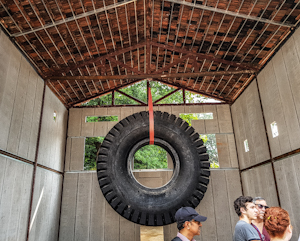
Works by many artists are on display in the various spaces within the extensive compound. This year most of the works on display are either video installations and/or conceptual art. There are a few works that are otherwise. I was disappointed by this year’s showing as compared with what I saw in previous years’ biennales. The selection of artworks seems unexciting, tired.

However, one work in this year’s show at Aspinwall stands out way ahead of the rest. It is “More Sweetly Play the Dance” made in 2015 by the South African artist William Kentridge.

Moving images are projected onto eight large screens. These images are both drawn (as in cartoons) and photographic. A procession of figures, both drawn and photographed, move from one screen to the next, travelling through a drawn landscape that changes continuously in subtle ways. The motion projected on the screen is accompanied by a brilliant musical soundtrack that is inspired by African music. The result is a spectacular audio visual experience that is both joyous and slightly sinister. I felt that the ‘white’ Kentridge was portraying the experiences of South African Black people, both their joys and their tragedies. His work, on display in a large warehouse with a tiled ceiling at Aspinwall, is truly artistic at all levels of appeal, from the sensual and emotional to the intellectual. It is a positive contrast to much of the other art on display at Aspinwall, which requires explanation before it might possibly be enjoyed.

I look forward to visiting many of the other places connected with the Bienniale. I hope that I will be seeing art that grabs me emotionally as well as intellectually.

PS Since writing this, I have visited many other parts of the Biennale. Some of these, especially the places housing the works of current art students (The Students Biennale) and the artworks in the TKM Warehouse, are outstandingly good. If you are in Cochin for a limited time, skip Aspinwall and head for Mattancherry where the most exciting works are on display.