LIBERTÉ ÉGALITÉ (MAYBE) FRATERNITÉ IN A FORMER FRENCH COLONY

PONDICHERRY IN SOUTHERN India was a French colony between about 1674 and 1954. This picturesque city is still divided into White Town, where the French lived, and Black Town, where the Tamils and other Indians resided.  The segregation of Europeans and non-Europeans persisted after the French Revolution  of 1789. It was during (or soon after) this historic uprising that  the motto ‘Liberté, Egalité, Fraternité’ came into existence. However, it was during a visit to the lovely church of Notre Dame des Anges in White Town that we discovered that the motto might not have applied to the Non-European inhabitants of the Pondicherry colony.


Within the neoclassical church, there is an informative panel outlining the church’s history.  The present edifice was constructed in 1855, but the parish is older. It was established by Capuchin monks in the seventeenth century. In 1699, the Capuchins established a Tamil Christian community. Soon, the Jesuits took over the Tamil community, and the Capuchins began a parish for Europeans and “Eurasians” (people with both Indian and European heritage). The Capuchin church of Notre Dame des Anges served Europeans and Eurasians, but not Tamils, who attended another church.


In 1887, almost 100 years after the French Revolution,  Archbishop Lauennen decreed that Notre Dame des Anges was for the exclusive use of Europeans and Eurasians. So much for the ‘égalité’ and ‘fraternité’, which was so dear the the French.


In 1984 Fr. Dusseigne, of the Société des Missions Étrangères de Paris (M.E.P) was the last M.E.P. Parish Priest, to serve the parish. He served until 2007, and was the last of a long line of Capuchin priests to lead the parish.


Dusseigne was succeeded by Fr. Michael John Antonsamy, who was the first Indian priest to lead the parish. Although he was the first Indian parish priest, I  have not yet discovered when non-Europeans began to be allowed to worship in this church in White Town.


Near the church, there is small walled cemetery where Capuchin monks have been buried. The earliest person to have his tomb there died in 1703. Sadly, the graveyard was closed, but we managed to see the well maintained funerary monuments through gaps in the locked gate.

  Colour bars were common in European colonies in Asia and elsewhere. Some of the clubs and schools founded by the British in India forbade entry of Indians even until several years after independence. So, one should not be surprised that colour bars existed in churches such as St Marie des Anges.  But what amazed me somewhat is that even after the French Revolution,  racial inequalities were not frowned upon in a French colony such as Pondicherry.

Souvenirs of imperialism at the British Museum

THE BRITISH MUSEUM contains many objects that were obtained when much of the world was part of the British Empire. Over the past couple of years, the artist Hew Locke (born 1959) has been selecting items in the museum’s collections and putting them together in a special exhibition called “What have we here?”. The exhibition will continue until the 9th of February 2025.

The items he has chosen are exhibited alongside sculptures and other artworks he has created in recent years. Each of the museum objects that Locke has chosen is accompanied by a short text that places the exhibit in the context of British imperialist exploits and exploitation. This has been done sensitively and gives the viewer an idea of what the objects meant to their original owners and why British collectors deemed them worthy of bringing home to England as ‘souvenirs’ of their activities in far off lands.

Interspersed amongst the exhibits chosen from the British Museum’s collection there are artworks by Hew Locke. Each of these beautiful things has been created to illustrate aspects of colonialism. For example, the model boats he has made symbolise exploration, trade, and the transport of goods and people (often against their will). There are also several historic companies share certificates on which Locke has added paintings. The shares were issued by companies that used slave labour. Perched above the display cabinets are a series of well-crafted but grotesque models of people, often dressed in clothes made from fragments of company documents. They represent the people who were downtrodden by their imperialist rulers.

In this exhibition, Locke neither seeks revenge nor condemns the activities of the colonialists. Instead, he tries to improve our understanding of what happened, hoping that history will not repeat itself. As with many other of Locke’s creations, this exhibition at the British Museum is both imaginative and eye-catching. It is well worth a visit.

The azulejo tiling of Portugal is moving onwards

ONE OF THE CHARMING aspects of Portuguese culture is the use of the mainly blue and white decorative tiling known as ‘azulejo’. It can be found in Portugal and wherever else the Portuguese had colonies. One of the former colonies was Brazil. It was there that the artist Adriana Varejão was born in 1964 (in Rio de Janeiro). Today (the 11th of October 2024), at the Frieze Masters art show in London’s Regents Park, we saw a fine exhibition of her works in the booth set up by the Victoria Miro Gallery.

It was fascinating to see how Adriana subverts the azulejo, which was introduced to what is now Brazil by its Portuguese conquerors. Clearly inspired by the traditional tiling, her works both refer to it and distort the technique to create attractive, imaginative artworks that allude to the distortive effects of colonialism on indigenous culture.

I love seeing traditional azulejo. Seeing Adriana’s work was particularly enjoyable given that, to use a well-worn expression, ‘I know where she is coming from’. And I like the way that she has been moving the age-old art of azulejo into pastures new.

Modernism in Ghana and India in a museum in London’s South Kensington

UNTIL THE 22nd OF SEPTEMBER 2024, the Victoria and Albert Museum in London’s South Kensington is hosting an exhibition called “Tropical Modernism: Architecture and Independence”. It focuses on two countries: Ghana and India. It was the exhibits relating to India that interested me most, although those connected with Ghana were also intriguing.

The Royal Institute of British Architects describes Modernism as follows:

“Rejecting ornament and embracing minimalism, Modernism became the single most important new style or philosophy of architecture and design of the 20th century. It was associated with an analytical approach to the function of buildings, a strictly rational use of (often new) materials, structural innovation and the elimination of ornament.” (www.architecture.com/explore-architecture/modernism).

Modernism began both in the USA and Europe in the 1920s and 1930s. Its better-known pioneering exponents include Le Corbusier, Mies van der Rohe, Walter Gropius, Maxwell Fry, Louis Kahn, and Eero Saarinen. The Modernist architects, like the abstract painters of the early 20th century, broke with traditional approaches to form and style.

On the 15th of August 1947, India became independent. The country was no longer ruled by foreigners. Jawaharlal Nehru (1889-1964) became India’s first Prime Minister, a position he retained until his death. His vision for India was for it to shake off the shackles of the past (both colonial and traditional) to become a modern state. This extended to architecture in his new India. He invited Modernist architects including Le Corbusier and his cousin Perre Jeanneret to design a new city in the Punjab (following the loss of Lahore to Pakistan): Chandigarh. This is illustrated well in the V&A exhibition. Le Corbusier wanted to create his ideal of a city, which included forbidding street markets and cows to wandering in its streets. His pupil and collaborator, Balkrishna Vithaldas Doshi, who died in 2023, had a more human approach to architecture. Having seen some of his buildings, notably in Ahmedabad and Bangalore, I would say that Doshi developed an architectural opus, which might be loosely described as ‘user-friendly Corbusier’.  Incidentally, Doshi was also taught by Louis Kahn, who worked in India, notably in Ahmedabad.

A label in the exhibition noted that in 1959, at a conference about national identity in Indian architecture, Nehru urged Indian architects not to be “imprisoned by tradition”, but to experiment as had been done at Chandigarh (built between 1951 and 1956). Examples of this experimentation can be seen in the exhibition.

Naturally, since Nehru’s death, there have been many changes in India. I notice new changes every time we make our annual trips to the country. Nehru’s vision of a secular India has been replaced by a different vision in the minds of the leaders of the present Indian Government. Modernism’s internationalist aspects, which attracted Nehru and some of his successors, appear to have lost their appeal currently in India.

Immediately after gaining independence, both Ghana and India favoured Modernism in architecture. The exhibition at the V&A shows that even before independence, architects (almost all European) in Ghana had been building in the Modernist style, but specially adapted to cope with intense heat and high humidity. Ghana’s first leader, Kwame Nkrumah, encouraged the continuation of this architectural style. The exhibition includes a fascinating video about this. In India, Modernism seems to have been introduced post-independence. Both leaders wanted to project visions of a emerging modern countries, freed from the constraints of colonialism. Yet both promoted an architectural style developed largely by architects who came from countries that had had colonies in Asia and Africa.

Before ending this piece, I must not forget to mention two exhibits, which caricatured the great British colonial architect, Edwin Lutyens, who was certainly not a Modernist. One of them is a model of Lutyens’s head which has been combined with a model of one of his imperial buildings in New Delhi. The other, which is painted in the style of a Mughal miniature, shows Lutyens offering a model of the (British) Viceroy’s House (in New Delhi) to the Viceroy.

The exhibition was fascinating. Despite its rather obscure title, a good number of viewers were there during the Monday mid-afternoon when we visited it.

A COMMANDER OF THE BRITISH EMPIRE AND THE ARTISTIC INTERPRETATION OF COLONISATION

THE ARTIST YINKA SHONIBARE was awarded the prestigious CBE in 2019. In case you do not know what these three letters stand for, it is ‘Commander of the British Empire’ – not that Britain has much of, if any, empire left to boast of. For much of its long existence, places in the British Empire witnessed many injustices and inhumanities. This was especially true before the abolition of the slave trade in the early 19th century. Yinka Shonibare, who was born in London in 1962 and brought up between that city and Lagos in Nigeria, uses his artistic skills to explore Britain’s lengthy history of imperialism imaginatively and creatively. Even without knowing that he does this, his art works are in themselves visually exciting and fascinating to the viewer. The pieces on display until the 1st of September 2024 at the Serpentine South gallery in Kensington Gardens are well worth seeing both for their inherent beauty and for the way that Shonibare expresses his interpretation of Britain’s colonial past and its legacy.

For more information about the exhibition, please visit: www.serpentinegalleries.org/whats-on/yinka-shonibare-cbe-suspended-states/

Entangled messaging at an exhibition at London’s Royal Academy

I LEAVE SOME EXHIBITIONS feeling both inspired and exhilarated. Some other displays of art neither thrill nor depress me. However, the current show at the Royal Academy of Art (‘RA’) in London’s Piccadilly – “Entangled Pasts 1768 – now” – left me feeling both disappointed and a little irritated. Before proceeding further, I should explain that 1768 was the year in which the RA was founded. The exhibition is, to quote its associated handout, to explore:

“… connections between art associated with the Royal Academy and Britain’s colonial histories.”

It does this by mixing artworks by academicians with those by other artists in a series of mostly poorly lit, gloomy galleries. Each of the rooms is supposed to contain works that are connected with a particular theme, although I found that the linkage between the artworks and the theme within each gallery was weak to say the least.

The sad thing is that many of the exhibits on display are interesting works of art, but seeing them altogether reminded me of visiting a poorly organised jumble sale. Although the works in each room were supposed to be thematically linked, that was hard to realise by looking at them as a group. The overarching concept of the exhibition was to, yet again, remind us of Britain’s unsavoury history of relations with ‘people of colour’. Consequently, many exhibits were ones that had been exhibited before in shows with similar messaging. One gallery managed to combine the unpleasant history of Britain’s involvement with the slave trade with another topical subject – climate change. This is probably because there are many who link colonialisation with industrialisation and its effects on climate.

Although I am presenting you with a negative view of the exhibition, I should in all fairness point out a couple of things I loved. One was an installation consisting of models of ships suspended from the ceiling by fine threads. This visually exciting work was created by Hew Locke, and was in one of the few rooms that was brightly lit. The other exhibit, which occupied two galleries was a collection of painted wooden cut-outs depicting people at a carnival. This work, which was accompanied by a soundtrack with voice and music, was created by Lubaina Hamid – like Locke a Royal Academician – in 2004. I was also interested to see the original painting of Dido Elizabeth Belle and her cousin Lady Elizabeth Murray by David Martin (1737-1797), who was a Royal Academician. These two ladies were associated with Kenwood House in north London, where a photograph of the painting is on display. It was nice to see the original. There were other artworks I liked in the exhibition, but felt that their impact was spoiled by being displayed alongside other works without much evidence of thoughtful curating.

I felt that “Entangled Pasts” was yet another ‘blockbuster’ show designed to earn income, which is greatly needed in the present difficult economic climate. This exhibition exploits the race card to attract visitors, which it appears to be doing. Just in case I have not discouraged you from seeing the show, you should know that it ends on the 28th of April 2024.

Five and a half hours ahead of Greenwich Mean Time (GMT): India

INDIA IS A very large country. At its greatest width, it spans almost 1800 miles from east (the Manipur/Bangladesh border) to the west (the western edge of Kutch where it borders Pakistan.). When it is 4 am (GMT) in London, 1500 miles away in Moscow (Russia) and 1800 miles away in Ankara (Turkey), it is 7 am.   Yet, when the sun rises at 4 am in the far east of India, people in Kutch (western Gujarat) will not see the sun rise until 5.30 am. In both places, the clock will show ‘4 am’. This difference arises because all of India (as well as Bangladesh and Sri Lanka) are in the same time zone (Indian Standard Time: ‘IST’). IST is five and a half hours ahead of Greenwich Mean Time (‘GMT’). Incidentally, while researching this piece, I noticed that clocks in Nepal are 5 ¾ hours ahead of GMT.

Some countries spanning many degrees of longitude such as India does, are divided into several time zones (e.g. the USA, the Democratic Republic of the Congo, and Russia). However, all of India is in a single time zone, I wondered why and whose idea it was in the first place.

Prior to the colonisation of India by the British, various methods of standardising time were adopted in different eras and under varying ruling regimes. For example, in the 4th century BC, the prime meridian was chosen as a line passing through what is now the modern town of Ujjain (in Madhya Pradesh) and the unit of time was based on the ‘prana’ (about 4 seconds – the length of a normal breath).

In 1802, John Goldingham, the official astronomer of the British East India Company, established Madras Time, which was 5 hours, 21 minutes and 14 seconds ahead of GMT. In 1884, Calcutta Standard Time was established. This was 5 hours, 53 minutes and 20 seconds ahead of GMT. It remained in use until 1948 despite other changes in time zoning having already occurred in India. At the same time as Calcutta Standard Time was created, Bombay Standard Time also came into existence – it was 4 hours and 51 minutes ahead of GMT. Although it no longer exists, it is still used in Parsi fire temples in Bombay.

Madras Time was used by the railways in British India until the 1st of January 1906, when IST came into existence. It was then that the geographical reference point for time standardisation was moved from Madras to Shankargarh Fort in the district of Allahabad. The reference meridian chosen, 82 degrees and 30 seconds East, was deemed to be the midpoint of India, as it was under British rule. In 1947, when India became independent, IST was kept as the country’s official time. However, both Calcutta Time and Bombay Time remained in use until 1948 and 1955 respectively. The idea of splitting India into two time zones has been mooted, but has yet to happen.

Although IST is the official time in all parts of India, an interesting variation is still in use in the tea gardens in the far east of the country (www.timeanddate.com/time/zone/india). Called ‘Chai Bagan Time (Tea Garden Time), it is one hour ahead of IST (and 6 ½ hours ahead of GMT). It was introduced by British tea companies to increase the number of daylight hours available for working, and is still in use. Using this timing, the sun rises at 5 in the morning instead of at 4 (IST) and sets at about 6 in the evening instead of 5 (IST).

Bombay Time has all but disappeared from use. However, it has been replaced by what some call ‘Bombay timing’, which refers to the habit of people to arrive incredibly late for appointments – especially social engagements. Finally, in a book about Bangalore by Peter Colaco, there is mention of yet another measure of time. There is ‘fie-mint’, which does not mean ‘five minutes’, but does mean ‘not very soon’. For example, he wrote:

“A waiter in a restaurant, once told me our order would take ‘fie-mint’. Did he mean a ‘five minute ‘fie-mint’ or a 30-minute ‘fie-mint’, I asked. He considered the question seriously. ‘Twenty-mint fie-mint’, he clarified.”

An old Mughal painting in an altered format

THE PADSHAHNAMA WAS created by Abdul Hamid Lahori (and others) and completed in between 1630 and 1637. It is an illustrated history of the reign of the Mughal Emperor Shah Jahan I (1592-1666). In 1799, a copy of this valuable manuscript was sent by Saadat Ali Khan II, the Nawab of Awadh as a gift to the British King George III. This edition has been preserved in the Royal Library at Windsor. It contains 44 intricately painted Mughal miniatures. In 1997, reproductions of the paintings in this version of the Padshahnama were published in a catalogue produced to accompany the precious book as it travelled the world in an international touring exhibition. As with many publications, the illustrations in it are subject to copyright.

One of the paintings in the Windsor Padshahnama depicts the arrival of the gifts for Nadira Banu, the bride of Shah Jehan’s son, the ill-fated Dara Shikoh. They married in 1632, a year after Shah Jehan’s wife – Mumtaz Mahal – died.  The Taj Mahal was built in her honour. This painting has been lent by the Royal Collection to be displayed in a brilliant exhibition, “Beyond the Page – South Asian Miniatures and Britain, 1600 to Now”, which is being held at the M K Gallery in Milton Keynes until the 28th of January 2024. This lovely painting hangs in the first of the gallery’s five rooms.

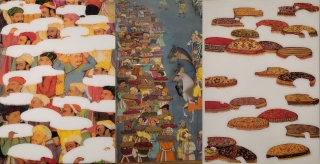
In another room, the viewer will encounter a work by Hamra Abbas (born 1976 in Kuwait). Her artwork consists of four panels. The two central panels are enlarged copies of two pages of the catalogue of the above-mentioned exhibition. One of them is the title page of the catalogue, and to its left is the “all rights reserved” page, which warns the reader that no part of the publication may be reproduced in any way at all.  These two pages are flanked by two images (illegally) reproduced from the images of the original miniature in the catalogue, and then modified.

Ms Abbas has reproduced the part of the page in the Padshanahma which depicts the crowd of men bearing the bridegroom’s gifts to his bride. To the left of the two middle panels, we see the image of these bearers, but the gifts they were carrying have been removed from the image, leaving white spaces with the outlines of the shapes of the gifts, On the right side of the middle panels, we see the depictions of the removed gifts arranged against a white background. The artist has named this work “All Rights Reserved”. She devised it in 2004. By removing the gifts from the bearers, the artist has made her own interpretation of the removal of the Padshahnama from India in 1799.

The Padshahnama was not the only gift that Saadat Ali Khan II gave the British. He was crowned in 1798 by the British Governor General of Bengal, Sir John Shore. In gratitude, he ceded half of the Awadh (Oudh) kingdom to the British. Now that colonialism is being examined critically (at last), Ms Abbas’s intriguing artwork makes a subtle but powerful statement.

The lion of Lendy in Sunbury-on-Thames

THERE IS A LOVELY walled garden, open to the public, in Sunbury-on-Thames. We were introduced to it today (20th August 2023) by our friends, Sue and Imtiaz, who live in Richmond. The large garden is well-tended and awash with flowers including a wonderful crop of late flowering roses. In the centre of the square garden, there is a carved stone lion on a plinth.

The lion commemorates the deaths of Captain Charles Frederick Lendy on the 15th of January 1894, aged 30. And his brother Edward August William Lendy on the 23rd of December 1893, aged 25. Charles died in Bulawayo (now in Zimbabwe) during the Matabele Campaign. And Edward, who was a captain in the Sherwood Foresters and Inspector General of the Sierra Leone Frontier Police, died in Warina (in Sierra Leone). According to a website (https://victorianweb.org/sculpture/warmonuments/9.html), he died as a result of ‘friendly fire’, and Charles died “from the effect of the Matabele campaign”, whatever that might mean. According to another website (www.photosunbury.com/lendymemorial4.htm), Charles

“… collapsed and died of peritonitis on 15th January 1894. Elsewhere, another interpretation places him at the Tati Hotel (in Botswana) where his illness was attributed to a heavy bout of drinking and eating.”

The brothers were the only sons of French born Major Auguste Frederic Lendy (1826-1889), a Royalist, who came from France as an exile, and settled in Sunbury-on-Thames. He ran his Practical Military College in nearby Twickenham, which prepared young men for entry into the major British military academies. He also wrote some books about warfare, and encouraged the British to be well prepared for military encounters. His sons’ military careers, though prematurely ended, were a credit to his teaching and philosophy.

Both brothers were in Africa to assist in the preservation and growth of Queen Victoria’s British Empire. One of them died because of friendly fire, and it seems that the other died of illness rather than during fighting. I doubt that their father would have been too pleased to know that neither of them had died whilst attempting something demanding bravery.

Apart from the Lendy memorial, there is a café in the walled garden, and next to that there is a small gallery. The gallery contains a fascinating embroidery on which most of the old houses in Sunbury-on-Thames are depicted beautifully and in great detail.

In addition to the walled garden and its contents, Sunbury-on-Thames has many old houses and a magnificent church (St Marys), which was designed by the Victorian architect Samuel Sanders Teulon (1812-1873), son of a French Huguenot, and built in 1857. I am very grateful that our friends introduced us to this charming place on the Thames.

Julia Margaret Cameron at the National Portrait Gallery in London

RECENTLY I PUBLISHED a book about the highly innovative Victorian photographer Julia Margaret Cameron (‘JMC’; 1815-1879). She married a British colonial administrator and lived during the heyday of the British Empire.  In my book, I tried to portray her sympathetically, but I do hint briefly that she was a ‘child of her times’ as far as he attitudes towards the colonised was concerned. Today, the 11th of July 2023, I paid a visit to London’s National Portrait Gallery (‘NPG’) to see how JMC and her works are currently presented.

JMC was a friend of the painter George Frederic Watts. His portrait of her hangs in the NPG. Another portrait by Watts hanging in the gallery depicts the historian and social commentator Thomas Carlyle (1795-1881). Nearby in another room, you can see Carlyle as portrayed in a photograph taken by JMC. This photograph is close to JMC’s photograph (see photo above) of Edward John Eyre (1815-1901). As British Governor of Jamaica, this gentleman was responsible for the brutal suppression of a revolt against British rule on the island. Under his command, 1000 homes were burned and 439 people were killed. Although this outraged many in Britain, it was defended by people such as Carlyle. Eyre’s portrait, made whilst he was awaiting trial, was, according to the NPG’s label, crafted by JMC to make him seem as if he was vulnerable and not:

“… a ruthless murderer but a sensitive man of duty.”

Another caption, next to a photograph of JMC by an unknown photographer suggests that her:

“… photographs are admired for their beauty and artistry. They also reflect the values of the Victorian era. Her portrait of Governor Eyre indicates her support for him following his violent suppression of the Morant Bay uprising.”

From what I have just written, you might get the impression that someone who composes the labels in the NPG is disapproving of JMC. Much as I feel that JMC’s apparent support for Eyre (and Carlyle) is not to my 21st century taste, one must remember that Cameron was living in a time when any uprising in the colonies would have been regarded as a dangerous – even apocalyptic – threat to the privileged life that she and her contemporaries enjoyed.

In all fairness to the NPG, they also have on public display one of JMC’s photographs of a less controversial sitter – the scientist Sir John Herschel (1792-1871). JMC met him in South Africa whilst she was convalescing from an illness she caught in India where she was living in 1837. It was Herschel who sparked off JMC’s enduring fascination with photography, which really ‘took off’ when she received her first camera in late 1863. She was then living on the Isle of Wight next door to her friend the poet Alfred Lord Tennyson.

JMC did not confine herself to taking photographs of defenders of colonialism. She made wonderful photographs of anyone she could find – both famous and completely unknown. What distinguished her work from that of her contemporaries is that, by experimenting with techniques in the studio and also in the darkroom, she created photographs that were works of art rather than slavish attempts to record real life accurately. Like great portrait painters, her photographic portraits give the viewer a sense of the sitter’s inner personality as well as his or her physical appearance.

My book is “Between Two Islands: Julia Margaret Cameron and Her Circle”. It is available from Amazon: https://www.amazon.co.uk/dp/B0BZFCVLX9/