
A nursery for bonsai trees and the death of an automobile

ABOUT FIFTEEN YEARS ago, some friends visiting England from from Calcutta wanted us to meet their friend, Peter Chan, with whom they were staying at his home near Lingfield in Surrey. One weekend, we drove down from London to meet them. What we did not know before we reached the Chan’s home was that Peter runs one of the best – if not the very best – Bonsai nurseries in this country. He showed us around his remarkable collection of Bonsai trees, which he sells, and what we saw made a great impression on us. Winner of 21 Chelsea Flower Show gold medals, Peter named his business Herons Bonsai.

About a year later, we were invited to a golden anniversary luncheon in a pub near Lingfield. Having arrived too early, we decided to revisit Peter’s bonsai nursery and to say hello to the Chans. We parked our Saab car in the nursery’s car park, and returned to it after greeting the Chans and having a quick look at the bonsai plants. I turned the ignition key. The car made a strange noise and smoke wafted out from the engine’s bonnet. I tried again – the car had died. We called the Automobile Association (‘AA’), and after about twenty minutes, an AA rescue man arrived. He quickly diagnosed the problem. I asked him to estimate the cost of repairing it. He said it would cost at least £300.

I had just had the car serviced, and while it was at the Saab garage I asked the sales staff to tell me how much I should expect to get if I part exchanged our car with a newer vehicle. I was told that I would get no more than £400 because of our car’s age. In addition, I was informed that several serious faults would soon need rectifying by the time I came for the next annual service. These repairs would have been costly. Knowing these things, it was easy to decide that our Saab had reached the end of its life – it was not worth repairing. We left the car at the bonsai nursery, having explained to the Chans that I would arrange for it to be collected by scrap dealers within a few days. The AA man drove us to Gatwick Airport, where we hired a car, and managed to arrive at the anniversary lunch by the time that the main course was being served.  Our Saab was taken away two days later.

This June (2024), my wife’s cousins met us for lunch at a pub, which they had chosen and booked. We knew nothing about the place. They drove us from Redhill station to the Wiremill pub near Lingfield. As we neared the place, I began recognising the countryside, notably a modernistic church built in 1958 by the Mormons. We turned off the main road into Wiremill Lane, and to our great surprise we passed Peter Chan’s bonsai nursery.

After a leisurely lunch, we visited Herons Bonsai. Before we arrived, I warned our cousins about the fate of our Saab, but they were not worried about parking at Herons.  After admiring some of the wonderful plants, we met Peter Chan, who vaguely recalled our last visit and the demise of our car. He introduced us to one of his regular customers, an Anglo-Indian, who had been brought up in Calcutta. He was at the nursery, showing it to his cousin who was visiting from Canada. Peter invited them and our party (my wife, her cousin and her husband, and me) to join him for tea in the nursery’s meeting hall that overlooks the Japanese style garden that Peter has created. We drank tea, exchanged gossip, and listened to Peter telling us about some of the fascinating things he has done in his life.

We left Herons without any automobile-related mishaps. Was it pure chance that we had been booked to eat at the Wiremill pub, or did the hidden hand of fate cause my wife’s cousin to choose the pub so near to the bonsai nursery?
A house on the Isle of Wight and a plantation in Sri Lanka: chapter 1

OUR CAR FERRY from Lymington docked at Yarmouth on the Isle of Wight after dark on a rainy evening in September 2022. As we drove to our friend’s house in Ventnor, we passed a building whose name, Dimbola, brought back memories of an exotic trip we made 28 years ago.

In February 1994, my wife and I spent a few days in Sri Lanka on our way back from India to London. It was our honeymoon and Sri Lanka was riven by civil war. Our host in Sri Lanka sent a car and driver to Colombo airport, which, despite its excessively high security presence, was attacked by terrorists soon after we departed for London. For several hours, we drove through the countryside after nightfall. Every few miles, we stopped at police check posts. Unlike bus passengers, who were obliged to leave their vehicles at each of these stops, we did not have to disembark. Our car was fitted with a bright lamp that the driver turned on so that the police could see his passengers without them having to leave the vehicle. It was also likely that our driver and his employers were well known to the authorities. About halfway through our long journey, we stopped at a tea stall in a village. The golden tea was fragrant and delicious. Even now, I believe that it was one of the best cups of tea I have drunk during my long life.

We continued driving through the darkened landscape. Every now and then, animals’ eyes reflected the illumination coming from the car’s headlights. It was only when we made the return trip to Colombo in daylight that I realised our driver’s great skill. The narrow road had many potholes and other defects and wound perilously up and down hillsides and close to deep ravines. Eventually, we arrived at the home of the manager of the tea plantation where we were going to spend about a week. We had met him and his wife at the home of a mutual friend, who lives in Ootacamund (‘Ooty’) in south India. This kind couple, having met us only once, had invited us to stay with them in Sri Lanka.

Mr Jain, our host, had been invited by the Sri Lankan government to revitalise a failing tea plantation. Situated about 4 miles northeast of the small town of Hatton, the estate where we stayed was called Dimbula – and still is. Seeing the name Dimbola on the house on the Isle of Wight made me remember Dimbula in Sri Lanka. I wondered whether Dimbola was a name chosen at random, or whether it was in some way related to Dimbula, where we stayed in Sri Lanka.

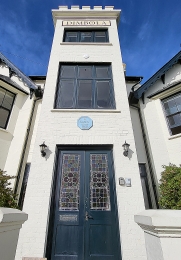
Dimbola house, Freshwater Bay, IOW

On our first full day on the Isle of Wight, the sun shone brightly, and we decided that it was perfect weather to visit Alum Bay to see its famed coloured cliffs and views of the Needles Rocks at the western end of the Isle. To reach this place we drove back along the road we had travelled the previous night. This road runs along clifftops close to the south coast of the island and provides many exciting views. We stopped at a couple of places to enjoy the spectacular coastal scenery, and before reaching Alum Bay, we made yet another stop at Freshwater Bay. By then, we were yearning for mid-morning coffee. Not seeing anywhere open close to the seafront, we drove a little further and noticed that Dimbola has a café.

Dimbola is a two-storey Victorian house with four full height bays, each of which is beneath a roof gable. In the middle of the long southeast-facing façade there is a tall square tower topped with crenellations. This separates the bays into two pairs. The east half of the ground floor houses a second-hand bookshop, which is now closed because its owner does his business on-line only. The west half houses a café, which serves excellent coffee made from beans roasted on the Isle of Wight. Most of the rest of the ground floor and much of the first floor is a museum and its shop. I will go into more detail about this museum soon.

Almost as soon as the waiter came to take our order, I asked him about the name Dimbola. He was not sure, and suggested I asked someone at the museum. After enjoying my coffee – it was so good that we returned for more on a couple of other days – I found someone working in the museum. I told her that I was interested in the similarity of the name of the house and that of the place where we had stayed in Sri Lanka. She told me that a former owner of Dibola had been married to a man who owned coffee (and then later tea) plantations in Sri Lanka when it was British Ceylon, and that the house was named after one of them called Dimbola. I was told that the house at Freshwater Bay was named after the plantation at Dimbula, which is exactly where we stayed in February 1994.

By 1994, Dimbula was a long-established tea plantation. However, it had begun life as a coffee plantation. It had been owned by Mr Charles Hay Cameron (1795-1880). A follower of the great philosopher Jeremy Bentham, Cameron became a barrister, having been called to the bar at Lincoln’s Inn in 1830. In 1835, he went out to India to serve on the Supreme Council of India (which had previously been known as ‘The Council of Bengal’). In 1838, he married Julia Margaret Pattle (1815-1879), whom he met in The Cape of Good Hope (now ‘South Africa’). Their marriage took place in early 1838 in Calcutta (now Kolkata). In 1848, he and his family left India and lived in their homes in London’s Putney and Freshwater Bay on the Isle of Wight. In 1875, he and Julia travelled to Sri Lanka, where Charles owned plantations. They lived there until their deaths. I will return to Mrs Cameron shortly.

The reason that Dimbula now grows tea is that during the 1870s, the market for coffee slumped. The Cameron, both in a poor state of health moved to Sri Lanka because the cost of living there was far lower than in England. During their stay in England, they spent much time at Dimbola between the years 1860 and 1875.

Interesting as was Charles Cameron’s life, that of his wife Julia was exceptionally outstanding. I had never heard of her before having coffee at Dimbola, but our art historian daughter was most excited to learn that we had stumbled upon and visited the former home of the famous photographer, Julia Cameron. TO BE CONTINUED SOON!

Small injection, small world

WE JOINED A SMALL queue at the vaccination centre, or “hub” as it calls itself, early one sunny but cool morning. All of us were waiting to receive our covid 19 booster vaccine, six months having elapsed since receiving the second of our first two ‘jabs’. Eventually, we were invited into the local hospital, in which the hub is located.

Photo by Karolina Grabowska on Pexels.com

I was directed to a cubicle where a lady, a volunteer vaccinator, was seated. After having been asked some preliminary medical questions and given some advice about possible aftereffects of the vaccine, she said to me, having already noted my name:

“Are you South African?”

“My parents were,” I replied.

“I know a Craig Yamey,” she said.

“He is a relative of mine.”

Then, she said:

“I knew an old gentleman, a Mr Yamey married to a Greek lady.”

“He was my father,” I replied, adding: “How do you know him”

It turned out that the lady’s mother lives next door to where my father lived for the last 27 years of his long life.

Having established that and just before giving me the injection, quite painlessly I should add, she said:

“In that case, I must take very special care of you.”

The world can seem remarkably small, don’t you think?

Only the name is the same

AFTER A SUNNY DAY spent at Whitby in North Yorkshire, we stopped for a drink at sundown in a small pub for a pre-prandial alcoholic beverage. Behind and slightly above the pub, we could see a well-maintained 12th century parish church with later modifications and a square tower. Below the pub, a narrow stream, lined with bushes and trees, ran alongside the main road. Apart from the infrequent passing car, the place was silent except for some pleasant birdsong. From where we sat on the terrace of the hostelry, we could see a small, sloping village square with a simple war memorial, some parked cars, and a small post box. At first, I did not realise where we had stopped. Then, I noticed that the village is called Kilburn.

Kilburn, North Yorkshire

There is another Kilburn about 215 miles south of the lovely village where we stopped for an evening drink. The latter is in North Yorkshire and the place with the same name many miles south of it is in north London. Apart from sharing the same name, London’s Kilburn is anything but rustic and peaceful, as many Londoners will know. London’s Kilburn is not really picturesque in conventional people’s eyes; it might appeal to lovers of urban sprawl.  It is a crowded metropolitan area with much commercial activity and a racial profile infinitely more diverse than that of the village in North Yorkshire.

I am not sure which of the two Kilburns is the oldest. North Yorkshire’s village was mentioned in the Domesday Book of 1086 and named ‘Chileburne’. London’s Kilburn was a settlement on an ancient Celtic route, a track between the places now known as St Albans and Canterbury. A priory was constructed on a stream that flowed through where London’s Kilburn now stands. The stream was known variously as ‘Cuneburna’, ‘Kelebourne’, and ‘Cyebourne’.

Whatever the origins of these two Kilburns, I know which of them is the place where I would prefer to linger in front of a glass of bitter.

I wonder if you know…

I do not know how many millions of people live in Calcutta, but I know it is well in excess of 14 million.

One day, a friend, M, met us in London. He told us that a mutual friend, D, was married to a woman born in Calcutta. As my wife went to school in that city, M said to her: ” You might know D’s wife.”

My wife replied: “Do you realise how many people live in Calcutta, M?”

Then after a moment, she asked; “What is her name?”

M mentioned a name. Hearing this, my wife answered: “She was a year junior to me at school.”

I thought it was amazing how small the world can seem even when a city as huge as Calcutta is being discussed.

Strange coincidence

white and blue floral table lamp


My mother’s birthday was the 15th of October. My good friend, the late Michael Jacobs, a fine author, was also born on that day, but many years later. Michael’s mother, the late Maria-Grazia, was born on the 8th of May. I was born on the same day, but many years later.

The chance of two people sharing the same birthday is quite small. It is 1 in 365 or 0.0028. Things get more interesting when one considers a group of people. In a room of 23 people, the chances that two people share a birthday is 0.5 or 50%, and when there are 75 people the probability increases to 0.99 or 99% (see: https://betterexplained.com/articles/understanding-the-birthday-paradox/ and https://en.wikipedia.org/wiki/Birthday_problem).  

I have no idea how to calculate the probability that my mother and my good friend share the same birthday AS WELL AS his mother and me sharing the same birthday. It is too long since I studied statistics and probability at school!Even then, I doubt I could have worked it out.


Photo by fotografierende on Pexels.com