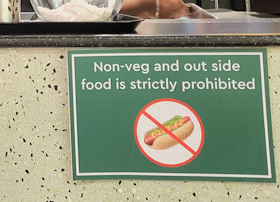
This coffee stall
In Bangalore’s busy airport
Remains free of meat
‘Outside food‘ is food not sold by the stall. You must not bring food you have obtained elsewhere. This coffee stall only sells vegetarian products.

This coffee stall
In Bangalore’s busy airport
Remains free of meat
‘Outside food‘ is food not sold by the stall. You must not bring food you have obtained elsewhere. This coffee stall only sells vegetarian products.
THE TRAINS THAT used to run into Folkestone Harbour station have not done so for many years. The station has been restored and repurposed as a pleasant, tasteful leisure amenity.

The signal box that used to regulate rail traffic in and out of the station still stands. It is now used as a café. With fine views of the harbour and Folkestone town, the signal box now contains equipment for making coffees and seats for customers. Apart from being an interesting old building, the old signal box contains the levers that used to operate the points within the station and on the bridge across the small harbour that connects it to the main land.
The café is not only housed in an original building, but also the coffee made there is above average in quality.
GOING THROUGH SOME old photographs today, I came across a few taken in the India Coffee House that used to be on Bangalore’s MG Road. Here is what I wrote about the place in my book “Coracles and Crocodiles: 101 Tales of India”:
“When I first visited Bangalore in 1994, there was a coffee house on Mahatma Gandhi (‘MG’) Road close to the now derelict Srungar Shopping Complex. This venerable, popular ‘hole in the wall’ was a branch of the Indian Coffee House (‘ICH’) chain. In both appearance and atmosphere, it reminded me of some of the older coffee houses I had seen Belgrade and Sarajevo in Yugoslavia (when it still existed).

At the ICH, customers sat at old wooden tables on wooden benches with hard, upright backrests. Old Coffee Board (‘ICB’) posters hung on the walls. The waiters were dressed in white jackets and trousers held up by extremely wide red and gold belts – like cummerbunds – with huge metal buckles that bore the logo of the ICB. These gentlemen wore white turbans with red and gold ribbons on their heads. In addition to (in my humble opinion) rather average quality, but low-priced South Indian filter coffee, a variety of snacks and cold drinks were also on the menu.
During the British occupation of India, admission to most coffee houses was restricted to European clients. In the late 1890s, the idea of establishing an ICH chain of coffee houses for Indian customers began to be considered. In 1936, the ICB opened the first ICH in Bombay’s Churchgate area. By the 1940s, there were at least 50 branches all over what was then British India. In the mid-1950s, the ICHs were closed by the Coffee Board. The Communist leader AK Gopalan (1904-1977) and the Coffee Board workers managed to get the Board to hand over the ICH outlets to them, and they formed a series of Indian Coffee Workers’ Co-operatives. The cooperative in Bangalore was formed in August 1957. There are now several branches in the city. The MG Road branch, which opened in 1959, closed in 2009 … “
DISCOVER more about this and many other things I have experienced in India by reading my book, which is available from Amazon:
THERE IS A DENTAL practice in Golborne Road (North Kensington). One afternoon in late 1994, I went to meet its then owner, Mr M, with a view to working there. It so happened that he remembered me from his days as a pre-clinical dental student at University College London. At that time, I was a PhD student and once a week I taught (tutored) physiology to the pre-clinical dental students. I believe that I learned more about the subject than my students while I was teaching them.

Because both of us had studied in the Physiology Department and later at the College’s Dental School, we knew a great deal in common and had much to chat about. While we were talking, Mr M offered me a coffee. He ordered this from the café next door to the surgery. It was some of the best espresso coffee I had tasted for a long time. We reminisced for a couple of hours during which we had one or two more of the superb cups of espresso coffee. He offered me the job, and I accepted. I worked in the practice during the next five years, and then left for another one. Later, Mr M sold the practice, which is now owned by another dentist and is still in business.
The café next door to the practice, Lisboa Patisserie, is also still in business, and the quality of the coffee served there has never been less than excellent. This popular Portuguese establishment also serves a wide range of Portuguese baked products, both sweet and savoury. Although it is now about 25 years since I last worked at the surgery, my wife and I visit the Lisboa Patisserie on average at least once a fortnight.
Yesterday, 29 March 2025, I was standing across the road from the surgery and the café when I noticed the magnificent blossom on a tree standing close to them. Seeing this, brought back memories of how delicious espresso coffee helped to entice me to accept a job at Mr M’s dental practice.
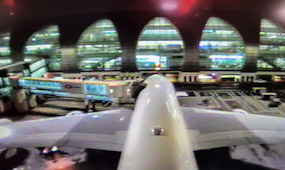
THINGS DID NOT BEGIN well for me when I arrived at Bangalore Airport’s recently opened Terminal 2 prior to boarding an Emirates airline flight to Dubai, where we were to catch another flight to London. We arrived at the airport in good time – before the check-in desks were open. After finding somewhere to sit, I walked to the Chaayos refreshment stall and asked for two cups of south Indian filter coffee. The server must have misheard me and only charged me for one. When this arrived instead of the two, I was expecting, I paid for another cup. While it was being made, I carried the first to my wife. I returned to the stall and picked up the second cup. It was filled to the brim, very hot, and the cup was poorly insulated. Just before I reached where we were sitting, my hand moved slightly, and the boiling hot coffee fell on my palm. This was extremely painful. I dropped the cup and the rest of its contents. I rushed to the washrooms, and after finding a tap that worked, I rinsed my palm in cold water. Meanwhile, my wife managed to get me some ice to put on the scalded part of my hand.
After dropping off our baggage and collecting boarding passes (printed on extremely thin paper), we headed for the security check. This involves divesting oneself of anything that contains metal before walking through a metal-detecting arch and then being frisked by a security official. Because the trousers I was wearing were too big, I had to keep one hand on them to stop them falling down. Meanwhile, I was somewhat shocked, and my hand was still smarting after the scalding.
After the frisking, I went over to the conveyor belt that carried our hand baggage and other items slowly through an x-ray machine. After rescuing both my wife’s and my own cabin baggage, telephones, wallets, coats, neck cushion, and my trouser belt, I secured my trousers with the latter. It was then that I realised that my boarding pass was nowhere to be seen. I was horrified – in so many decades of flying, I had never lost a boarding pass.
We reported the loss to the security supervisor – a female officer. She rang for an official from Emirates airline. While waiting for him to arrive, she said to my wife in Hindustani:
“He should not worry. They won’t leave him behind.”
After an agonising wait – actually, it was no longer than about 15 minutes – the official arrived. By then, I was feeling both anxious and extremely upset. The Emirates man explained that I would be issued a new boarding pass at the boarding gate. Not entirely happy with that, we left the security area, and headed for the departure lounges. On the way, we came across an empty baggage trolley, and began loading it with our carry-on bags and coats. As we were doing that, something fell to the ground – it was my missing boarding pass. In an instant my mood of melancholy and apprehension switched to one of immense happiness and relief. I rushed back to the security supervisor to tell her the good news. As the Emirates man was still around, I told him and shook his hand.
The flight to Dubai was pleasant. There was nothing to complain about. At Dubai, we had to pass through another security check. This time, I decided not to remove my belt before passing through the metal detector. Instead, I untucked my shirt and covered my belt with it. Despite there being a large metal buckle on the belt, the detector did not detect it. Nobody stopped me. Meanwhile, passengers’ hand baggage was passing through an x-ray machine so quickly that I doubt there was time to examine the series of x-ray images in any detail – if at all.
After enjoying exorbitantly expensive hot drinks, which I did not manage to spill, we entered a departure lounge dedicated to our flight to London. Before entering the lounge’s seating area, an official examined each passenger’s passport and boarding pass. Most passengers, including my wife and I, had to head for a line of trestle tables. By each of them there was a male or female security official. A few passengers were sent straight into the seating area, bypassing the tables.
The officials standing at the tables first searched the contents of bags – rather cursorily. Then, using an electronic wand, they frisked the passenger. After that, each passenger was asked to present their hands, palms facing upwards. An explosives detector sponge was rubbed on each palm, on the clothing, within the footwear (which had to be removed), on the mobile ‘phones, and other carry-on items. After placing the (re-usable) sponges in a machine, we were allowed to sit down and await the flight. My wife told me that the security lady who examined her was both rude and rough.
This process took quite a while. I sat watching it and gradually, I and my wife became aware of something curious. About a third of the passengers on our flight were women wearing hijabs (Muslim head coverings). This was not surprising in an airport in a Gulf State. What was astonishing was that not one of them had to be searched at the tables. They were allowed to board the flight without having been checked as thoroughly as the other passengers had been. Given that very recently, soldiers wearing hijab were able to enter a hospital in Gaza and attack it with firearms, was it wise to assume that because they were wearing hijab, the passengers on our flight to London were beyond suspicion, whereas all the other passengers – both male and female – needed to be regarded as potential terrorists?
The flight to London could not be faulted. And in case you are wondering, by the time we landed at Heathrow, my scalded palm was neither painful nor inflamed.
THERE IS A BRANCH of the India Coffee House chain in College Street, Calcutta. Housed on the first and second floors of Albert Hall (built 1876 in memory of Victoria’s Prince Consort), it is located in the midst of a vast bazaar specialising in bookselling – mainly textbooks and technical manuals. Soon after it was opened, the coffee house within Albert Hall became a centre of anti-British agitation.
The first floor serving area – many chairs and tables – is overlooked by two huge portraits. One photograph depicts Rabindranath Tagore as a young man and next to this, there is another of the poet and writer Kazi Nazrul Islam. Other smaller painted portraits line the walls of the café. Waiters wearing pugrees busily wandered around taking orders and delivering food and drinks – mostly coffee.

This ninth of January (2024) was a special day when an annual blood donation camp was held in memory of the Bengali footballer Sailendra Nath Manna (1924-2012). It was, as we discovered today, being carried out on the second floor gallery overlooking the serving area of the College Street India Coffee House.
Loudspeakers within the coffee house and in the streets surrounding it were exhorting people to come and donate some blood. A steady stream of volunteers climbed the staircase to the second floor. One of the officials, who was having coffee at a table near us, suggested we took a look upstairs.
The gallery was full of people. Chairs lined the walls. Donors were sitting in these with catheters in their veins. Several medics were wandering about with stethoscopes around their necks. Those who had donated blood were given packages contains bottled water and snacks. There were a few folding beds ready for anyone who fainted or collapsed during or after they had given blood, but these were unoccupied. Despite the seriousness of the purpose of the occasion, the blood donation camp seemed more like a joyous fair or party than a clinical situation.
We had come to College Street to enjoy the historic ambience of the old coffee house. Little had we expected to come acros a blood donation festival within it.
DURING THE LATE 1950s and much of the 1960s, my mother created artworks in the sculpture workshops of St Martins School of Art, which was then located on Charing Cross Road near to Foyles bookshop. My mother was a keen follower of the recipes of Elizabeth David (1913-1992), who introduced Mediterranean food to British kitchens. Near to St Martins in Old Compton Street, there were many food shops that supplied the ingredients that were required to follow Ms David’s recipes accurately. There used to be a French greengrocer between Charing Cross Road and Greek Street. This was one of the only places where ‘exotic’ salads such as mâché (lamb’s lettuce) could be purchased. Further west along Old Compton Street, there was a Belgian butcher, Benoit Bulcke, which cut meat in the French style, which my mother preferred. She claimed that English butchers were not ‘up to scratch’. Both these shops have long since disappeared. Another Soho establishment, which we used to visit regularly, was Trattoria da Otello in Dean Street. We went there so often that we were treated like old friends. Now, sadly, that wonderful restaurant is no more.

Three Old Compton Street shops frequented by my mother are still in business. They are the Algerian Coffee Stores, whose appearance has barely changed since the early 1960s when I first remember entering it; and a supplier of Italian foods: I Camisa & Son. Lina Stores, which my mother also used to visit still exists, but its branch on Brewer Street (and other newer branches) seems to have become more like restaurants than Italian delicatessens.
During school holidays, I used to accompany my mother on trips from Golders Green, where we resided, to the West End. On most of these excursions, food shopping in Soho was on our itinerary. So, as a youngster I got to know these various food shops quite well. As an innocent child, I associated Soho with food shopping rather than its other more colourful activities.
Every visit to Soho involved a stop at Bar Italia on Frith Street. There, I would be treated with a cappuccino while my mother drank an espresso. From when I first knew it in the early 1960s (or possibly the late 1950s), the overall appearance of Bar Italia has barely changed. As a friend remarked on a recent visit, the cracked Formica counter opposite the bar is typical of how cafés would have been fitted out back in the 1950s.
Bar Italia is almost three years older than me. It was founded in late 1949 by Lou and Caterina Polledri. Lou was born in the Italian city of Piacenza. According to the Bar’s website, some of the above-mentioned Formica was put in place in 1949, when the establishment was for its time ‘state-of-the-art’. The floor is that which was laid down by members of the Polledri family in 1949.
When it opened, Soho had a large Italian community, which much appreciated the Bar Italia as a home-away-from-home. At the far end of the small establishment, there is a television that broadcasts Italian TV, mostly sporting events. Each time I visit the place, the screen sems to have been replaced by a larger one. However, I cannot recall whether there was a television in place when I visited as a child. What I do remember is that next door to Bar Italia, there used to be a Greek restaurant called Jimmy’s, which, for some reason, my mother never took us there.
Once a local for the Italian community, Bar Italia has become somewhat of a Soho landmark and tourist attraction. In addition to coffee and alcoholic drinks that would be available in any local bar in Italy, Bar Italia now also serves hot meals. It also sells Portuguese ‘natas’, which are not typical fare in bars in Italy. Apart from this change, the prices of its excellent coffee have shot up to levels higher than most London cafés charge. Whereas one can expect to pay from on average £2.80 to “£3.20” for an espresso, Bar Italia is now charging over £4.20. I mention this, but do not begrudge them because by patronising Bar Italia we are helping to preserve a delightful historical London landmark.
NOW watch this lovely little video about the place:

With tray in hand
A smart turban upon his head
He brings us coffee
The illustration is from my new book about travels in India:
MANY READERS – ESPECIALLY those with some knowledge of physics – will have heard of the German Werner Heisenberg (1901-1976), who is well known for his famous Uncertainty Principle that relates to quantum physics. Because of my uncertainty about what exactly this principle expresses, I will let you look it up on Google or elsewhere.

One thing I was not uncertain about was seeing a café called Heisenberg in Chiswick’s Turnham Green area. As it was nearly 11 am, I was certain that I needed a cup of coffee, and what better place to have it than a place named after a person who ‘discovered’ uncertainty. The café is small but quirkily decorated and the coffee it served was very good. We drank from disposable cups, which bear the motto:
“Perfection cannot be measured as explained by the Heisenberg theory. However, this is the closest you’ll get to the perfect cup of coffee.”
Although I am uncertain whether the second part of this is true, I am certain that when I am next in the area, I will try another cup of Heisenberg’s coffee.
Somnath in the state of Gujarat is one of India’s important Hindu pilgrimage centres. People flock to the small town to worship in the Somnath Temple (also known as the ‘Deo Patan’). The shrine has been in existence for many centuries, but was demolished by Muslim invaders several times, and re-built after each episode of demolition. The structure you see today was built in the early 1950s.
To enter the temple, one must first divest yourself of cameras, all electronic equipment, and anything made with leather – remember, the cow is sacred in Hinduism. Although we did not enter the crowded temple because of the long queue, we watched the line of people waiting to file through the security check point at the temple compound’s entrance. Everyone passed beneath a metal detector archway and then was frisked. But it was a frisking with a difference. The security personnel passed their hands up and down, and close to, each of the visitor’s bodies, but made no physical contact with them.

Far less visited than the temple, but close by, there is a fascinating museum containing artefacts – sculptures and architectural fragments. All of the exhibits had once been parts of the former Somnath temples, which had been destroyed. Part of the collection was housed in a building constructed with domes and pillars from the former reincarnations of the temples.
After viewing the museum on a warm morning in March 2018, we were ready for a drink. It was around 11 am and coffee would have been very welcome, but our chances of finding some were pretty slim because we had discovered that in most of Gujarat coffee is not available in outlets providing drinks. As we walked away from the museum, a lady, hearing us speaking in English, stopped us in the street, and told us that she was a retired English language teacher. Kindly, she asked us to come into her home, next to which we were standing, to join her for a cup of – we could hardly believe what we were hearing – coffee. Full of anticipation, we followed her indoors. She told us that she drank coffee all day.
Our hostess fetched two disposable cups and filled them with hot milk to which she added a few grains of instant coffee powder. She seated us in her living room, and soon we were joined by another lady, who had just dropped in to say hello. At about the same time, some (wild) street dogs also entered the house, and our hostess fed them biscuits. Now, I do not want to sound ungrateful, but it was difficult even to imagine that we were drinking coffee because the amount of coffee she had added to the milk was so little; it was homeopathic in quantity.
After a while, our hostess’s husband arrived home and joined us. A retired businessman, he had become a pandit (a Hindu priest). As with many people we had already met during our travels in Gujarat, the first question he asked my wife was about her caste. In her case, that is not a simple question to answer because her parents, who did not believe in the importance of the caste system, were not from the same caste. In fact, my wife had no idea of what her caste until she was 27 years old. One of them was a Kayasth. The pandit explained that the Kayasths are offshoots of the Brahmins, but essentially Brahmin. Later, we spoke about the temples in Somnath. He was attached not to the main pilgrimage temple but to a smaller one nearby, which is much older than the Deo Patan. We had visited it earlier in the day. Kindly, he walked with us through the town, helping us find our way back to our hotel, which was near the town’s quite grand railway station.
Although the coffee was not quite what we were hoping for, the disposable cups deserve more of a mention. The Pandit’s wife cannot have been sure of our castes and was too polite to ask. Well, I do not qualify for any reference to the caste system, and she had not asked my wife about her caste, or even whether she is a Hindu. As a devout Hindu, and a pandit’s wife, she could not risk her coffee cups becoming polluted by being touched by people who were not, or might not be, of the right caste. For safety’s sake, she used the cups that could be disposed of after we had touched them.
 yamey
yamey 