A beach in the heart of London

The River Thames is tidal where it flows through the heart of London. At low tide, sandy beaches appear alongside the river’s banks. What is often beneath the water is revealed for a few hours. People, known as ‘mudlarks. wander along the sandy beaches looking for objects and fragments that have been thrown into, or lost in, the water over the many centuries that the city has been in existence. I have never attempted mudlarking, but many people enjoy searching for lost treasures.

A cafe in a church in London designed by Christopher Wren

in London

ST NICHOLAS COLE Abbey is a church a few yards southeast of London’s St Paul’s Cathedral. Like the cathedral, St Nick’s (as it is affectionately known) was designed by Sir Christopher Wren and built between 1672 and 1678. The earlier church on this site had been destroyed during the Great Fire of London in 1666. It was the first of the 51 churches lost in the Fire to have been rebuilt. In 1941, it was severely damaged during a German air raid. It remained a shell until it was repaired and reconsecrated in 1962. Sadly, the windows designed by the pre-Raphaelite artist Edward Burne-Jones were destroyed in the air raid. They have been replaced by three attractive windows, which reminded me of the work of Chagall, designed by Keith New (1925-2012).

When we entered the church today (28 April 2025), we found that the floor of its spacious interior was occupied by tables and chairs and along its south side, there was a counter where hot and cold drinks as well as snacks were being served. Most of the tables and chairs were occupied. Some people were enjoying refreshments, others were working with their laptop computers, and yet others were chatting quietly. There are also tables and chairs on the terrace outside the south side of the church. Although the church serves as a café on weekdays, during weekends and on some other days, services are held.

The café has been in existence for about 10 years. Although we have passed the church innumerable times, it was only today that we first ventured inside it. So near to St Pauls and all the eateries catering to tourists visiting it, this church-cum-café seems to be well off the tourists’ beaten track, but well-known to local office workers.

Lost and found at the Founders near Barbican

THE LIVERY COMPANIES were founded long ago by members of the same craft or trade. They were established originally to protect their businesses from rogue traders and to ensure that anyone practising a trade worked to satisfactory standards and good quality. Today, the livery companies still exist although now they are mostly involved in the life of the City of London and philanthropic activities.

The Founders Company, which was established in 1365, was made up of members who cast metal as their trade. They worked with castable metals such as brass and latten (a combination of copper and zinc). Their current headquarters are housed in a modern building just east of the east end of the church of St Bartholomew the Great (near the Barbican). One side of the building runs along the narrow St Bartholomews Passage. It was there that, at ground level, I spotted a bas-relief portrayal of a coat of arms made in white material.

A small information panel next to the crest related that this white material is Coade stone. This material, which was invented in the late 18th century, was an artificial material containing various ingredients. It solidified by firing in a furnace. This durable, weather-resistant material is easy to mould before firing, and was therefore favoured by sculptors and building designers. It went out of fashion by the 1840s.

The Coade stone crest outside Founders Hall was made in 1800, and then it got lost during the 19th century. Many years later, in the early 21st century, it was found and presented as a gift to its original owners, the Founders.  It commemorates the Company’s three Masters, who served in 2013, 2014. And 2015.

Although I have visited St Bartholomew the Great many times, it was only yesterday, the 31st of July 2024, that I first walked along Bartholomew Passage – just to see where it led. Luckily, on the way I found the well-preserved Founders’ Coade stone crest.

From sewer to seating on the streets of London

THE VICTORIA EMBANKMENT was constructed along the River Thames in the 1860s. It was built to enclose a newly constructed sewer: the Main Low Level Sewer, which was part of the grand sewage system improvement project designed by Sir Joseph William Bazalgette (1819-1891). The wall of the embankment facing the river was constructed from large brick-shaped, carved granite stones, each weighing about 1 tonne. Several of these have had to be removed to construct a new sewage conduit – the Thames Tideway Tunnel.

58 of the granite stones have been repurposed to become a series of open-air public art installations. This series was created by Matthew Barnett Howland, Oliver Wilton, and CSK Architects. Small groups of these have been placed in seven locations: St Peter’s Hill, Carter Lane Gardens, St Paul’s Cathedral, Christchurch Greyfriars Church Garden, King Edward St, Little Britain and Smithfield Rotunda. Today, the 31st of July 2024, we came across the group placed in Little Britain, which is not far from Barbican Underground Station. What we saw were 3 of the huge locks of granite arranged in a straight line. A gentleman was using one of them as a bench while he looked at his mobile telephone. Next to them, a wooden sign explained what is going on. This was useful because if there had been no sign next to them, we might not have given them a moment’s notice.

You might well be wondering why this series of stones were placed at seven places in London. I will leave it to someone else to explain:

“The idea behind the project is to stimulate discussion about reuse, material lifespan and cultural heritage, at a time when we can make a significant contribution to a more sustainable built environment.” (www.cityoflondon.gov.uk/services/streets/from-the-thames-to-eternity-installation)

I wonder what Bazalgette would have thought of this.

Sell the wife at Smithfield instead of divorcing her

IF YOU WISH to see the meat market at London’s Smithfield in action, either you must go to bed very late or wake up quite early, because the market is only open between 2 am and 10 am. This April, we visited it at about 1.30 in the afternoon, and there was little to see and there was hardly any odour in the air.

Back in October 2017, I walked from Clerkenwell to Smithfield, and wrote about it in a blog I published (https://londonadam.travellerspoint.com/44/). Here is what I wrote about the meat market:

At Peters Lane, Cowcross street turns southward towards to meet St Johns Street, which commences at the north side of Smithfield Market, an indoor wholesale meat marketplace. Smithfield’s central Grand Avenue is entered through an archway flanked by two heraldic dragons and a pair of stone sculptures. The Avenue runs beneath a high roof supported by ornate painted ironwork arches. Side aisles are lined with the meat dealers’ stalls and glass-covered display cabinets. In 1852, London’s livestock market was moved from Smithfield to Copenhagen Fields in Islington (off Caledonian Road, where the Caledonian Park is now located). This cleared the area for the construction of the present meat market, which was completed by 1868. Constructed in an era before refrigerators were used, the market was designed to keep out the sun and to take advantages of prevailing breezes.

I continued as follows:

In mediaeval times, Smithfield had a bad reputation. It was known for criminal activity, violence, and public executions. In the early 19th century, when obtaining divorce was difficult, men brought their unwanted wives to Smithfield to sell them, then a legal way of ending a marriage (see: “Meat, Commerce and the City: The London Food Market, 1800–1855”, by RS Metcalfe, publ. 2015).

In relation to disposing of a spouse, I quoted the following verse by an unknown author quoted in “Modern Street Ballads”, by John Ashton (published 1888):

“He married Jane Carter,

No damsel look’d smarter;

But he caught a tartar,

John Hobbs, John Hobbs;

Yes, he caught a tartar, John Hobbs.

He tied a rope to her, John Hobbs, John Hobbs;

He tied a rope to her, John Hobbs!

To ‘scape from hot water,

To Smithfield he brought her;

But nobody bought her …”

What I did not mention in my 2017 piece is that John Ashton noted in his book:

Wives at the market did not fetch good prices; the highest I know of, is recorded in The Times, September 19, 1797: “An hostler’s wife, in the country, lately fetched twenty-five guineas.” But this was extravagance, as, with the exception of a man who exchanged his wife for an ox, which he sold for six guineas, the next highest quotation is three and a half guineas; but this rapidly dwindled down to shillings, and even pence. In 1881, a wife was sold at Sheffield for a quart of beer; in 1862, another was purchased at Selby Market Cross for a pint; and the South Wales Daily News, May 2, 1882, tells us that one was parted with for a glass of ale. Sometimes they were unsaleable …”

Fascinating, but horrific when you think about it. In any case, you will be pleased to know that although I visited Smithfield with my wife a few days ago, I had no intention of selling her! Instead, we enjoyed some liquid refreshment in the nearby branch of the Pret A Manger café chain.

A Dutch name on a gravestone in the City of London

AT THE OLD BAILEY court on the 18th of February 1767, Edward Wild was formally accused (indicted) of stealing 25 yards of woollen cloth worth £10 from the widow, Winifred Vanderplank (https://www.oldbaileyonline.org/record/17670218), and found guilty. At the trial, Winefred’s son Bartholomew Vanderplank told the court:

“I live in Bartholomew-close with my mother; I am a cloth-worker. Last Monday three weeks, the piece of cloth mentioned was taken away; the prisoner at the bar was stopped with it; I was before Justice Welch when he and the cloth was; he there confessed he took it away.”

According to “The records of St. Bartholomew’s priory and of the church and parish of St. Bartholomew the Great, West Smithfield” (publ. 1921), Mr Vanderplank lived close to the Church of St Bartholomew the Great, formerly part of the Priory that existed there until it was disbanded and partially demolished during the reign of King Henry VIII. The records stated:

“… The house of  Mr.  Vanderplank close by (he  lived  at  No.  54 [ i.e., Bartholomew Close])  was  the  monastery  kitchen  from  which  a  subterranean  passage communicated  with  the  church,  persons  having  passed  through  it to  the  knowledge  of  the  proprietor.”

The same records revealed that the Vanderplanks lived at 54 Bartholomew Close:

“In the London Directory  of  1770, No.  54 was in the occupation of the Vanderplanks,  cloth  workers, who  lived  in  the  parish  until  the  middle  of  the  nineteenth  century.”

You might be wondering why I should be telling you about a family whose surname indicates that it probably has Dutch origins. Well, the reason is that yesterday (the 2nd of April 2024), I was in the church of St Bartholomew the Great (near Smithfield Market) when I looked at the floor and spotted the gravestone recording the deaths of several members of the Vanderplank family, including that of Bartholomew, who appeared in court on the 18th of February 1767. 

Regarding Bartholomew, he was affiliated to the City of London’s Clothworker Company (guild) (https://londonroll.org/search), as were some other members of the family, who lived in Bartholomew Close. I have not yet been able to find out when exactly the Vanderplank family settled in England,  but I have read (www.ourmigrationstory.org.uk/oms/londons-evil-may-day-riots):

“The Flemish and Dutch arrived in England in large numbers in the fourteenth and fifteenth centuries and were primarily artisans, especially weavers and other cloth workers. This was partly due to ‘pull’ factors in the form of royal invitations and ‘letters of protection’ issued by the king. The Crown was keen to boost the English cloth industry by encouraging the arrival of skilled foreign workers. However, immigrants from the Low Countries also came due to ‘push’ factors, especially the hardships caused by warfare in the region and sentences of mass exile in the late fourteenth century for participating in revolts in Flanders.”

The top of the stone reads:

“Here lieth the Body of Barthow Vanderplank Late of the Parish who died July 19 1792 aged 48 years.”

The stone also commemorates the deaths of other members of his family – his wife and children. Because I was curious about the surname, I did a little research on the Internet, and found what I have just described.

Once everyday objects, now souvenirs of times long past

CLOSE TO POSTMANS PARK in the City of London, there are two restored items on the pavement of the street called St Martin’s Le Grand. One of these would have been commonly seen all over the City a few decades ago. The other is rarer.

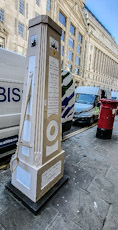
One of the objects is a restored Police Call Post. Free to use, these slender items topped with a red, light signal could be used by members of the public to call a police station. If a police station wanted to call the policeman on the beat, the red light would flash to attract his (or her) attention. Fortunately, I never had cause to use this service. Designed and made in the early 1930’s by British Ericsson, these telephone posts were decommissioned in the 1960s because of the availability of mobile police radio transmitters and receivers. Most of these posts were sold during the 1980s, but eight remain in the City. These have been carefully restored by Rupert Harris Conservation Ltd, and are now protected heritage items. According to the company’s website (https://rupertharris.com/products/police-call-posts-1):

“A few examples of similar posts exist in Westminster and throughout the country, but those differ slightly in design and colour. The Westminster models bear a Royal crest above the front ‘POLICE POST’ panel, and are painted dark blue.”

Ony a  couple of days ago, I noticed one of the Westminster models at Piccadilly Circus outside of what was once the magnificent Tower Records shop.

Standing close to the Police Call Post near Postman’s Park, there is a Victorian post box (pillar box). Painted black rather than the usual red, it resembles other Victorian post boxes I have seen in London (e.g., on Ladbroke Grove) and in Fort Kochi (India). A plaque on the black post box (near the defunct Police Call Post) states that this kind of pillar box was designed by John Penfold in 1866, and that this particular example commemorated 500 years since Brian Tuke (1472-1545), the first Master of the Post, was knighted by Henry VIII in 1516. It stands outside the building that was the GPO’s headquarters from 1894-1984. Unlike its neighbour the Police Call Post, this venerable letter box is still in use. Within a short distance from the much-visited St Pauls Cathedral, these less well-known sights and the nearby Postmans Park (see: https://adam-yamey-writes.com/2023/05/21/self-sacrifice-remembered/) are well worth investigating

Tokenhouse Yard

ST MARGARET LOTHBURY CHURCH stands on Lothbury, facing the north side of the Bank of England. It is, so the rector told us, the only one of the churches designed after the Great Fire of London (1666) by Christopher Wren, which did not suffer damage during WW2. It contains some beautifully crafted wooden features including a choir screen originally erected in the Church of All Hallows the Great (demolished 1894) in about 1683. In a side chapel, my wife spotted a gravestone that aroused our interest.

The black grave stone is to commemorate the Barnes family. The name at the top of the carved inscription is “James Barnes Jnr” of Tokenhouse Yard, who died in 1830. Other members of the family, who died later than him are listed below his name. What interested us was James’s address. Tokenhouse Yard, which is just under 100 yards in length, still exists and runs in a northerly direction beginning a few feet away from the west end of St Margaret’s church.

Tokenhouse Yard was laid out by the economist Sir William Petty (1623-1687) during the reign of King Charles I on land which had been occupied by the house and garden of the Earl of Arundel. Petty was, in addition to being an economist, a physician, physicist, philosopher, and one of the first members of the Royal Society. According to an online history of London (www.british-history.ac.uk/old-new-london/vol1/pp513-515) the Yard:


“… derived its name from an old house which was once the office for the delivery of farthing pocketpieces, or tokens, issued for several centuries by many London tradesmen. Copper coinage, with very few exceptions, was unauthorised in England till 1672.”


Daniel Defoe (c1660-1731), who was a child when the Great Plague broke out in London in 1665, later wrote that he remembered terrible sounds and scenes in the then densely populated, and probably somewhat squalid Tokenhouse Yard, many of whose inhabitants were infected. As it was during the worst days of our recent covid19 pandemic, back in 1665 there was nobody out in Tokenhouse Yard. He wrote:


“Passing through Tokenhouse Yard, in Lothbury, of a sudden a casement violently opened just over my head, and a woman gave three frightful screeches, and then cried, ‘Oh! death, death, death!’ in a most inimitable tone, which struck me with horror, and a chilliness in my very blood. There was nobody to be seen in the whole street, neither did any other window open, for people had no curiosity now in any case, nor could anybody help one another. Just in Bell Alley, on the right hand of the passage, there was a more terrible cry than that, though it was not so directed out at the window; but the whole family was in a terrible fright, and I could hear women and children run screaming about the rooms like distracted; when a garret window opened, and somebody from a window on the other side the alley called and asked, ‘What is the matter?’ upon which, from the first window it was answered, ‘Ay, ay, quite dead and cold!’ This person was a merchant, and a deputy-alderman, and very rich.”

Today, few, if any, people live in Tokenhouse Yard. It is now lined with office buildings, some quite elegant. At the north end of the Yard, there is a large decorative terracotta coloured Victorian edifice – number 12, named Token House. This was built for Huth’s Bank in 1872 to the designs of EA Gruning, a German immigrant. The bank was founded by another German – Frederick Huth (1777-1864). Today, the building houses offices.

An archway in the façade of Token House is the entrance to a covered alleyway – effectively a tunnel – that leads to Telegraph Street. This is so-named because it was near the building housing the Electric and International Telegraph Company (founded in 1855). Of interest, if you happen to be in the area, there is a nice coffee house, Ravello, on this street.

The Fire of London destroyed many buildings in 1666. Although these were replaced by newer ones, many of which have been demolished since, the conflagration did not destroy the medieval street layout of pre-Fire London. Thus, today we can enjoy the quaint narrow streets of yesteryear even though many of them, including Tokenhouse Yard and Telegraph Street (formerly the eastern part of ‘Great Bell Alley’) are lined with buildings constructed after Queen Victoria ascended to the Throne. The archaic network of streets in the old City of London add charm to what otherwise would have become a far less interesting urban area.

Before we began carrying personal water supplies

LONG BEFORE LONDONERS began the current fashion of carrying bottle of water wherever they go, the city’s inhabitants had to rely on water sources such as hand-operated street pumps. Although there are still a few functioning public drinking fountains in London, there are no usable pumps to be found. However, a few of them have been kept as historic monuments. One of these is located on the north pavement of Cornhill, a few yards east of the Royal Exchange building.

The pump, which is now kept looking like new – except that it no longer works – was set-up in 1799. On one of its four sides, the manufacturers, Phillips & Hopwood (“Engine Makers”), have included the information that the pump was paid for by the Bank of England, the East India Company, Fire Offices (i.e., insurance companies), and the “bankers and traders of the Ward of Cornhill”. The inscription on this side of the pump also mentions that the it was erected above a well that had been discovered and enlarged.

On another side of the pump, that facing south, there is a brief history of the well. It was first dug before 1282 when Henry Wallis (aka Henry le Walleis; died 1302), thrice Mayor of London, built a “House of Correction” on the spot. This was a prison for “night walkers” and was known as “The Tun”. Stow writing his “Survey of London” in 1598, noted that the prison was built of stone and (preserving Stow’s spelling) we learn:
“In the yeare 1298. certaine principall Citizens of London, brake vp this prison called the Tunne, and tooke out certain prisoners for the which they were sharply punished by long imprisonment, & great fines, as in another place I haue shewed.
In the yeare 1401. this prison house called the Tunne was made a Cesterne for sweete water conueyed by pipes of Leade frõ the towne of Tyborne, and was from thence forth called the conduite vpon Cornhill: Conduite vpõ Cornhill.Then was the wall planked ouer, and a strong prison made of Timber, called a Cage, with a payre of stockes set vpon it, on the top of which Cage was placed a Pillory for the punishment of Bakers offending in the Assise of Breade: for Millers stealeing of Corne at the Mill: and for baudes Cage, stockes and pillorie vpon Cornhill.and scolds &c.”

By the time the pump was set-up, the prison had long since gone (? demolished). How and why the well was rediscovered, I cannot say, but it was, and its water became accessible by using the pump. The top of the pump serves as an advertisement. At the top of each of the four sides of the pump, there are symbols, which people would have recognised as being the trademarks of four insurance companies in existence at the time that it was established. Back in the 18th and early 19th centuries, firefighting services were provided by the insurance companies. The trademarks of insurance companies were placed on buildings so that firefighters of each insurance company could recognise which houses had paid for policies that made them eligible to be saved by the firemen.

Today, firefighting is no longer provided by insurance companies, and water is no longer available from public pumps. So, it is not surprising to see many people wandering around London with their own supplies of drinking water – in plastic bottles and other containers. What does surprise me is that when I was younger, in the 1960s and 1970s, one hardly ever saw people carrying their own drinking water. Now, it is quite common to see people sipping from their personal water carriers. Have people become thirstier recently, or what is it that makes them feel that they should never be without a portable supply of potable water?

Guardian dragons

CAST-IRON STATUES of dragons mark the City of London’s boundaries on main roads leading into it., The City includes the oldest part of the metropolis.

Standing on their hind legs, the dragons stick out their red-painted tongues and rest their left forepaws on a shield with the coat-of-arms of the City of London. The creatures were designed by James Bunstone Bunning (1802-1863), who was architect to the City of London from 1843 until his death.

Thirteen of these dragons can be found in London. Some of them were placed at entrances to the City as late as the 1960s. The dragons are part of the City’s coat-of-arms, which was in use by 1381. In this emblem, a pair of them supports a crest.

I consider that these creatures look far from welcoming.