Americans in Mayfair

MY UNCLE SVEN Rindl (1921-2007) was a structural engineer. He was involved in the construction of the building on the west side of Mayfair’s Grosvenor Square, which used to house the Embassy of the USA until recently. About yards south of the former embassy building, there is another place associated with the USA on South Audley Street. Far older than the embassy, this is the Grosvenor Chapel, whose foundation stone was laid in 1730 by Sir Richard Grosvenor (1689-1732), the local landowner. The relatively simple brick and stone church with some neo-classical features was ready for use in 1731. When the church’s 99-year lease ran out in 1829, it became adopted as a chapel-of-ease (i.e., a chapel or church within a parish, other than the parish church) to St George’s Hanover Square.

Until very recently, I had often passed the Grosvenor Chapel when going to and from The Nehru Centre, also on South Audley Street, but had never entered it. Yesterday (26th of August 2022), the doors were open and, being early for a dance performance at the Nehru Centre, I looked inside the chapel. Its interior is simply decorated. The wide nave lies below a barrel-vaulted, plastered ceiling. Galleries supported by columns with Ionic capitals flank the north and south sides of the nave. The chancel is separated from the nave by a screen with openings, each of which is flanked by pairs of Ionic columns. The screen was added by the architect John Ninian Comper (1864-1960) when he remodelled the church’s interior in 1912.Ionic columns with their bases on the gallery support the ceiling of the nave. Windows (with plain glass panes) on two levels, both below and above the galleries, give the chapel good natural illumination. In summary, the simple, white-painted chapel, though not large, feels spacious. Its simplicity is a complete contrast to its neighbour, the flamboyant Gothic Revival style Catholic Church of the Immaculate Conception.

An inscribed stone plaque on the west front of the chapel records its American connection. The words on it are:

“In this chapel the Armed Forces of the United States of America held Divine Service during the Great War of 1939 to 1945 and gave thanks to God for the Victory of the Allies”

The American General Dwight David Eisenhower (1890-1969) was amongst those who worshipped there during WW2. Many years before that, another person connected with the USA, John Wilkes (1725-1797) was buried in the chapel. Wilkes, a radical journalist and politician, was a supporter of the American rebels during the American War of Independence.

America (i.e., the USA) has been associated with Mayfair since it gained independence from the British. Its first embassy was in a house in Mayfair belonging to John Adams (1735-1786), who was the first US Minister to the Court of St James (between 1785 and 1788). The embassy’s Chancery moved several times before 1938, when it was housed in 1 Grosvenor Square, now the home of the Canadian High Commission. Thus, during WW2, it was close to the Grosvenor Chapel. The embassy building, in whose construction my uncle was involved, was designed by the architect Eero Saarinen (1910-1961), and completed in 1960. By January 2018, the embassy had shifted from Grosvenor Square to a newly constructed edifice across the Thames at Nine Elms.

Returning to the small chapel, a small note about its name. The place’s website (www.grosvenorchapel.org.uk) explained:

“It retains its title of Chapel because it is not, and never has been a parish church, and its continuing existence is entirely dependent upon the generosity of those who worship here regularly or visit from time to time.”

Built during a time of war

FROM THE OUTSIDE, the church of St Barnabas in Pitshanger Lane (Ealing) is not particularly attractive. Even though we visited it on a Sunday, it was locked up. However, we were fortunate to meet a lady, who had been in the church hall and happened to have the key to the church with her. Kindly, she unlocked the edifice, and we were able to enter. The church’s interior, unlike its exterior, is wonderful.

The church stands close to Brentham Garden Suburb, which was built largely between 1901 and 1915. I will write about the Suburb at a later date, but now I will concentrate on the church. Although the Suburb was built with a magnificent club house, there had been no plans to include a church. In 1907, a temporary church made from corrugated iron sheets, and dedicated to St Barnabas was constructed at the junction of Pitshanger Lane and Castlebar Park. Eventually, it was too small to accommodate its congregation in an area where plenty of housing was being constructed. For legal reasons, it was not possible to build a larger church on the site. So, in 1911 a larger plot was acquired at the corner of Pitshanger Lane and Denison Road (one of the streets within the Garden Suburb).

Ernest Shearman (1859-1939) was the architect chosen to build the larger St Barnabas Church, which can be seen today. After working in Buenos Aires and later at Sandringham, he moved to Winchester in 1907. From that year onwards, his work was mainly concerned with designing churches. According to a book by Hugh Mather about the centenary of the church of St Barnabas, all of Shearman’s churches:

“…are tall imposing buildings without spires, and their austere, simple architecture was designed so that elaborate furnishings and other adornments could be added subsequently …”

His churches represent “… almost the final flowering of the last phase of the Gothic Revival.”

All except one of his churches demonstrate Shearman’s fascination with rose windows and elaborate tracery. St Barnabas is a fine example of this.

The construction of the church began just before the start of WW1, in June 1914. It was completed in the middle of the war by June 1916, when it was consecrated.

The church has a spacious nave, which has a lovely timber ceiling. Although it was designed to reflect the heritage of the gothic era, the inside of the church feels almost contemporary. There is an enormous organ at the west end of the church. Made in 1851, it was made by the company of William Hill and  originally housed in St Jude’s Church in Southsea. It was moved to St Barnabas in 2011. Some of the pipes on the south side of the central tall organ pipes do not make sounds. They were added to the organ for purely aesthetic reasons. The current organ replaced an older, less reliable instrument, which was removed in 2010.

The apse is adorned by a large painting by James Clark (1857-1943), who was living in Bedford Park not far from the church when he created it. He was one of many artists residing in Bedford Park, which was an ancestor of the Garden Suburb movement. His painting in the apse depicts the three hierarchies of angels praising and adoring the Holy Trinity. It is a magnificent addition to the church.

As we did not want to delay the lady who opened the church for us, we did not have sufficient time to examine its interior in great detail, but it did demonstrate how wrong it was to, to rephrase a well-known saying, to judge a church by its cover.

The lepers’ doorway

RAINHAM IN THE London Borough of Havering, but formerly in Essex, has an attractive and venerable parish church: St Helen & St Giles. Helen (c247-c330) is mistakenly believed to have been British. Probably born in Asia Minor, she was mother of Constantine the Great. Giles was a 7th century saint of Greek origin. Much of the body of this building was constructed in the 11th century. A small doorway on the south side, which has a fine carved stone Norman arch, was added in the 12th century, and is known as the Priest’s Entrance. The main entrance is via the South Porch, which was restored or recreated in 1897. As with so many old parish churches, Rainham’s is filled with interesting features, some of which I will describe.

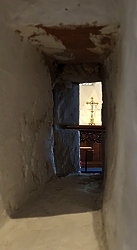
View through the squint (hagioscope) in Rainham parish church

The simple stone font bowl is from the 12th century. Almost as old as the church, it stands on a carved stone pedestal, created in the 15th century. The nave is flanked by sturdy square columns that support semi-circular arches typical of the pre-gothic era. The arch above the chancel has geometric carvings (chevrons), a fine example of Norman architecture. At the southeast corner of the nave, there is an old wooden door, covering the entrance to a spiral staircase that used to lead up to a no longer existing gallery. The door was originally located in the above-mentioned Priest’s Entrance, and was constructed in the 13th century. On the floor near this old door, there lies the black gravestone of John Harle, who built nearby Rainham Hall in the 1720s. His wife and son are also buried beneath it. Near to the grave, there are a couple of memorial brasses set in the floor.

Close to Harle’s gravestone on the wall of the south aisle, there is a niche in the wall and below this, part of a late 12th or early 13th century piscina. This small basin was used by the clergy for washing sacred vessels used during a service. The nave receives natural light through several clerestory windows. In Rainham’s church, these are shaped like human eyes. Probably installed in the 13th century, their shape is extremely unusual in English churches.

The lady, who was kindly showing us around the church, pointed out a slit in the north side of the western end of the chancel. The slit, which passes through the thick wall, is not perpendicular to the wall. It runs from the northwest to the northeast. It is what is known as a ‘squint’ or a ‘hagioscope’. These were incorporated into churches to allow worshippers a view of the high altar when their view was obstructed by the walls of the side aisles in churches where the width of the chancel was considerably less than that of the combined aisles and nave.

Our guide suggested that the squint in Rainham’s church might have been used by diseased worshippers such as those suffering with leprosy. She believed that these unfortunates would have been admitted to the church by the small north door and confined to the northern aisle. By peering through the squit, they could glimpse the crucifix on the high altar in the chancel. Where or not this was really what happened, I cannot say, but I like the story.

We were extremely lucky to have been able to enter the church because, as we learned later, it is often closed. We happened to arrive when our self-appointed guide and her colleauges, all volunteers, were decorating the building with flowers.

Alice through the stained glass windows

CHARLES LUTWIDGE DODGSON (1832-1898), better known as Lewis Carroll, author of “Alice’s Adventures in Wonderland”, was born in the village of Daresbury in Cheshire. During his first few years of life, Charles’s father was the curate of the local church of All Saints.

When he was 11, the Dodgson family moved away from Daresbury. Eventually, Charles entered Christ Church College in Oxford. It was here that he met the young child Alice Liddell, daughter of the Dean of Christ Church. It was this young child who inspired Dodgson to create and later publish his famous story. Unlike many other Victorian tales for children it was free from moral instructions.

Dodgson/Carroll died in Guildford, where he was buried. To celebrate the 100th anniversary of his birth, money was raised to create a window in the church in Daresbury to commemorate him. Known as the Lewis Carroll Window, it allows light into a Chapel in the southeast corner of the church. Designed by Geoffrey Webb, it was dedicated in mid 1935.

The stained window incorporates depictions of both Carroll and Alice Liddell, as well as some of the creatures drawn originally by John Tenniel, who illustrated the book about Alice.

A modern addition to the church was built onto its North side. This contains a Lewis Carroll exhibition. One of the exhibits is an old Bell. This used to be attached to a barge that served the religious needs of the people who lived and worked on the canals near Daresbury. This floating chapel was the creation of Lewis Carroll’s father.

We visited Daresbury on a July day when the air temperature was 37 degrees Celsius. Fortunately, it was cooler inside the church. I am grateful to Christine Casson for encouraging us to visit the church with the Wonderland window.

Benjamin Franklin and Saint Bartholomew

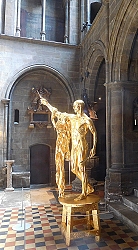
ONE OF LONDON’S FEW remaining pre-1666 (Fire of London) buildings is the church of St Bartholomew the Great close to Smithfield Market. Founded in the 12th century, the building has many Norman (Romanesque) features. It also contains some contemporary artefacts including “Colloquy” (a work made from glass) by Sophie Arkette, and “St Bartholomew. Exquisite Pain” (a work in gilded bronze) by Damien Hirst.

By Damien Hirst

Beyond the chancel at the east end of the church there is the spacious Lady Chapel. During the Reformation (after about 1529), this part of the church was closed off from the rest of it, and used as commercial premises. In the 18th century, it was used as a printer’s workshop owned by Mr Palmer. Benjamin Franklin (1706-1790), one of the founding fathers of the USA, worked as an apprentice in this printing works in 1725. Then, he was lodging nearby in Little Britain. While he was working in the converted Lady Chapel, he wrote his philosophical pamphlet, “A Dissertation on Liberty and Necessity, Pleasure and Pain.” Franklin wrote:

“At Palmer’s I was employed in composing for the second edition of Wollaston’s “Religion of Nature.” Some of his reasonings not appearing to me well founded, I wrote a little metaphysical piece in which I made remarks on them. It was entitled “A Dissertation on Liberty and Necessity, Pleasure and Pain.” I inscribed it to my friend Ralph; I printed a small number. It occasion’d my being more consider’d by Mr. Palmer as a young man of some ingenuity, tho’ he seriously expostulated with me upon the principles of my pamphlet, which to him appear’d abominable.”

The workshop was purchased by the church and restored as a Lady Chapel in 1897. An information panel next to it provides its history and connection with the young Franklin. It was by pure chance that I came across this London link with the American Revolution on the 4th of July.

St Cuthbert’s extraordinary lectern in London’s Earls Court

HIDDEN IN A residential crescent, Philbeach Gardens, near Earls Court is a late Victorian church, whose exterior is far from attractive. However, St Cuthbert (completed 1888) has an interior which cannot fail to amaze the visitor’s eyes. The church contains what can only be described as an ‘over-the top’ array of decorative features. Some of them are typical of the Gothic Revival style beloved of Victorian church designers, and others that are typical of the Arts and Crafts Movement, which flourished in the last decades of the 19th and the first few of the 20th century.

One item in the church, which is particularly eye-catching, is made of wrought iron and hammered (repoussé) copper. It is a lectern with two large arms on either side of the leather-covered book holder. These are supports for large candles. The lectern is approached by a small set of stairs whose treads have studs on them. The studs are arranged to spell out words, which I found difficult to decipher. The part of the base facing the congregation is an intricately decorated folded screen with Arts and Crafts Style decorative motifs. Most probably handmade, the lectern, although fantastically crafted, has a very slightly amateurish look about it. It is more unusual and eye-catching than beautiful.

I would not have visited St Cuthbert had my friend, the excellent Olsi Qinami, not been conducting the London City Philharmonic Orchestra performing a concert there. The church with its colourful marble pillars and almost surreal interior is well worth a visit even if there is no concert being performed. It is a ‘must-see’ for lovers of Victorian church architecture.

Queen Elizabeth and the Elizabeth Line

THE VICTORIA LINE began carrying passengers in late 1968 when I was 16 years old. I remember when this happened and how exciting it was. Recently a new railway line opened in London: the Elizabeth Line. Originally named ‘Crossrail’, it began carrying passengers several years after it was supposed to have been completed. It is supposed to convey people from east of London to well west of the city. However, what exists now (July 2022) is not exactly what I expected. In order to travel from, say, Shenfield, at the eastern end of the line to, say, Maidenhead, west of London, you need to change trains at Paddington. Currently one section of the new line runs east from Paddington, and the other runs west from that station. Unlike Queen Elizabeth’s long continuous reign, the line named to honour her has a discontinuity at Paddington.

A visitor from abroad wanted to experience the new line today, a Sunday. He was looking forward to seeing the new station platforms on the line that heads east from Paddington. Sadly the section that fruns east from Paddington does not operate on Sundays at the moment. So, we had to head west. The Elizabeth Line trains are new, but the train follows tracks that were laid down as far back as the 19th century. Apart from being over efficiently air-conditioned, the new trains are comfortable and run remarkably smoothly.

We travelled (on a train bound for Heathrow Terminal 5) to Hayes and Harlington station, and from there headed to Barra Hall Park in the old part of Hayes. There, we enjoyed a picnic before walking to the mediaeval parish church, St Mary the Virgin. We had visited it once before, but were completely unprepared for what we saw this time. The hedges lining the path leading to the south door of the church were decorated with bunches of cut flowers. A cardboard cut-out of Queen Elizabeth II greeted us at the door. The lovely church was filled with attractively arranged bouquets of flowers. Quite by chance, we had arrived whilst the church’s 57th annual Festival of Flowers was being celebrated. We were fortunate because we arrived on the 3rd of July, the last day of the festival. The festival’s theme was “A Tribute to Queen Elizabeth”. How appropriate to have travelled to it on the Elizabeth Line.

Asleep in his armour

ENGLISH PARISH CHURCHES are full of surprises. The church of St Mary the Virgin in the Essex village of Hatfield Broad Oak (once known as ‘Hatfield Regis’) is no exception. Its nave is a surviving remnant of a Benedictine priory founded in 1135 by Alberic De Vere (c1085-1141) The highlight of this church is a recumbent stone effigy of Alberic’s grandson, Robert de Vere, 3rd Earl of Oxford (c1155-1221), who was born in Hatfield Broad Oak. He was one of the barons who forced King John into signing the Magna Carta at Runnymede in 1215. The effigy was placed in the church either by his son or his grandson. It lies on the floor of the chancel in front of the nave and close to the high altar. Whereas in many churches, there is an unobstructed view of the altar (or a rood screen) from the western end of a church, Robert’s effigy sticks out like a sore thumb when you are looking along the length of the nave

The effigy, which is in remarkably good condition given its age, depicts Robert lying with his legs crossed. His right hand clutches a sword and there is a shield attached to his left arm. His left foot rests on something that is not easily identifiable as it has been damaged. What is most remarkable about this funerary sculpture is that Robert is almost entirely clad in chain mail. Part of his face peers through a circular gap in the armoured head dress. The carver of this monument took great pains to show the chain mail in fine detail. For me, this is what makes the effigy quite wonderful.

Fascinating as is the effigy, Robert’s family interested me because of its connection with Kensington in London. Robert’s great grandfather Alberic (or Aubrey) De Vere (1040-1112) was a tenant-in-chief of William the Conqueror. The Domesday Book records that he was a great landowner with properties in nine counties. One of these was the manor of Kensington in the County of Middlesex. His name is remembered today in the Royal Borough of Kensington and Chelsea by the street name Aubrey Walk, which leads to Aubrey House, currently a private residence.

The day before we visited Hatfield Broad Oak, we were in Coggeshall (Essex), where I spotted a memorial to a protestant martyr, Thomas Hawkes (see: https://adam-yamey-writes.com/2022/06/26/burnt-rather-than-baptised/), who had worked for the De Vere family. Had Hatfield Broad Oak not been such a pretty village, I doubt that we would have stopped there. That would have been a pity because then we would have missed seeing the chain mail clad effigy and its interesting connection with a part of west London, with which I am quite familiar.