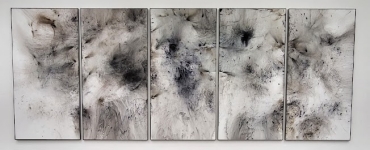
CAI GUO-QIANG IS an artist who was born in Quanzhou, Fujian Province, China, in 1957. Many of his artworks involve the extravagant and clever use of explosive materials, as can be seen in a documentary film being screened at the White Cube Gallery in Bermondsey (south London) until 9 September 2025. The film is accompanied by a collection of the artist’s images created on canvas, glass, and mirrors. Pleasing to the eye, these images have been created by an unusual method.
Guo-Qiang uses gunpowder, and ignites it, to assist him produce his pictures. The gallery’s website outlined his technique:
“… each composition is first mapped by sprinkling the powder, then covered and weighted before ignition, so that the blast disperses, recomposes and fuses matter into image.”
The unpredictability of the explosive material adds an interesting chance element to the finished product, but despite this, the composition was initially planned by the artist. In some of the works on display, not only was gunpowder placed on the base (i.e., paper, glass, etc) but also pigment powders. The explosions caused by igniting the gunpowder cause interesting spreading and scattering of the pigment.
The artist began experimenting with using explosives in his works on materials such as canvas and paper in the early 1980s in Quanzhou. Occasionally, the work in progress would ignite, and the fire had to be smothered to save the artwork. The works on display at White Cube were created after 2015, mainly in the 2020s. By now, he has refined his technique so that wholescale conflagration does not happen. However, as a gallery assistant told us, if you look carefully at some of the works, small burn marks can be found here and there.
Apart from being created in an intriguing way, I found the pictures being displayed in the gallery to be both attractive and beautiful.
THE SHIRLEY SHERWOOD Gallery of Botanical Art is a relatively new addition to the buildings dotted around London’s Kew Gardens. It is an attractive clean lined contemporary edifice containing several interconnected exhibition spaces of varying sizes. Until 23 March 2025, it is housing an exhibition of mostly enormous ceramic objects, which were created by Felicity Aylieef, Professor of ceramics and glass and research at the Royal College of Art, London.
The enormous ceramic objects, which look like grossly magnified jars and vases, were handmade by craftsmen in China, whose names were not prominently displayed (if at all) in the exhibition. Ms Aylieff has painted attractive designs on the vessels using blue paint containing cobalt oxide. The painted ceramic objects are then placed back into enormous kilns, and fired once again to fix the painted designs and to glaze them. Undoubtedly, what she creates is impressive, but maybe pointless. However, the art historian John-Paul clarifies things a bit:
“These are objects to be encountered physically, peered at anear, admired from afar. They may derive from utilitarian vessels, but as objects they are architectural, sculptural even, in their forms. Painterly, we might also say, for the manner in which their surfaces are articulated with glazes”. (Quoted from a label at the show).
I enjoyed seeing these gigantic ceramic objects, but kept wondering whether the great effort (especially physical) to make them was worthwhile.
WHEN RABINDRANATH TAGORE (1861-1941) visited China in 1924, he gave a series of lectures in English, which were translated for the Chinese audiences by the talented young poet Xu Zhimo (1897-1931). During a visit to Cambridge (UK) in August 2024, in several shop windows I noticed a book called “Xu Zhimo Cambridge & China” by Zilan Wang. Even though Cambridge has many students and tourists from China, I wondered about it.
Xu Zhimo was born in Haining (China). He studied law in Beijing, then in 1918 travelled to the USA, where he studied for, and was awarded a degree at Clark University in Worcester, Massachusetts. After starting a degree at Columbia University in New York City, he left the USA because he could no longer stand the place. He then travelled to the UK, where he first studied at the London School of Economics, and then at Kings College, Cambridge. It was in Cambridge that he became deeply attracted to poetry, and began writing it. In 1922, he returned to China, where he became an important figure in China’s modern poetry movement. He was a believer in ‘art for art’s sake’ rather than the (Chinese) Communists’ belief that art should serve politics.
When Tagore came to China, the country was in turmoil: there was fighting between rival warlords and the risk of an invasion by the Japanese was great. Xu Zhimo served as one of his oral interpreters, translating Rabindranath’s romantic (English) language into vernacular Chinese. Tagore did not rate his visit to China a great success. He was met with some hostility as Huan Zhao explained in the introduction to an article entitled “Interpreting for Tagore in 1920s China: a study from the perspective of Said’s traveling theory” (Perspectives, Volume 29, 2021 – Issue 4):
“During Tagore’s visit, his initial perceptions of welcome were transformed dramatically into a feeling of rejection, resulting in an unpleasant sojourn. After forty-odd days, Tagore left China, disconsolate, with his mission unaccomplished. Exactly what happened remains unclear. The introductory flyleaf of Talks in China claims his poor reception had much to do with ‘organized hostility from the members of the Communist Party and was labeled as a reactionary and ideologically dangerous.’ Others maintain that Xu, as Tagore’s interpreter, should shoulder much of the responsibility for the visit’s outcome – that Xu’s efforts to enhance his own fame while welcoming Tagore effaced Tagore’s purposes and ideas”
And in the author’s conclusion, the following was written:
“In 1920s China, Tagore’s lectures and Xu’s interpretations faced strong resistance from Chinese intellectuals who sought radical social reform. This resistance interrupted Tagore’s visit and inflicted lasting anguish on his interpreter Xu Zhimo. Although challenged by critics, Tagore’s lectures continued to influence Chinese philosophers, thanks in large part to Xu’s unyielding efforts to expand and explain Tagore’s lectures.”
Xu Zhimo was killed in an air crash in November 1931.
On our recent visit to Kings College in Cambridge, we stopped to look at a large stone on which Chinese writing characters are inscribed. We had passed it on previous visits to the city, but had not investigated it. This time, we noticed a short path leading from the stone into a circular enclosure surrounded bushes and trees. The path is lined with rectangular paving stones on which some lines of a poem by Xu Zhimo is carved. Alternate stones are in Chinese, the others are in English. The words are from Xu’s poem “再别康桥” (Zài Bié Kāngqiáo, which means ‘Taking Leave of Cambridge once more”), which he wrote in 1928. The enclosed area has a small bench upon which we sat, watching a continuous stream of Chinese people visiting the memorial, stopping to look at it respectfully.
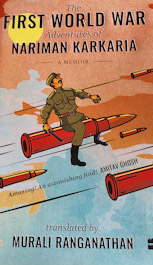
I HAVE JUST FINISHED reading a fascinating book gifted to me by my wife’s cousin. Most of the text is a Parsi’s experiences of fighting for the British during the First World War. Unlike other books about Indian soldiers who fought during that conflict, which deal with statistics and a general overview, this one contains the personal reminiscences of an individual who experienced the battlefronts first-hand.
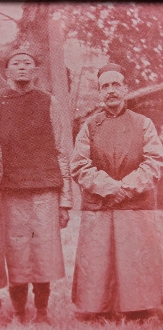
The book is a translation from Gujarati of the memories of a Parsi (a Zoroastrian) from the town of Navsari in Gujarat – Nariman Karkaria (1895-1949). At the age of only 15, Nariman, wishing to see the world, ran away from home, and with hardly any money in his pocket, reached Hong Kong. From there, he slowly travelled through China to Siberia. His impressions of the places he visited are recorded in his often entertaining book.
When WW 1 broke out, Nariman travelled across Russia and through Scandinavia before embarking on a ship to Newcastle in the UK. From there, he reached London, where he enlisted in an English regiment. After detailing the training he received, he describes his journey to the Western Front in France.
In addition to describing the conditions on the battlefields of France, Egypt, Palestine, and Greece, vividly and often in great detail, Nariman portrays his fascination for seeing new places and people in a delightful way. Reading his memoir, I was infected with his enthusiasm for seeing the world.
Near the end of WW, Nariman spent time in Jerusalem, which he describes most interestingly. His accounts of Tbilisi, Istanbul, Baku, and post-WW1 London are fascinating. I was intrigued reading about daily life in Tbilisi and Baku as they were only a short time before the Russian Revolution.
Nariman’s writings portrayed him as a a genial person, whom it would have been fun to have met. His prose is easy to read and never dull. As the translator, Murali Ranganathan, explained in his introduction to the book, what Nariman wrote is a rare account of the travels and wartime experiences of an adventurous young Indian man from Gujarat.
This is a book well worth reading not only because of its unique perspective of WW1 but also its highly agreeable narrative style.
YOU NEVER KNOW WHAT you might discover when you stop in a small English town or village. And wherever you halt, you are highly likely to find something intriguing. Camelford in Cornwall is no exception to this. We stopped there to buy meat from Steve Heard Quality Butchers, and their meat is so excellent that we have shopped there twice in the last few days. After our second visit to the shop, we strolled around Camelford and soon came across the Methodist Free Church, which is housed in a rather plain grey stone edifice. A small sign near its entrance advertised that there was an exhibition inside its entrance lobby. Luckily, the church was open, and we were able to discover something about Camelford’s missionary in China.
Samuel Pollard (1864-1915), the son of a Bible Christian Church preacher, was born in Camelford. After commencing a career in the British Civil Service, working in the Post Office Savings Bank in London’s Clapham, he was appointed a missionary to China in 1886. His change of career was prompted by his having attended a conference (The Southsea Methodist conference). In 1887, he set off for southwest China, where he became a Christian missionary amongst the Miao people. In 1891, he was posted to a newly opened Bible Christian mission station in Zhaotong. It was there that he began establishing a Christian movement amongst the Big Flowery Miao (aka ‘A-Hmao’) people, who live in the cold, rugged, mountainous areas of southwest China. In Zhaotong, Samuel married Emma Hainge, and they had four sons.
During the last 10 years of his life, Samuel converted 80% of the 400,000 Big Flowery Miao to Christianity. According to a Methodist website (www.myunitedmethodists.org.uk/content/people/ministers/sam-pollard):
“Sam Pollard worked from a missionary base in Zhaotong but travelled extensively around the province of Yunnan sometimes alone but usually with other missionaries or with Christian converts. From 1897 to 1904 Sam’s missionary efforts was focused on anyone who would listen. He and his colleagues held services which were often in the open air in a town centre or village market place. To gain attention he started off either banging a gong or attempting to play a concertina. Then, in order to have more effect, he blew a trumpet but he always maintained that he had little or no musical ability. As his reputation spread there was less need for this noisy introduction and simply standing up in a crowded place or advertising a meeting by word of mouth was enough. Sometimes many hundreds of people would attend and occasionally up to 3000!”
Apart from many adventures whilst living in, and travelling around, China, Pollard, who learned Mandarin at China Inland Mission training school at Ganking, is best known for a linguistic achievement. Along with several colleagues, he developed a script for the language spoken by the Big Flowery Miao. It has become known as ‘Pollard Script’. The Methodist website explained:
“‘Pollard Script’ was developed by Sam and several of his colleagues to help the A-Hmao to read in their own language. This proved a difficult task because many of the words use different tones rather than phonetics. He took inspiration from a script that had been developed by a Methodist Missionary working with North American Indians and also adapted Pitmans shorthand to indicate the level of the voice tones. Sam managed to translate much of the New Testament into this script before he died and there have been some improvements since, but it is still known as ‘Pollard Script’ and is also used by several other ethnic groups such as those that speak Tibeto-Burman languages.”
Samuel died of typhoid whilst trying to help a Chinese child suffering from that illness. Returning to the website already mentioned:
“The A-Hmao, Big Flowery Miaos still venerate Samuel Pollard as their spiritual leader. Their deep respect has survived Communism and the extremes of the Cultural Revolution right through to today. And it all started with Sam’s birth in the Bible Christian Manse in Victoria Road 150 years ago in Camelford in Cornwall!”
A recent President of China (‘reigned’ from 2003 to 2013), Hu Jintao, restored Pollard’s grave (at Weining Yi in Miao Autonomous County). He is said to have asked his officials to be like Pollard and support the poor.
Had it not been for the excellence of the butcher in Camelford, we would not have returned to the town. Because the town centre is quite picturesque, we spent some time looking around, and, as luck would have it, we stumbled across an exhibition about a remarkable man, of whom I had never heard.
I BET YOU DID NOT KNOW that Michael Alphonsus Shen Fuzong (c1658-1691) was the first documented person from China to visit England. I did not know that he met King James II in 1687. Furthermore, did you know that the Chinese sculptor Tan-Che-Qua (c1728-1796) from Canton, who visited London between 1769 and 1772, not only exhibited at London’s Royal Academy but also met King George III before returning to his native land. Maybe, I might have stumbled across these two notable men from China by accident had I not visited the British Library today (the 20th of March 2023), but this is highly unlikely. Until the 23rd of April 2023, there is a fascinating, well-displayed exhibition called “Chinese and British” at London’s British Library.
Beginning with the earliest Chinese visitors to Britain, this splendid exhibition charts the growth and considerable achievements of Chinese people who chose to live in Britain. John Hochee (1789-1869) was one of the first people from China to have settled permanently in England. He arrived from Canton in 1819, worked as a property manager with John Fuller Elphinstone (1778-1854; son of William Elphinstone a Director of the EIC: see https://www.rh7.org/factshts/hochee.pdf), whom he probably met whilst working for the East India Company in China. Hochee married an English lady, Charlotte Mole, and James (1832-1897), one of their seven children, became a surgeon. John was naturalized in Brighton in November 1854.
Since Hochee (Ho Chee) settled in Britain, many more people from China have followed in his footsteps. The exhibition at the British Library illustrates this well. Early settlers included many who had worked on ships and had landed in Liverpool or London. Chinese communities became established in the 1880s, notably in London’s East End. The Chinese in Britain established businesses to serve their community and their British neighbours. Chinese restaurants and laundries figured largely amongst the early enterprises. With the advent of laundrettes in the 1950s and 1960s, the Chinese laundry business faded away, but still today the Chinese are very important in Britain’s catering industry. It was after WW2 that restaurants and take-aways really took off in Britain. These outlets supplied both British and Chinese food. Many of their workers and owners were from Canton and Hong Kong.
During WW1, nearly 100,000 Chinese men provided support for The British Army in Europe – digging trenches, burying the dead, and other tasks. Some of these men had signed 3-year contracts, which obliged them to return to China after the war, which most of them did. The exhibition devotes some space to the activities of these men.
Apart from what I have already described, the exhibition has displays illustrating the many other achievements of the Chinese British. One exhibit that particularly amused me was a selection of books in English by Chinese British authors. They were displayed on a ‘lazy Susan’, a revolving serving platform often found in the centre of round tables in Chinese restaurants.
All in all, I am very pleased that a post on Instagram alerted me to this interesting exhibition, and I encourage everyone to visit it.
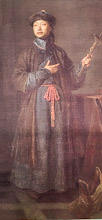
THERE IS A ROOM in Knole House (near Sevenoaks in Kent), which contains several portraits painted by Joshua Reynolds (1723-1792). One of them is a self-portrait. Near to this, there is a portrait of a man with a red cap, seated cross-legged. His youthful face has Chinese features. The sitter is Wang-y-tong (‘Huang Ya Dong’: born c 1753). Reynolds painted him in about 1776.
Wang was one of the earliest known Chinese people to have visited England. He came over following in the footsteps of an earlier Chinese visitor, the artist Tan-Che-Qua (c1728-1796), who arrived in London in 1769. Tan met King George III, and his work was shown at the Royal Academy in 1770. In about 1770, Wang was brought from Canton to England by John Bradby Blake (1745-1773), an employee of the East India Company. Blake was a naturalist and was interested in Wang’s knowledge of cultivating Chinese plants, and their uses. Wikipedia noted:
“Wang visited the Royal Society on 12 January 1775. In a letter of 1775, he is said to be about 22 years old. He was visited at Blake’s house, where he discussed the manufacture of Chinese ceramics with Josiah Wedgwood, and acupuncture with physician Andrew Duncan.”
It also describes how Wang became a page to Giovanna Bacelli (1753-1801), who was a mistress of John Sackville, 3rd Duke of Dorset, who owned Knole House. Wang lived at Knole, and was educated at the nearby Sevenoaks School. He returned to China by 1784, at which date he was working as a trader in Canton.
Wang’s portrait hangs amongst those of many famous men painted by Reynolds, including Samuel Johnson and David Garrick, as well as the 3rd Duke. The latter is said to have paid Joshua Reynolds 70 guineas (almost £76) to paint Wang’s excellent portrait. Wang was well-received in England. It would be interesting to learn what he thought about life as he found it at Knole and other places he visited in England.
SERAMPORE NEAR CALCUTTA was a Danish colony, or at least under Danish administration, between 1755 and 1845. It was then known as ‘Frederiknagore’. When we visited the place briefly in 2019, we were struck by the similarity of the type of design of its Church of St Olave (built 1806) and that of the far better-known St Martin-in-the-Fields (built 1721-26) on the east side of London’s Trafalgar Square. Although there are similarities between the two churches, there are also many differences. One of them is that the interior of St Olave’s is far plainer that that of St Martin’s. Even though many thousands of miles apart, there is a tiny aspect of Asia in the church on Trafalgar Square.
In the southwest corner of St Martin’s, I spotted a memorial, which aroused my curiosity. It is a simple green cloth-covered square notice board surrounded by a wooden frame in which various things are carved. These include the words “Requests for prayer”; carved plant motifs; Chinese pictograms; and the words “Praise God for his servant Florence Li Tim-Oi DD. 1907-1992. The first woman ordained in the Anglican Communion 25 January 1944”. There were several notices and a couple of plastic drinking cups pinned on the board.
Florence was born in Aberdeen, Hong Kong during a time that most Chinese parents favoured male children. However, her parents were unusual in that they challenged the then current prejudice against girls. As a student, she joined the Anglican church, probably after hearing a preacher (in Hong Kong) asking for women to dedicate their lives to working for the Christian ministry. At her baptism, she chose her English name, Florence, to honour the late Florence Nightingale. After studying at the Canton Theological College, she was eventually, in 1941, ordained as a deaconess. At that time, she was sent to the then Portuguese colony of Macau to help refugees fleeing there from war-torn China.
When the Japanese occupied Hong Kong, it became impossible for ordained Anglican priests to reach Macau. Although she was not yet ordained, Florence had to perform all the functions normally carried out by an ordained priest. In January 1944, she met Hong Kong’s Bishop Raymond Hall in an unoccupied part of China. There, the bishop, realising that there was no Anglican priest in Macau and that Florence had the ‘gift of priestly ministry’, ordained her as an Anglican priest. In so doing, on the 25th of January 1944, Florence made history by becoming the first woman to be ordained as an Anglican priest. This was 30 years before the ordination of women was permitted by the Anglican Church in the rest of the world. So, her ordination was frowned upon by some leaders of the Anglican Church.
After WW2 was over, Florence lived and ministered in China. In Maoist China, churches were closed (from 1958 to 1974), and during the so-called Cultural Revolution, Florence led a miserable life, as did many other Chinese people. She was sent to a farm to work with chickens and her home was raided several times. After a long time, she was allowed to retire from the farm and was given permission to leave China. In 1983, she was taken to Canada, where she assisted in the religious activities of a church in Toronto. By then, the Anglican Church in Canada had approved of the ordination of women. On the 40th anniversary of her ordination in China, she was reinstated as a priest. In later life, Florence served at the Anglican Cathedral in Toronto, where she lived the rest of her life.
I do not know when the memorial noticeboard commemorating Florence was installed in St Martin-in-the-Fields. However, on the 25th of January 2014, a service was held in the church to mark the 70th anniversary of her ordination as the first female Anglican priest. I am pleased that I spotted the somewhat unobtrusive notice board because if I had missed seeing it, I might never have known about this remarkable woman of faith.
THE CHINESE MEDICAL College in Hong Kong was founded in 1887 by the physician Sir James Cantlie (1851-1926), who was the inventor of what we now call ‘first aid’ and one of the founders of The London School of Tropical Medicine. One of his first students in Hong Kong was Sun Deming, better known as Sun Yat Sen (1866-1925). In 1878, Sun went to Honolulu to live with his elder brother. There, he was educated well in English at school. Aged 17, he returned to China. After desecrating a temple, he fled to Hong Kong, then under British rule, where he continued his education, joining the Chinese Medical College in 1887, having already studied a bit of western medicine elsewhere. In 1892, he graduated as a medical doctor. He became a friend of Sir James Cantlie.
In 1896, poor health forced Cantlie to return to London. That year, Sun came to England to visit Cantlie. Already out of favour with the Imperial Chinese government because of his revolutionary activities, private agents employed by the Chinese were sent to Liverpool where he landed to follow his movements. The reason for his conversion to political activism are summarised in an on-line article (www.newstatesman.com/international-content/2021/10/the-london-kidnapping-that-changed-china) as follows:
“The contrast between the colonial advancement he encountered abroad and the endemic poverty he knew from home convinced Sun that China needed revolutionary change. Rather than becoming a doctor, he helped engineer a rebellion in Canton (Guangzhou) in 1895. The failure of the uprising forced Sun to go on the run, which is why he ended up in Britain the following year.”
The first person that Sun visited after arriving in London was his old teacher Cantlie, who lived close to the Chinese embassy, which was, and still is, in Portland Place. On his way there, Sun was kidnapped and held captive in the embassy. He would have faced death had not he persuaded the embassy’s English housekeeper, a Mrs Howe, to smuggle a note to Dr Cantlie. An influential man, Cantlie managed to get Sun released, as was described in the above-mentioned article:
“In the end, it was an article about the kidnapping in the Globe that did the trick. On the following day, 23 October 1896, a large crowd formed outside the legation, noisily demanding Sun’s release. While diplomatic and legal wheels moved in the background, the ambassador and his staff realised they had to let their prisoner go. Sun emerged on to the street a national hero. While recovering at Cantlie’s house, he gave a long interview to the liberal-left Daily News, giving British readers their first insights into China’s embryonic revolutionary movement.”
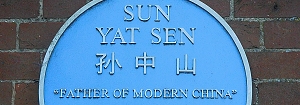
Late last year, we were driving to Buntingford in Hertfordshire when we passed through the nearby village of Cottered. As the traffic was slow-moving, we managed to spot a memorial plaque attached to a house. We did not stop, but we saw enough of it to realise it had something to do with Sun Yat Sen. Very recently, we returned to Cottered to look at the plaque more carefully because we were intrigued that the Sun Yat Sen had a connection with a tiny Hertfordshire village. The plaque attached to a house called The Kennels reads as follows: “Sun Yat Sen “Father of Modern China” was a frequent visitor to this house while in exile from his home country.” Beneath Sun’s name there are three Chinese characters: “孫中山” which Google translates as ‘Sun Yat-sen’.
Curious to know more, we rang the doorbell of the house in Cottered and were greeted by a kindly gentleman, who explained that The Kennels was formerly owned by Sir James Cantlie. An article in an issue of the “The Comet”, a Hertfordshire newspaper, dated March 2017 (https://www.thecomet.net/news/sun-yat-sen-in-cottered-the-father-of-modern-china-5358282) revealed:
“His connection to the property, called The Kennels, comes from his life-long friendship with physician Sir James Cantlie, who owned the house, earlier taught him medicine in Hong Kong – and in 1896 saved him from imprisonment by agents of the Qing monarchy at the Chinese Legation in London.
Dr Sun visited the Cantlies in London and Cottered whenever he was in Britain … Sir James’ son Kenneth recalled one of the statesman’s visits to the village:
‘I must have been about five years old. It was sunset on a summer evening, and Dr Sun was walking up and down in the orchard. He was wearing a grey frock-coat and his homburg hat was tilted forward to keep the level sun out of his eyes. He had his hands behind his back and was pondering deeply. I was about to rush up to him in my usual impetuous way, when I stopped. ‘He is probably thinking great thoughts,’ I said to myself, and I went quietly away. I was not in the least afraid of Dr Sun, who was kindness itself – but my parents and my nurse may have put the idea into my head that here was a great man who must not be interrupted when he was thinking.”
Lieutenant Colonel Kenneth Cantlie (1899-1986) was about five years old in 1904, which was when Sun was living outside China.
The article continued:
“In 1912, after the success of the Xinhai Revolution – which established a Chinese republic, with Sun Yat-sen as its first provisional president – the doctor wrote with clear affection to the Cantlies. On paper headed ‘The President’s Office’, he wrote: “It makes me feel more grateful to you when from the present position I look back on my past of hardships and strenuous toil, and think of your kindnesses shown me all the while that I can never nor will forget.”
Both Sir James and his son Lt Col Kenneth are buried in the cemetery of Cottered’s parish church close to its southern door. According to “The Comet”:
“After Dr Cantlie died and was buried at St John’s Church in Cottered in 1926, the Chinese minister to Britain, Sao-Ke Alfred Sze, laid a memorial tablet at the church. Dr Cantlie’s grave in the churchyard is engraved with a Chinese translation of the gospel verse Matthew 5:7.
China Central Television visited the house in 2001, and again in 2011 as part of filming for a documentary series on the Xinhai Revolution.”
Sadly, I could find neither the tablet amongst the Cantlie family gravestones nor the engraving in Chinese, which is a translation of “Blessed are the merciful, for they will be shown mercy”. Despite this, revisiting Cottered was well worthwhile, and it has for me sparked an increased interest in the birth of modern China. We hope to return to Cottered to see inside its church, which, judging by pictures posted online, looks fascinating.
AT FIRST SIGHT, this clock, on the esplanade overlooking the seashore at Folkestone in Kent, looks unexceptional. But look again, and you will see that it is missing the figures ’11’ and ’12’. It is a decimal clock forming part of an artwork.
There are as you know 24 hours in a day and of these twelve are usually displayed on a clock face. For a few years during the French Revolution, it was decided to divide the day into ten hours instead of the usual 24. This was not all: the decimal hour was divided into 100 decimal minutes, each of which consisted of 100 decimal seconds. Midnight became 0 in decimal time, and 1 in decimal time was 2.24 am in the 24 hour system, 2 occurred at 4.48 am, 3 at 7.12 am, and so on. This attempt at revolutrionising time did not last for long in France. It was abandoned in 1805.
The French were not pioneers in using decimal time. They were preceded by the Chinese, who ceased using it in favour of the 24 hour system in 1645.
The decimal clock in Folkestone is one of ten in the town, which were created by Ruth Ewan as part of an artwork named “We could have been anything that we wanted to be”. The Tate Gallery website noted: “The commission comprised ten decimal clocks of different designs installed around the seaside town of Folkestone in Kent. All the clocks were displayed publicly, some in very prominent positions such as the town hall, and others that had to be either assiduously sought out or happened upon by chance, such as those found in a pub or a local taxi. With each clock, Ewan replaced the dials and mechanism to achieve the decimal regulation of time.”
The example, which we saw near a Victorian bandstand on the Esplanade has a decimal clock on one side and a regular one on the other side.






 yamey
yamey 