An angel at a town in Suffolk

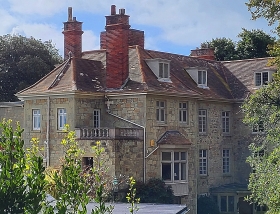
DURING THE EARLY 1960s, my parents used to take us to Cambridge, where one of my father’s friends,  the late Cyril Sofer, lived with his family. Often, we spent the night before our meeting with the Sofers at Bury St Edmunds. We always slept at the town’s Angel Hotel that faces the park containing the ruins of the monastery attached to the still existing Abbey.


Angel at Bury St Edmunds

This June (2025), my wife and I spent a little time in Bury St Edmunds. The Angel, whose facade is covered with foliage, is still in business. When I used to stay there many decades ago, the bedrooms were equipped with harnesses attached to ropes. These were to enable the occupants to escape from the room during a fire.  I mentioned this to the receptionist during our visit in 2025. She had never heard of these fire escape aids, but then, I stayed at the hotel long before she was born.


While looking at the hotel’s facade,  I noticed that the writer Charles Dickens had stayed there at least once. The town figures in “The Pickwick Papers”.


While walking in the park opposite the hotel, we came across a sculpture shaped like a teardrop. Placed in 2015, it is a memorial to all victims of genocide.  It also records that 57 Jewish residents of Bury St Edmunds  were massacred near the spot on Palm Sunday in 1190.


Brief as was our latest visit, Bury St Edmunds offers many interesting things for visitors to discover


Hindoo Stuart and a son of  a great author

THE SOUTH PARK Street Cemetery in Kolkata was opened in 1767 and was used as a burial ground for Europeans (mainly British) until 1830. It contains a large collection of funerary sculpture (mostly mausoleums and obelisks), much of which is in the neoclassical style. This now peaceful oasis in central Kolkata with much greenery is the final resting place of many people who had roles in the British East India Company (including its armies) and their families.  Although the place contains the remains of many interesting people  I will concentrate on two of them, both of whom had military careers.

Tomb of Hindoo Stuart

Charles Stuart (c1758-1828) was born in Ireland (Dublin) and joined the East  India Company when aged 19. He served in one of its armies, reaching the rank of Lieutenant Colonel.  In India, he was attracted to, and fascinated by, Hindu culture and traditions. He adopted many Hindu ways of life including religious practices. For example, when off duty,  he wore Indian clothes and bathed in the Ganges (the Hooghly) daily. In addition,  he wrote many articles, published in the newspapers of Calcutta,  which extolled the Indian ways of living, and encouraged Europeans to wear Indian garb rather than western clothing. He felt that ladies from Europe would feel more comfortable and look better wearing saris in India. His sympathy for the Indian modes of life and admiration of Indians earned him the nickname ‘Hindoo Stuart’, but did not impede his military career.  His funerary monument in the South Park Street Cemetery is in the form of a small Hindu temple, quite different in form from all of the other monuments in the graveyard.


The other military person commemorated at South Park Street  has a very modest, barely legible gravestone. It records the death of the short-lived Walter Landor Dickens (1841-1863).  He was the fourth child and second son of the author of “Oliver Twist” and many other famous novels: Charles Dickens. Walter became an officer cadet in the East India Company armies, arriving in India in 1857, just before the so-called Indian Mutiny began. After the end of this revolutionary activity and the end of the Company’s rule in India and the start of the British government’s control of the country, he became a soldier in the British Army. Illness resulted in his death in a military hospital in Calcutta.


Walter was buried at the Bhowanipore Military Cemetery in Calcutta.  In 1987, some students at Kolkata’s Jadavpur University raised funds and had Walter’s gravestone moved to the South Park Street Cemetery. This was done because it was not being cared for and to honour his father, the famous author.


Having recently become a fan of the novels of Charles Dickens,  I  was pleased to have been able to view Walter’s gravestone.  The lettering on it is legible, but not too easy to read.


During our recent visit to the Cemetery, which we made in December 2024, we saw the two graves mentioned above and many others which we had not noticed on previous visits.  For those interested in the early history of Kolkata during its British occupation, the South Park Street Cemetery should not be missed.

Epic narration and a great plot: it would make exciting cinema

THE GORDON RIOTS which occurred in London in 1780 were a reaction to a law passed in 1778. The law gave rights to Roman Catholics and aroused the hostility of no-papists (anti-Catholics). The disturbances,  which resulted in much destruction of property in London were instigated by the hateful propaganda of Lord George Gordon (1751-1793).


I first became interested in the Gordon Riots when I was writing my book about Hampstead and its surroundings. The rioters headed out of London towards Hampstead on their way to Lord Mansfield’s country house at Kenwood.  Mansfield’s house in London’s Bloomsbury district had just been razed to the ground by the riotous mob, and they had hoped to do the same thing at Kenwood.  Fortunately, they were stopped just before they reached Mansfield’s country mansion.

 Given my interest in the above-mentioned,  I  was excited to find that Charles Dickens had written a novel about the riots: “Barnaby Rudge”. It was first published in 1841.


Barnaby Rudge is a peculiar character, a simpleton whose best friend is a talking raven. At first, it was not obvious to me why the novel should bear his name, but slowly his importance in this complex tale becomes evident.  Although his role is important, there are a large number of other equally important characters woven into the plot.


Dickens explores the private antagonisms between some individuals as well as attractions between others, and gradually weaves these relationships into the ever increasing rumblings that develop into riots and mindless destruction.


Dickens wrote long before cinematography was invented, yet his written descriptions of both peaceful scenes and incredible chaos have a vividness and impact that much modern cinema (especially some blockbuster Bollywood productions) are able to throw at their audiences.  And Dickens does this with words alone: without Dolby sound and dramatic photography.


In brief, I  found “Barnaby Rudge” to be a veritable tour-de-force. My enjoyment of the book was enhanced by the fact that the Penguin edition I was reading was richly supplied with notes (mainly historical) researched and written by Gordon Spence.


Before reading “Barnaby Rudge”, I knew that the Gordon Riots were a fairly horrendous episode in British history.  However, Dickens, who was writing just 40 years after they had occurred and might have known people who had witnessed them, brought this age of turmoil to life in a credibly dramatic way.

Charles Dickens and a house in Berkshire

BASILDON PARK IS an 18th century stately home in Berkshire. Now managed by the National Trust, it has had many owners including the Sykes family. Sir Francis William Sykes inherited the place from his grandfather. When his wife had an affair with the artist Daniel Maclise, Sir Francis disowned her and publicly humiliated her. Now, Maclise was a close friend of the author Charles Dickens, and at the time when Sykes was being unpleasant towards his wife, the author was working on his novel “Oliver Twist”. Dickens created the nasty criminal character called Bill Sikes to take his revenge on Sir Francis (see http://www.basildon-berks-pc.gov.uk/basildon-berks/basildons_past-20268.aspx)

Fagin

We visit Basildon Park regularly. For this reason and because of its connection with Bill Sikes, I had decided to read “Oliver Twist”. It is the third of the Dickens novels that I have read recently. It was one of the first that he wrote. Compared with the two I have already read, “Nicholas Nickleby” and “Martin Chuzzlewit”, it flows easily and is very exciting.

The first thing that struck me was how early in the book the famous “Please Sir, can I have some more” scene occurs. It is an important episode but one that people seem to remember more than the rest of the book.

“Oliver Twist” is full of wonderful characters, both good and evil. Amongst the latter, Sikes, Bullseye (a dog), Fagin, Mr Bumble, and Monks are particularly well portrayed. There is a host of characters who see the best in Oliver’s personality. Oliver and his troubled young life is brilliantly narrated, and as I turned the pages, my heart was in my mouth as I waited to see what misadventure would next befall him.

I found the novel to be fast moving and exciting. As the saying goes, it is a real ‘page-turner’. I had no idea that Dickens’s writing could be so thrilling. Having come to the end of “Oliver Twist”, I am next embarking on “Barnaby Rudge”, which I have chosen because it concerns the Gordon Riots of 1780, about which I have read in history books.

I wondered if it was worth reading books by Charles Dickens?

WHENEVER CLASSIC BOOKS were recommended to me during my childhood, I never bothered to read them because I hated to be told what to read by people who had no idea what interested me. Therefore, until a couple of months ago I had not read anything by highly acclaimed British authors such as the Brontes, Thomas Hardy, Jane Austen, Scott, Trollope, Thackeray, and Dickens. I have read and enjoyed English translations of French authors including Balzac, Flaubert, and de Maupassant.

This summer (2024), we paid a visit to the delightful coastal town of Broadstairs in Kent. This place is rich in souvenirs of the author Charles Dickens (1812-1870). It was in this town that he worked on several of his novels. After our brief visit to Broadstairs, I was suddenly filled with the desire to begin reading something by Dickens to see what I have been missing for so many years, and to discover whether I ought to have followed the many recommendations I was given (during my youth) to read his work. I began with “Nicholas Nickleby” because some of it had been written in Broadstairs. After reading and enjoying this 600-page novel, I moved on to “Martin Chuzzlewit” (762 pages), which I have just finished. That I have already begun reading “Oliver Twist”, another novel by Dickens, shows that I have begun to like Dickens’s writing.

I do not find that reading Dickens is easy-going. Often, he says what could be said in a few words in many sentences, thus spinning out the story. Another problem is keeping track of the vast numbers of characters in the stories. It felt to me that every few pages, a new character is introduced. Some of them appear for a few pages and then disappear for a long time, only to reappear much later. So, when they do reappear, it is sometimes difficult to remember anything about them. As for the plots, they are complex, but fascinating. Despite the lack of conciseness, the huge number of characters, and the length of the novels, Dickens knew how to keep the reader engaged from start to finish. He had to do this because at first his stories were published as monthly episodes in magazines. If he had not kept his readers engaged one month, then they might not have bought the next episode a month later. Even though the plot acquires more and more sometimes seemingly unconnected strands, I felt instinctively that eventually they would coalesce. How Dickens kept track of what he was writing and did not ‘lose the plot’ amazes me. And how well he holds the reader’s attention is also a marvel.

Dickens’s mastery of detail amazes me. It is fascinating to read how parts of London, which I know well, were when Dickens was writing about them. His minute descriptions of aspects of daily life in early Victorian England are of great interest. His ability to portray villainous people is something else I have enjoyed. The villains and crooks are, for me, the most enjoyable of the characters in the two novels I have already read. Page after page, I realised that in the end they would receive their comeuppance, but how this happens eventually is a wonderful surprise that is revealed in the final pages of the books. Would I recommend reading Dickens? Well, I have been enjoying what I have read so far. To those who read quickly, I would strongly suggest trying Dickens. But for those who read slowly, I am not so sure. My reading habits have changed over the years. Had I attempted Dickens when I was younger, I doubt I would have read an entire novel. Now, in my retirement, I find that I am reading faster. Although Dickens should not be read too fast because of the incredibly large amount of detail he includes, I find that I can now cope with his writing and enjoy it. I am glad that I ignored the many who tried to persuade me to read Dickens when I was a child. I am pleased that at long last I have discovered how much fun it is to read his novels. I shall certainly be carrying something by Dickens to read during my next long-haul aeroplane journey.

Charles Dickens used to write by the sea at Broadstairs

THE VICTORIAN AUTHOR Charles Dickens (1812-1870) visited Broadstairs, a seaside town in east Kent frequently. During a recent visit to the town in August 2024, we saw three buildings which are associated with the famous author.

The Royal Albion Hotel hosted Dickens several times. Nearby, there is what is now the Dickens House Museum. This was the home of Miss Mary Pearson Strong, who was the inspiration for Betsey Trotwood in “David Copperfield”.

On a hill overlooking both the popular Viking Bay Beach and other parts of Broadstairs, there is a large building with castellations. This was built in 1801 as Fort Howe. It was, and still is, a private residence. It was here (and at the Albion Hotel) that Dickens used to write while staying in Broadstairs. The author leased the house from the 1840s until 1852. Some people claim that the house was the inspiration of the title of Dickens’ novel “Bleak House”, but this is by no means certain.

At thus point, I must admit that I have not read any Dickens apart from highly abridged versions of “A Christmas Carol” and “Oliver Twist”. Having now visited Broadstairs, I feel there is a good chance that I might tackle a full novel, maybe “Bleak House” or “David Copperfield”. Which would you recommend?

What the Dickens? David Copperfield on the Isle of Wight

BY THE END OF the last Ice Age (which occurred 1800 to 8000 years ago approximately), there was a huge landslip on the south coast of the Isle of Wight (‘IOW’). This resulted in the formation of an almost level strip of land about 5 miles long and between ¼ and a ½ mile in width. South of it is the sea, and to the north it is flanked by a steep hillside. Known as the ‘Undercliff’, the town of Ventnor stands upon it. At the eastern end of the Undercliff, the small village of Bonchurch stands. Where this village is located the Undercliff is not exactly flat but slopes considerably, which means that many of the buildings in the place are at different levels. This part of the Undercliff is perched on a high, constantly crumbling cliff overlooking the sea.

The village of Bonchurch is mentioned in the Domesday book. The name is probably derived from the Anglo-Saxon words meaning ‘Boniface’ and ‘church’. The oldest existing building in the village is the small St Boniface Church, now known as ‘The Old Church’. A notice outside it states that it was rebuilt in 1070. In good condition, this simple building is hardly used in comparison with the newer village church built in 1848. A steep path with some steps leads from the old church to the sea front, where the crumbling cliffs can be studied. The path crosses a babbling brook, which carries water from a spring next to the Old Church. Some believe that it was the existence of this spring that encouraged the first humans to settle in this district.

Later settlers and visitors to Bonchurch included some literary figures, who have become well-known. In 1819, whilst staying in Shanklin, the poet John Keats wrote to his sister Fanny Keats:

“Bonchurch too is a very delightful Place—as I can see by the Cottages, all romantic—covered with creepers and honeysuckles, with roses and eglantines peeping in at the windows. Fit abodes for the People I guess live in them, romantic old maids fond of novels, or soldiers’ widows with a pretty jointure—or any body’s widows or aunts or anythings given to Poetry and a Piano-forte—as far as in ’em lies—as people say. If I could play upon the Guitar I might make my fortune with an old song—and get two blessings at once—a Lady’s heart and the Rheumatism. But I am almost afraid to peep at those little windows—for a pretty window should show a pretty face, and as the world goes chances are against me.”

However, the poet did not stay in Bonchurch.  Amongst the celebrated literati who spent time in the village, were the historian Canon Venables (1819-1895); the novelist Elizabeth Missing Sewell (1816-1906); the author Henry de Vere Stacpoole (1863-1951); the poet Algernon Charles Swinburne (1837-1909), and, most famous of all, Charles Dickens (1812-1870).

According to a booklet I purchased in the Old Church, between July and October 1849, Dickens stayed in a large house called Winterbourne (see photograph), which he had rented from his friend the writer and vicar, Reverend James White. It was here that Dickens wrote six chapters of his novel “David Copperfield”. Each of these chapters were initially published month by month, as was the case for many of the author’s other stories. In addition to writing, Dickens enjoyed rambling in and around Bonchurch and playing rounders on the seashore. Also, he spent much time socialising with James White and his wife Rosa, who lived elsewhere in the village. A website (www.bonchurchvillage.co.uk/post/a-christmas-story-the-grandfather-s-story) recorded:

“Dickens and his wife Catherine with their children became very close friends of Rev. White and Rosa White (nee Hill) and their children during their holiday at Winterbourne in 1849.”

It also noted:

“James White had already had success with plays performed in London and stories contributed to ‘Blackwells Magazine’ in Edinburgh.”

A visit to Bonchurch is a delightful experience. Climbing its steep roads and paths makes a picturesque substitute for a ‘work out’ in a gym.

A church near Madame Tussauds

I HAVE PASSED IT OFTEN while travelling along London’s busy Marylebone Road and admired its elegant neoclassical portico supported by six columns with Corinthian capitals, but never entered it until today (the 7th of September 2022). I am referring to the Church of St Marylebone, consecrated in 1817. One of its predecessors, dedicated to the Blessed Virgin Mary was erected nearby in about 1400. It stood near the River Tyburn. The name Marylebone seems to be derived from a conjunction of the words Mary and ‘burn’ (from Tyburn, which began to have a bad reputation because of the much-used gallows close to its banks). This early church was replaced by another, constructed in 1740. It survived until it was demolished in 1949.  Nearby, the present larger church, which we see today, was constructed in 1817 on what was then the New Road, a by-pass on the northern edge London, and is now Marylebone Road. Its grand portico faces north, and the high altar and the colourfully decorated apse are in the south end of the building. The church, a typical example of a Regency interior with first-floor galleries, is tall and spacious.

Charles Dicken’s son was baptised in the church. The poet Robert Browning (1812-1889) married a fellow poet Elizabeth Barrett (1806-1861) in the church in 1846. And the composer John Stainer (1840-1901) composed his oratorio “The Crucifixion” specially for this church in 1887 when he was already a fellow of the Royal Academy of Music, which is across the main road facing the church.

The Methodist Charles Wesley (1707-1788), who lived nearby, asked to be buried in what was the churchyard of the older (1740) church. Where this edifice stood is now a peaceful open space, the Garden of Rest, next to Marylebone Lane (a few feet south of Marylebone Gardens). In this small space, there is a stone obelisk mounted on a pedestal. This commemorates the life of Charles Wesley and several members of his family.

Close to Madame Tussauds and the Royal Academy of Music and neighbouring one of London’s more enjoyable shopping areas – Marylebone High Street, stands the lovely church of St Marylebone, which as I discovered today, merits a visit.

A tavern on the Thames

THE BATTLE OF TRAFALGAR, fought in 1805 in the waters off Cape Trafalgar on the Atlantic coast of Spain, was a major victory for British naval forces under the leadership of Horatio Nelson (1758-1805). Sadly, it was after that battle that Nelson died, having been hit by a bullet fired from the French vessel “Redoubtable”. Most people are familiar with Trafalgar Square in central London, which commemorates the great victory. Fewer people might be familiar with a riverside hostelry in Greenwich, which also celebrates the battle.

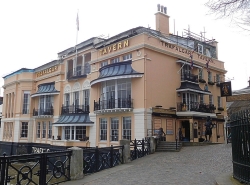
The majority of visitors to Greenwich concentrate mainly on the Cutty Sark, the Royal Naval College, the Greenwich Meridian, the Naval Museum, and Greenwich Market. The Trafalgar Tavern is, I suspect, not on everyone’s list of things that must be seen on a visit to Greenwich. It is located on the riverbank immediately east (downstream) of the former Royal Naval College (now partly occupied by the University of Greenwich).

Before dealing with the tavern, let me digress a little about the origin of the name Greenwich. In the Anglo-Saxon Chronicle, first written in the 9th century, the place was called ‘Grénawic’ or ‘Gronewic’, meaning ‘the green village’. The Scandinavian invaders of Britain might have given it a name meaning ‘the green reach’.  The Domesday Book of 1086 lists it as ‘Grenviz’.  In 1291, a document called it ‘Grenewych’, which is close to its current name. During the 18th century the hitherto principally  naval town also became a popular resort.

The Trafalgar Tavern was built in 1837 to the designs of the architect Joseph Kay (1775-1847), who helped to design the centre of Greenwich, on the site of an older inn, The Old George Tavern. In 1830, the owner of the Old George had wanted to enlarge his premises, but his ideas were sabotaged by the architect he had employed, who could see great potential for the inn and then decided to acquire the pub for himself (www.trafalgartavern.co.uk/history). The new owners of the pub submitted numerous plans for enlarging it until at last in 1837, they got the go ahead to proceed. The elegant building, with bow windows covered with canopies, looking out over the river, that exists today is what they built and re-named The Trafalgar Tavern in 1837.

The tavern’s name was well-chosen. After Nelson was shot, his body was returned to England, where it landed at Spithead. Eventually, Nelson’s embalmed corpse was transferred to Greenwich Hospital, where it was examined (https://www.navyhistory.org.au/the-preservation-of-horatio-lord-nelsons-body/). On the 5th of January 1806, the body lay in state in the magnificent Painted Hall of the hospital. The pub’s name was chosen, according to the Trafalgar’s website, because of its proximity to this place, which is about 200 yards away. In accordance with his wishes, Nelson was buried at St Pauls Cathedral.

Writing in 1876, James Thorne noted that the Trafalgar and other riverside inns in Greenwich were “… all celebrated for their whitebait dinners…” The Tavern’s history website explains that the whitebait were cooked after being caught fresh from the Thames. From the late 18th century onwards it became the fashion for parliamentarians to travel by boat from Westminster to Greenwich to discuss politics discreetly over a dinner of whitebait at one of the riverside hostelries, including the Trafalgar, which  was favoured by the Liberals and The Ship that was favoured by the Tories (www.foodsofengland.co.uk/whitebait.htm). The writer Charles Dickens visited the Trafalgar frequently. It is said that he based the wedding dinner scene in “Our Mutual Friend” in the inn. I did a word search of an online edition of the novel and failed to find the name ‘Trafalgar’. However, it has been noted that the dinner took place in “…a dinner at a hotel in Greenwich overlooking the Thames…” (https://victorianweb.org/art/illustration/mstone/44.html). Some of the other notable visitors to the Trafalgar include William Makepeace Thackeray, JMW Turner, William Gladstone, and Benjamin Disraeli.

After WW1, the Trafalgar became used as a home for retired sailors. Later, it was used as accommodation for serving naval officers. In 1968, the place was restored to its original Victorian glory and it became a pub once again. Since then, well at least until the covid19 pandemic, the place has been serving drinks and food including whitebait, although the source of this ingredient is unlikely to be the water flowing past the Tavern.