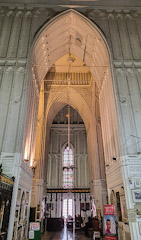
FIRST THE DUTCH demolished it in 1693. Then, it was replaced on the same site, only to be demolished again in about 1730. Once more, a new one was constructed on the same site, and this was then demolished by the British in 1761. The current version of this building, the Immaculate Conception Cathedral in Pondicherry, was completed in 1791, and is still in use today. Regular Roman Catholic services are held here in the Tamil, French and English languages.
Today (3 February 2025), while waiting for a nearby shop to open, we sat quietly in the cool aisle of the Cathedral. After a while, some beautifully dressed people entered. They walked up to the front of the church close to the high altar, and posed for photographs. It was obvious that amongst them was a just married couple. The bride was wearing a sari, had flowers in her hair, and a luxuriant flower garland around her neck.
As they walked away from the altar towards the open west door, they passed us, and my wife asked them if they had just married. They accepted our congratulations and asked us to join them. We did and as we stood next to the newlyweds, who had just married in another church, the four of us posed for photographs. Then, the bride asked us to bless them by touching their foreheads. We were moved by this request.
The marriage party went on their way, and we crossed the road to enter the huge bookshop that had just opened.
This is the tower of the 15th century St Peter Mancroft in Norwich, Norfolk. Situated next to the market place, this is the city’s parish church. It is the centre of civic worship, whereas the magnificent cathedral is the ecclesiastical centre of the city’s worship. Both this church and the cathedral make a visit to Norwich worthwhile. The city has other magnificent attractions, which I will write about soon.
THE NATURAL HISTORY Museum in South Kensington, a well-known landmark, was designed by the architect Alfred Waterhouse (1830-1905). Not too distant from this edifice, there is a church he designed in 1891. It is an unusual building with an oval nave, and it stands on the corner of Duke Street and Weighhouse Street. It was built originally as a place of worship for the Congregational King’s Weigh House congregation. During WW2, the church was badly damaged, and in the 1950s, after the church had been repaired, the congregation had declined significantly.
In 1968, the church was acquired by the Ukrainian Catholics in the UK, and it became known as the ‘Ukrainian Catholic Cathedral of the Holy Family in Exile’. Now, it is called the ‘The Ukrainian Catholic Cathedral of the Holy Family’. Fitted with a colourful iconostasis that hides the high altar, its congregation practise the Orthodox rites but look to the Pope in Rome as their religious leader. The oval shape of the nave, with an oval gallery running around it on the first floor makes for an interesting and unusual feeling of space within the church. The building contains much decorative tiling, which was put there when it was built. In 2022, when the Russians attacked Ukraine, the cathedral became a rallying point for Ukrainians residing in Britain.
With its adaptation to the needs of its Ukrainian congregation and its unconventional design, this church near Selfridges is well worth a visit.
THERE ARE MANY statues depicting Mohandas K Gandhi (the Mahatma; 1869-1948) all over the world. There is one in Manchester close to the city’s cathedral. A small notice next to it notes that it was gifted by the Kamani family to honour their grandfather Bhanji Khanji Kamani (1888-1979). Inaugurated in 2019, it is a project by the Shrimad Rajchandra Mission in Dharampur (Gujarat).
Shrimad Rajchandra (1861-1901) was a Jain philosopher, scholar, and reformer. Gandhi was introduced to him in Bombay in 1891, and the two men wrote to each other when the Mahatma was a lawyer and activist in in South Africa. Gandhi wrote in his autobiography that Shrimad was his “guide and helper” and his “refuge in moments of spiritual crisis”. Well, I did not know that.
As for Bhanji Khanji Kamani, the notice next to the statue in Manchester notes that he was “… a Fellow Scholar of Gandhi.” I am unclear about the meaning of this because Bhanji was about 19 years younger than the Mahatma. I wonder whether he was actually a disciple of Gandhi, rather than a Fellow scholar.
We saw the statue representing a man who advocated peaceful protest on a day when violent protests were predicted all over England.
IN FEBRUARY 1961, Queen Elizabeth II and Prince Philip paid a visit to Kolkata (Calcutta). People lined the streets along which they drove. Every now and then their car stopped and the Queen shook hands with people in the crowds. A little girl stepped forward to shake Her Majesty’s hand. Thirty-three years later that little girl became my wife.
Apart from shaking hands with the future Mrs Yamey, the Queen visited Kolkata’s Anglican St Paul’s Cathedral. Unlike is namesake in London, it does not have a dome. It was built to replace the older St John’s Cathedral. St Paul’s foundation stone was laid in 1839 and the gothic revival edifice was completed by 1847. It was designed by Major General William Nairn Forbes og the Bengal Engineers. Since its completion, various disasters have necessitated repairs, but the edifice looks to be in good condition.
The Cathedral is full of interesting features, a few of which I will now mention. The stained glass window at the western end of the church was designed by the Pre-Raphaelite artist Burne-Jones. The mosaic panels that can be found on the east wall were the creations of Arthur Blomfield, who was involved in the design of many Victorisn churches in London. The walls of the nave have the crests of the Dioceses of the former Anglican Province of The Church of India. Prior to 1947, St Paul’s was the Mother Church of what are now India, Pakistan, Bangladesh, Burma, and Sri Lanka.
I noticed that the pews in the nave are divided into male a female sections, separated by the central corridor. A Church worker explained that the sexes are no longer separated during services and that the signs marking where men and women should sit have been left as historical curiosities.
The TocH Chapel was dedicated on Armistice Day 1927. It contains the impressive sculpted funerary memorial to Sir Charles Allen, Chairman of the Calcutta Corporation. It also contains the helmet of an Indian soldier who died while fighting in the 1971 Bangladesh War. Next to this is a crucifix made from charred timber from a war damaged house in Bangladesh. These monuments to those who fell in Bangladesh are remarkably moving.
I have mentioned a few things that interested me in St Paul’s. In addition to these, there are plenty of memorials to Britishers, who came to India for one reason or another, and died there. One example of these is George Ham from Bristol, who drowned in the River Hooghly in 1866, aged 33.
Photographs of Queen Elizabeth II’s visit to the cathedral are on display within it. When my wife saw these today, the 18th of January 2023, she remembered shaking the hand of royalty back in 1961, and told me about it.
ST MARKS CATHEDRAL in Bangalore was constructed between 1808 and 1812. It is an elegant late Baroque church standing in its own spacious grounds. We visited it on Christmas Day 2022. There was a service in progress. The congregation was too large to be fully accommodated within the building. Many people were sitting outside the church, some of them under a canopy. The service was conveyed to those outside the building using loudspeakers and a giant television screen.
While the cleric began reciting the words associated with taking communion, he spoke of receiving the body of Christ. As he said that, I noticed a woman in the congregation opening a small container and taking a small flat white object from it, and then slipping it into her mouth.
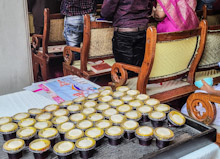
A man nearby asked if we wished to take communion, and then pointed to a table covered with small round plastic containers with lids. Each of these contains a communion wafer fragment and some “communion nectar”, which I imagine represents the blood of Christ.
At St Mark’s, it appears that Holy Communion is self-administered, rather than being handed out by a cleric, as is the case in most churches where I have witnessed Holy Communion. I wondered whether these little pots of Holy Communion ‘ingredients’ are an attempt to reduce the risk of transmitting disease in these times when the covid19 virus is so prevalent.
THERE IS A COPY of an icon, originally painted in Constantinople, in Truro Cathedral. This well-executed replica stands near the west end of the chancel. It depicts the Holy Child, Jesus, being held by the Virgin Mary. It exemplifies what we were told several years ago whilst being shown around a collection of icons in the Sicilian town of Piana degli Albanese, whose population is descended from Albanians who fled from the Ottomans in the late 15th century. These folk speak not only Italian but also a dialect of Albanian, known as Arberesh.
The icon in Truro shows the Virgin Mary dressed in dark blue and Jesus dressed in red. Our guide in Piana had shown us that in all the icons, the same thing can be seen. Conventionally, in Byzantine icons, Jesus is almost always dressed in red and the Virgin Mary in blue. The copy of the icon on display in Truro Cathedral is no exception to this tradition.
THE SYNAGOGUE IN Bayswater’s St Petersburg Place, a gothic revival edifice, looks no more exotic or out of place than the Victorian gothic Church of St Matthew built 1881-82 on the same street. In fact, it is another building to the north of these two that is unashamedly exotic in appearance: Aghia Sofia (Saint Sophia), the Greek Orthodox cathedral on Moscow Road. This domed building constructed for a community of prosperous Greek merchants was designed by John Oldrid Scott (1841-1913 and completed in 1877.
The first Greeks began arriving in London at the end of the 17th century. By the late 19th century (according to the website http://www.stsophia.org.uk), members of the Greek community in London:
“… were distinguished for their industry and their business acumen, and … soon became for the most part financially independent. They now wished to enjoy a more comfortable life, both for themselves and their families. They kept their offices in the City, but took up their private residences in other parts of London. The favourite districts were Lancaster Gate and Bayswater. These districts, which today are almost in the centre of the unending metropolis, were then only on its fringe, and to go from the City to Hyde Park, for instance, was considered a long excursion, which was undertaken, normally, only on holidays, as a relaxation and in order to enjoy the fresh country air.
After three decades had passed from the founding of the Church of Our Saviour [in the City near London Wall], no one any longer had his private residence in the City; and whereas previously all had lived within a very short distance of the Church, now five whole miles divided the Church from the residential district of the faithful.
For the men, in particular, who had every day to make the journey to the City, a tiring one with the means of transport then available, it was hard to undergo the same fatigue on Sundays also, when they were supposed not only to perform their religious duties, but also to rest from the labours of the week. Moreover, the number of the Greeks had greatly increased, and there was scarcely room for them all in the Church then existing. These various difficulties made it imperatively necessary to build a new larger Church, situated closer to the residences of the Brothers.”
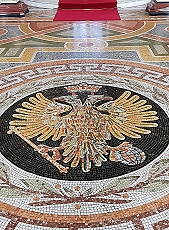
Just as the Jewish people, who had also settled in Bayswater, far from the older synagogues in the City and established a new one near their new homes, the Greeks did the same. Moscow Road’s St Sophia’s church interior is filled with icons and other religious paintings is colourful and attractive. Instead of frescos on the walls, which were believed to be at risk of damage from London’s damp climate, the church’s interior is lined with mosaics. Some of the earliest of these were designed by Arthur George Walker (1861-1939). In 1926, the Russian born mosaic artist Boris Vasilyevich Anrep (1883-1969) created some more mosaics for the cathedral. The marble floor of the edifice is also attractive.
IN THE 1930s, both the sculptor Barbara Hepworth (1903-1975) and the painter Piet Mondrian (1872-1944) lived in Hampstead (north London). Hepworth and her two successive husbands lived and worked in the Mall Studios near Parkhill Road. Mondrian lived at 60 Parkhill Road. According to one of Hepworth’s biographers, Eleanor Clayton, writing in “Barbara Hepworth. Art and Life”:
“The beginnings of a friendship between Hepworth and Mondrian can be seen in her letters to Nicholson at the time: ‘so glad Mondrian said nice things about me & work. Goodness U did learn a LOT.’”
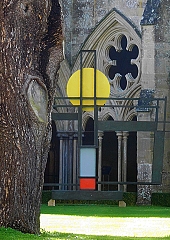
Visitors to the cloisters of Salisbury Cathedral can see an abstract sculpture at the southeast corner of the grassy space enclosed by them. At first sight, it looks like a sculptural version of a painting that might have been created by Mondrian. It is a sculpture by Barbara Hepworth called “Construction (Crucifixion)”. This bronze artwork was created in 1966, and then donated by the artist to the Cathedral in 1969. It is according to a notice by the sculpture:
“What we see are 3 verticals linked by a single horizontal bar, and by 2 other horizontals at different heights.
A large circle, attached to the intersection of the horizontal and vertical lines, is painted citrus yellow on one side and blue on the other. At the bottom of the central vertical, we see red on its own beneath the blue side of the circle, and red and white beneath the yellow. On the yellow side, a metal hoop encircles the point of crossing.
Hepworth wrote that she found it ‘very serene and quiet’, but that doesn’t have to guide what we make of this piece. We could see the yellow circle as the sun, the blue circle as the moon, the red paint as blood, the 2 verticals on either side as the crosses of the 2 men crucified with Jesus.
Or we could contemplate its hardness, weight, size (12ft tall and 2-and-a-half tons) and stark simplicity. We could seek to find meaning here, or we could stand before it and try to imagine the experience of meaningless horror and sheer emptiness which brutality of any kind must impose on those who witness it. For us, it need not seem ‘serene and quiet’ as for Hepworth. On the contrary this cross might confront us with the tragic lack of meaning which has so often afflicted humanity since the cross of Christ was first set up.”
Whatever its symbolism, Hepworth’s piece is attractive and looks good surrounded by the gothic architecture of the cloisters. Above all, its appearance immediately brings to mind thoughts about thw works of art created by Mondrian. One website (https://artistscollectingsociety.org/news/barbara-hepworth-sculpture-returns-salisbury-cathedral-permanent-display/) describes the piece as “Construction (Crucifixion): Homage to Mondrian” and then continued as follows:
“The sculpture is thought to explore the duality of Jesus Christ in its use of geometric symbols and features bold colours borrowed from the palette of ACS member Piet Mondrian, referenced in the artwork title.”
I was very pleased to see this work once again in March 2022, soon after publishing my book about Hampstead, past and present, in which I have included a substantial chapter about the modern artists who lived and worked in the area between the two World Wars. There is a good chance that Hepworth’s encounters with Mondrian and his work whilst they were both in Hampstead is reflected in the appearance of this abstract Crucifix, which stands in the cloisters at Salisbury.
THE CITY OF CHELMSFORD is the county town of the English county of Essex. It is a place that until November 2021 we felt. without any reason, was not worthy of a visit and have tended to avoid, skirting it on its by-pass. It was only recently that we realised that the place is home to a cathedral. Being nearby on a recent tour in Essex and curious about its cathedral, we paid a visit to Chelmsford and were pleasantly surprised by what we found.
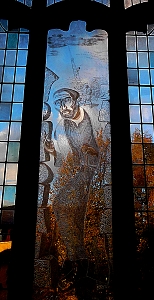
St Cedd window in Chelmsford Cathedral
The cathedral, which I will discuss later, is housed in what used to be the parish church of St Mary. The edifice is in the centre of a pleasant grassy open space. One of the buildings on the south side of this green bears a plaque commemorating Thomas Hooker (1586-1647), who was the curate and ‘Town Lecturer’ (a position established by the Puritans) of Chelmsford between 1626 and 1629.
Hooker was born in Markfield, a village in Leicestershire (www.britannica.com/biography/Thomas-Hooker) and studied at the University of Cambridge (https://connecticuthistory.org/thomas-hooker-connecticuts-founding-father/). At Cambridge, he underwent a moving religious experience that made him decide to become a preacher of the Puritan persuasion. He became a well-loved preacher, first serving the congregation of a church in Esher (Surrey) before moving to preach at St Mary’s in Chelmsford in 1626. A preacher in a neighbouring parish denounced Hooker to Archbishop Laud (1573-1645), a vehement opponent of Puritanism, and was ordered to leave his church and to denounce Puritanism, which he was unwilling to do. In 1630, Hooker was ordered to appear before The Court of High Commission. Soon, he forfeited the bond he had paid to the court and, fearing for his life, fled to The Netherlands.
In 1633, Hooker immigrated to The Massachusetts Bay Colony, where he became the pastor of a group of Puritans at New Towne (now Cambridge, Mass.). To escape the powerful influence of another Protestant leader, John Cotton (1585-1652), Hooker led a group of his followers, along with their cattle, goats, and pigs, to what was to become Hartford in what is now the State of Connecticut. They arrived there in 1636.
When Hooker and his followers reached the Connecticut Valley, it was still being governed by eight magistrates appointed by the Massachusetts General Court. In 1638, Hooker preached a sermon which argued that the people of Connecticut had the right to choose who governed them. This sermon led to the drawing up of a document called “The Fundamental Orders of Connecticut”, which served as the legal basis for the Connecticut Colony until 1662, when King Charles II granted The Connecticut Charter that established Connecticut’s legislative independence from Massachusetts. Hooker’s importance in this process has led him to be remembered as “the father of Connecticut.”
In 1914, the church of St Mary in Chelmsford, was elevated to the status of ‘cathedral’. The reason for this is slightly complex but is explained in a well-illustrated guidebook to the cathedral written by Tony Tuckwell, Peter Judd, and James Davy. In the mid-19th century, London expanded, and the size of its population grew enormously. Many previously rustic parishes that became urbanised were absorbed from the Diocese of Rochester into the Diocese of London. This resulted in a denudation of the Diocese of Rochester. To compensate for this, Rochester was given parishes in Hertfordshire and Essex. The Archbishop of Rochester lived in Danbury, Essex, which was closer to the majority of his ‘flock’ than anywhere in Kent. In 1877, the county of Essex was transferred into the new Diocese of St Albans in Hertfordshire. However, by 1907, 75% of the population of this new diocese were living in Essex. A further reorganisation led to the creation of two new dioceses, one in Suffolk and the other in Essex. After some acrimonious competition between the towns of Barking, Chelmsford, Colchester, Thaxted, Waltham Forest, West Ham, and Woodford, it was decided that Chelmsford should become the cathedral seat of the new Diocese of Essex. St Mary’s, where Hooker of Connecticut once preached in Chelmsford, became the new cathedral. In 1954, the cathedral’s dedication was extended to include St Mary the Virgin, St Peter, and St Cedd, whose simple Saxon chapel can be seen near Bradwell-on-Sea.
The cathedral, of whose existence we only became aware this year, is a wonderful place to see. Its spacious interior with beautiful painted ceilings contains not only items that date back several centuries but also a wealth of visually fascinating art works of religious significance created in both the 20th and 21st centuries. To list them all would be too lengthy for this short essay, so I will encourage you to visit the church to discover them yourself.
Having just visited Chelmsford, its cathedral, and its tasteful riverside developments, my irrational prejudice against entering the city and preferring to avoid it by using its bypass has been demolished. Although Chelmsford might not have the charm of cathedral cities such as Ely, Canterbury, Winchester, and Salisbury, it is worth making a detour to explore it if you happen to be travelling through East Anglia.
As a last word, it is curious that although there are places named Chelmsford in Massachusetts, Ontario, and New Brunswick, there does not appear to be one in Connecticut; at least I cannot find one.




 yamey
yamey 