Pop Art on show in a gallery in Bombay

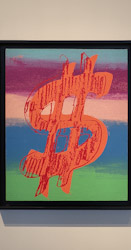
DURING THE FEW DAYS we have been in Bombay, we have visited 10 art galleries. With one exception, the exhibitions have been both beautifully displayed and contained exciting works of art. The exception is an exhibition of Pop Art being held at the recently constructed Nita Mukesh Ambani Cultural Centre in the Bandra Kurla district of Bombay.

The spacious gallery occupies parts of four floors of a glitzy cultural centre-cum-shopping mall. To view the exhibition, one needs to book a time-slot, and part with 800 Rupees (about £8) per person. When we visited on a Sunday afternoon, the few visitors to the gallery were vastly outnumbered by security personnel and charming, but seemingly poorly informed, young ladies who are employed to provide information about the exhibits.

The flyer for the exhibition promises the visitor the opportunity to see works by 12 exponents of Pop Art. However, the majority of the items were creations of Andy Warhol. Almost my favourite piece was a large creation by Robert Rauschenberg.

Each of the very spacious, well-lit galleries had surprisingly few artworks. Of the four galleries, I thought that the one on the third floor was best. It contained, amongst a few other things, the Rauschenberg, and a work by Claes Oldenburg, and yet more Warhol images.

Would I recommend making a visit to this exhibition? Probably, I would not. If you are familiar with Pop Art it offers little to add to what you already know and/or like. If you are not familiar with this kind of art, I am not sure that the exhibition would provide you with much if any insight. And at 800 Rupees per person, you might be better off buying a decent book about this exciting era of art.

Bargaining for a book in Bombay

NEAR BOMBAY’S FLORA Fountain there are several booksellers on the pavement. They stock both new (original and pirated copies) and old books. In general, the vendors are amenable to bargaining with their customers.

Today (in December 2023), I found a second-hand, oldish book about the history of Bombay. It looked as if it would satisfy my requirements. I asked the price. It was 800 Rupees. Because I have become accustomed to hagling over the price I offered 600. I was hoping that we would eventually agree on a price of about 700. The bookseller was adamant. He would sell it for 800 and no less. He kept saying it had been 1000 when it was new … long ago. I walked away, and viewed other bookstalls nearby.

Keen to have the book, I returned and offered 750. The stubborn vendor said to me:
“What is 50 Rupees to you? You are rich man.”
I walked away, and joined my wife who had just engaged a taxi to take us elsewhere. Seeing me board the taxi, the bookseller ran up to our vehicle, and proposed that we pay 780. My wife, who was not yet in the vehicle, offered him 750, which he accepted.

The man was right. What was 50 Rupees to me? Only about 50 pence. However, that was not the point. Getting the book was one thing but the pleasure of fighting to reduce the price, and succeeding, is another. And the sense of achievement after serious bargaining leaves me with a curiously fine sense of contentment.

Bats in a baobab tree in Bombay

I HAVE SEEN PHOTOGRAPHS of baobab trees, but until we visited the café of the formerly named Prince of Wales Museum in Bombay, I had never seen one ‘in the flesh’. A member of the mallow family of plants, baobabs are native to Madagascar.

Baobab tree in Bombay

These trees with curious looking conical trunks were imported to India by Arab traders. Although this is the case, this baobab in Bombay is the first such tree I have seen during my 30 years of frequent visits to India.

As we sat with our cold drinks, I looked up at the high branches of the baobab, and saw something flapping about. At first, I thought it was a black plastic bag caught in the branches. Then I noticed that it was a large bat stretching its wings. I saw it was not alone, but one of a large number of bats hanging on the high branches. These large creatures had black wings and dark brown bodies.

Despite the fact we had just seen a wonderful exhibition of ancient sculptures (from India, Ancient Rome and Greece, and Assyria), finding the baobab and seeing the bats in it, made my day.

An iconic but ironic famous landmark in Mumbai

WE HAVE BEEN VERY fortunate to get a booking at the Royal Bombay Yacht Club, located next door to the world famous luxurious Taj Mahal Hotel. Our bedroom is directly opposite the front of the Gateway of India – Bombay’s best known landmark.

The Gateway was built to celebrate the arrival in India of the British King George V – Emperor of India. However, as it was only completed in 1924, the king only got to see a cardboard model of the archway. Construction of this edifice only began in 1915, when the land on which it now stands was first prepared. The Gateway’s foundations only began to be built in 1920.

The magnificent archway was designed by George Wittet (1878-1926), an architect who worked mainly in Bombay. The Gateway was designed in an Indo-Saracenic style with many features borrowed from 16TH mosques found in Gujarat.

The Gateway is a brilliant piece of architecture. In its position next to the sea, it ‘works’ successfully. It has become not only an icon of Bombay but also, I believe, of India. I find it ironic that like that other icon of India, the Taj Mahal in Agra, its construction was inspired not by Indians but by invaders of the Indian Subcontinent. Despite that, Indians love it and flock to see it.

An Art Deco hotel in Ryde on the Isle of Wight

WE PARKED OUR CAR in Ryde on the Isle of Wight. I noticed that we had stopped outside a building that looked as if it had been transported from Marine Drive in Bombay to the Isle of Wight. Like many of the buildings that line Marine Drive, this one in Ryde is a beautiful example of the Art Deco architectural style, which became popular in the 1930s.

The former Royal York Hotel

The building in Ryde was constructed as the former Royal York Hotel. Completed in 1938, it was designed by JB Harrison and HP Gilkes.

When the hotel was opened, Ryde had become a popular destination for ’high society‘ holidaymakers. The then state-of-the-art hotel would have been in high demand. Partly because of the increasing ease of foreign travel, the hotel’s customers gradually decreased in number. So, in 2006, the hotel closed forever, and remained disused and looking dejected.

When we saw it in October 2023, there was scaffolding on the edifice and evidence that work was being carried out. I have read that there are plans to work on the building to create residential flats as well as a new hotel within it. Let us hope that this splendid example of Art Deco architecture will be preserved.

From Bombay to Belsize Park

SEVERAL OF OUR FRIENDS born in India came to study accountancy in the UK during the late 1960s and early ‘70s. In those days, studying accountancy had two benefits apart from giving our friends the opportunity to have careers in commerce and finance. First, coming to the UK was an opportunity to live abroad, and, more importantly, because they had to study whilst employed by an accountancy firm, they got income to cover their living expenses. All of them have had successful careers in business and/or banking. Some years earlier (in 1950), Lancelot Ribeiro (1933-2010), born in Bombay, came to the UK to study accountancy. However, he did not complete the course. Instead, he began studying art at London’s St Martins School of Art between 1951 and 1953. At that time, he lived in London’s Chalk Farm with his half-brother, the artist Francis Newton Souza (1924-2002), who was born in Goa. In August 1954, Lancelot was conscripted into the RAF. He was released from this in January 1955. Then, he returned to Bombay.

In Bombay, Lancelot was employed by the Life Insurance Corporation. He remained in this company for four years, by which time his poetry and painting were becoming recognised by Bombay’s artistic community, notably by the poet Nissim Ezekiel, the critic and poet Rajagopal Parthasarathy, the critic Rudolf von Leyden (German born, but lived most of his life in Bombay), and the Tata industrial group (who commissioned some of his works). By 1959, he had decided to make painting his profession. By the early 1960s, he was exhibiting in both group shows and solo exhibitions and was gaining wider, and influential recognition. Lancelot and his wife returned to London at the end of 1962/early 1963.

After living in various parts of London, the Ribeiro’s settled in the Belsize Park area of Hampstead – at Belsize Park Gardens – for a few years. By now, Lancelot’s works, and those of other Indian artists living in England, were being exhibited both in the UK and India. Life in London was not easy even in the late 1970s for people with ‘brown’ skins as Lancelot found out the hard way. Several times, he was attacked in the streets near Swiss Cottage, and once badly injured when attacked outside Hampstead Police Station. In addition, some of his pictures were vandalised when on display at the Swiss Cottage Library in 1986-87. However, none of this subdued his irrepressible creativeness.

Some of his prolific and highly inventive artworks were exhibited in Hampstead’s Burgh House when it held an “Indian Month” in 1980. Although he did not enjoy as much fame as his better-known half-brother, Ribeiro’s work is well worth seeing. An opportunity to do so is currently available at Burgh House until the 17th of December 2023. The well-displayed exhibition, “Lancelot Ribeiro: Finding Joy in a Landscape” can be seen free of charge. The Burgh House website describes it as follows:

“A journey through the changing landscapes of Hampstead-based expressionist poet and painter Lancelot Ribeiro, from his roots in pre-Independence 1930s India to life in mid-20th century Britain.

Ribeiro experimented with form and materials, moving from conventional depictions of the Lake District to otherworldly townscapes and sharp, bright abstracts inspired by geology. Each work encourages us to look anew, reconsider the form and substance of our environment, and how we might depict and share those landscapes with others.”

I can strongly recommend that you pay a visit to this show to see the works of an artist, who should be more widely known.

Finally, I wonder what would have become of our few dear friends had they abandoned accountancy prematurely. One of them, in his retirement from many years in banking, has become written a highly acclaimed novel. Another, who retired from a career in an international corporation, is now highly developing his skills as a cook. A third, who dropped out of accountancy, has become a successful translator.

Black Horse and a festival

THE KALA GODHA (Black Horse) is a statue in the heart of old Mumbai. It was erected in 2017 and designed by Alfaz Miller and sculpted by Shreehari Bhosle. It stands on the site of an equestrian statue of King Edward VII, which was removed from this spot in 1965 (and can now be seen in Byculla Zoo).

The Kala Godha

The statue gives its name to an annual arts festival, The Kala Godha Festival, that has been held since.1999. It has grown over the years and attracts many visitors. People come to enjoy film, literary events, heritage walks, booksales, exhibitions, artworks, other cultural happenings, and sales of handicrafts from all over India.

Held for nine days in February, this festival is a lot of fun.

Exotic vegetables and a building in Paddington

EXOTIC VEGETABLES AND PADDINGTON STATION

CRAWFORD MARKET IN central Mumbai was completed in 1869. Its British architect William Emerson (1823-1924) designed it in an Indo-Saracenic style, which attempted to combine Victorian Gothic and Indian architectural features.

Crawford Market

I am familiar with some of Emerson’s other buildings. One of them is the Nilambagh Palace in Bhavnagar, Gujarat. Now a hotel, we have stayed there. Another building, which is closer to our home in London, is the Clarence Wing of the St Mary’s Hospital in London’s Paddington. You can read more about the hospital in my book “BEYOND MARYLEBONE AND MAYFAIR: EXPLORING WEST LONDON”, which is available from Amazon.

Two of the entrances to the market hall are surmounted by lovely bas-reliefs, which were created by Rudyard Kipling”s father John Lockwood Kipling (1837-1911). The building was the first in India to be lit by electricity. This was added in 1882. There is a noteworthy Gothic revival drinking fountain in the market hall. This was gifted by Cowasji Jehangir. Many cats and kittens were running around its base. No doubt at night, they threaten the rodents that might be lurking around the market. During the day, they are given tidbits by the market traders.

The market is mainly for food and household goods. When driving past it on the nearby JJ Flyover, there is usually a whiff of fish emanating from it. However, within the market, this is not noticeable.

Amongst the numerous vegetable stalls, we noticed a few selling typical European products such as lollo rosso lettuce, fresh basil leaves, and other herbs associated more with European cuisine than Indian. At one of these stalls, we spotted Chinese cabbage and pak choi. The stalls selling these described themselves as purveyors of “exotic” or “English” vegetables.

A visit to Crawford Market is always worthwhile. You are likely to be approached by porters who will offer to follow you around whilst you shop. They will carry your shopping in cylindrical baskets, which they balance on their heads. As we were ‘just looking’, we did not take up their offers.

Long live the revolution!

NAGPADA JUNCTION IS one kilometre east of Mumbai Central Station. There are several interesting memorials located around this place where six busy roads meet. Each of them commemorates someone of the Islamic faith.

One memorial, a large rectangular bas-relief, is dedicated to the great poet Mirza Ghalib (1797-1869).

Dominating the junction is a tall flagpole from which India’s flag flutters. The base of this includes a large curved bas-relief in grey stone. The base has carvings of several important Indian freedom fighters including Mahatma Gandhi. There are also scenes of these leaders behind bars and other Indians being attacked by Britishers. The words “Quit India” can also be seen in several languages. The Quit India movement was one of many attempts to get the British to leave the huge country they ruled until 1947.

This monument and its flagpole are mainly dedicated to the memory of Maulana Abul Kalam Azad (1888-1958). In brief, he was all of the following and much more: an Indian independence activist, Islamic theologian, writer and a senior member of the Indian National Congress. Between 1947 and 1958, he was independent India’s first Minister of Education.

Lesser known than Ghalib and the Maulana, but also commemorated at Nagpada Junction is the freedom fighter Maulana Fazlul Hasan Hazrat Mohani (1875-1951). This celebrated writer of poetry in the Urdu language is best known for a slogan he created in 1921: “Inquilab zindabad”, which means “Long live the revolution”. He is also credited as being one of the first Indians to demand complete independence for India, rather than increases in the degree of the country’s autonomy whilst remaining part of the British Empire.

At first a member of The Indian National Congress, Hasan Hazrat later joined the Communist Party. He was against the Partition of India and would have preferred that India had become a confederation of states such as was the case in the USSR.

Nagpada Junction is both rich in traffic and memorials to notable Muslim men. One more memorial and a street name commemorate another Muslim, Sofia Zuber (Zubair), at this meeting place of busy. thoroughfares. She was an education superintendent for Urdu affiliated to a civic body and later a corporator from Nagpada. The short road named after her used to be a meeting place for Urdu authors and journalists.

I would not have written about this interesting traffic junction had I not noticed the Maulana Abul Kalam monument as we sped past it in a yellow and black taxi. Curious about it, we returned later and had a look around, and then ate good kebabs in the Sagar restaurant beside the junction.