EGLOSHAYLE IS ACROSS the Camel river, facing the Cornish town of Wadebridge. The Earl of St Vincent pub is hidden away up a hill behind Egloshayle’s St Petroc church. It is housed in a building built in the 17th century as a boarding house for masons. Later, it became a pub. One of its many guests was Admiral Sir John Jervis (1735-1823).
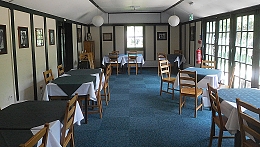
The interior of the pub has timber roof beams and a delightful feeling of times long gone by. It is a great example of many people’s idealised vision of a typical ‘olde worlde English’ country pub. Soon after entering the dimly lit establishment, and your eyes adjust to the low light levels, it becomes evident that the pub is full of clocks, mostly differing in design. Most of them appear to be in working order, but not many of them show the same time. A great number of the clocks chime at least once an hour, but not all at the same time. This being the case, there is usually at least one clock chiming at any given moment. This produces a lovely background symphony of chimes.
I asked one of the pub’s staff why there were so many clocks in the pub. She replied:
“Some people like children. We like clocks”
Later, I asked the landlady about the clocks. She told me that when they took over the pub some years ago, there was no clock in it. She and her husband bought one clock for the pub, and this became the start of their collection. They could not stop buying timepieces. She told me that there are over 200 clocks in the pub and winding them up every day is quite a huge task.
Apart from the fascinating clocks, the pub can be recommended for the delicious, excellently prepared, unpretentious food that can be eaten there.
GENESIS CHAPTER 28 describes a dream experienced by the biblical Jacob. In it, he dreamt that there was a ladder set on the earth that reached up to heaven. In his dream, he watched angels of God ascending and descending what is now called ‘Jacob’s Ladder’.
The small town of Sidmouth on the coast of Devon has its own Jacob’s Ladder. Unlike the one seen in the dream, it neither reaches heaven nor is it being used by angels. Often rebuilt, Sidmouth’s Jacob’s Ladder is made of wood and consists of three flights of stairs which connect Connaught Gardens with the magnificent stretch of sandy beach (at the western end of Sidmouth). This lovely, gently curving strand, known as Jacob’s Ladder Beach, is flanked by red stone cliffs and is about a mile in length. The views from the top of the Ladder and the café in the Connaught Gardens are spectacularly beautiful.
The Ladder was first constructed in 1853 on the instruction of Mr Lousada of nearby Peak House. It was rebuilt in the late 19th century, and then again following WW2. The Connaught Gardens on the clifftop overlooking the beach were first laid out in 1934 by the Gardens Department of Dartington Hall Ltd.
It is unusual features such as Sidmouth’s Jacob Ladder that give many British seaside towns great character and individuality, and makes them fun to visit.
KENSINGTON COURT IS between the Whole Foods department store and Curry’s electrical store, both on High Street Kensington. The doorway to a brick building with white stone masonry trimmings is beneath a carved stone notice that reads “Electric Lighting Station”.
This was an outhouse converted in 1888 to an electricity generating station by a local resident, an electrical engineer Rookes Evelyn Bell Crompton (1845-1940). According to the RBKC website (rbkc.gov.uk):
“A dynamo transmitted direct current on bare copper mains through subways to the houses to charge batteries or accumulators. This quickly expanded to become the Kensington and Knightsbridge Lighting Company, housed in a basement below street level and continuing as a substation until 1985. It has since been converted into private premises and the exterior restored. This quickly expanded to become the Kensington and Knightsbridge Lighting Company, housed in a basement below street level and continuing as a substation until 1985. It has since been converted into private premises and the exterior restored. ”
The original generating equipment was designed and installed by Crompton. Now no longer in use to produce electricity, it is an example of one of the earliest surviving generating stations in the UK.
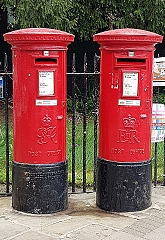
WHILE WALKING IN CAMBRIDGE, I spotted a pair of pillar boxes. At first sight they looked identical but soon I realised that they were not. One had a wider orifice for inserting letters than the other. The wider one bears the ‘logo’ of Queen Elizabeth II and its neighbour with the narrower slit bears the logo of the Queen’s father, King George VI. Apart from these differences, there were much the same.
The two pillar boxes I saw in Cambridge are not particularly old. The first post box on the British mainland was placed in Carlisle in 1853. The idea of using such receptacles for collecting mail is connected with the author Anthony Trollope (1815-1882). An informative website (https://www.postalmuseum.org/collections/highlights/letter-boxes/#) related:
“Anthony Trollope, now more famed as a novelist, was, in the 1850s working as a Surveyor’s Clerk for the Post Office. Part of his duties involved him travelling to Europe where it is probable that he saw road-side letter boxes in use in France and Belgium.He proposed the introduction of such boxes to Britain and a trial on the Channel Islands was approved. Four cast-iron pillar boxes were installed on the island of Jersey and came into use on 23 November 1852. In 1853 the trial was extended to neighbouring Guernsey. None of the first boxes used on Jersey survive. It is possible that one still in use on Guernsey together with another in our collection, originally sited in Guernsey, date from the 1853 extension to the trial.”
Before the introduction of pillar boxes:
“… there was [sic] principally two ways of posting a letter. Senders would either have to take the letter in person to a Receiving House (effectively an early Post Office) or would have to await the Bellman. The Bellman wore a uniform and walked the streets collecting letters from the public, ringing a bell to attract attention.”
Well, all that history is news to me and I might not have bothered to find out about it had I not seen the father and daughter pillar boxes standing side=by-side in Cambridge’s Market Square.
HERE IS SOME PRAISE FOR MY PUBLISHING ACTIVITIES in a book review by Stephen Turner (of the University of South Florida College of Arts and Sciences (USA)) in the Journal of Classical Sociology 2022, Vol. 22(2) 247–253:
“Adam Yamey, a retired dentist and son of an LSE Professor, has published, through Lulu, a self-publishing company discussed in the book, several books about London, the history of places in Britain,the social movements of the Indian diaspora, travel in the Balkans, his great-grandfather, who was a Jewish South African politician, and other historical topics with a strong“social” content. His blog and webpage (https://adam-yamey-writes.com) are nicely professional and indistinguishable from the pages digitally competent academics produce.”
The tradition of covering roofs with thatch continues all over the English countryside. Although most buildings are now roofed with tiles, there are still quite a few that have a covering of thatch. The thatch has to be renewed regularly, This is a lengthy and costly business that can only be carried out by the small number skilled thatchers, who operate around the country. Because of the costliness of maintaining it, having a thatched roof is now a conspicuous sign of wealth, whereas once it was not.
THE SHORT-LIVED POET Rupert Brooke (1887-1915) lived outside Cambridge in the nearby village of Grantchester, where he rented a room in The Old Vicarage between 1909 and 1912. In May of 1912, Brooke was sitting in the Café des Westens in Berlin and feeling nostalgic about his life in Grantchester. He put pen to paper and composed his poem “The Old Vicarage, Grantchester.” Clearly fed up with Berlin, the poet begins the final verse of his poem with:
“God! I will pack, and take a train,
And get me to England once again!
For England’s the one land, I know,
Where men with Splendid Hearts may go;
And Cambridgeshire, of all England,
The shire for Men who Understand;
And of that district I prefer
The lovely hamlet Grantchester…”
The final verse ends with the famous lines:
“The lies, and truths, and pain?… oh! yet
Stands the Church clock at ten to three?
And is there honey still for tea?”
Inside the old pavilion at the Orchard in Grantchester
Having recently visited Grantchester, I can sympathise with Brooke’s desire to return to this charming village whose meadows run along the bank of the winding River Cam. The parish church of St Mary and St Andrew contains structures created as early as the 12th century, but most of the building dates from the 14th and 15th centuries. The west tower is mainly early 15th century. The clock on it no longer stands at ten to three, but it was stuck at that hour during the era when Brooke was in Grantchester.
The Orchard, which lies across the High Street from the church and between it and the meadows by the river, was planted in 1868. Before moving into the Old Vicarage, Brooke had lodged in a house in The Orchard. In 1897, a group of Cambridge University students asked Mrs Stevenson of Orchard House if they could enjoy tea under the blossoming trees. Thus began The Orchard Tea Gardens, now a popular haunt of students and tourists. Because of the unreliability of the English weather, a wooden pavilion was built at the end of the 19th century. In case of rain, tea drinkers could sit in the pavilion and enjoy their tea without getting soaked. Rupert Brooke was one of those, who used this place often. The Orchard’s website (www.theorchardteagarden.co.uk/history-new/) noted:
“In taking tea at the Orchard, you are joining an impressive group of luminaries including Rupert Brooke (poet), Virginia Woolf (author), Maynard Keynes (economist), Bertrand Russell (philosopher), Ludwig Wittgenstein (philosopher), Alan Turing (inventor of the computer), Ernest Rutherford (split the atom), Crick and Watson (discovered DNA), Stephen Hawking (theoretical physicist, cosmologist and author), Jocelyn Bell (discovered the first pulsar) and HRH Prince Charles (future King of England). There is a list of some of the famous people who have visited in a separate page on our web site, and there are photographs of many of them on the walls of the Rupert Brooke Room.”
The Rupert Brooke Room was constructed later than the pavilion. The famous visitors included several noteworthy Indians including Jawaharlal Nehru, Salman Rushdie, and Manmohan Singh. There is a whole host of other well-known personalities who have taken tea at The Orchard including a group of Cambridge students, who achieved notoriety for their involvement in espionage for the Soviet Union: Anthony Blunt, Guy Burgess, John Cairncross, Donald Maclean, and Kim Philby.
As for Brooke’s question “And is there honey still for tea?”, I forgot to ask during our far too brief visit to The Orchard. Brooke was commissioned into the Royal Naval Volunteer Reserve force at the outbreak of WWI. In early 1915, he set sail with the British Mediterranean Expeditionary Force. In late February, he developed a serious infection following an insect bite and despite the efforts of surgeons on a French hospital ship moored near the Greek island of Skyros, he died. He was buried in an olive grove on the island. In the churchyard of St Mary and St Andrew, Brooke’s name in carved on the church’s simple war memorial.
The pedestrian crossing signals in London’s Trafalgar Square are fitted with a variety of different green lights, such as can be seen in the two examples in the photograph. I have not seen these sorts of green signals anywhere else in London. They are a part of a project to promote ‘diversity’ in London.
THE CRANE IS a tributary of the River Thames. Named after Cranford (Middlesex) through which it flows it is about 8 ½ miles in length. It rises as Yeading Brook and flows towards its mouth at Isleworth, just opposite the southern tip if Isleworth Ait. On its way, the Crane passes east of Heathrow Airport, Hounslow Heath, Whitton, Twickenham, and St Margarets. It also feeds the man-made Duke of Northumberland’s River, which enters the Thames about 610 yards downstream from the mouth of the Crane.
The shot tower at Crane Park
The Crane flows through beautiful, wooded parkland known as Crane Park. This incredibly peaceful open space, part of which is a nature reserve, is in Whitton near Twickenham. Part of the park is in the Borough of Richmond-on-Thames and the rest in the Borough of Hounslow. The Crane, which contains a wooded island and breaks up into rivulets occasionally, is bordered on both sides by the park. The island, Crane Park Island, now a lovely nature reserve, a peaceful oasis in a busy part of London, was created for a purpose that was far from peaceful: warfare.
In the 1760s, a gunpowder works was established in what is now the west part of Crane Park. The island was created to form a millstream for operating a waterwheel connected to a mill for grinding saltpetre (nitrates of either sodium, potassium, or calcium) used to make gunpowder. It was part of a complex of buildings that housed the Hounslow Powder Mills. Before the 19th century, what is now Crane Park would have been part of the then much vaster Hounslow Heath. The website of the Twickenham Museum noted that gunpowder mills were established on the Heath as early as during the reign of King Henry VIII.
All that remains of the Hounslow Powder Mills is a tall brick tower topped with a lead roof and a small lantern with a weathervane. It resembles a lighthouse. This was built either late in the 18th century or early in the 19th. Lying near it are a couple of circular millstones, which might have been used for grinding gunpowder. Described by some as a shot tower, it might have been used to manufacture lead shot. Molten lead would have been poured through a copper mesh near the top of the tower, and as it fell downwards, it formed into droplets, which when cooled became pellets of lead shot. This is most likely, but others suggest that the tower was part of a windmill.
Manufacturing gunpowder was a hazardous procedure, and unintended explosions were not unusual. The Twickenham Museum’s website related:
“Joseph Farington noted in his diary on Monday 25 January 1796 that: “The Powder Mills at Hounslow were blown yesterday. The concussion was so great as to break the windows in the town of Hounslow. Hoppner having been to Eaton, on his return rode to the spot where the Mills had stood, not a fragment of them remained. They were scattered over the country in small pieces. Three men were killed”… Burial records note deaths from further explosions: 5 on 17 November, 1 on 19 June 1798, 7 0n 15 July 1799, 2 on 27 June 1801, and so on through the century. Abraham Slade noted in his diary for 1859 that: “On the 29 of March the Powder Mills blew up, sending 7 poor souls into eternity in a moment. It has broken a great deal of glass in Twickenham & neighbourhood. We thought the whole place was coming down.””
The last major explosion at the Hounslow Mill was in 1915.
The powder mills passed through the hands of various operating companies: Edmund Hill, John Butts and Harvey and Grueber until 1820, then Curtis and Harvey until 1920, and then by Nobel Industries.The licence for producing explosives at Hounslow Powder Mill was revoked in 1927. In 1927, a Twickenham councillor, Frank Yates, bought the site. Later, he sold part of it for housing and the rest to Twickenham Council, who used it to create what is now Crane Park.
In addition to the impressive tower and a rusting sluice gate, several other less impressive remnants of the manufacturing complex can be seen on the island in the form of the bases of engine housings: lumps of bricks and concrete with thick metal rods protruding from them. Apart from the tower and a few other barely identifiable remnants, it is hard to believe that the sylvan and peaceful Crane Park was ever a place where the material of warfare had been produced for several centuries.