An unusual “Christmas tree” in a garden in Bangalore

WHENEVER I THINK ABOUT Christmas trees, I envisage a smallish pine tree that is roughly conical in shape. Today, I noticed a tall conifer growing in a garden in Bangalore. Attached to it there was a metal label identifying it as “Christmas tree. Araucaria cookei.” This tree bore no resemblance to any Christmas tree I have ever seen.

I used the Internet to look up ‘Aracauria cookei’, and learned that it is commonly known as ‘Captain Cook’s Pine’. It was first ‘discovered in New Caledonia by a botanist travelling with Captain Cook on his Second Voyage (between 1772 and 1775).

One botanical website revealed that when planted in a pot, this tree can be used as an alternative to regular Christmas trees. Other websites describing this plant make no mention of this. In any case, the specimen I saw labelled in Bangalore was taller than an average three-storey building. It was far too tall to be used as a Christmas tree.

Diwali and a film from Germany about the futility of warfare

GEORG WILHELM PABST (1885-1967) was a film director born in Austria. His film “Westfront 1918” was produced in 1930. This harrowing film vividly portrays the horrors of trench warfare and its effects on both the active German soldiers and their families back home in Germany. It is really an anti-war film. It was banned by the Nazis because it did not portray German soldiers as victorious heroes. Today, the 11th of November 2023 (Armistice Day), we watched a screening of this horrifying film about the last months of WW1 at Bangalore’s Max Mueller Bhavan (a branch of the Goethe Institute).

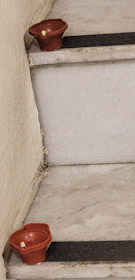
After the screening and interesting discussion about the film were over, we walked down the staircase instead of using the lift in which we had ascended. On each of the steps, there were small terracotta oil lamps (diyas), such as are typically lit during the Hindu festival of light – Diwali. Seeing this charming set of lamps placed to celebrate the imminent festival raised my spirits after having watched such a depressing film about the futility of warfare.

Eating off a banana leaf in the south of India

DURING OUR HONEYMOON in 1994, we travelled around places in southern India. At one point, we had to change trains at Coimbatore in Tamil Nadu state. With a few hours to spare, we ate dinner at a modest small restaurant near the station.

At Bheema’s restaurant in Bangalore

We sat down and banana leaves were placed on the table in front of us. These served as plates. There was no menu. A waiter hurried around the restaurant, stopping next to each diner and placing dollops of vegetarian culinary preparations on the leaves. He returned and placed a pile of steamed rice next to the mounds of vegetable items. He kept running from table to table, replenishing foods as required by the diners. This seemingly endless distribution of food set us back a total of 12 Rupees, which in 1994 was about £0.40 (yes, 40 pence). The coffee we drank at the end of the meal was the same price.

Yesterday, the 9th of November 2023, I was reminded of this experience whilst watching a waiter serving Andhra style vegetable preparations on a banana leaf in Bheema’s restaurant on Bangalore’s Church Street. Naturally, the meal cost a lot more than we paid in Coimbatore in 1994, but it was still very good value.

A café under the banyan trees in Bangalore

AIRLINES HOTEL IN BANGALORE has an outdoor seating area where you can enjoy beverages and South Indian vegetarian dishes, seated beneath venerable banyan trees.

You can read more about this popular, charming ‘al fresco’ café in my book of tales about travels in India. It is available from Amazon ( e.g., https://www.amazon.co.uk/HITLER-LOCK-OTHER-TALES-INDIA/dp/B0CFM5JNX5/ ) AND ALSO (if you live in India) from https://store.pothi.com/book/adam-yamey-hitler-lock-and-other-tales-india/

The Sport of Kings and a bar in Bangalore

I MUST ADMIT that I have never been much of a sportsma, and I know hardly anything about the game of polo, apart from the fact that it involves both horses and humans. Yesterday evening, as I enjoyed a postprandial brandy in the recently renamed ‘Polo Bar’ (formerly, ‘The Mixed Bar’) at the Bangalore Club, I spotted a large ‘coffee table’ book by Jaisal Singh about Polo and India.

What surprised me is the great age of the game of Polo. It seems to have been existence in some recognisable form as long ago as the 6th century BC. Then, it was played by some nomadic peoples in Central Asia. The book in the Polo Bar has a photograph of a terracotta model of a Chinese woman playing polo. This model was made between the 7th and 11th century AD. Another photograph shows the earliest known picture of a Polo player. This depicts a man on a horse, and was created in the same era as the model.

Much of the rest of the book is about polo in India. It charts the rise in popularity of the game amongst the wealthy rulers of the Princely States and the upper echelons of the British administrators and military in India.

The Polo Bar, which until recently was known by another name, has been decorated with polo memorabilia (e.g., photographs, trophies, and horseshoes). The handle on the door leading into the bar is horse-shaped. However, for me, the most interesting polo related item is in the Club’s Gardens. It is an inscribed stone block, which was the foundation stone of the Domlur Polo Pavilion laid in January 1914 by Lady Daly, wife of the British Resident.

The stone includes the information that one Major C Rankin was “Hon-Secy” and R Evans Esq was the architect. Both were military personnel, members of the “7th (Q.O.) Hussars”. The pavilion’s building contractor was BV Venkataswami Naidu.

In “Bangalore, the Story of a City”, by M Jayapal, the author wrote that initially the race course was out at Domlur. [Hence, the existence of Old Race Course Road]. In the late 19th century it moved to near Lalbagh, and then to its present position near to High Grounds. Presumably, because there had been equine facilities at Domlur, this would have been a suitable place for the Bangalore Club to locate its polo club there. I am not sure whether anything remains of the polo club pavilion whose foundation stone stands in the Bangalore Club gardens.

According to a blog article (https://wp.me/p1YuI1-1xA) about the pavilion, this is of interest:
“Information, thanks to the Bygone Bangalore group on Facebook: The Polo Club was located on Cambridge Road, in the area that is now Cambridge Layout. Opposite the Sai Baba Temple, there exists a portion of an old building which is said to be a part of the Polo Club.”
Incidentally, the centre of Cambridge Layout is less than a mile from the heart of Domlur.

As for the Bangalore Club’s association with polo, the following words quoted from the Club’s website (www.bangaloreclub.com) are of interest:
“Bangalore Club was established in 1868 as the Bangalore United Services Club for the officers of the British Empire. Originally the buildings were occupied by the Polo Club which moved out in the beginning of the 1860’s.”

I do not know how many current members of the Club play Polo these days. Even if it is not many, the Club’s former associations with the military ( the Club was formerly a club for military officers) and the land upon which it stands justify the naming of one of its bars to commemorate what was once known as “The Sport of Kings”.

A new airport terminal in Bangalore

DURING THE FLIGHT from Dubai to Bangalore (Bengaluru), the overhead baggage lockers on the ‘plane were filled to capacity with a diverse variety of often bulky carry-on luggage. This was in sharp contrast to what I observed on the flight from Heathrow to Dubai. On the whole, the passengers on this longer flight carried modest amounts of cabin baggage, and there was no problem accommodating it.

After a smooth flight from Dubai, we landed at Bangalore on time. I was excited to discover that we were being disembarked into the new terminal. Its construction was still underway when we left Bangalore in February 2023. It has been in use for no more than about 3 months.

I have only seen the arrivals section of the new terminal, and will have to wait before seeing, what I have heard, are the visually spectacular departure areas.

As for what I was able to see as an arriving passenger, I was neither amazed nor disappointed. The place has a feeling of great spaciousness and has much natural lighting. However, although much effort has been made to use ‘natural’ materials and plant-derived matter. For example, the immigration desks are lit from above by electric lamps in giant basket work shades. The desks are decorated with an external latticework of what looks like thin strips of bamboo. I wondered how long this would last before it becomes damaged by frequent wear and tear.

After passing through passport control, passengers enter a duty free shopping area. Its flamboyant decor seems to have been inspired by the ‘over the top’ interiors in Dubai’s airport terminals. Beyond this retail area, one reaches the baggage reclaim area, which seemed more spacious than what exists in the older terminal.

Despite not being overwhelmed by the visual nature of the new terminal, I must say that our passage through it was smooth and quicker than any of my many other arrivals at Bangalore’s airports, both old and very much older.

Wonderful new highways link the new terminal to the main road onto the city of Bangalore. However, after about 20 minutes speeding along, you are plunged into tthe city’s characteristic noisy, slow moving, congested traffic.

The force of ambition standing in Kensington Gardens

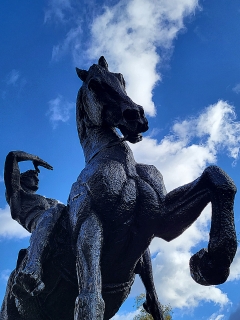
CAST IN BRONZE, he sits aside a rearing horse. He looks west towards Kensington Palace and uses his right hand to shield his eyes from the setting sun. I am describing a cast of a sculpture by George Frederic Watts (1817-1904), which bears the name “Physical Energy”. The sculptor was born on the birthday of the conductor George Frederic Handel – hence his two first names.

Watts began work on an equestrian sculpture in 1870, when it was commissioned by Hugh Lupus Grosvenor, who became 1st Duke of Westminster. It was to depict Hugh Lupus, 1st Earl of Chester. This was at Eaton Hall near Chester. In the early 1880s, Watts began working on “Physical Energy”, which was inspired by this sculpture. The first bronze casting of “Physical Energy” was made in 1902, and transported to southern Africa.   

Watts had been principally a painter until the 1870s, when his interests moved towards sculpture. “Physical Energy” was the high point of his efforts. A plaque next to the bronze horse and rider explained that this sculpture depicted:

“… a universal embodiment of the dynamic force of ambition …”

One man for whom these words might well be applied was the mining magnate and a Prime Minister of the South African Cape Colony, Cecil Rhodes (1853-1902), who ruthlessly let nothing get in the way of his ambitions. Therefore, it was particularly appropriate that one of the casts of Watts’s “Physical Energy” (that made in 1902) was placed at Groote Schuur (in Cape Town) as part of a memorial to Rhodes after Rhodes’s death. Unlike a bust of Rhodes placed nearby, which was vandalised recently, the equestrian statue has survived … so far.

An article published by Artnet News (https://news.artnet.com/art-world/watts-sculpture-royal-academy-ideological-baggage-1155971) made the following remarks:

“Watts, like Rhodes, believed in British imperial might to back its right to rule … the artist “plied” a leading politician with suggestions that military service should be introduced. (The colonial statesman Lord Grey was the man who suggested Watts turn the equestrian sculpture into a memorial to Rhodes after he died…)

… Watts’s imperialism was “liberal” and that the sculpture’s ideological meaning is open-ended. Socialists used the image, too. In fact, Watts had multicultural references in mind when he first conceived the statue: It was due to be dedicated to great empire builders including Mohammed, Attila the Hun, and Genghis Kahn. (Trowmans adds that May Watts, the artist’s second wife and a fellow artist, was much more sceptical of Rhodes.)”

The quotation mentions that Watts married twice. His first wife was the young actress Ellen Terry (1847-1928). They married when she was 16 years old. They separated after 10 months. During that brief period, she met, and was photographed by the Victorian pioneer of artistic photography, Julia Margaret Cameron (1815-1879). I have written about both Watts and his young bride in my book about Mrs Cameron (“BETWEEN TWO ISLANDS: JULIA MARGARET CAMERON AND HER CIRCLE”).

In addition to the cast in Cape Town, at least two others were made. One of them was produced in 1959. It now stands outside the National Archives in Harare (Zimbabwe). The cast which stands in Kensington Gardens was cast by AB Burton (a founder) in Thames Ditton in 1905, and was put in its present location in 1907. It stands on a line that runs between a Henry Moore sculpture on the bank of the Serpentine and Kensington Palace. Another cast was made in 2017 to commemorate the 200th anniversary of Watts’s birth. Briefly, it stood in the courtyard at the Royal Academy. Now, it stands at the Watts Gallery near Guildford.

We pass “Physical Energy” on our frequent strolls through Kensington Gardens. From it, there is a fine view of Henry Moore’s tall concrete sculpture across the Serpentine Lake. Watts was a contemporary of the French sculptor Auguste Rodin (1840-1917). However, sadly, neither Watts nor Moore produced works as fine as those of Rodin.

[My book about Julia Margaret Cameron is available from Amazon, e.g.,

https://www.amazon.co.uk/dp/B0BZFCVLX9/ ]

Some interesting places around Hampstead

I LIKE THE WORD “environs”. I believe that I first encountered it as the title of an American road map of Philadelphia, which I acquired when I was living in Chicago, Illinois, in 1963. In those days, I was an avid collector of maps, and I had a relative who lived in Chicago and worked for the Sinclair Oil Corporation. It was he who gifted me a collection of Sinclair’s company road maps and some others, which included the one mentioned already.

The word ‘environs’ is according to an etymological website (www.etymonline.com):

“… late 14c. (implied in environing), “to surround, encircle, encompass,” from Old French environer “to surround, enclose, encircle,” from environ “round about,” from en- “in” (see en- (1)) + viron “a circle, circuit,” also used as an adverb, from virer “to turn” …”

So, it was an appropriate word to use in my book “BENEATH A WIDE SKY: HAMPSTEAD AND ITS ENVIRONS”, which I published in 2022. The ‘Wide Sky’ refers to the firmament above Hampstead, which fascinated, and was often painted by, the artist John Constable. The ‘environs’ include several places around Hampstead, which are described in the book, and listed below.

My book includes West Hampstead and North End, which although some distance away from the heart of Hampstead, have always been considered part of Hampstead. Its many residents have included a former British Prime Minister -William Pitt, the Elder – and a famous architectural historian – Nikolaus Pevsner. Golders Hill Park, once the grounds of a stately home, lies partly in the borough of Camden, and partly in Barnet. So, much of it is an environ of Hampstead.

Hampstead used to be separated by countryside from Swiss Cottage. I have written about this place, which is where I went to school between 1960 and 1965. Close to my old school, there is a drama school and a separate, highly acclaimed theatre. Although not as old as Hampstead, Swiss Cottage is not devoid of interest. For example, Sigmund Freud lived the last years of his life in the area. And near his former home, there is the Tavistock Institute, which has attracted some controversy in recent years. And the architecturally interesting Swiss Cottage Library, built in the early 1960s, is well worth a visit.

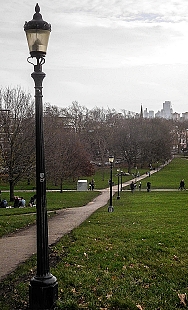
Primrose Hill (see photo above) also deserved a chapter in my book. It was visited by the artist/poet William Blake. The windows of the house where the philosopher Friedrich Engels for several years lived looked over towards the Hill. It was here that Karl Marx visited his friend Engels often. Nearby, later, the poet Sylvia Plath also resided for a while.

I have written quite a long chapter about Highgate, which is where I went to school between 1965 and 1970. Like Hampstead, the old village is rich in historic buildings and has had many now famous residents. This chapter also includes amongst many other places of note Highgate Cemetery, Kenwood, and its close neighbour the Spaniards Inn. Lesser-known places including a former school for Jewish boys and a block of flats designed by the Modernist Lubetkin are also described in this section of my book.

As you are probably beginning to realise, my book about Hampstead, which focusses mainly on the place, does include a great deal about areas that surround the old village. Apart from being factual, my book includes personal reminiscences of all the places described in it. What you will find when you read it is that you are in the hands of a guide who has known the area well for over six decades.

To obtain a copy of the book (or its Kindle version), head for an Amazon website such as:

https://www.amazon.co.uk/BENEATH-WIDE-SKY-HAMPSTEAD-ENVIRONS/dp/B09R2WRK92/

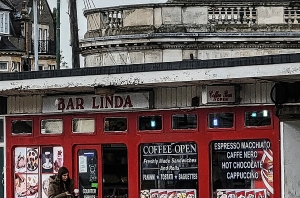
Trains, buses, and Bar Linda in London’s Golders Green

MUCH HAS CHANGED IN Golders Green since I was a small child in the 1950s. However, a few things have remained more or less the same. My earliest memories of Golders Green Underground station and its neighbouring open-air bus terminus date back to about 1960, when I began travelling by bus to school in Swiss Cottage.

The Underground station used to have two entrances. One, which faces the bus yard, is still in use. The other, which was approached by a long, covered walkway from beneath the bridge crossing Finchley Road, was closed to the public many years ago, but the passageway still exists. It was this entrance that my family used when using the train to travel into central London. There was also a covered staircase situated between these two entrances – this, now disused, was opened during rush hours. It led to the small parking area where the H2 bus, which serves Hampstead Garden Suburb, begins its journey. During my childhood, there was no public transport in the Suburb. Every day, I used to make the 10-minute walk to Golders Green station, passing the crematorium and the Jewish cemetery on my way.

Overlooking the eastern edge of the bus yard, is what was once the Hippodrome Theatre. When I was a lad, this was a flourishing theatre showing plays and pantomimes. Later, it was taken over by the BBC. After they left it, various religious organisations have used it for their meetings. Built in 1913, six years after the Underground was extended from Hampstead to Golders Green, this building’s exterior looks much as it did when I first remember seeing it.

The western edge of the bus yard has always been lined with a row of single storey sheds. Most of these have been used as shops and offices for London Transport. One of them houses a small café called Bar Linda. This was not in existence when I first used to visit the station, but I believe that it opened in the 1960s. Although this friendly little place has been serving customers for many decades, the first time I ventured inside it was in about 2017 when I was about to walk around Golders Green to take photographs for a blog article I was planning to write. I have re-visited it several times since then.

Although Golders Green might not be as aesthetically pleasing as its neighbours, Hampstead and Hampstead Garden Suburb, it is an area full of interest. Much has happened there since 1907 when it began growing from a rural hamlet into a leafy suburb. You can discover much more about Golders Green – its past, my memories of it, and its vibrant present – by reading my book “GOLDERS GREEN & HAMPSTEAD GARDEN SUBURB: VISIONS OF ARCADIA”, which is available (paperback and/or Kindle, from Amazon websites, such as: