A COMMANDER OF THE BRITISH EMPIRE AND THE ARTISTIC INTERPRETATION OF COLONISATION

THE ARTIST YINKA SHONIBARE was awarded the prestigious CBE in 2019. In case you do not know what these three letters stand for, it is ‘Commander of the British Empire’ – not that Britain has much of, if any, empire left to boast of. For much of its long existence, places in the British Empire witnessed many injustices and inhumanities. This was especially true before the abolition of the slave trade in the early 19th century. Yinka Shonibare, who was born in London in 1962 and brought up between that city and Lagos in Nigeria, uses his artistic skills to explore Britain’s lengthy history of imperialism imaginatively and creatively. Even without knowing that he does this, his art works are in themselves visually exciting and fascinating to the viewer. The pieces on display until the 1st of September 2024 at the Serpentine South gallery in Kensington Gardens are well worth seeing both for their inherent beauty and for the way that Shonibare expresses his interpretation of Britain’s colonial past and its legacy.

For more information about the exhibition, please visit: www.serpentinegalleries.org/whats-on/yinka-shonibare-cbe-suspended-states/

Paintings by artists in India who escaped from western European artistic traditions – at the Brunei Gallery

WHENEVER I VISITED my in-laws in India, I used to admire the painting by the Bengali artist Jamini Roy (1887-1972), which used to hang in their flat. His style of painting was both modern (20th century) and at the same time almost folkloric. When our friend Bob Annibale posted on Facebook about an exhibition at the Brunei Gallery (in London’s Bloomsbury) that included Roy’s works, we could not resist visiting it, and we were glad we viewed it.

The exhibition, which continues until the 22nd of June 2024, not only contains a good selection of Roy’s works, but also others by Bengali artists working mainly between the late 19th century and the 1950s. Apart from works by Roy’s contemporaries including various members of the Tagore family, Hemendranath Mazumdar, Nandalal Bose, and Qamrul Hassan, there were also paintings by lesser-known or unknown artists who painted in the traditional late 19th century Bengali (Kalighat) style, rather than in experimental styles of the 20th century.

The emergence of modern Indian painting was a consequence of the establishment of The Government College of Art in Calcutta (in 1854). As the website of the Brunei Gallery explained, it was:

“… established by a benevolent government for the purpose of revealing to the Indians the superiority of European art.”

In the late 19th century, Indian artists working in the college began questioning the validity of Indians painting in the alien Western European fashion that was being taught them. The gallery’s website continued:

“Academic art, introduced by the British Raj, was challenged by the nationalist art movement, the Bengal School of painting, led by Abanindranath Tagore (1871-1951) and his disciples who dominated the art scene in the first decades of the twentieth century.”

It is works by these artists, who used their creations as part of their expressions of desire to see India free of British rule, that form the greater part of the show at the Brunei.

Several things particularly interested me whilst viewing the excellently curated and displayed exhibition. One was three paintings by Jamini Roy that illustrate Christian themes (e.g., the Crucifixion, the Last Supper, and the Flight to Egypt). I had not before seen any of Roy’s paintings depicting Christian stories.  Another exciting discovery for me were a selection of paintings by Sunayani Devi (1875-1962), who was the sister of the artists Abanindranath Tagore and Gaganendranath Tagore, some of whose pictures are also hung in the show. These 3 siblings had a famous uncle, Rabindranath Tagore, some of whose paintings were also on show. At the exhibition, there were portraits of Rabindranath Tagore by each of his above-mentioned relatives, and one by Jamini Roy.

Yet another artist on show, whom I had never encountered, is Qamrul Hassan (1921-1988), who was born later than the other artists. Born in Calcutta before independence and the Bangladesh War (1971), he died in what is now Bangladesh. He studied at The Government College of Art in Calcutta in the late 1930s, and afterwards became involved with left wing political activities as well as his art. Later, he was active in the struggle for East Pakistan (now Bangladesh) to become independent of what was then West Pakistan. Beneath one of his creations at the Brunei, there is a quotation by Qamrul about his style of painting:

“… where Jamini Roy ends , I begin …”

And this is so easy to see in the excellent exhibition at the Brunei Gallery

I have told you what stood out for me, but although I have highlighted a few things, the rest of the exhibits are wonderful, and not to be ‘sniffed at’. After seeing the show, I thought that never before had I seen such a fine and large collection of paintings by the liberated artists either here in the UK or in India. The curators of this show deserve hearty congratulations.

Exploding with colour in a garden in London’s Richmond Park

LOCATED IN THE SOUTHWEST part of Richmond Park is one of London’s floral miracles: This year (2024), The Isabella Plantation is almost at its colourful best now (we visited it on the 12th of April) – a little earlier than usual. The camellia, azalea, and rhododendron bushes have exploded into flower alongside many other flowering plants. As you walk through the plantation, clouds of different coloured flowers seem to burst into view. Often two bushes of the same kind, but with different coloured flowers, have been planted together so that their blooms mix together to form an exciting ‘tapestry’ of flowers and contrasting hues.

During our latest visit, we were fortunate to have arrived at the right time to see some bluebells, but they were not close enough to each to seem like a carpet. However, they pale into insignificance in comparison with the flowering bushes, which have been skilfully planted so as to provide the viewer with three-dimensional, multi-coloured, natural works of art. On our recent walk around the Plantation, the morning sun (between 745 and 900 am) was shining brightly, enhancing the vividness of the flowers’ colours. Filtering through the trees, the sunlight created splashes of light on the flowers, producing an interestingly dappled effect. And some petals had sunlight shining through them, creating a lovely sight.  

There are three ponds in the Plantation. The largest is Peg’s Pond. Next largest and at a higher altitude is Thomsons Pond, which is surrounded by a few flowering bushes. The most magnificent pond is the smallest of the three. It is the Still Pond. It is almost surrounded by azalea and rhododendron bushes. When they are in flower, their incredibly exuberant blooms are reflected in the mirror-like water of the Still Pond. This amazing effect must be seen to be believed. We saw a few mandarin ducks in the pond. As they swam, they created ripples on the surface of the pond. The gentle undulations of the water surface create interesting shimmering reflections of the firework-like flowers on the bushes next to the pond.

As on previous occasions, we parked in the free Broomfield car park, which is a short, pleasant walk away from the Plantation. Next to this carpark there is a café, which sells snacks at rather outrageously high prices. Optimistically, I hope that some of the profit goes to maintaining the Plantation.

Seeing the resplendent display of colour in the Plantation provides a pleasant distraction from the many disturbing things that are happening in many places in the world beyond the boundaries of Richmond Park.

A GARDEN IN HAMPSTEAD WITH A FASCINATING  HISTORY AND WONDERFUL PLANTS

GAINSBOROUGH GARDENS IS a cul-de-sac that leads southeast from Hampstead’s Well Walk, not far from one of the former homes of the artist John Constable. Houses are arranged around an attractive sloping oval garden, which was once part of the grounds of Hampstead’s once famous, now defunct, spa water centre and resort – the lost since demolished Long Room, which I have described this in my book “Beneath a Wide Sky: Hampstead and its Environs” as follows:

“These extensive premises were demolished in 1882 to make way for an estate of residential buildings. The former Pump Room and Assembly Room occupied a plot that is bounded by Well Walk, East Heath Road, and Gainsborough Gardens. Present day Gainsborough Gardens runs around an oval open space, which is shown as a pond in the gardens of the former Pump Rooms on an 1866 map. The pond was later filled in.

At the corner of Gainsborough Gardens and Well Walk, there is a tall building with attractive neo gothic windows. This was built in about 1704. Next to this house, but separated from it by Gainsborough Gardens, stands Wellside, a house built in 1892 on the site of the Pump Room.”

Yesterday, the 10th of April 2024, we visited Gainsborough Gardens with a friend of ours who introduced us to the friendly and highly informative couple, Adrian and Lynn, who look after the common garden within the oval. They had been the gardeners employed by the renowned pianist Katharina Wolpe (1931-2013), who had taken a great interest in the planting and planning of the oval garden. She had lived in Wellside, the house mentioned above. The gardeners told us that when she died, according to her wishes, she had bequeathed the plants in her garden to them, and they have since planted many of them in the oval garden.

Another famous person resided in Gainsborough Gardens. We were informed. That the author John le Carré (1931-2020) had lived in a house on the southwest part of the oval. As yet, there is no commemorative plaque for either him or Katharina Wolpe. According to Wikipedia, other notable residents of the Gardens included:

“ The family of songwriter Gary Osborne … The women’s suffrage campaigner Elizabeth Knight … The historian Bernard M. Allen … The Labour MP Arthur Greenwood … The former Governor of Northern Nigeria, George Sinclair Browne … Archibald Chisholm, the oil executive and former editor of the Financial Times … CE Maurice, who helped preserve Parliament Hill Fields and limit the expansion of construction onto nearby Hampstead Heath.”

Gainsborough Gardens, despite being a private ‘road’, is freely open to the public, and its centrally located garden is a delight to see.

[My book about Hampstead is available as a paperback and Kindle from Amazon:

https://www.amazon.co.uk/BENEATH-WIDE-SKY-HAMPSTEAD-ENVIRONS/dp/B09R2WRK92 ]

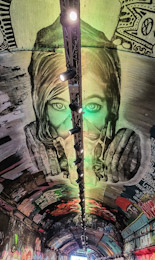
A colourful tunnel with paintings beneath Waterloo Station

LEAKE STREET RUNS beneath the platforms and tracks of London’s Waterloo Station. It is 300 yards long and its walls and ceiling are covered with colourful graffiti created with cans of paint spray. The artwork creation in this street that runs in a tunnel was inaugurated in May 2008 during the Cans Festival, which was organised by the artist known as Banksy.

Unlike many public places in London, painting the walls in Leake Street is legal. Walking along this highly decorated street is a magnificent experience, which you can repeat often because the images on the wall are frequently changed. If you are lucky, you can watch the artists in action.

Walking beneath the waters of the River Thames

IT IS NOT NECESSARY to be able to hold your breath for a long time or to carry a snorkel or even air cylinders to be able to stroll leisurely deep below the surface of London’s River Thames. If you fancy a walk beneath the water, the Greenwich Foot Tunnel is the place to be. It can be entered by stairs or using a wood panel-lined lift from one of its two entrances – the southern one near the Cutty Sark in Greenwich, and the northern one at Island Gardens.

The tunnel, which is circular in cross-section, is 405 yards in length, and 50 feet beneath the river at its deepest point. For most of its length it is 3 yards (9 feet) in diameter, and it slopes downwards at both ends. Its construction began in 1899 and was completed in 1902. Therefore, building the tunnel happened during the entire time that the 2nd Anglo-Boer War was being fought in South Africa. The lifts that are housed beneath domed structures at each end of the tunnel were ready for use in 1904. Judging by the appearance of the wood panelling within the lift carriages, it looks as if these were installed many years ago. Despite their vintage appearance the lifts have been modernised and work without needing an operator.

Although there many notices forbidding cycling in the tunnel, there is no shortage of cyclists disobeying this rule. This makes walking in the tunnel slightly hazardous as the cyclists speed along the narrow walkway in the long, straight tunnel. Using the tunnel is a convenient way of traversing the Thames and gives one the opportunity to walk under water.

Sell the wife at Smithfield instead of divorcing her

IF YOU WISH to see the meat market at London’s Smithfield in action, either you must go to bed very late or wake up quite early, because the market is only open between 2 am and 10 am. This April, we visited it at about 1.30 in the afternoon, and there was little to see and there was hardly any odour in the air.

Back in October 2017, I walked from Clerkenwell to Smithfield, and wrote about it in a blog I published (https://londonadam.travellerspoint.com/44/). Here is what I wrote about the meat market:

At Peters Lane, Cowcross street turns southward towards to meet St Johns Street, which commences at the north side of Smithfield Market, an indoor wholesale meat marketplace. Smithfield’s central Grand Avenue is entered through an archway flanked by two heraldic dragons and a pair of stone sculptures. The Avenue runs beneath a high roof supported by ornate painted ironwork arches. Side aisles are lined with the meat dealers’ stalls and glass-covered display cabinets. In 1852, London’s livestock market was moved from Smithfield to Copenhagen Fields in Islington (off Caledonian Road, where the Caledonian Park is now located). This cleared the area for the construction of the present meat market, which was completed by 1868. Constructed in an era before refrigerators were used, the market was designed to keep out the sun and to take advantages of prevailing breezes.

I continued as follows:

In mediaeval times, Smithfield had a bad reputation. It was known for criminal activity, violence, and public executions. In the early 19th century, when obtaining divorce was difficult, men brought their unwanted wives to Smithfield to sell them, then a legal way of ending a marriage (see: “Meat, Commerce and the City: The London Food Market, 1800–1855”, by RS Metcalfe, publ. 2015).

In relation to disposing of a spouse, I quoted the following verse by an unknown author quoted in “Modern Street Ballads”, by John Ashton (published 1888):

“He married Jane Carter,

No damsel look’d smarter;

But he caught a tartar,

John Hobbs, John Hobbs;

Yes, he caught a tartar, John Hobbs.

He tied a rope to her, John Hobbs, John Hobbs;

He tied a rope to her, John Hobbs!

To ‘scape from hot water,

To Smithfield he brought her;

But nobody bought her …”

What I did not mention in my 2017 piece is that John Ashton noted in his book:

Wives at the market did not fetch good prices; the highest I know of, is recorded in The Times, September 19, 1797: “An hostler’s wife, in the country, lately fetched twenty-five guineas.” But this was extravagance, as, with the exception of a man who exchanged his wife for an ox, which he sold for six guineas, the next highest quotation is three and a half guineas; but this rapidly dwindled down to shillings, and even pence. In 1881, a wife was sold at Sheffield for a quart of beer; in 1862, another was purchased at Selby Market Cross for a pint; and the South Wales Daily News, May 2, 1882, tells us that one was parted with for a glass of ale. Sometimes they were unsaleable …”

Fascinating, but horrific when you think about it. In any case, you will be pleased to know that although I visited Smithfield with my wife a few days ago, I had no intention of selling her! Instead, we enjoyed some liquid refreshment in the nearby branch of the Pret A Manger café chain.

“Dreams Have No Titles”: An exhibition at the Whitechapel Gallery in London

IT DISAPPOINTS ME when I sleep without being aware of dreaming. Even nightmares are better than no dreams at all. What I enjoy about dreaming is that what I perceive in my dreams is on the one hand so realistic – lifelike and credible, and on the other hand simultaneously so completely unrealistic. The art of cinema can achieve the same ambiguity between realism and fantasy, which is why I enjoy watching films. Until the 12th of May 2024, there is an excellent exhibition at London’s Whitechapel Gallery, which explores what I enjoy about films and dreams. Called “Dreams Have No Titles”, it displays the multi-media creations of the Franco-Algerian artist Zineb Sedira, who was born in 1963 – the first year that Algeria was independent of the French, who had colonised it since 1830.

The exhibition, which was first shown in the French pavilion at the Venice Biennale of 2022, consists of a series of film sets. On one of the film sets, an elegantly dressed couple of actors perform ballroom dancing ( https://youtube.com/shorts/kUrD3aJP9s0?si=zez0VWoRqWmJMy4l ) for a few minutes at various times of the day. Each film set reproduces a scene from one of several films made in the 1960s – each one referencing events that took place during the period when Algeria was fighting for its independence. Within the film sets there are video sequences about that period, and about the artist and her life. Born in France, she came to the UK in 1986. One of the exhibits is a wonderful film with the same title as the exhibition. In it she explores film, its creators, its actors, imagination, dreams, and her artistic approach. Each of the film’s 24 minutes is wonderful. The film and other video works in the exhibition are in harmony with what I find so similar between experiencing dreams and watching cinematic films. I came away from the exhibition feeling elated and full of admiration for Zineb and her artistic work.

Taking the scenic route from St Pauls cathedral to Paddington

ONE AFTERNOON IN April (2024), out of curiosity we travelled by bus number 46 from Smithfield to Paddington station instead of taking the much faster Underground train route. As we proceeded along the whole route of the number 46 bus, we realised that it links several places of interest to both Londoners and visitors to the city.

The 46 starts within easy walking distance of the BARBICAN CENTRE, SMITHFIELD MARKET, ST BARTHOLOMEW THE GREAT, and THE LONDON MUSEUM. Also, its first stop outside ST BARTHOLOMEWS HOSPITAL is not far from ST PAULS CATHEDRAL.

When the bus gets moving, you will soon pass the ornate Victorian HOLBORN VIADUCT and HATTON GARDEN – famed for its diamond merchants. Next, you will see the Victorian gothic PRUDENTIAL BUILDING and before turning on to Grays Inn Road, you will see a row of half-timbered houses – some of the only PRE-FIRE OF LONDON survivors. Much of the west side of Greys Inn Road is lined with the buildings of GREYS INN – one of London’s four historic Inns of Court.

KINGS CROSS STATION and the magnificent Victorian gothic ST PANCRAS STATION are the next things to look out for. You could leave the bus here to explore the new developments around Kings Cross including COAL DROP YARD and KINGS PLACE hall and events centre. If you remain on the bus, you will head north past the ROYAL VETERINARY COLLEGE to the not over attractive KENTISH TOWN. At CAMDEN ROAD STATION, you will not be far from the REGENTS CANAL and the popular CAMDEN MARKET.

Heading northwards, the 46 reaches Fleet Road in south Hampstead, which is a short walk from the famous Modernist ISOKON BUILDING in Lawn Road. You could disembark at South End Green and visit Mirko to enjoy refreshments in his small MATCHBOX CAFÉ. HAMPSTEAD HEATH is a few minutes’ walk away. If you remain on the bus, you will pass the ROYAL FREE HOSPITAL and next to it, the Victorian gothic ST STEPHENS CHURCH designed by SS Teulon.

The bus then heads up Rosslyn Hill into the heart of historic HAMPSTEAD, where there is plenty for the visitor to explore. Then, the 46 descends the steep Fitzjohns Avenue to Swiss Cottage. Just before it reaches there, look out for the statue of SIGMUND FREUD at the southern end of the Tavistock Institute. The house where Freud lived, now THE FREUD MUSEUM, is close by.

After passing St Johns Wood Station with its several scraggly palm trees, the bus winds its way through streets near Maida Vale until it reaches Warwick Avenue Underground station. Descend here to walk to the REGENTS CANAL near to where it enters the scenic LITTLE VENICE.

Soon, after passing beneath the elevated WESTWAY, the 46 heads for its last stop, which is on a bridge from which you can get a good view of the wonderful glass and ironwork roof of PADDINGTON STATION – a masterpiece of Victorian engineering.  From Paddington, there are a few bus routes that will allow you to continue your London sightseeing.