
It’s on the wall
In small tiles so clearly written
So we won’t forget
The notice is on a building in Riding House Street, London

It’s on the wall
In small tiles so clearly written
So we won’t forget
The notice is on a building in Riding House Street, London
TODAY, WE VIEWED an exhibition of paintings by an artist born in India, who spent most of her life in the British Isles. The artist is Gurminder Sikand (1960-2021), who was born in Jamshedpur, but moved to the Rhondda Valley in South Wales with her parents in 1970. Her artistic training was first at the Cardiff College of Art and Design (in 1979-80) and then at the City of Birmingham Polytechnic (now Birmingham City University), where she was awarded a fine art degree. In 1983, she and her husband moved to Nottingham. Her work began to attract wide attention after one of her pieces was selected as the winner of the East Midlands Art Prize by the South African artist Gavin Jantjes.

In an obituary written by her husband, published in thegauardian.com on the 14th of February 2022, it was noted that her work:
“… was characterised by images of strong women. This was true of her many self-portraits, her paintings influenced by Indian folk art, her watercolours of women hugging trees (inspired by the Chipko anti-deforestation movement), and latterly her drawings of muscular female figures whose physiques reflected Gurminder’s workouts at her city-centre gym in Nottingham.”
The paintings we saw today (22nd of May 2024) at the Maximillian William gallery in London’s Fitzrovia were some of Gurminder’s earlier works, created between 1986 and 1992. Most of the 19 works include depictions of women. All of them are slightly mysterious, but also eye-catching. Many of them include women with several heads. I wondered whether in creating these she was thinking about Hindu deities that are often shown as having many arms. As far as I am aware few, if any, Hindu deities are shown in images as having more than one head, but seeing Gurminder’s women with many heads made me think about the multi-limbed deities in Hindu imagery.
Trees also figure prominently in many of the paintings we saw. Regarding this and her painting style, the gallery’s press release has this to say:
“Images of women drawn from Indian mythology recur throughout Sikand’s work. Her interest in the figure of the goddess – particularly the Hindu goddess Kali, who both destroys and creates the world anew, and is often pictured with a garland of human heads – is evident in her depictions of women metamorphosing into nature. In Sikand’s paintings, women are seeds buried in soil, hang on tree branches to provide shelter, or are even the earth and sky themselves. These amorphous relationships between the figure and nature were further inspired by the Chipko environmental movement, which began in north India during the 1970s, when villagers – mostly women – embraced trees at risk of deforestation, a protest that also highlighted their primary role as caregivers. Sikand’s female figures are often portrayed as strong: appearing resolute with multiple heads or acting as protectors over her landscapes.”
Although Gurminder left India when she was only 10 years old, and was then immersed in British life, culture, and education, her Indian heritage never deserted her, and is expressed in her wonderful paintings. I enjoyed viewing this well-displayed exhibition, and I recommend seeing it before it ends on the 29th of June 2024.
AT GROUND LEVEL, London’s Oxford Street is lined with numerous retail outlets, many of which can be seen on shopping streets and in malls all over England. Raise your eyes above ground level, and you will notice that the shops are beneath buildings designed in a bewilderingly wide range of styles. Today (the 22nd of May 2024), I spotted a Modernist style building, number 219 Oxford Street, which is on the corner of Oxford Street and Hill Street. Its ground floor has become part of a Zara shop’s showroom.

The upper floors of the five-storeyed number 219 retain their 20th century Modernist style architectural features, and its Oxford Street facade is adorned with three bas-relief plaques. One of them, at the fourth-floor level bears the date ‘1951’ and a logo. Despite its date, the building has remarkably clean lines and an elegant simplicity. There is much information on the Internet about this edifice, but even though I have walked past it many times, it was only today that it caught my attention.
The Historic England website (https://historicengland.org.uk/listing/the-list/list-entry/1352668?section=official-list-entry) revealed that the building:
“… was designed by Ronald Ward and Partners in 1950 for the landlord Jack Salmon, who took the second-floor suite for himself. The scheme was revised in February 1951, but was not built until after August 1951 (explaining the plaques celebrating the Festival of Britain – an event which was held in the summer of that year), and appears not to have been completed until 1952, as evidenced by the dated tile near the door to the upper floors. Despite the delay in its construction the building was among the very earliest post-war commercial buildings to be put up in the capital.”
Another website (https://lookup.london/219-oxford-street-history/) provided some detail about what is depicted on the plaques. The plaque with the date 1951 also contains the (1951) Festival of Britain logo. Above this, the top plaque shows the Royal Festival Hall and next to it the Shot Tower from Lambeth Lead Works, which stood close to the Hall, but was demolished in 1962 to make way for the Queen Elizabeth Hall. The lowest plaque depicts the Skylon, which was also part of the Festival of Britain complex of structures (on the South Bank), but no longer exists.
Number 219 was threatened with demolition in 2004, but luckily for us it escaped this fate, and is now protected as a Grade II Listed Building.
DURING A VISIT TO Basildon Park near Reading, I spotted a display of photographs of “Nabob houses in the Indian Style”. A ‘nabob’ was someone who was conspicuously rich, having made his fortune in India. These were buildings constructed by people who had made their fortunes while working in India. for the British East India Company. Some, but not all of these, buildings incorporate architectural features derived from the architectural styles that the British found when they visited India.

Late 18th century Basildon Park, which was built by a Brit who had made his money in India, is a Nabob’s house, but without any features borrowed from the Indian subcontinent. It is a Palladian-style building. It was one of about 30 houses built in Berkshire for the nouveau-riche British ‘nabobs’, who had enriched themselves in India.
INSIDE KENWOOD HOUSE (in north London), the visitor can see a glorious collection of paintings by famous artists such as (to name but a few): Vermeer, Rembrandt, Constable, Gainsborough, Reynolds, Cuyp, Romney, and Van Dyck. These works are part of the Iveagh Bequest, which was the collection of paintings bought by the art collector, Irish brewing magnate, and philanthropist Edward Cecil Guinness, 1st Earl of Iveagh (1847-1927).

In the grounds of Kenwood House, there are two sculptures created after Iveagh’s death. They are both by sculptors, who are considered as some of the greatest British artists of the 20th century. One of them, which is near the house, is by Barbara Hepworth (1903-1975), and the other, which we examined when we walked past it today, illustrated above, is by Henry Moore (1898-1986). His large bronze sculpture is called “Two Piece Reclining Figure No. 5”, and was completed in 1963-1964. It has been lent to Kenwood by the Tate Gallery.
Apart from being superb sculptors and having works at Kenwood, Hepworth and Moore have other things in common. Both studied at the Leeds School of Art, where they met. And both lived in Hampstead, which is close to Kenwood, for a while between the two World Wars. While they were in Hampstead, they had studios close to each other: Hepworth in Mall Studios, and Moore in nearby Parkhill Road. You can find out more about their lives in Hampstead in my book “Beneath a Wide Sky: Hampstead and its Environs”.
ON THE FOURTEENTH of November 1940, Coventry’s cathedral was badly damaged by bombs dropped from aircraft of the German Luftwaffe. After WW2, a new, modernist cathedral was constructed next to the shell of the damaged one. Designed by Basil Spence, the new cathedral was built between 1956 and 1962. Visitors to this magnificent replacement cathedral can hardly miss seeing the enormous tapestry that hangs at the eastern end of the church. Depicting “Christ in Glory in the Tetramorph”, it was the creation of the artist Graham Sutherland (1903-1980). I have seen this work and admired it on several occasions, but little did I expect to find a connection with it when visiting a National Trust property not far from Reading – Basildon Park.

Set in lovely grounds surrounded by rolling hills that lead down to the rows of trees growing near the Thames, the house at Basildon Park was largely completed in the Palladian style by 1783. After a series of owners, including the military during the two World Wars, it was bought by Lord and Lady Iliffe (later known as ‘the 2nd Baron and Lady Iliffe’) in 1953. They restored the house, and filled it with artworks they collected. A great patron of the arts, Lord Iliffe was a friend of the artist Graham Sutherland. He and his wife were able to purchase many of the studies that Sutherland made when planning the great tapestry that hangs behind the high altar in Coventry Cathedral. Some of these were donated to the Herbert Museum in Coventry, and several of them are on display in a room on the ground floor of Basildon Park. The studies exhibited in Basildon Park demonstrate Sutherland’s great artistic talents. Each of them, although sketches of details to be included in the final tapestry, is itself a lovely work of art.
Sutherland’s studies are (for me) the highlights of the Iliffe’s artworks on show in their former home – they gave it to the National Trust in 1978. In addition to these fine works, a few others caught my attention. In one room on the first floor, there are four sketches of places in India by William Daniell (1769-1837). It is quite appropriate to find these in Basildon Park, which was originally built by Frances Sykes, who made his fortune in the British East India Company. Another, more recent, painting that interested me was a portrait of Lady Iliffe painted in the 1940s by Frank Salisbury (1874-1962). A society portrait painter, he interested me not because of his art, but because he owned a spectacular neo-Tudor mansion, Sarum Chase, on West Heath Road in London’s Hampstead. I came across him when I was doing research for my book about Hampstead.
For some reason, despite visiting many National Trust properties around it, today (the 19th of May 2024) was the first time we went to see Basildon Park. The house is worth seeing – its rooms are spacious and well-lit, and the artworks are, as I hope I have explained, of great interest. Also, it stands in beautiful grounds – an idyllic English countryside.

A glass of cider
Chilling by the lazy river
It’s summer time
THE STRAND IS a street in the heart of London, which runs close to the River Thames. It used to be close to the water. Hence, its name. Two churches stand like islands in this busy thoroughfare. One of them is St Clement Danes, and to the west of that is St Mary Le Strand, which we entered today (the 17th of May 2024) after visiting the Photo London exhibition at nearby Somerset House.
St Mary Le Strand was designed by James Gibbs (1682-1754) and constructed between 1714 and 1717. It was built on the site of a great maypole, which was the centre of May Day celebrations in the 16th and 17th centuries. The church’s interior is in an exuberant baroque style, reflecting its architect’s earlier travels and training in Italy.
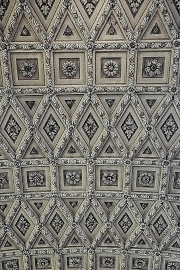
The walls of the nave are bare. It had been intended to have been painted, but this never happened. What really attracts the eye is the amazing geometric ceiling above the nave (see photograph). The ceiling is an expanse of triangles, squares, and lozenges that cover its barrel vaulting. In the centre of each of these many shapes, there is a sculpted flower. This ceiling was designed by Chrysostom Wilkins, who worked on other churches in London. It was created in plasterwork, shaped by hand, without using moulds.
St Mary Le Strand has been open less regularly than its neighbour St Clement Danes. Although I have visited the latter often, I believe that today was either the first or one of a very few visits to St Mary Le Strand. If you happen to be passing this church, and it is open, do take a few minutes to admire its wonderful ceiling.
ONE OF THE characteristics of a living organism is the ability to reproduce itself. Pollination of plants is an important stage in maintaining the survival of a species.

Yesterday (the 15th of May 2024), we saw a curious tree at Kew Gardens. It looked as if it had both green and white leaves. It is a Handkerchief tree (Davidia involucrata). The white appendages are not leaves but bracts. They form for about a fortnight each year, and serve to increase the chances of the tree’s flowers being pollinated.
I ENJOY VIEWING sculpture displayed in the open-air. Seeing sculpture ‘al-fresco’ is for me much more pleasant than viewing it in a gallery. From time to time, the Royal Botanic Gardens at Kew hosts outdoor sculpture displays. In the past, I have seen exhibitions of works by Henry Moore and Dale Chihuly. This year (2024), there are several sculptures by Marc Quinn dotted around the gardens. Quinn, who was born in the UK in 1964 is an adventurous creator, whose works sometimes give rise to controversy. I do not believe that the collection of his works now on display in Kew will give rise to much, if any, controversy.

Except for several bronze sculptures depicting larger than life bonsai trees, which have been placed in the Temperate House, the rest of the sculptures are made in highly reflective stainless steel. Appropriately for their setting, these sculptures are derived from the shapes of plants, leaves, and flowers. Because they are so reflective, they reflect the plants and trees growing near them. This helps to camouflage them, or make them seem as if they are merging with the surrounding vegetation. Although they contrast dramatically with their surroundings, their reflective nature softens the contrast when viewed from certain angles.
When I see sculpture next to nature, I often feel that however well the artwork has been created, it often palls when compared to what Nature has created. Quinn’s work at Kew has this effect, but somehow, probably because it reflects the plants around it, the comparison between what he created and what has been growing naturally is not too marked, and did not disturb me.
A visit to Kew Gardens is always enjoyable, and seeing the place with Quinn’s work in situ was a good experience. The exhibition will continue until the 29th of September 2024.
 yamey
yamey 