BANGALORE IS A CITY which changes rapidly. Sadly, much of the change involves the demolition of buildings of historical interest – so-called ‘heritage’ structures.
So, it is wonderful to come across residences (bungalows) that have been standing for many years. Some of these bungalows appear neglected and will most likely be demolished soon to make way for architecturally indistinguishable office blocks and blocks of flats. Others are still being used as homes and can be seen in varying conditions of repair. And, fortunately, some have been beautifully restored and are either being used as dwellings or for a new purpose.
2 Berlie Street
One of the restored bungalows is number 2 Berlie Street in Langford Town. It is now being used as an art space (for exhibitions) by an organisation called Kaash. We visited it today (22nd November 2024) to view a temporary exhibition about contemporary designs of devotional objects, mainly diyas (oil lamps used on Hindu ceremonies) and also some almost abstract depictions of Devi created by Jayshree Poddar. The artworks were tastefully displayed in some of the rooms in the Bungalow. The other rooms contained folk art from various countries in Africa.
It would be great if most of the remaining heritage bungalows could be preserved, but this is unlikely because the land on which they stand can be sold for enormous sums of money.
All of the photos are of Kaash in Berlie Street unless otherwise labelled.
I HAVE VISITED BANGALORE regularly over the past 31 years. Each time, I have been impressed by the city’s numerous well-stocked bookshops. Many of them are now located along the short Church Street, which runs parallel to a stretch of the much longer MG Road. At the last count, I found 9 bookshops along Church Street, which is less than half a mile in length.
Bookworm
One of these shops that impresses me most is called Bookworm. Its location has changed several times since I first found it in 1994. Now, it is housed in a former mansion set back from Church Street and reached by a tree shaded pathway. It contains many rooms, each of which has walls lined with bookshelves filled with books from floor to ceiling. Much of the floorspace in these rooms is covered by piles of books. The books range from the latest releases to out of print and secondhand volumes. Recently, a small room has been added to display rare antiquarian editions. Despite this, there are many old and interesting books within the other rooms.
Bookworm is an ideal place for browsing if you have plenty of time on your hands. If you are pressed for time or know what you are looking for, the helpful staff will either know where to find what you are seeking, or will search for you.
When you have selected what you wish to purchase, some of the newer titles are subject to a discount at the cash desk. The older books and secondhand editions are priced very reasonably.
Although there are other superbly stocked bookstores in Church Street, notably Blossom Book House, Bookworm is my favourite. It is truly a magnet for bookworms.
AN ICON IS a person or symbol worthy of veneration. These days ‘iconic’ has come to mean “widely known and acknowledged especially for distinctive excellence”. Thus, for example, the Taj Mahal and the Gateway of India are now described as being iconic.
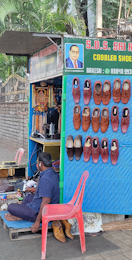
Today, we visited a pavement shoe-repairer (‘cobbler’ or ‘mochi’) in Bangalore. All over India, one can find these useful street side artisans. Often, they work from small open fronted huts, which contain their tools and materials as well as footwear that is either waiting to be repaired or already fixed. One could say that the mochis are iconic features of the streets of India.
Apart from being iconic, many mochis adorn their huts with icons. These icons always include at least one picture of BR Ambedkar (1891-1956). He not only drafted the Constitution of India but also fought for the political rights and social freedom of the Dalits (once known as the ‘untouchables’).
Traditionally and still today, mochis are almost always from Dalit communities. This is why mochis have images (icons) of Ambedkar on their huts. The mochi we visited today on St Marks Road had not only some images of Ambedkar but also one of a Mr Haris, the local member of the Karnataka legislative assembly. And this is not all. Within his hut, the mochi had an image of Shrinatji, who is the God Krishna represented as a young child. This was garlanded with flowers as was one of the pictures of Ambedkar hanging beside it.
The iconic mochi polished my well-worn leather sandals while I sat beside his hut covered in icons
THE DIRECT FLIGHT FROM London to Bangalore (Bengaluru), operated by British Airways (‘BA’) lasts about 9 hours and 20 minutes. In the past, we have travelled World Traveller Class (the cheapest seats) and were not satisfied with both the level of comfort and the attitude of the cabin staff.
This year (2024), we splashed out and paid for World Taveller Plus seats. The extra cost gets one bigger seats that recline more than adequately, more leg room, better treatment and attention from the cabin crew, and priority boarding. At the end of the flight, we felt that spending more on the tickets was easily justified.
KENIA ALMARAZ MURILLO was born in Bolivia in 1994. She moved to Paris in France at the age of 11 years. Until the 30th of January 2025, there is an exhibition of her work at the Waddington Custot Gallery in London’s Cork Street.
All of the exhibits contain woven textiles. Many of them also have objects added to them, making them like three-dimensional collages. The objects she has added were salvaged from Parisian scrapyards whilst the yarns she has used are indigenous South American in origin. The resulting artworks are both beautiful and exciting.
I can strongly recommend seeing this well-displayed show in a gallery a few yards away from the northernentrance to Burlington.
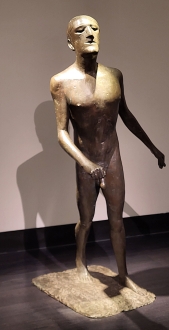
THE FAMOUS SCULPTOR Elisabeth Frink (1930-1993) was a regular visitor to our family home in Hampstead Garden Suburb during the 1960s. During that period, I met her whenever she was invited home for dinner, but then I was too young to realise how famous an artist she had become. She was a good friend of my mother, Helen Yamey (1920-1980), who was also a sculptor. Elisabeth and my mother got to know each other when they were both creating art in the Sculpture Department of the St Martins School of Art, when it was in Charing Cross Road.
By Elisabeth Frink
Today (15th of November 2024), I was reminded of my mother’s friendship with Frink when we entered Christie’s auction house in Mayfair. We always enter this place when we are passing near it to see some of the works of art that are on display prior to being auctioned. You never know what gems you are likely to see. Today, there was a small collection of British art created during the past 100 years. Amongst the works on display were two by Elisabeth Frink. There were also some pieces by Henry Moore (1898-1986) and by Barbara Hepworth (1903-1975). One of the works by Hepworth was a painting, the other two were sculptures. Each of these artists has become some of the greatest of 20th century British artists.
During the first half of the 1960s, my mother’s sculptures were chosen to be exhibited in prestigious exhibitions, mainly in London. In these various exhibitions, her work was selected to be exhibited alongside the creations of the three artists mentioned above, as well as other artists, who have now achieved fame (e.g., David Hockney, Paula Rego, Michael Ayrton, and Bridget Riley). Despite this, my mother’s artistic work is now largely forgotten. In my recent book about her, “Remembering Helen: My Mother the Artist”, I describe her life, her character, and consider why her art, which was judged worthy of display with the best artists of the time, has faded into obscurity.
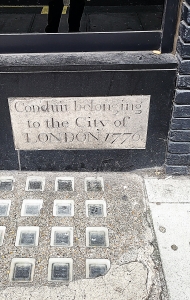
IT IS EASY to miss this small, inscribed stone set low down close to the pavement of Marylebone Lane just south of its intersection with Wigmore Street. The stone is inscribed with the following:
“Conduit belonging to the City of London 1776”
Noticing it for the first time today (14th of November 2024) although I have passed it many times before, I was puzzled by it.
Marylebone Lane runs between Oxford Street and Marylebone High Street. It is far from straight because it follows the course of the now hidden Tyburn River, one of the tributaries of the Thames. Since the middle of the 18th century, this river has run in an underground culvert. Water from this river was once taken from it to supply the City of London with water. As a website (https://coalholesoflondon.wordpress.com/2012/02/21/marylebone-conduit/) informed, the inscribed plaque:
“… reminds us where the water was once piped to the City of London, close by the Lord Mayor’s old Banqueting House, which once stood in fields now occupied by nearby Stratford Place. Alongside this field was a small lane leading to Marylebone – the present day ‘Marylebone Lane’ – where on this corner stood the chief conduit, now marked by this commemorative stone inlaid into the wall and dated 1776 with its City of London claim.”
Had this modest plaque not been placed and preserved, an interesting feature of London’s hydrological history might have been lost for ever. Apart from avoiding pitfalls on London’s not always perfect paving stones, looking where you are walking can often be quite interesting.
THE BEN URI Gallery and Museum began its life in 1915 as a place where Jewish immigrant craftsmen and artists could exhibit their works. At that time, mainstream British artistic institutions were reluctant to include artists from recently arrived minority immigrant communities. Things have moved on a long way since then, and the organisation no longer confines itself to Jewish artists. Ben Uri’s remit:
“… has expanded to include relevant works by immigrant artists to the UK from all national, ethnic and religious origins, who have helped to enrich our cultural landscape.” (https://benuricollection.org.uk/)
My mother, the painter and sculptor Helen Yamey, was born in South Africa, and came to England in 1948. She was an immigrant artist.
When I was researching her life to write her biography, I discovered something about her which I had not known before. It was that during the first half of the 1960s, her sculptural work was chosen to be exhibited in several prestigious exhibitions. She exhibited alongside now famous artists such as Elisabeth Frink, Anthony Caro, David Annesley, Eduardo Paolozzi, Menashe Kadishman, William Tucker, Phillip King, David Hockney, Henry Moore, Barbara Hepworth, Paula Rego, Bridget Riley, Duncan Grant, and Jean Arp. As a youngster in the early 1960s, I was unaware that my mother’s work was rated as highly as those with whom she exhibited. It was only when writing her biography to accompany some photographs of her work, which had recently come into my possession, that I realised that although she was now forgotten by the art world, she had achieved something quite significant in the artistic world of the early 1960s. Having learned this about her artistic prowess, I discussed the matter with my daughter, who is a curator and a historian of art. In turn, she mentioned it to the current director of the Grosvenor Gallery in Mayfair. He suggested that I should contact the Ben Uri to find out whether they had any information about my mother.
The Ben Uri had no material about my mother, and were interested when I sent them information about her association with the Sculpture Department of St Martins School of Art and the exhibitions in which her work was shown. They decided to add her to their already extensive database listing immigrant artists from of 100 countries. After donating a copy of my book to the Ben Uri’s research library and having been interviewed by one of the organisation’s researchers, they added my mother, a long-forgotten sculptor, to their database. In addition, the researcher, Ms Milcic, has added an 800-word profile of my mother and her art to one of their websites. It can be read online here: https://www.buru.org.uk/contributor/helen-yamey- . This webpage also gives links to a site where some pictures of my mother’s sculptures can be viewed.
It gives me great satisfaction that my mother’s works, which had become largely forgotten, have at last been given some of the prominence they deserve. The reasons why she became forgotten and many other details about her life can be found in my recently published book “Remembering Helen: My Mother the Artist” (available from Amazon: www.amazon.co.uk/REMEMBERING-HELEN-MY-MOTHER-ARTIST/dp/B0DKCZ7J7X/)
AT FIRST SIGHT, there seems to be little content in the 17 paintings on show at the Tristan Hoare Gallery in London’s Fitzroy Square until the 13th of December 2024. It is not long before you realise that these images that contain larges expanses of colour are quite pleasing and visually intriguing. The artworks, all of which were created in 2024, are by Vipeksha Gupta (born 1989) who lives and works in New Delhi (India). As I looked at her work, I was reminded of the paintings by Mark Rothko in which the viewer is confronted with large areas of colour. In Rothko’s case, the borders between one colour area and its neighbour are deliberately ‘fuzzy’, whereas Vipeksha Gupta defines these transitions more sharply, yet not completely abruptly.
“The subtle abstraction of her work is seen within the repeated marks, geometries and the resistant voids made within the material. The surfaces of these works are generated through the iteration of small units into patterns that the artist then proceeded to render dynamic through gestures of rupture, incision, or slippage. She created folds, hinges or selvages of light, around which darkness could pivot and ripple. Gupta carefully plays with the structure of the paper, creating an interplay between illumination and shadow. This use of light shifts the narrative of her work as these folds generate movement, granting fluidity to the deep and mesmerising colours which she carefully crafts.” Abstraction is art often a creator’s way of distilling the essence of something that could also be represented more obviously as a recognisable physical object or scene. In Gupta’s case, she seems to be experimenting with her media (Fabriano paper [handmade with cotton fibre], paint pigments, graphite, and charcoal) to create subtly interesting visual effects for the eyes of the paintings’ viewers to enjoy. In this, she is successful. What at first viewing appeared to be organised areas of colour can be seen to be more complex and interesting the longer one looks at them. In addition, these paintings are somewhat soothing to look at.






 yamey
yamey 