RELIGIOUS DIVERSITY AT A SUFI SHRINE IN RAJASTHAN


IN MY BOOK “Coracles and Crocodiles: 101 Tales of India”, I have described how practices associated with Hinduism can sometimes be seen in Indian mosques. This is particularly true in the Sufi dargah (shrine) in Ajmer, where Khawaja Gharib Nawaz (1143 – 1236), also known as ‘Muʿīn al-Dīn Chishtī’, buried. According to Wikipedia, he was:

“… one of the first major Islamic mystics to formally allow his followers to incorporate the “use of music” in their devotions, liturgies, and hymns to God, which he did in order to make the ‘foreign’ Arab faith more relatable to the indigenous peoples who had recently entered the religion.”


The shrine is in a large compound containing a mosque and other shrines in the heart of Ajmer.

 The dargah compound is much visited, not only by Muslims but also by adherents of other religions: Hindus, Sikhs, etc. Visiting the dargah is considered to be a very special auspicious event. Visitors of all religions buy baskets of red petals to place on the various shrines in the complex. In many places, there are Muslim clerics who bless you by tapping your head with what looks like a large peacock feather duster. In exchange for this benediction, the recipient is expected to leave a financial donation. If the donation is large enough, it and your name will be recorded in a ledger, and you will receive a receipt. If it is insufficient,  the cleric appears to pocket it.


Apart from the groups of musicians playing and singing qawwalis (قوّالی). surrounded by appreciative pilgrims seated around them, there were several other things that interested me. All of these can be found in Hindu places of worship. They include burning incense sticks (agarbatti); lighting diyas (oil lamps) and placing them in holders such as can be found in Hindu temples; and tying threads to parts of the shrines.  Another activity that I found unusual in a Muslim place of worship was blessing of pieces of cloth that were then tied around the pilgrim’s head.


The atmosphere in the dargah compound was lively and festive. People seemed happy to be there. And surprisingly for someone like me, who is not particularly religious, I  felt that the place seemed very holy. This might be because those around me were at the dargah not as an obligatory ritual but because they believed strongly in its holiness.

[ MY book is available from https://www.amazon.co.uk/CORACLES-CROCODILES-101-TALES-INDIA/dp/B0DJZ6DMYB

Built as a Jain temple, then repurposed as a mosque

AT THE TOP OF a short but hazardous flight of stairs, one reaches the compound of an extremely interesting mosque in Ajmer (Rajasthan, India). It is the Adhai Din Ka Jhonpra mosque, whose name means ‘Two and a half day hut’. To what the two and a half day refers is not certain.

The building was originally constructed as a Jain temple in 660 AD. In about 1190, the temple was destroyed by the Afghan leader Muhammad of Ghor. He built the mosque on the site of the former temple using carved stonework plundered from Hindu and Jain temples. The resulting edifice, although shaped like a mosque, contains many architectural features and decorative motifs that you would expect to find in 12th century (and earlier) Hindu and Jain temples.

The mosque and its ccompound is very popular with visitors. I noticed that I was the only European amongst several hundred visitors. The site is a much desired place to be photographed. There are many photographers carrying Nikon SLR cameras, all touting for business. And there is no shortage of people wanting to pose for photos. The photographers seemed to have plenty of customers despite the fact that most people carry mobile phones.

Although the nearby dargah (a Sufi shrine) attracts most tourists, the Adhai Din Ka Jhonpra is well worth visiting.

A first peek at the Pink City of Rajasthan

FOR VARIOUS REASONS, we hired an autorickshaw to give us a first glimpse of Rajasthan’s Pink City: Jaipur. Although the Pink City is the oldest part of Jaipur, its main thoroughfares were laid out centuries ago in a grid pattern typical of modern cities. A complex warren of narrow streets and courtyards lead off from the main roads. We have yet to explore these byways.

The city is so-named because its buildings are all painted with various shades of pink paint. Apparently, this has been done since the structures were first built in order to hide the inferior quality of the stones used in their construction.

After our elderly Bihari driver, Ganesh, had driven us along the straight main roads of the Pink City as well as some of the twisty, narrow lanes leading off them, he took us to see two factories. At one, we were shown men at work making the silver settings for precious stones. At the other, we were shown the way block printing on fabrics is carried out by hand.

At both factories, after we had been shown how the goods were prepared, we were (not surprisingly) invited to make purchases. We bought a few small objects. After leaving each factory, Ganesh asked us how much we had spent. This was not idle curiosity. He told us that he received 1% of whatever his passengers had spent. He told us that the factories, which sell their goods at wholesale prices, give him a much smaller commission than retail outlets.

I am glad that Ganesh took us to the factories rather than the retailers because it was interesting to watch the manufacturers at work.

Tomato soup in the tandoori oven by the roadside in Rajasthan

WHEREVER I HAVE BEEN in India, both in big cities and in small rural places, tomato soup is often available at eateries be they humble or grand. What is more, everywhere I have consumed this soup in India, it always been flavoured differently. It always tastes of tomato, but the detailing of the taste is never the same. This is because the soups are prepared in the kitchens of the restaurants, and not in a factory.

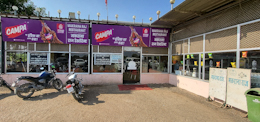
Makrana Raj restaurant

Today (29th November 2024), we were travelling along the six lane highway between Jaipur and Ajmer when we stopped for a light lunch at the roadside Makrana Raj restaurant. This unpretentious, well-run place is not far from Ajmer. We ordered a light lunch including a paratha stuffed with cauliflower, a garlic naan, and a bowl of tomato soup. The excellent paratha was served with a garlic chutney and butter churned in the restaurant.

As usual, the tomato soup had a unique flavour. It tasted slightly smoky and was delicious. We asked the waiter how it was prepared because we had never before come across smoky tomato soup. He told us that the soup is cooked in the wood fired tandoori oven, which is why its taste reminded me of the flavour of charcoal-grilled meats and fishes.

While I would not recommend making a special detour to visit the Makrana Raj, if you happen to be travelling by road between Ajmer and Jaipur, then look out for the place, and have something to eat there.

Charles Dickens and a house in Berkshire

BASILDON PARK IS an 18th century stately home in Berkshire. Now managed by the National Trust, it has had many owners including the Sykes family. Sir Francis William Sykes inherited the place from his grandfather. When his wife had an affair with the artist Daniel Maclise, Sir Francis disowned her and publicly humiliated her. Now, Maclise was a close friend of the author Charles Dickens, and at the time when Sykes was being unpleasant towards his wife, the author was working on his novel “Oliver Twist”. Dickens created the nasty criminal character called Bill Sikes to take his revenge on Sir Francis (see http://www.basildon-berks-pc.gov.uk/basildon-berks/basildons_past-20268.aspx)

Fagin

We visit Basildon Park regularly. For this reason and because of its connection with Bill Sikes, I had decided to read “Oliver Twist”. It is the third of the Dickens novels that I have read recently. It was one of the first that he wrote. Compared with the two I have already read, “Nicholas Nickleby” and “Martin Chuzzlewit”, it flows easily and is very exciting.

The first thing that struck me was how early in the book the famous “Please Sir, can I have some more” scene occurs. It is an important episode but one that people seem to remember more than the rest of the book.

“Oliver Twist” is full of wonderful characters, both good and evil. Amongst the latter, Sikes, Bullseye (a dog), Fagin, Mr Bumble, and Monks are particularly well portrayed. There is a host of characters who see the best in Oliver’s personality. Oliver and his troubled young life is brilliantly narrated, and as I turned the pages, my heart was in my mouth as I waited to see what misadventure would next befall him.

I found the novel to be fast moving and exciting. As the saying goes, it is a real ‘page-turner’. I had no idea that Dickens’s writing could be so thrilling. Having come to the end of “Oliver Twist”, I am next embarking on “Barnaby Rudge”, which I have chosen because it concerns the Gordon Riots of 1780, about which I have read in history books.

He moves with the sun on Jewellers Street in Bangalore

JEWELLERS STREET RUNS in a north/south direction. In the morning, the sun shines on the west side of the street and in the afternoon, on the east side. As its name suggests, the street is lined with many shops selling jewellery.

Jewellery breaks sometimes, but it can often be repaired. K is a jewellery repairer. In the morning he sits working in the shade on the pavement on the east side of the street, outside a particular shop. In the afternoon, you will find him outside a shop close to a silver and hold plating shop on the west side of the street.

K squats bare-footed alongside his trays of tools and materials, and mends a wide variety of jewellery. When re-threading necklaces and bracelets, he uses his toes to hold one end of the thread. We visit this friendly, highly skilled man whenever we are in Bangalore, usually with items if jewellery that have broken since our last visit to the city.

Made of paper in the north  of India

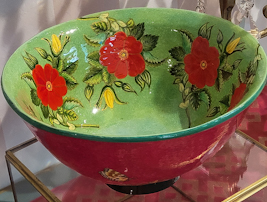
A naqashi bowl

NAQASHI is a traditional handicraft practised in Jammu & Kashmir.  It is papier-maché hand painted with Mughal inspired motifs. The objects created with this technique are lacquered  to produce a shiny finished surface.

[The word ‘naqashi’ means ‘painting’]

An alarming purchase at a supermarket in London

A TRUE STORY

I entered one supermarket and purchased a bottle of gin. I paid for it, and as I left the store, the alarm rang. I ignored it. Nobody stopped me.

I took a bus to another area, where I  entered a different supermarket.  Once again, as I  left the store, nobody, not even the store’s security guard, stopped me.

When I got home, I  discovered that the anti-theft device had been left on my bottle. It should have been removed when I paid for the gin.

I tried removing the tag, which was tied to the neck of the bottle with tough metal cable. I realised that without breaking the glass bottle,  I would not be able to reach the gin.

In the end, I  retraced my steps and returned to the shop, which was a 10 minute bus ride away. I explained what had happened, showed the shop assistant the receipt, and demanded a fresh bottle, but with the security tag removed.

This episode made me wonder why so much effort is put into protecting goods when the security officials at the supermarkets take so little heed of their alarms when they are set off.