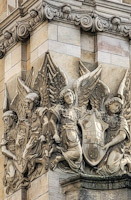
Angels clinging
High up on a drafty corner
In Old Cambridge town

Angels clinging
High up on a drafty corner
In Old Cambridge town
ONE OF THE MANY JOYS of living in London is the ability to view exhibitions in the city’s commercial galleries, many of which can be found in Mayfair and the West End. These galleries display artworks, which are mainly for sale, or occasionally borrowed from places away from London. The exhibitions are of a temporary nature. Visiting them allows members of the public to view works, which might never be on public view again in London because they will be sold to private collectors, big corporations, or to galleries and museums abroad. When we are in London, my wife and I try to visit several of the commercial galleries at least once a week. At the recommendation of our daughter, whose employment is in the world of art, we paid a visit to Pace Gallery in Hanover Square to see an exhibition that will continue until the 15th of April 2023.
The artist, whose works are being displayed in the spacious modern rooms at Pace, is Gideon Appah. He was born in 1987 in Accra, Ghana. His training as an artist was at the Kwame Nkrumah University of Science and Technology in Ghana. His first major exhibition was in 2022 at the Institute of Contemporary Art at Virginia Commonwealth University in Richmond, Virginia (USA). His paintings have also been exhibited in many other places.
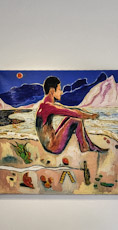
All of Appah’s works on show at Pace are oil and acrylic on canvas. They are all highly colourful and include, with one exception, figures in a variety of landscapes. The figures are positioned in landscapes that have an intensity that makes them look slightly unreal, yet completely compelling. One of the pictures we particularly liked is “Night Vision” which depicts a brightly lit town on a hill at night reflected on a sea of still water. The leaflet issued by the gallery describes Appah’s work as “dreamlike”, and this was also my opinion. On the whole, the dreamy nature of the works is quite distinct from that seen in the works of the great Surrealists of yesteryear. Appah portrays his scenes with the clarity and strangeness that I associate with the dreams I experience. His works are intriguingly eery, but not scary. If you can get to Pace, do so to enjoy the well-executed and fascinating works by this artist from Accra.
PARTICIPANTS IN HUMAN endeavours frequently like to work together or in small communities. By being in close contact they can inspire and encourage each other; criticise each other’s work; influence each other; provide mutual assistance both theoretical and practical; and so on. Working communally is often favoured by groups of artists. Such was the case at Black Mountain College (‘BMC’) in North Carolina. The establishment was founded by John Andrew Rice, Theodore Dreier, Frederick Georgia, and Ralph Lounsbury in 1933 as a private liberal arts college. These people had been dismissed as faculty members from Rollins College (in Florida) after an incident that threatened their academic freedom. BMC thrived until it was closed in 1957.

In the year that BMC was opened, the Nazis in Germany closed down a ground-breaking art and design establishment in Dessau – the Bauhaus. Many faculty members fled from Germany to the USA, and some of them, notably Josef Albers (1888-1976) and his wife Anni (1899-1994), joined BMC. Josef headed up BMC’s art programme and Anni taught weaving and design. The college was unusual in many ways and differed from other liberal arts colleges in the States.
BMC favoured an inter-disciplinary approach to teaching. It attracted artists and other cultural figures, who were at the forefront of the avante-garde in the USA. These people included Buckminster Fuller, Merce Cunningham, John Cage, Charles Olson, and Robert Creeley, Willem & Elaine De Kooning, to name but a few. It would not be an exaggeration to say that the remotely located BMC was one of the most important powerhouses for the development of modern art in 20th century USA.
Until the 15th of April 2023, there are two exhibitions being held at the David Zwirner Gallery in London’s Grafton Street (in Mayfair). One of them is dedicated to a series of paintings by Josef Albers. The other, and more interesting show is a collection of artworks created by several artists, who attended BMC either as students or members of the faculty. The works in this exhibition include a few works by Anni and Josef Albers, as well as by other artists, including the De Koonings, Buckminster Fuller, Sue Fuller, Leo Amino, Ray Johnson, and Ruth Asawa. It is a small but excellent show, and well worth a visit. Until today, when I visited David Zwirner, I must admit that I had never heard of BMC, which was founded at the same time as the Germans were closing down the Bauhaus, which had already become one of the most influential pioneers of innovative design during the 20th century.
OBSERVANT VISITORS TO KETTLES Yard art centre in Cambridge will notice a couple of incised stone signs embedded into the centre’s wall facing Castle Street. One of them reads:
“Godmanchester Turnpike Road Ends Here”.
Below this, there is another stone sign that reads:
“To the Horse-shoe Corner, Godmanchester, 14 Miles 4 Furlongs”
Just in case you did not know, or have forgotten (as I had), there are 8 furlongs in 1 mile (1.6 Km), and a turnpike is a toll-road. Godmanchester is northwest of Cambridge.

The turnpike was in existence by 1744. According to a website (www.geograph.org.uk/photo/568133), the tolls were:
“… collected by the Godmanchester to Cambridge Turnpike Trust. Horseshoe Corner in Godmanchester is almost probably the location of the then Horseshoe Inn at the southern end of Post Street. It was also where markets were held as early as 1533.”
The turnpike might well have run along a part of the course of a road built by the Romans – Via Devana. Robert Fox, writing in his 1831 history of Godmanchester, noted:
“The celebrated William Stukely had no doubts upon this point; for, in describing the course of the Via Devana through Cambridge, in his Itinerariium Curiosum, republished 1757,4to, at page 203 we find ‘Out of the ruins of this city—Granta now Cambridge—William the Norman Duke built a castle; a very straight Roman road comes to it from Durosiponte, Godmanchester. It passes as straight through the present Cambridge by Christ College and Emanuel College… so to Camulodunum, Colchester.’ “
Stukely was almost certainly describing Castle Hill and its southern continuation Magdalene Street, which leads almost straight towards Christ and Emannuel Colleges.
The stones were originally set higher than they are at present. They were then at the level of the eyes of coachmen seated high up on the front of their vehicles. The stones were discovered when Kettles Yard was undergoing restoration in 2016, and have been set at a level lower than would have been the case in the past.
Though not of as great visual impact as some of the exhibits in Kettles Yard, the two reminders of an old toll road are of considerable historic interest.
HAILEYBURY SCHOOL WAS founded by the East India Company (‘EIC’) in Hertfordshire in 1806. It was an institution where young British men heading out to India to become British colonial administrators were given training. It was not the first of such establishments. In 1800, Fort William College (in Fort William, Kolkata) was founded by the Governor General Richard Colley Wellesley (1760-1842) to teach Indian languages, laws, and so on, to young recruits to the EIC. This school continued until it was closed in the 1830s. For various reasons, the EIC decided to open a training school in England – The East India College.
The East India College was first housed in Hertford Castle, where it remained whilst bigger premises, designed by the architect of University College London, William Wilkins (1778-1839), were being built nearby in Haileybury. When it was completed, the college moved from the castle to the new building, where a school has been located ever since then. Teachers at the East India College included well-known people such as Thomas Malthus and the Sanskrit scholar Monier Monier Williams.
It is ironic that one of the former students of the EIC college at Haileybury was Allan Octavian Hume (1829-1912). After studying at London’s University College Hospital, he was nominated to the Indian Civil Service. He went out to India in 1849 having passed through the course at the EIC college at Haileybury. After returning to England in 1894, having worked in the Indian Civil Service, he recognised that there was a sense of hopelessness and unrest amongst the Indian population and that the people were held in contempt by their British rulers. To try to remedy the plight of the Indians and to provide a ’safety valve’ for relieving unrest that he perceived in Inda, he founded what soon became the Indian National Congress. Little was he to know that eventually this organisation would play an important role in getting Britain to leave India.
Taking a rather circuitous route from Cambridge to London, we stopped for lunch in Hertford. I wanted to see the castle because I had just read about it and its brief connection with the EIC in an interesting book, “The Colonial Subjugation of India”, by Amar Farooqi. After enjoying a portion of splendid fish and chips, we entered the small park in which the castle is located.
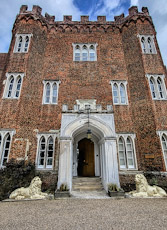
What can be seen today is a well preserved brick building with crenellations and windows in gothic style frames. When viewed face on, the edifice can be seen to consist of a tall central portion flanked by two lower wings. The tall central part, which was constructed in the 15th century was the gatehouse to the castle, which was fell into disuse and was demolished long ago (in the 17th century). The two wings were added during the reign of George III. Today, the so-called castle, erstwhile gatehouse, houses Hertfordshire council offices. We entered the lobby and noticed the gothic revival interior décor within the castle. We will revisit the castle on one of its open days and see some more of the building.
Hertford Castle played a short role in the history of British India and the EIC. The school at Haileybury continued its imperialistic function until 1857/8, when the EIC was wound up after the Indian Mutiny (First Indian War of Independence) of 1857-58. The present school, Haileybury College, a private school with boarding facilities, opened its doors to pupils in 1862 and occupies the old college’s premises.
THE JAPAN HOUSE in London’s High Street Kensington first opened in 2018, and its aim is to increase people’s awareness and knowledge of Japan, the Japanese, and their culture. Until the 11th of June 2023, the Japan House is host to a superbly laid-out exhibition of Kumihimo – Japanese silk braiding. The braiding is a complex form of plaiting, using dyed silk threads. When, for example, hair is plaited or braided, three or more strands of hair are intertwined to form a plait. Practitioners of Kumihimo plait great numbers of often different coloured threads to create braids with beautiful repeating patterns. The most expert craftsmen and craftswomen can braid patterns using up to 140 different threads.

The exhibition shows how the threads are dyed, then spun into bobbins before finally being woven into braids. The braider uses a stand that holds the reels of thread. The threads are then plaited over each other in a repeating sequence to produce a patterned braid. Great concentration is required to maintain the sequence without making errors. A weight is hung onto the braid to hold it straight and taut whilst it is being created. In addition to examples of the various types of braiding stands, there are well-made videos illustrating braiders at work. There are many examples of finished products, including belts, fashion items, armour plating, and modern artworks. All of them are intricately patterned and incredibly beautiful.
The exhibition was set up by a Tokyo-based company, Domyo, which has been producing braided silk cords since 1652 AD. Kumihimo was a technique imported into Japan between 538 and 794 AD from the Asian mainland, and then refined and developed in Japan
When I learned that I was to visit an exhibition of braiding, I was not filled with enthusiasm. However, as soon as I entered the basement exhibition area, I realised that I was about to see a fine and most interesting display. Not only is there great beauty in the exquisitely detailed braiding, but this was also the case for the way the exhibits have been arranged. To summarise, see this exhibition if you can!
ONE OF MY UNCLES commissioned a ceramic work by the celebrated potter Lucie Rie (née Gomperz; 1902-1995). This used to be on display in my aunt and uncle’s house, which I used to visit often. Thus, I became familiar with the name Lucy Rie.
Lucie was born in Vienna (Austria), where she attended an avant-garde school of arts and crafts from 1922. After graduating, she set up her own studio in Vienna. Bring Jewish, she left Vienna in the late 1930s, and settled in London.

Encouraged by Bernard Leach, she established a studio in London. For a while she worked with the potter Hans Coper, but the artistic styles of the two artists differed considerably. Over the years, Lucie created objects in a variety of styles. She experimented with glazes and other techniques, creating pottery which was truly 20th century. Unlike Leach, whose works reference ancient Chinese and Japanese ceramics and mediaeval English, Lucie was innovative and inventive.
Until the 25th of June 2023, you can see a good exhibition of Lucie’s works, from her earliest to her later creations, at Kettles Yard in Cambridge. Undoubtedly, her works are of a high quality, both artistically and technically, but I was not particularly excited by the show. A video of David Attenborough interviewing Lucie in her studio interested me far more than her works on display.
By all means visit the exhibition, but in my opinion this is a show for Lucie Rie enthusiasts, rather than for the average exhibition goer.
HOBSON STREET IN the heart of Cambridge is one way and is used by traffic avoiding the pedestrianised section of Sidney Street. Hobson Street is lined with buildings of various ages. One of these, which has always attracted me, is a disused cinema whose facade has Art Deco features.

Built in about 1930 to replace an earlier cinema constructed in 1921, it was The Central Cinema. Its white tiled facade has Egyptian and Art Deco details.
In 1972, the cinema closed and was converted, as many other old cinemas have been, into a bingo hall. This establishment thrived until 2009 when the British government banned smoking in public places. Apart from three days when the building was occupied by squatters for 3 days, the old cinema has been boarded up and disused.
Various plans have been proposed for its future use, but none of them have been carried out. One of the problems is that because it is a protected edifice, any future plans have to preserve its original features. And as most of the new ideas for the old cinema involve adding windows, and adding them would infringe the protection order, all of the new plans have had to be abandoned. The protection order has saved the building but hindered its future development.

City of towers,
Students, books, and scholars
Astride the river Cam
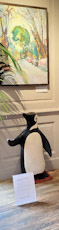
HAMPSTEAD’S BURGH HOUSE was constructed in 1704 and retains many of its original architectural features. Several of its rooms house a fascinating museum with exhibits relating to the history of Hampstead. I have visited the museum many times, but it was only today (the 9th of March 2023) that I noticed a model penguin on display. This used to stand inside High Hill Bookshop, which was located on Hampstead High Street. Founded by Ian Norrie in 1956, it remained in business until 1988.
During my childhood, in the 1950s and 1960s, I used to visit Hampstead almost every Saturday morning with my parents and my sister. We used to park the family car near to Jack Straws Castle, which is close to Whitestone Pond – one of the highest spots in London. Then, we would walk down Heath Street and along the High Street until we reached High Hill Bookshop. My parents were keen to encourage my sister and I to read. Therefore, every time we visited the bookshop, we had to choose one book each, which they purchased for us. I cannot recall all of the books I chose, many of them Puffin paperbacks, but I do remember that during these visits I gradually built up my collection of the adventures of Tintin by Hergé.
According to an article (https://jessicanorrie.wordpress.com/2017/08/04/the-best-independent-bookshop-in-london/) by Norrie’s daughter, Jessica Norrie, there was a party for Penguin Books held in the shop in 1960. The model penguin, which I saw in Burgh House today, was in attendance at that party back in 1960. I was eight in 1960, but I am afraid that I cannot remember seeing the penguin. It must have been in the shop during some of my visits, but then my interest in choosing a book was greater than looking for model penguins.
The penguin in the museum is black and white. On the white section of the bird’s belly, there are words, including “October 12th, 1960. High Hill Bookshop Silver Jubilee Party” and, also, some signatures. One of the signatures is that of Allen Lane, founder of Penguin Books. He died 10 years after the party. Another signature is that of the novelist Olivia Manning, There are several other signatures, but I found them too difficult to decipher.
Seeing the penguin at Burgh House brought back happy memories of my childhood and, at the same time, made me sad because High Hill Bookshop was irreplaceable. Waterstone’s, which followed in its wake, although well-stocked, lacks the charm of Ian Norrie’s wonderful creation.
You can read more about Hampstead past and present in my recently published book “Beneath a Wide Sky: Hampstead and its Environs”, which is available from Amazon: https://www.amazon.co.uk/BENEATH-WIDE-SKY-HAMPSTEAD-ENVIRONS/dp/B09R2WRK92/
 yamey
yamey 