Bacon, the Bard, and Butler’s Retreat in Epping Forest

VISITORS TO QUEEN Elizabeth’s Hunting Lodge in Epping Forest can obtain food and drink at the nearby Butler’s Retreat. I will describe the Hunting Lodge in another essay, and will now concentrate on the small weatherboard clad building called Butler’s Retreat, and something that stands close to it. The Retreat is housed in an edifice that was originally built as a barn in about 1859. The Conservators of Epping Forest converted it into a retreat – a refreshment place – in about 1878.

The Retreats in Epping Forest were originally refreshment stalls set up by the Temperance movement to serve non-alcoholic drinks to the many trippers who came to enjoy the forest. Butler’s Retreat is one of the last surviving Victorian retreats in the forest. Its name derives from that of:

“John Butler who took over the lease of the barn on 1st January 1891 having previously operated a kiosk in the forest.” (www.chingfordhistory.org.uk/butlers-retreat-and-drinking-fountain)

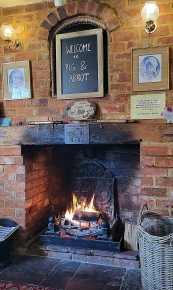
His wife, Hannah, took over the refreshment business in 1903, and the Butler family ran it until 1971. After closing in 2009, the building was refurbished by the City of London Corporation (which maintains the forest) and re-opened as a cafe in 2012. The café no longer confines itself to non-alcoholic beverages. In addition to drinks, it serves a range of snacks and light meals. These can be eaten at tables outside the building or within its attractive dining areas in which supporting timber beams can be seen. They support the roof above the first-floor dining room.

Forty-five feet away from the northeast corner of Butler’s Retreat, there is an intact, but disused, pink granite drinking fountain, which was restored in 2011. Constructed in 1899, it was donated by Sir Edwin Durning-Lawrence, Bart, MP (1837-1914). After studying law at London’s University College, he qualified as a barrister at Middle Temple in 1867. During his working life he was both a Justice of the Peace and served as a Member of Parliament for Truro (from 1895 to 1906). Two of his brothers served as Lord Mayors of London.

Sir Edwin was a prolific author. He is best known for his writing in support of the idea that the plays attributed to William Shakespeare (1564-1616) – the Bard – were not written by him but by Francis Bacon (1561-1626). I am in no position to assess Sir Edwin’s arguments, but I believe that most modern scholars tend to believe that it was not Bacon but Shakespeare who wrote the plays.

Apart from providing the fountain near Butler’s Retreat, Sir Edwin donated his extensive library to the University of London. Also, some of the money he left to the university was used to endow a professorial chair in the History of Art department at his alma mater – University College London.

The drinking fountain at Butler’s Retreat is nothing too out of the ordinary to look at, but I am pleased that I did examine it closely to see what was inscribed on it, and noticed the name of Sir Edwin. It is interesting that this drinking fountain, which was donated by someone who doubted Shakespeare’s authorship, should be situated only a few yards away from a building that was standing during the Bard’s (and Bacon’s) lifetime – Queen Elizabeth’s Hunting Lodge.

A ghost sign on a building near Kings Cross railway station

Definition: GHOST SIGNS are ” … fading advertisements once painted by hand onto buildings …”

(http://literarylondon.org/the-literary-london-journal/archive-of-the-literary-london-journal/issue-5-2/ghost-signs-londons-fading-spectacle-of-history/)

The photograph above is a simple example. Now a branch of Nando’s, this place in York Way (near Kings Cross station), which bears a ghost sign. It used to house a place where other refreshments were available long before Nando’s company was established.

THY HAND, GREAT ANARCH BY NIRAD CHAUDHURI

HAVING BEEN BEFRIENDED by the author’s son Prithvi, and having seen some of his father’s belongings stored in the Calcutta Club (in Kolkata), I finally got around to reading a book that I bought almost 30 years ago. The 960-page volume by Prithvi’s father, Nirad C Chaudhuri (1897-1999), is called “Thy Hand, Great Anarch”, and was first published in1987. The title comes from a couplet in a poem by Alexander Pope (1688-1744):

“Thy hand, great Anarch! lets the curtain fall;

And universal Darkness buries All.”

This pessimism well summarises what Chaudhuri has written in his enormous tome.

The book is the second part of Chaudhuri’s autobiography. It covers the period from 1921 to 1952 – the years leading up to the end of British rule in India and the first few years after the country gained its independence. Chaudhuri was a keen observer of what was going on in India during this period. Without pulling any punches, he gives his often-critical opinions of what was going on in the country, and never fails to point out what he felt was being done wrong both by the British and also by the Indians fighting for the end of British rule. Although he wrote this book long after 1952, he quotes from things he wrote during the period he described. He did this, I believe, to prove to the reader that his frequently idiosyncratic opinions were not as a result of looking back with hindsight, but were what he thought at the time.

One of Nirad’s chief criticisms of the various different freedom fighters was that they all expressed their dislike of British rule but, according to him, none of them proposed plans for how India was to be ruled if or when independence was achieved. I have read several books about the history of India’s fight for freedom, and most of them portray leaders such as Gandhi, Nehru, Vallabhai Patel, and Subhash Chandra Bose as heroic figures. This was not how Nirad portrayed any of them. Having been the personal secretary of Bose’s brother Sarat Bose, Nirad was in a good position to observe many political events at close hand. As for Gandhi, he wrote (giving his reasons):

“To take the question of his contribution to Indian independence first. It is a blatant falsehood to say that he or his movements brought it about, whatever their moral effect.”

This was not an opinion I had come across before in histories of the struggle for India’s independence. It is his highly individual and original views that help to make his book so engaging. He writes very scornfully of Subhash Chandra Bose’s politics and his cooperation with the British Empire’s enemies during WW2. As for Jinnah – the ‘father’ of Pakistan – he showed less disdain, writing:

“I must set down at this point that Jinnah is the only man who came out with success and honour from the ignoble end of the British Empire in India.”

Unlike members of the Indian National Congress and their opponents – the British Government, Jinnah:

“… never made a secret of what he wanted, never prevaricated, never compromised, and yet succeeded in inflicting an unmitigated defeat on both the British Government and the Indian National Congress.”

Although I got the feeling that Chaudhuri admired the British and believed that Indians would fare better by being part of the British Empire than they would in an India ruled by Indians, his book is by no means short of criticism of the British as colonists, during the last years of empire, and after India became independent. Figures such as Attlee and Mountbatten get little or no praise from Nirad. At the beginning of a chapter called “Mount Batten Piled on Mount Attlee”, he wrote:

“As if Attlee single-handed was not enough to complete the work of demolition begun by the more cunning mediocrity. Baldwin, he piled on himself Lord Mountbatten to add greater work to his policy, which brought endless misfortunes to the Indian people.”

As the book’s title suggests, the text contains Nirad’s views on the anarchy he perceived developing as India approached independence, and then after having achieved it. It is not surprising, given what he wrote and thought about the country of his birth that Nirad chose to move to England (in about 1982) and lived there until he died. Many readers might be surprised or even horrified by what the author wrote, but he takes care to make whatever he thought sound reasonable to his readers. There are parts of the book which I found hard going – difficult to comprehend, but I ploughed on regardless, and was pleased that I did.

DON’T EXPECT TOO MUCH FROM THE END OF THE WORLD AT A CINEMA NEAR LONDON’S HOLBORN

THE GARDEN CINEMA is in Parker Street, which is near both Holborn Underground station and Covent Garden. This gem of a place opened in 2022. Housed in the building which formerly contained the offices of businessman Michael Chambers, who founded Chambers and Partners in 1989, a research company for law firms around the world, it was the realization of Mr Chambers’s dream to create a cinema for film enthusiasts such as he is.

The ticket office is on the ground floor. Stairs and lifts lead to the basement, where the bar, various small seating areas – some quite discrete, and the two auditoriums are located. The premises are designed and decorated with many Art Deco features and a good selection of sculptures and prints. The darkly coloured wallpaper (with nods to the William Morris style) and subdued lighting give the place a cosy, intimate night club atmosphere. The bar is reasonably priced. The staff are friendly and helpful. This is a cinema complex quite unlike any other I have visited in London – it is both stylish and intimate.

We watched a Romanian film made in 2023: “Do Not Expect Too Much from the End of the World”. Before I discuss this excellent movie, let me tell you one more unusual thing about The Garden Cinema. There were no advertisements (commercials) prior to showing the main film – only several trailers of forthcoming shows in the cinema. This is quite different from other ‘independent’ cinemas, in which the feature film is always preceded by ads including one for the car company (currently Kia), which supports independent cinemas.

The Romanian film, which runs for almost three hours, is a ‘whacky’ and gritty black comedy with serious comments about life in post-Communist Romania. The brilliantly acted film blends skilfully ‘doctored’ flashbacks to life in Ceausescu’s Romania with scenes in Romania since the war in Ukraine commenced. One of the many things that this highly entertaining film emphasises is how the difficult, regimented, but relatively simple life under the dictatorship contrasts with the hectic, corrupt, and very hard life in capitalist Romania. Nothing was easy during Ceausescu’s ‘reign’, but after it ended, nothing has made life any easier. The film made me think that the tyranny of the dictator has been replaced by the tyranny of corruption and exploitation of cheap labour by countries outside Romania. Another thing that I felt was that the film showed how when the shackles of a highly oppressive regime were released following the death of the dictator, Romanian society seems to have gone crazy. Whether this is an exaggeration by the film makers or truly reflects contemporary life in Romania, I do not know. All I can say is that the 163 minutes of the film sped past remarkably quickly because I found it so highly enjoyable and engaging.

Even if I had not enjoyed the film so much, I would have thought highly of the Garden Cinema – a place I hope to visit many more times in the future.

AN OLD THOROUGHFARE NEAR LONDON’S WATERLOO RAILWAY STATION

WE ARE KEEN on many of the plays put on at the Young Vic Theatre on The Cut near Waterloo Station. Last night (the 11th of March 2024), after seeing a superb performance of a weird but enjoyable play (about a painting by an infamous dictator) called “Nachland”, we walked along The Cut and then further west along a street called Lower Marsh. Sometimes. we return from the theatre via Lower Marsh, and I have often wondered about its name.

About 344 yards in length, Lower Marsh runs southwest from near the Old Vic theatre on Waterloo Road to Westminster Bridge Road. Until the 19th century, much of the northern tip of the old Parish of Lambeth, where Waterloo Station and the South Bank are now located, was marshland. A settlement called Lambeth Marsh (after which Lower Marsh was named) was first recorded on a document in 1377. This settlement ran along a raised road that some believe dated back to Roman Times. The marshland was drained in the 18th century, and by the 19th century isolated individual houses were being built in Lambeth Marsh. In 1848, after the opening of Waterloo railway station, the area known as Lambeth Marsh became known as it is now – as Waterloo. Lower Marsh and its neighbour The Cut formed the commercial area of the district.

There has been a market in Lower Marsh since the early 19th century. As I have only ever walked along Lower Marsh in the late evening, I have never seen the market in action.  The street, which was already marked on a map drawn in 1690, linked two bridges (Waterloo and Blackfriars) constructed in the mid-18th century, and ran past:

“Leisure activities, including pleasure gardens, circuses, theatres which characterised the south bank in the late eighteenth and early nineteenth centuries [and] were present in and around Lower Marsh.” (www.lowermarshmarket.co.uk/).

During the 19th century

:“The building of Waterloo Station in 1848 and its subsequent expansion cut the street off from the riverside, creating a number of yards and cul de sacs from former streets. In the twentieth century war damage, and subsequent housing redevelopment significantly changed the historic street patterns, confining the street market to Lower Marsh.”

Until quite recently (in the 21st century) Lower Marsh and its surroundings would have been described as somewhat ‘run down’. But of late, the area has undergone ‘gentrification’ and become quite a ‘trendy locale. As the Lower Marsh Market website related:

“The current buildings on Lower Marsh Street represent many different phases of development and several styles. Amongst the diverse buildings are some interesting examples of early nineteenth century vernacular architecture, continuing the Georgian vernacular patterns and layouts of the eighteenth century. Good examples of shop-fronts from different eras are present on the street and courts and alleyways and some original paving can still be seen on streets off to the sides. This variety gives the area great character, enhanced by the market.”

In 2015 and 2016, the market took first place in the shopping category of The Time Out Love London Awards.  Next time we go to a matinée at either The Young Vic or The Old Vic, we will leave early enough to take a look at the market.

A WOMAN FROM GUJARAT AT AN INDUSTRIAL DISPUTE IN LONDON’S WILLESDEN

WHAT IS YOUR EARLIEST memory of a news item? In my case, I remember my parents discussing something about Cuba. This was The Cuban Missile Crisis of October 1962. I had little or no idea about it, but later I learned that US President John F Kennedy was involved in its resolution. A year later, when we were staying in the USA, we were there when he was assassinated. I well recall that and my feelings about it at the time. That remains in the forefront of my memory, but far back in the fleshy recesses of my grey matter, the name Grunwick resides. While visiting an exhibition at the Tate Britain recently, I saw several photographs that brought this vague memory back into my consciousness.

Grunwick Film Processing Laboratories (‘Grunwick’), located at Willesden in northwest London, processed photographic films and produced finished prints from them. Photographers (mostly amateurs) put their undeveloped exposed films into an envelope along with payment, and sent them to Grunwick, who later returned the developed film and the prints made from it. In 1973, some workers at Grunwick joined a trade union and were subsequently laid-off by the company. The company employed many workers of Asian heritage – including a substantial number of ladies. As the then Labour politician Shirley Williams pointed out, the Asian ladies were being paid very much less than the average wage, and conditions were bad – hours were long, overtime was compulsory (and often required without the employer giving prior notice).

On the 20th of August 1976, Grunwick sacked Devshi Bhudia for working too slowly. That day, three other workers walked out in support of Devshi. Just before 7 pm that day, Jayaben Desai (1933-2010) began walking out of the factory. As she was doing so, she was called into the office and dismissed for leaving early. When she was in the office, Jayaben said (see guardian.com, 20th of January 2010):

“What you are running here is not a factory, it is a zoo. In a zoo, there are many types of animals. Some are monkeys who dance on your fingertips, others are lions who can bite your head off. We are those lions, Mr Manager.”

Thus began a two-year long strike, which was supported not only by the company’s workers but also by many politicians and trade unions, including, for a short time, the Union of Post Office Workers, who refused to cross the Grunswick picket lines.

Jayaben was born in Dharmaj, now in the Anand district of the Indian state of Gujarat. Soon after marrying, she and her husband migrated to what is now Tanzania. Just before the Commonwealth Immigrants Act (1968) made it difficult for Commonwealth citizens to settle in the UK, the couple moved to England. There, she was obliged to take up poorly paid work, first as a sewing machinist, and then as a worker at Grunwick.

Not only did Jayaben initiate the strike, but she helped keep it going until the dispute was resolved. In November 1976, when the Post Office workers stopped supporting the strike, she told an assembly of  Grunwick’s workers:

“We must not give up. Would Gandhi give up? Never!”

Later, like Gandhi, she employed his tactic – the hunger strike – outside the Trade Union Congress in November 1977. During the court of enquiry led by Lord Justice Scarman, she gave powerful evidence against her erstwhile employer. When the strike was over, she went back to sewing, and then later became a teacher of sewing at Harrow College. After passing her driving test at the age of 60, she encouraged other women to do so to increase their freedom.  After her death, some of her ashes were deposited in the Thames, and the rest in the Ganges.

The reason that Grunwick came to mind at Tate Britain was that its current exhibition “Women in Revolt! Art and Activism in the UK 1970-1990” (ends 7th of April 2024) includes several photographs taken at Grunwick during the strike. Three of them include portraits of Jayaben in action.

As I wrote earlier, I had heard of Grunwick, but I could not recall why until I saw the exhibition. As for the remarkable Jayaben Desai, I am happy that I have become aware of her and her amazing achievements.

An email from the USA about a sculpture made of metal

A COUPLE OF DAYS ago (in March 2024), I received an email from the widow of an American (USA) anthropologist with whom my father collaborated many years ago (in connection with the economic aspects of peasant society). She wrote that she had read one of my blog articles about my mother’s career as a sculptor, and wanted to let me know that she and her husband had bought one of them while my mother was alive (she died in 1980).

I asked the lady whether she could send me pictures of the piece they had purchased. She did. The piece is abstract, and made of pieces of steel welded together. At first sight, you might mistake it for a work by Anthony Caro (1924-2013). This similarity might well have arisen because my mother and Caro worked together in the sculpture studios of London’s St Martin’s School of Art.

I was pleased to receive the two photographs of the work because I remember that steel and metal working were my mother’s favourite materials for creating sculptures. After she left St Martin’s, she had a studio in a garage in Golders Green, but did not have access to welding equipment and other tools needed for making steel sculptures. Instead, she created large abstract works from heavy chunks of timber, but this did not satisfy her nearly as much as working with metal. Gradually, she lost enthusiasm for sculpting, which I felt was a great shame.

I am very grateful having received the photographs, and seeing them prompted me to write this short piece.

PHOTOGRAPHY, POLITICS, AND FEMINIST PROTEST IN PECKHAM

PHOTOGRAPHY HAS LONG been an artistic medium for expressing protest. This is well exemplified by photographic images on display at the excellent “Women in Revolt” exhibition, which is on at London’s Tate Britain until the 7th of April 2024, and is well worth seeing. Running concurrently with this. is an exhibition at the South London Gallery (in Peckham) – “Acts of resistance: photography, feminisms and the art of protest”, which is on until the 9th of June 2024.

As its title suggests, the show at Peckham consists mainly of exhibits that make use of photography. There are also several digital items.  The subject matter deals with matters that concern feminists (and ought to concern everyone) including rape, abortion, genital mutilation, other forms of violence against women, and so on. Unlike the exhibition at Tate Britain, which deals mainly with feminist activities in Britain during the 1960s to 1980s, this show was to coin a phrase ‘art sans frontières”, and bang up to date. The exhibition has as its inspiration the words that the artist Barbara Kruger used in 1989:

“Your body is a battleground”.

Incidentally, there is an exciting exhibition of Kruger’s work at the Serpentine South Gallery (in Kensington Gardens) until the 17th of March.

The exhibition at Peckham (to quote the gallery’s website):

“… explores feminism and activism from an international and contemporary perspective. Looking at different approaches to feminism from the past 10 years, the show highlights shared concerns including intersectionality, transnational solidarity, and the use of social media and digital technology as a tool for change.”

It includes works by at least 20 artists, some of them working as collaborators. Their creations are displayed well both in the gallery and its annexe nearby in a disused fire station. Put simply, the works on display at Peckham have a far more visceral impact than those being shown at Tate Britain, which in many cases appeal more to the brain than to the heart. Even if you ignore the messaging conveyed by the artists in the works at Peckham – and this is not easy to do – their visual impact is magnificent. They are works of art as well as being tools of protest. This is an exhibition well worth making the trek out to Peckham!