A cook from Kutch in Norway

THE SHARAD BAUG HOMESTAY is in the extensive, luxuriant, verdant grounds of the Sharad Baug Palace. Badly damaged in the 2001 earthquake, the palace is a short walk from the excellent homestay. This accommodation is owned and run by members of the royal family of the former Kingdom of Kutch.

Close to the homestay in the middle of a field, there is another ruined edifice. This was formerly used as a guesthouse by important guests of the ruler, the Maharao. For some time, the poet Dara Shiko (1615-1659) hid from his brother (the future emperor Aurangzeb) in this building.

Near the ruined palace, there is a building, which was the last Maharao of Kutch’s sitting room and dining hall. Now, the building houses a small museum filled with exhibits relating to the royal Jadeja family. Amongst these, there are several items connected with the last ruler of independent Kutch when he spent some time in Norway.

After Kutch had joined India soon after 1947, its last Maharao, Madansinhji (1909-1991), was appointed India’s ambassador to Norway. There are photographs relating to his stay in Norway in the museum. There is also a Christmas card in Norwegian and a certificate issued by the Oslo Tennis Club. He served in Norway between 1957 and 1960.

While in Norway, Madansinhji was served by his chef from Bhuj, a member of the Yadav family. For many generations, the Yadavs have been chefs, specialising in non-veg food.
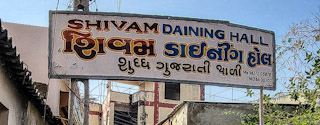
When we first visited Bhuj, in 2018, we were recommended to eat in a simple, small restaurant in the bazaar of Bhuj. Named Shivam Daining (sic), it serves very tasty pure vegetarian food. We returned to eat there several times during our recent (January 2023) stay in Bhuj. While chatting with its chef and his relatives, we learned that the man who produces the excellent food is a grandson of the Mr Yadav, who cooked for Madansinhji in Norway. Although the family have a tradition of cooking meat and fish, they do not offer it at Shivams because they rightly feel that there is little demand for non-veg food in the mainly vegetarian city of Bhuj.

Without knowing it when I booked the Sharad Baug homestay, it turned out that it and one of our favourite restaurants in Bhuj had at least one common connection, and that is Norway.
An illustrious ancestor

QUEEN VICTORIA’S SON Prince Alfred (1844-1900) visited India in December 1869. In his honour several schools in India were founded in his name. In the present State of Gujarat, there are at least 3 still in existence. One is in Rajkot, another in Bhavnagar, and one in Bhuj (formerly the capital of the Princely State of Kutch).

Alfred High School in Bhuj

In Bhuj, we have a friend, Pramod Jethi, who is a historian of Kutch. Some of what I am about to relate is based on information kindly provided by him. Much of the rest is gleaned from what my wife’s family have told me.

My wife’s mother’s great grandfather was one Laxmidas Ravji Sapat (aka Sampat), who was born in the mid-19th century, or a bit earlier. Along with Gokaldas Parekh, Laxmidas was one of the first teachers in the Alfred High School in Bhuj (founded by Rao of Cutch, Pragmalji II in 1870). It is likely that he was its headmaster for a time. I have yet to see it, but his portrait hangs in the school. One of my wife’s relatives, also a descendant of Laxmidas, arranged to have it restored a few years ago.

In 1890, Laxmidas left the school. Later, along with his son-in-law, Cullyanji Murarji Thacker, he went to London (UK) to become a barrister. He studied for the Bar at Middle Temple and was called to the Bar on the 27th of June 1900, along with his son-in-law. Mr Thacker, who was my wife’s mother’s grandfather. The two men received financial help for their studies from the Kutch Royal family.
Both men were members of the Bhatia community in Kutch. Back at the end of the 19th and the early 20th it would have been unusual for a man and his son-in-law to travel out of India together to study.

Laxmidas, after leaving the Alfred School, became appointed as police chief of Bhuj, then diwan (Prime Minister) of Jaisalmer, and after that Chief Justice of Jodhpur. Apparently, he was very successful in reducing dacoitry in the Kingdom of Kutch and also Jaisalmer.

Recognising that the dacoits robbed because they were impoverished and starving, he helped make arrangements that reduced these poor peoples’ need to steal. It was this success that attracted other rulers of Princely States to offer him employment.

Regarding Jaisalmer, I discovered this quote:
“On his retirement, one Laxmi Das Raoji Sapat, who had lately served as Police Commissioner in the Kutch State, was appointed as Dewan of Jaisalmer”
This was in 1903.

As for Mr Thacker, he was successful enough to have owned a large house with two separate kitchens (one veg, the other for meat), and to have employed an English governess for my wife’s maternal grandmother, Benabhai, who married the surgeon Haridas Bhatia FRCS (died of septicaemia whilst on duty in 1926).

Incidentally, Benabhai was sent to London to study at the former Bedford College at the same time as her husband was studying for his FRCS. This contrasts with Mahatma Gandhi, who went to study in London, leaving his wife behind in India.

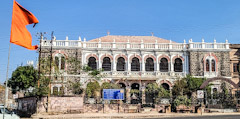
In January 2023, whilst spending a short time in Bhuj, we took a look at the elegant exterior of the city’s Alfred High School, which adjoins the Bhuj Museum. Badly damaged in the earthquake of 2001, the school building has been well restored. A less attractive, newer building was built to enlarge the school. On a future and lengthier visit to Bhuj, we hope to be able to view the portrait of Laxmidas that hangs inside the school.

Long live the revolution!

NAGPADA JUNCTION IS one kilometre east of Mumbai Central Station. There are several interesting memorials located around this place where six busy roads meet. Each of them commemorates someone of the Islamic faith.

One memorial, a large rectangular bas-relief, is dedicated to the great poet Mirza Ghalib (1797-1869).

Dominating the junction is a tall flagpole from which India’s flag flutters. The base of this includes a large curved bas-relief in grey stone. The base has carvings of several important Indian freedom fighters including Mahatma Gandhi. There are also scenes of these leaders behind bars and other Indians being attacked by Britishers. The words “Quit India” can also be seen in several languages. The Quit India movement was one of many attempts to get the British to leave the huge country they ruled until 1947.

This monument and its flagpole are mainly dedicated to the memory of Maulana Abul Kalam Azad (1888-1958). In brief, he was all of the following and much more: an Indian independence activist, Islamic theologian, writer and a senior member of the Indian National Congress. Between 1947 and 1958, he was independent India’s first Minister of Education.

Lesser known than Ghalib and the Maulana, but also commemorated at Nagpada Junction is the freedom fighter Maulana Fazlul Hasan Hazrat Mohani (1875-1951). This celebrated writer of poetry in the Urdu language is best known for a slogan he created in 1921: “Inquilab zindabad”, which means “Long live the revolution”. He is also credited as being one of the first Indians to demand complete independence for India, rather than increases in the degree of the country’s autonomy whilst remaining part of the British Empire.

At first a member of The Indian National Congress, Hasan Hazrat later joined the Communist Party. He was against the Partition of India and would have preferred that India had become a confederation of states such as was the case in the USSR.

Nagpada Junction is both rich in traffic and memorials to notable Muslim men. One more memorial and a street name commemorate another Muslim, Sofia Zuber (Zubair), at this meeting place of busy. thoroughfares. She was an education superintendent for Urdu affiliated to a civic body and later a corporator from Nagpada. The short road named after her used to be a meeting place for Urdu authors and journalists.

I would not have written about this interesting traffic junction had I not noticed the Maulana Abul Kalam monument as we sped past it in a yellow and black taxi. Curious about it, we returned later and had a look around, and then ate good kebabs in the Sagar restaurant beside the junction.

Meeting Mahatma Gandhi in 2023

INDIA BECAME A REPUBLIC on the 26th of January 1948. Every year since then the 26th of January has been a public holiday known as Republic Day. On the 25th of January 2023, we met a senior advocate sitting in the Gujarat Club, which is next door to Ahmedabad’s Civil & Sessions Court. After showing us around the court building, he invited us to join him and his colleagues for the next day’s celebration.

The Republic Day celebrations began in the garden of the Court building at 9 am. A few soldiers, some of them armed with automatic rifles, arranged the flag raising. At 9 o clock, the Indian flag was unfurled by one of the senior judges, wearing a colourful pugree on her head, in front of a large group of senior advocates and some of the court’s staff. Many of the female advocates were attractively dressed in saris decorated with the colours of the Indian flag (green, saffron, and white). One of the ladies told us that 25 of these had been specially ordered from Agra.

When the flag was unfurled at the top of the flagpole, everyone sung the national anthem,”Jana Gana Mana”. Then everyone began taking photographs of one another. After this, we moved en-masse from the court garden to the compound of the Gujarat Club, where Mahatma Gandhi met Vallabhai Patel for the first time.

You can imagine my astonishment when I saw an elderly man who looked just like Mahatma Gandhi, both in physiognomy and in his manner of dressing. Holding a wooden staff and dressed in a white dhoti, sandals, and a shawl, he was a highly credible Gandhi lookalike.

Residing in the USA, this Gandhi impersonator has attended many Indian patriotic ceremonies. To date, he has appeared in 35 in the USA and about 60 in Ahmedabad. His presence was a huge success. Everyone wanted to be photographed alongside him. With his sturdy staff in one hand, he held his mobile phone in the other. Had they been available, I wonder whether the real Mahatma would have been happy to use one.

The lookalike took part in the Club’s flag raising ceremony, giving a short speech. After the ceremony was over, we were invited to join the advocates for a special breakfast in the Club. We were served jelebis, ganthia, kadhi, and shredded raw papaya with whole green chillies.

We were very happy to have been invited to join the advocates in their extremely enjoyable celebration of Republic Day at the Gujarat Club. This occasion increased my already great affection for the lovely city of Ahmedabad.

Geometric and meaningful

BETWEEN A ZOROASTRIAN (Parsi) well and Churchgate railway station, both in central Mumbai, there stands a wonderful steel sculpture, which was financed by the Tata company (named after its Parsi founder).

The sculpture, completed in 2011, is the creation of the architect Nuru Karim and colleagues. Consisting of two closely placed spirals, it rises to a height of 11 metres. The spirals are formed using a set of triangular frames made of a type of Tata steel alloy.

The sculpture is named ‘Charkha’, which means ‘spinning wheel’, and refers to the spinning wheel which Mahatma Gandhi encouraged his followers to use to help make India self-sufficient and less dependent on British imported textiles. Each of the triangles are unique. Combined together in this sculpture, they are supposed to portray unity within diversity, and India’s rich mix of diverse cultures. In other words, the artwork is expressing the idea or hoped-for ideal that although a rich mix of different people, India is one united country.

Whether or not India has achieved this ideal, this sculpture is both aesthetically pleasing and a welcome addition to Mumbai’s incredibly rich mix of visual delights.

A bell at Byculla railway station

THE RAILWAY LINE between Bombay(Mumbai) and Thane was opened in 1853. Byculla Station was one of its original stations when trains began running along this stretch of track. At first a wooden building, it was soon replaced by the present stone structure, which was ready for use in 1857. This historic station, the oldest surviving railway station in India. was beautifully restored recently.

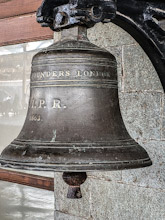
On platform 1, I spotted an old bell hanging close to one of the station’s offices. It is marked with the initials “GIPR”and the date 1863. The letters are the initials of the Great Indian Peninsula Railway company, which was incorporated in 1849. In contract with the British East India Company, its aim was to link the British Presidencies by rail. The first stretch to be built was that between Bombay and Thane.

The bell carries the name of its manufacture – “Mears & Co. Founders London”. This bell foundry, first established in the 16th century, moved to London’s Whitechapel Road in the very early 18th century. It was where one of the largest bells in St Paul’s Cathedral was made. The Mears family ran the foundry between 1784 until 1873.

The foundry ceased working in 2017. The bell at Byculla Station has by now long outlived the bell foundry in Whitechapel and the British Empire, during whose existence it was manufactured.

One lady with four husbands

ALTHOUGH THERE WERE ALREADY villages on the banks of the River Hooghly where the city of Kolkata (Calcutta) now stands, the Britisher Job Charnock (1630-1693), a man of commerce, is often regarded as the founder of Calcutta. He died there and his remains are interred in a charming mausoleum (1695) of oriental design in the churchyard of Kolkata’s former cathedral, the church of St John.

Job Charnock’s mausoleum

Job does not rest alone in that structure. His companions include the surgeon William Hamilton, who died in 1717. He had cured Ferukseer, the “ King of Indostan”, and beneath his memorial, written in English, there is another written in Persian script. Job’s wife Mary lies next to him. She died in 1700. There is no mention of his other wife, an Indian named Maria. There is also a memorial to Martha Eyles, who died in 1748, having first been married to John Gumley (who died in Dhaka in what is now Bangladesh), and then married Edward Eyles, who was on the council of Calcutta’s Fort William.

Whereas Martha Eyles had had two husbands, Mrs Frances Johnson, whose remains lie in a mausoleum a few feet away from Charnock’s, had a more exciting marital record. Born in 1725, she died in 1812 at the age of 87. Frances had four husbands. First, she married Parry Purple Templer, then after his demise , James Altham. Mr Altham died of smallpox a few days after marrying Frances. Next, she married William Watts, and they produced 4 children. In 1774, after the death of Mr Watts, she married the Reverend William Johnson. He survived until Frances died.

Apart from the above-mentioned graves in the churchyard of St John’s, there are many others that commemorate the deaths of early European inhabitants of Charnock’s Calcutta, and there is also a memorial to those who died in the Black Hole of Calcutta, but more about this at a later date.

Colour bar at prestigious clubs

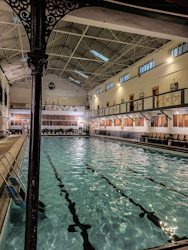
LAST NIGHT, THE 18th of January 2023, a relative by marriage hosted us for dinner at a historic swimming club in Kolkata. It was established in 1887. However, it was not until the 1960s that Indians were able to become members.

Despite India becoming independent of British rule in 1947, many of the prestigious clubs established in India prior to that date did not admit Indians as members until several years later.

In the 1960s, when eventually the Tollygunge Club in South Kolkata began admitting Indians as members, my father-in-law was offered membership to this exclusive previously ‘whites only’ club. He turned down the offer because he was a nationalist at heart and was upset that the Club had remained racist so long after 1947. In contrast, he happily became a member of the Bangalore Club, which welcomed Indian members almost immediately after Independence.

It is a mark of the tolerance of Indians that elite clubs (and some schools) were allowed to exclude non-Europeans so long after 1947, and, incidentally, that statues of Queen Victoria (and other British ‘worthies’) can still be found intact in many Indian cities.

St Paul’s Cathedral without a dome

IN FEBRUARY 1961, Queen Elizabeth II and Prince Philip paid a visit to Kolkata (Calcutta). People lined the streets along which they drove. Every now and then their car stopped and the Queen shook hands with people in the crowds. A little girl stepped forward to shake Her Majesty’s hand. Thirty-three years later that little girl became my wife.

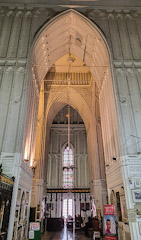
Apart from shaking hands with the future Mrs Yamey, the Queen visited Kolkata’s Anglican St Paul’s Cathedral. Unlike is namesake in London, it does not have a dome. It was built to replace the older St John’s Cathedral. St Paul’s foundation stone was laid in 1839 and the gothic revival edifice was completed by 1847. It was designed by Major General William Nairn Forbes og the Bengal Engineers. Since its completion, various disasters have necessitated repairs, but the edifice looks to be in good condition.

The Cathedral is full of interesting features, a few of which I will now mention. The stained glass window at the western end of the church was designed by the Pre-Raphaelite artist Burne-Jones. The mosaic panels that can be found on the east wall were the creations of Arthur Blomfield, who was involved in the design of many Victorisn churches in London. The walls of the nave have the crests of the Dioceses of the former Anglican Province of The Church of India. Prior to 1947, St Paul’s was the Mother Church of what are now India, Pakistan, Bangladesh, Burma, and Sri Lanka.

I noticed that the pews in the nave are divided into male a female sections, separated by the central corridor. A Church worker explained that the sexes are no longer separated during services and that the signs marking where men and women should sit have been left as historical curiosities.

The TocH Chapel was dedicated on Armistice Day 1927. It contains the impressive sculpted funerary memorial to Sir Charles Allen, Chairman of the Calcutta Corporation. It also contains the helmet of an Indian soldier who died while fighting in the 1971 Bangladesh War. Next to this is a crucifix made from charred timber from a war damaged house in Bangladesh. These monuments to those who fell in Bangladesh are remarkably moving.

I have mentioned a few things that interested me in St Paul’s. In addition to these, there are plenty of memorials to Britishers, who came to India for one reason or another, and died there. One example of these is George Ham from Bristol, who drowned in the River Hooghly in 1866, aged 33.

Photographs of Queen Elizabeth II’s visit to the cathedral are on display within it. When my wife saw these today, the 18th of January 2023, she remembered shaking the hand of royalty back in 1961, and told me about it.