THE ARTIST ANDREW Salgado was born in Canada in 1982. He graduated at Chelsea College of Art with a Masters Degree in Fine Arts. He lives and works between London (England) and New Brunswick (Canada). Until 28 June 2025, there is a wonderful exhibition of his imaginative, colourful paintings at Beers gallery in Little Britain, close to the Barbican and Smithfield Market.
The exhibition has the artist’s chosen title “Self-portrait as a Stack of Books”. Several of the paintings on display and one sculpture portray books. Salgado is an avid reader, and he says he has been influenced by some of the authors he has read. Whether they contain books or not, his creations are intriguing and hint at confused imagery of dreams. As to the artist’s intentions in the collection of works at Beers, the gallery’s hand-out noted:
“Asking Salgado about the intentions, symbolism, or directive in this collection of paintings – because it’s obviously ripe with his (now) trademark imagery – he becomes deferential, ambiguous, and almost evasive about everything from idea to technique, to presentation, and even the compelling title piece: a rare venture into sculpture which seems – whether through its books or its chair, or its uncanny, discombobulated human parts – to reference the paintings and even the act of painting itself. But also books. Words. Memory. Fallability. That head at the apex is glass. It’s his.”
It is right that the artist is evasive. He leaves the enjoyment of interpretations of his works to the viewer, and that is admirably democratic.
If you have not come across Beers gallery already, it is always worth visiting their exhibitions. The works they display are often joyfully colourful and never dull.
BORN IN SEATTLE (USA), the black American artist Noah Davis (1983-2015) led a brief but productive life. Son of a lawyer and an educator, Noah became addicted to painting during his early teenage years. By the age of 17, he had his own studio. He studied art at the Cooper Union School of Art in New York City between 2001 and 2004, and from 2004 onwards he lived and worked mainly in Los Angeles. Until 11 May 2025, there is an excellent exhibition of his works (mainly paintings) at the Barbican Centre Gallery in London. Until I visited this show, I had never heard of Noah Davis, but I am pleased that I have now ‘discovered’ him and his work.
Noah’s lifelong aim was (to quote what is recorded in Wikipedia as having been said by him):
“… to just show black people in normal scenarios, where drugs and guns are nothing to do with it …”
And to portray these scenarios in images created to illustrate:
“… where black aesthetics and modernist aesthetics collide …”
Although most of the paintings illustrate mundane or normal aspects of the lives of Black American people, Noah does so in ways that make the ordinary seem less ordinary and more magical.
In a documentary film that visitors to the exhibition can watch, Noah, who comes over as being a delightful person, made an interesting point. He said that in some forms of art like film, theatre, and literature, a story can gradually develop as the performance or novel proceeds. In painting, on the other hand, the artist must create an image that tells the whole story from start to finish, all on one canvas. This is something he does successfully.
In 2015, Noah was diagnosed with a rare but usually lethal carcinoma. Even while lying in bed in hospital, he continued to create images. In fact, he made 70 wonderful small works (many of them experiments in abstraction) while undergoing treatment for the disease that tragically ended his life. Many of these works are shown in the exhibition. During the month before his death, he made three large canvases, each one expressing his anticipation of his life’s imminent ending. One depicts two girls asleep on a sofa. This picture honours togetherness and restfulness. Another depicts a funeral. And the third shows a man walking in front of self-storage lockers. This image represents the loneliness in which each of us leaves the world of the living.
Having become acquainted with the creativity of Noah Davis, I feel that it is a great tragedy that this wonderfully poetic artist lived for such a brief time.
THE LIVERY COMPANIES were founded long ago by members of the same craft or trade. They were established originally to protect their businesses from rogue traders and to ensure that anyone practising a trade worked to satisfactory standards and good quality. Today, the livery companies still exist although now they are mostly involved in the life of the City of London and philanthropic activities.
The Founders Company, which was established in 1365, was made up of members who cast metal as their trade. They worked with castable metals such as brass and latten (a combination of copper and zinc). Their current headquarters are housed in a modern building just east of the east end of the church of St Bartholomew the Great (near the Barbican). One side of the building runs along the narrow St Bartholomews Passage. It was there that, at ground level, I spotted a bas-relief portrayal of a coat of arms made in white material.
A small information panel next to the crest related that this white material is Coade stone. This material, which was invented in the late 18th century, was an artificial material containing various ingredients. It solidified by firing in a furnace. This durable, weather-resistant material is easy to mould before firing, and was therefore favoured by sculptors and building designers. It went out of fashion by the 1840s.
The Coade stone crest outside Founders Hall was made in 1800, and then it got lost during the 19th century. Many years later, in the early 21st century, it was found and presented as a gift to its original owners, the Founders. It commemorates the Company’s three Masters, who served in 2013, 2014. And 2015.
Although I have visited St Bartholomew the Great many times, it was only yesterday, the 31st of July 2024, that I first walked along Bartholomew Passage – just to see where it led. Luckily, on the way I found the well-preserved Founders’ Coade stone crest.
THE CITY OF LONDON has suffered many upheavals including, to mention but a few, the great Fire of London (1666), heavy bombing during WW2, and often overzealous redevelopments after 1945. Despite these major changes, remains of mediaeval London can still be found. One of these is close to the church of St Bartholomew the Great, which escaped being damaged during WW2, and has been standing since 1123. It was founded as part of an Augustinian priory that was dissolved by Henry VIII in 1543. Close to this fascinating church, and running in a straight line from east to west is the narrow East Passage.
This alleyway is about 80 yards long and lined with the rear facades of buildings – mostly not particularly old. Yet, East Passage has been in existence since the dissolution of the priory in the 16th century (www.ianvisits.co.uk/articles/londons-alleys-east-passage-ec1-36703/). It is a thoroughfare developed on land that had belonged to the priory, and was sold to Sir Richard Rich (1496-1567), who was Lord Chancellor during the short reign of King Edward VI, successor to Henry VIII. East Passage was one of a new series of streets laid out soon after the priory was closed. As the author of the ianvisits.co.uk website pointed out, the group of small straight streets, of which East Passage is one, was one of the earliest planned developments in London (with straight rather than haphazardly arranged, curvy streets), predating the planned development of Covent Garden in the 17th century.
Today, East Passage is about half the length it used to be. Before it was known as East Passage, it was known as ‘Back Court’ or ‘Back Street’. At its west end, there is the rear of a pub called The Old Red Cow. It is one of the longest established pubs near to Smithfield meat market, although the building housing it looks as if it was built in the 19th century. Close to this hostelry, but not on East Passage, there is another pub, The Hand and Shears. Established in 1532, but housed in a more recent building, whose name reminds us that it used to be frequented by cloth merchants. A note in a website (https://darkestlondon.com/tag/old-red-cow/) mentioned that The Hand and Shears:
“… was used as the venue to settle disputes and grievances of people who visited the annual St Bartholomew’s Fair – licences were granted, weights and measures were tested, and fines imposed on fraudulent traders. For many years, the Fair was officially opened from the inn’s doorway by the Lord Mayor – but impatient clothiers would later wait at the pub the night before and declare it open on the stroke of midnight, signalling to gathering crowds that the Fair was officially open by waving a pair of shears in their hands.”
Possibly, I would not have noticed the slender East Passage had we not been sitting in a café nearby. I spotted it through the window of the Pret a Manger on Long Street that runs parallel to East Passage, and felt I had to explore it. As I walked along it, I had not idea that this small back passage had such a long history and would never have existed had Henry VIII not fallen out with the Pope in Rome.
BURNHAM BEECHES IS an area of woodland not far from Slough and Windsor. Rich in beech trees, it was purchased by the Corporation of London in 1880. The German composer Felix Mendelssohn (1809-1847) visited Britain several times between 1829 and 1847. While staying in England, Felix enjoyed spending time in Burnham Beeches. It is said that there was one old beech tree under which the composer liked to sit. Legend has it that it was in the shade of this tree that he gained inspirations for some of his compositions including some of the well-known “Incidental music to ‘A Midsummer Night’s Dream’” (composed 1842). In January 1990, when the tree was about 500 years old, it fell over during a storm.
Part of the fallen tree was presented to the Barbican Horticultural Society. Like Burnham Beeches, the Barbican (a post WW2 development in the City of London) is managed by the Corporation of London. The remnant – part of the tree’s trunk – stands on a section of the elevated walkway not far from Barbican Underground Station. Next to it, there is a plaque detailing its history and its probable connection with the composer.
What I have described so far appears in many websites detailing the curiosities of London. However, not one of them mentions that there is yet another fragment of this tree within the barbican. This piece of the dead tree is smaller than that on the walkway, and can be found, somewhat hidden by vegetation, within the Barbican’s magnificent conservatory.
I wondered what had attracted Mendelssohn to Burnham Beeches. In an article by Helen J Read, published by the Buckingham Archaeological Society on its website (www.bucksas.org.uk), I learned that Felix was often a guest of Mr and Mrs Grote, who lived close to Burnham Beeches. They often entertained musical and literary figures. Amongst their many guests was the Swedish singer Jenny Lind, who first performed in London in 1847. The singer also had a favourite tree, which, like Mendelssohn’s, was destroyed in a storm.
Regarding Mendelssohn and his tree, Ms Read wrote:
“Mr and Mrs Grote also entertained the composer Felix Mendelssohn. His favourite part of the Beeches was a mossy slope between Grenville Walk and Victoria Drive, at that time covered with pollarded trees. Many maps mark this area as Mendelssohn’s slope, and it is thought that the music for Puck and Oberon from ‘A Midsummer Night’s Dream’ was inspired by this area. After Mendelssohn’s untimely death, Mrs Grote erected a headstone in his memory but the headstone was removed …
… There is no specific mention in the earlier maps or guides of any particular tree favoured by the composer, but a plaque was later erected on an old pollard tree. The tree blew over and the plaque was moved to one nearby until the storm of 1987, when this tree lost all its branches.”
Judging by what Ms Read wrote, it seems to me that there is a possibility that the fragments of tree, now commemorated at the Barbican as being Mendelssohn’s Tree, might not be remnants of the one beneath which he sat. Even if these bits of timber are not from his favourite tree, they make a charming memorial to a composer whose music gives pleasure to so many people.
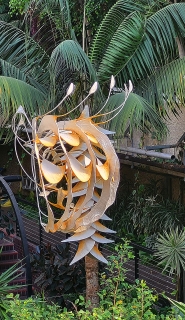
I ENJOY SEEING SCULPTURES displayed in gardens or other plant-filled locations. Until March 2024, the wonderful conservatory in London’s Barbican Centre is hosting a selection of sculptures by Ranjani Shettar. She was born in Bangalore (Bengaluru, India)) in 1977, and now lives and works in rural Karnataka. Her current exhibition in the Barbican is called “Cloud Songs on the Horizon”. The works on display were made especially for this site.
Her works are made of various materials (wood, stainless steel, muslin, and lacquer) and she employs techniques that have been adapted from traditional Indian crafts. Ms Shettar’s organic sculptures look like magnified plants or parts of plants. As she said once:
“Nature’s beauty is ever present, art helps to uncover, perceive and appreciate it.”
Seeing her exhibits in the Conservatory, certainly confirms this. However fine the artworks, putting them amongst plants helps emphasise the greater beauty of nature’s creations. The beauty of the sculptures competes with that of the plants, but the latter almost always win. So, placing one’s artworks within an area rich in plant life is a brave thing to do. I felt that Ms Shettar had done it successfully. Her creations have a harmonious relationship with the plant life surrounding them.
Whether or not you visit the exhibition, which I enjoyed, seeing the Barbican’s Conservatory – the second largest in Greater London – is always a worthwhile experience.
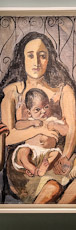
DESCRIBED AS THE FIRST living artist to have had a retrospective exhibition in the Soviet Union, the American painter Alice Neel (1900-1984), there is a superb exhibition of her art at the Barbican Centre in the City of London until the 21st of May 2023. Alice, who was born in a small town in Pennsylvania, led a colourful life – and by this, I am not referring only to her paintings. Politically, she was leftward leaning. In 1935, she joined the US Communist Party and remained a member throughout the McCarthy era and after it. She participated actively in anti-fascist activity before WW2. Some of the portraits she painted were of Marxists and members of the US Communist Party. Maybe, it was this political activity that got her, her family, and her paintings invited to Moscow in 1981. She was a Communist but objected to the bureaucracy associated with the Party. In late life, when she was asked about her political views, she replied that she was “an anarchic humanist.”
During the Great Depression that hit the USA in 1929, President Franklin Delaney Roosevelt initiated the New Deal programme to deal with the unemployment crisis. In 1933, as part of this the Public Works Art Project was set up, and Alice joined it immediately. She was paid US $26.88 per week to produce a painting every six weeks. Her works done for this organisation and its successor, the Federal Art Project of the Works Progress Association, depicted urban scenes of adversity and social injustices. These paintings were her own brand of Socialist realism. I liked what was on display.
Alice remained a figurative artist throughout her life and throughout the period when most of her fellow American artists were moving away from the figurative and increasingly towards the abstract. The highlights of the exhibition are her portraits, some of them of subjects who have removed their clothing. In all of her portraits, she gets beneath her subjects’ clothing or external appearance and portrays not what a conventional portraitist depicts, but the personalities of her subjects as she understood them. The results were not always liked by her subjects, but the viewer can get much more of an idea of what the people would have been like had we been lucky enough to meet them. Like the Victorian photographer Julia Margaret Cameron (1815-1879), Alice’s portraits are not a slavish reproductions of nature but a wonderful attempt to portray what lies beneath the surface – the subject’s soul and character. She once said:
“As for people who want flattering pictures of themselves, even if I wanted to do them, I wouldn’t know what flattery is. To me, as Keats said, beauty is truth, truth beauty … I paint to reveal the struggle, tragedy, and joy of life.”
Included at the Barbican’s exhibition, there is a documentary film about Alice made by Nancy Baer. Alice was filmed in various situations, and comes across as a delightful person. Some of the scenes in the documentary show her at work on a portrait. What impressed me when watching these scenes in her studio was her ability to create straight from life unwaveringly. She looked at her subject and without faltering painted elements of the portrait that did not need adjusting. Her eye-brain-hand coordination looked to be superb.
“…a wall text incorrectly refers to Neel’s 1981 Moscow exhibition as being by the “first living artist to have a retrospective in the Soviet Union,” whereas many artists including Yuri Petrov-Vodkin, Alexander Deyneka, Pablo Picasso and Fernand Leger had exhibited there from the 1930s onwards.”
They may well be right, but whether the artists mentioned were showing a few of their works rather than a retrospective covering their whole output until the date of the exhibition, is a question I cannot answer. In any case, it was no mean achievement to have been both invited to exhibit in Moscow during the Cold War and to have been elected to the American Academy and Institute of Arts and Letters (in 1976).
Once again, I must admit my ignorance: Alice Neel was an artist who was new to me. However, I am pleased that she is now on my radar. I can strongly recommend visiting the exhibition at the Barbican for an exciting visual feast.
AT THE TICKET desk of the Barbican Gallery we were hesitantly asked if we knew about the exhibition of Carolee Schneemann (1939-2019) because it contains some sexually explicit exhibits. We said we knew roughly what we were heading for.
The exhibition is laid out on two floors and visitors are given a suggested route that allows one to see the gradual development of Schneemann’s work from abstract and semi-abstract painting through to highly adventurous installations and happenings (to use a word that assumed a special meaning in the 1960s).
The artist’s earlier works are on the upper floor. Dissatisfied with the relative flatness of painting on canvas, she began adding a third dimension to her paintings. Soon she was producing collections of objects in boxes, rather like the kind of things produced by Joseph Cornell. Unlike Cornell, who filled his boxes and frames with intact objects, Schneemann filled hers with damaged objects, such as rusty musical boxes and fragments of broken glass.
Much of Schneemann’s work became involved with the human body and sexual experiences, as depicted from the female point of view. In many of her creations, she used her own body as a prop. For example, there is a film recording of a ‘happening’ during which she painted glue on her naked body and then applied scraps of paper to herself, creating a human collage. Many of her other works either defy description or if described might disturb the squeamish or prudish reader.
Later in her career, she moved from depicting the body and sexual matters to political comment and protest. Most of these often powerful works are in the form of videos and installations.
I much preferred the earlier works on the upper floor. They were created as timeless artworks that could be looked at whenever. The more adventurous and innovative works on the lower floor are mostly almost static records of events that would have been seen to full and maximum effect when they took place in real life so many years ago. That said, this exhibition was both exciting and interesting.
REMNANTS OF LONDON’S ROMAN wall can be seen from various points in the Barbican Estate, whose construction began in 1965. The not entirely unattractive residential brutalist concrete jungle, known as The Barbican is sited next to the northern edge of what was formerly Roman Londinium. According to a history of the area (www.cityoflondon.gov.uk/services/barbican-estate/barbican-estate-history):
“The name of the Barbican comes from the Low Latin word ‘Barbecana’ which referred to a fortified outpost or gateway: an outer defence of a city or castle or any tower situated over a gate or bridge which was used for defence purposes. The “Barbecana” was probably situated somewhere between the northern side of the Church of St. Giles Cripplegate and the YMCA hostel on Fann Street.”
By the 1850s, the district of Cripplegate, where the Barbican is located, was very crowded with dwellings and business premises. Much of the area now occupied by the Barbican had been destroyed by bombing during WW2. The Estate was built to replace what the Luftwaffe had destroyed.
Apart from several water features, there is one oasis of greenery on the otherwise extremely urban site. This is the Barbican Conservatory. Opened in 1982, it is located above the Barbican’s main theatre and can be entered through an entrance close to that of the Barbican’s Art Gallery. Despite it having been in existence for so many years and having known about it for several decades, it was only yesterday (6th of April 2022) that I first ventured inside it. We had just viewed the current exhibition in the Gallery, “Postwar Modern: New Art in Britain 1945-1965”, an impressive display of rather unexciting artworks. Entering the Conservatory was literally “a breath of fresh air” after viewing the exhibits that had been arranged to illustrate the depressing emotional aftermath of WW2 as depicted by artists in Britain.
I was surprised to learn that the Barbican Conservatory is:
“… the second largest in London (after Kew Gardens) and home to over 1,500 species of plants, but is one of the city’s lesser-known green spaces.” (www.atlasobscura.com)
Apart from the plants, many of them exotic, which are arranged on various levels and can be viewed from both a lower floor and an elevated walkway, there are three ponds. One contains koi carp and the other, raised above ground level, is home to two terrapins, which were found in ponds on Hampstead Heath. The Conservatory is divided into two main sections. The larger is the tropical section, where visitors are permitted to wander about. The other, which was locked up yesterday, is the arid section, containing cacti and succulents.
Despite being in the midst of a manmade, visually intriguing, but harsh urban environment, the Conservatory with its tall trees, bushes, flowers, and other vegetation, feels like another world – a primaeval paradise from which the modern world can be glimpsed in the background.
AT FIRST GLANCE, the lower floor exhibition space at the Barbican art gallery in London resembles the lighting department of a furniture store such as Habitat. It is full of lighting units with Japanese-style paper and bamboo shades. After a moment, you will notice that these lighting units are not run-of-the-mill illuminations; they are interestingly shaped works of art lit up from within. These lamps are part of an exhibition of the artistic creations of Isamu Noguchi (1904-1988). Born in Los Angeles, he was the son of a Japanese father and an Irish American mother. The first 13 years of his life were spent in Japan, where he began learning carpentry whilst helping his mother building their family house. From these early skills, it was not long before he embarked on what was to become a highly productive creative career, making works from a wide variety of materials from wood and stone to metals and plastics and … you name it.
Noguchi studied sculpture at the Leonardo da Vinci Art School in New York City. In 1927, he was given a grant to travel to Paris. It was there that he was apprenticed to the Romanian-born sculptor Constantin Brâncuși (1856-1957), who introduced him to abstraction. After learning much from the great sculptor in Paris, Noguchi abandoned pure abstraction and moved towards depicting the living world. However, his experiences working with Brâncuși influenced his artistic output for the rest of his life. After Paris, Noguchi travelled extensively, learning about techniques and philosophies, especially Chinese and Japanese. In 1929, he first met the architect and inventor Richard Buckminster Fuller (1895-1983), whose ideas about science and technology chimed with his. In the exhibition, there is a shiny chrome-plated bronze bust he made of Buckminster Fuller in 1929. There are also a couple of models he created in collaboration with Buckminster Fuller. Noguchi’s interest in science was not only expressed in sculptures but also in stage settings for ballet performances choreographed by Ruth Page and for performances by Martha Graham.
During WW2, although it was not required for him to enter one of the camps where the Americans ‘cooped up’ potential Japanese enemy aliens – Japanese who lived in the USA – Noguchi volunteered to be confined in a camp in Arizona. By doing so, his aim was to create an arts programme that would ease the lives of those confined in the camp. The barren landscape surrounding his camp proved to be yet another influence on his creative output.
Amongst the many exhibits in the Barbican’s show, there are, in addition to the lighting units, several pieces of furniture designed by Noguchi. One of these is a triangular plate glass tabletop supported by two interlocking timber supports. I have seen this elegant item for sale in upmarket furniture shops, but until I saw the exhibition, I had no idea it had been designed by Noguchi as long ago as 1944. It is still being made today. The wonderful variety of lighting sculptures, which at first reminded me of lampshades that were trendy in students’ rooms in the 1970s, are examples of ‘Akari’. Noguchi began creating them in the early 1950s, and despite their fragile nature, they are still in good condition now. One of the gallery invigilators told us that the translucent paper used to construct these lamps is made from mulberry tree bark. Known as ‘Washi’, this handmade paper can also be made from the bark of some other tree species.
As with other exhibitions at the Barbican gallery, the artworks are well-displayed and beautifully lit. If you go to this exhibition, you should not miss the video film in which Noguchi talks about his life and art very eloquently. And while you are watching it, you can sit on stools and a bench Noguchi designed. Prior to visiting this show, I had heard of Noguchi and seen a few of his works. The exhibition, which continues to the 23rd of January 2022, has truly opened my eyes to what a magnificent artist he was.





 yamey
yamey 