AIRLINES HOTEL IN BANGALORE has an outdoor seating area where you can enjoy beverages and South Indian vegetarian dishes, seated beneath venerable banyan trees.
I MUST ADMIT that I have never been much of a sportsma, and I know hardly anything about the game of polo, apart from the fact that it involves both horses and humans. Yesterday evening, as I enjoyed a postprandial brandy in the recently renamed ‘Polo Bar’ (formerly, ‘The Mixed Bar’) at the Bangalore Club, I spotted a large ‘coffee table’ book by Jaisal Singh about Polo and India.
What surprised me is the great age of the game of Polo. It seems to have been existence in some recognisable form as long ago as the 6th century BC. Then, it was played by some nomadic peoples in Central Asia. The book in the Polo Bar has a photograph of a terracotta model of a Chinese woman playing polo. This model was made between the 7th and 11th century AD. Another photograph shows the earliest known picture of a Polo player. This depicts a man on a horse, and was created in the same era as the model.
Much of the rest of the book is about polo in India. It charts the rise in popularity of the game amongst the wealthy rulers of the Princely States and the upper echelons of the British administrators and military in India.
The Polo Bar, which until recently was known by another name, has been decorated with polo memorabilia (e.g., photographs, trophies, and horseshoes). The handle on the door leading into the bar is horse-shaped. However, for me, the most interesting polo related item is in the Club’s Gardens. It is an inscribed stone block, which was the foundation stone of the Domlur Polo Pavilion laid in January 1914 by Lady Daly, wife of the British Resident.
The stone includes the information that one Major C Rankin was “Hon-Secy” and R Evans Esq was the architect. Both were military personnel, members of the “7th (Q.O.) Hussars”. The pavilion’s building contractor was BV Venkataswami Naidu.
In “Bangalore, the Story of a City”, by M Jayapal, the author wrote that initially the race course was out at Domlur. [Hence, the existence of Old Race Course Road]. In the late 19th century it moved to near Lalbagh, and then to its present position near to High Grounds. Presumably, because there had been equine facilities at Domlur, this would have been a suitable place for the Bangalore Club to locate its polo club there. I am not sure whether anything remains of the polo club pavilion whose foundation stone stands in the Bangalore Club gardens.
According to a blog article (https://wp.me/p1YuI1-1xA) about the pavilion, this is of interest: “Information, thanks to the Bygone Bangalore group on Facebook: The Polo Club was located on Cambridge Road, in the area that is now Cambridge Layout. Opposite the Sai Baba Temple, there exists a portion of an old building which is said to be a part of the Polo Club.” Incidentally, the centre of Cambridge Layout is less than a mile from the heart of Domlur.
As for the Bangalore Club’s association with polo, the following words quoted from the Club’s website (www.bangaloreclub.com) are of interest: “Bangalore Club was established in 1868 as the Bangalore United Services Club for the officers of the British Empire. Originally the buildings were occupied by the Polo Club which moved out in the beginning of the 1860’s.”
I do not know how many current members of the Club play Polo these days. Even if it is not many, the Club’s former associations with the military ( the Club was formerly a club for military officers) and the land upon which it stands justify the naming of one of its bars to commemorate what was once known as “The Sport of Kings”.
DURING THE FLIGHT from Dubai to Bangalore (Bengaluru), the overhead baggage lockers on the ‘plane were filled to capacity with a diverse variety of often bulky carry-on luggage. This was in sharp contrast to what I observed on the flight from Heathrow to Dubai. On the whole, the passengers on this longer flight carried modest amounts of cabin baggage, and there was no problem accommodating it.
After a smooth flight from Dubai, we landed at Bangalore on time. I was excited to discover that we were being disembarked into the new terminal. Its construction was still underway when we left Bangalore in February 2023. It has been in use for no more than about 3 months.
I have only seen the arrivals section of the new terminal, and will have to wait before seeing, what I have heard, are the visually spectacular departure areas.
As for what I was able to see as an arriving passenger, I was neither amazed nor disappointed. The place has a feeling of great spaciousness and has much natural lighting. However, although much effort has been made to use ‘natural’ materials and plant-derived matter. For example, the immigration desks are lit from above by electric lamps in giant basket work shades. The desks are decorated with an external latticework of what looks like thin strips of bamboo. I wondered how long this would last before it becomes damaged by frequent wear and tear.
After passing through passport control, passengers enter a duty free shopping area. Its flamboyant decor seems to have been inspired by the ‘over the top’ interiors in Dubai’s airport terminals. Beyond this retail area, one reaches the baggage reclaim area, which seemed more spacious than what exists in the older terminal.
Despite not being overwhelmed by the visual nature of the new terminal, I must say that our passage through it was smooth and quicker than any of my many other arrivals at Bangalore’s airports, both old and very much older.
Wonderful new highways link the new terminal to the main road onto the city of Bangalore. However, after about 20 minutes speeding along, you are plunged into tthe city’s characteristic noisy, slow moving, congested traffic.
IN JANUARY 1994, we had a Hindu wedding ceremony in the Indian city of Bangalore. Although the ceremony was attended mostly by family and a few close friends, the reception that followed it had about 350 guests, most of whom I had never met before. So, as an attempt to introduce me to some of them, my parents-in-law arranged a series of parties to introduce me to some of them before the ‘big day’. The gatherings were held in the spacious living room of my in-laws’ home in Koramangala – a suburb of Bangalore. As with many parties held in India, the proceedings began with a long session of drinks and snacks (‘finger food’). The parties end with food served at a buffet. Once, this late supper has been consumed, the guests leave, and the occasion ends abruptly.
My in-laws had a bar counter in their living room. At each party, an off-duty employee from the Bangalore Club was hired to serve as barman. Back in 1994, my preferred alcoholic drink was vodka. I enjoyed drinking it either with lumps of ice or with a drop of water.
At one of the series of parties, I went up to the bar and asked for vodka with water. I was handed a tall glass (approximately 330 ml, I guess) filled with a transparent, colourless liquid. I sipped it. It was rather dilute vodka – not very exciting! When I had finished the glass, I returned to the bar, and said:
“Another vodka, but less water this time, please.”
I did not watch the barman preparing my drink. He handed me a freshly filled glass, which was the same size as the one I had just emptied.
I took a small taste of my second drink. I could not believe what I tasted: it was neat vodka. The barman had poured me a third of a litre of pure vodka. I could not believe my luck. As the evening moved on, I took sips of my reservoir of vodka, and chatted to various people – I hope reasonably coherently.
Eventually, the drinking part of the evening’s proceedings were over, and people began to partake of the dishes on the buffet. Being a member of the family, I waited until the guests had taken their food, before approaching the tables where it was displayed. As I reached a counter, I felt my ankles weakening, and I thought that I might have been just about to topple over, which would not have looked good. Luckily, the vodka had not affected my brain. So, sensing the imminent risk of falling, I gripped the counter with my hands, and thereby averted embarrassing the family.
Now, my drinking habits are not the main point of this short tale. It is the meaning of the word ‘less’ in English spoken in India that is important. If, for example, you want to order coffee without sugar in India, you should say:
“Sugar less.”
That does not mean that you want less sugar in your coffee. It means you do not want any sugar in your beverage. It has taken me years of visiting India to realise this meaning of ‘less’. That is, ‘less’ means ‘none’. I did not know this in January 1994 when I asked for less water in my vodka. I suspect what happened was that English was not the barman’s mother tongue. So, hearing, the word ‘less’, when I had asked for ‘less water’, he had believed that I wanted not a drop of water in my drink.
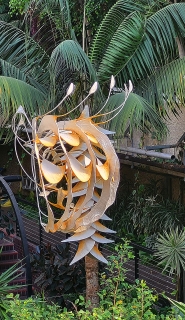
I ENJOY SEEING SCULPTURES displayed in gardens or other plant-filled locations. Until March 2024, the wonderful conservatory in London’s Barbican Centre is hosting a selection of sculptures by Ranjani Shettar. She was born in Bangalore (Bengaluru, India)) in 1977, and now lives and works in rural Karnataka. Her current exhibition in the Barbican is called “Cloud Songs on the Horizon”. The works on display were made especially for this site.
Her works are made of various materials (wood, stainless steel, muslin, and lacquer) and she employs techniques that have been adapted from traditional Indian crafts. Ms Shettar’s organic sculptures look like magnified plants or parts of plants. As she said once:
“Nature’s beauty is ever present, art helps to uncover, perceive and appreciate it.”
Seeing her exhibits in the Conservatory, certainly confirms this. However fine the artworks, putting them amongst plants helps emphasise the greater beauty of nature’s creations. The beauty of the sculptures competes with that of the plants, but the latter almost always win. So, placing one’s artworks within an area rich in plant life is a brave thing to do. I felt that Ms Shettar had done it successfully. Her creations have a harmonious relationship with the plant life surrounding them.
Whether or not you visit the exhibition, which I enjoyed, seeing the Barbican’s Conservatory – the second largest in Greater London – is always a worthwhile experience.
SINCE I LEFT school in 1970, I have only worn a shirt and tie on occasions when I can not avoid doing so. Frankly, I hate wearing ties and formal outfits, but unfortunately, I cannot always avoid engagements where this get-up is obligatory. Usually, I wear a tie with a long-sleeved white shirt.
Some years ago, there used to be many street sellers’ stalls on Bangalore’s Mahatma Gandhi Road (‘MG Road’). One day, we spotted a stall selling white 100% cotton shirts for formal wear. They were ridiculously cheap. The seller was asking 100 Indian Rupees (approximately £1 Sterling) for one shirt. The shirts were new, probably surplus stock. I bought two of them.
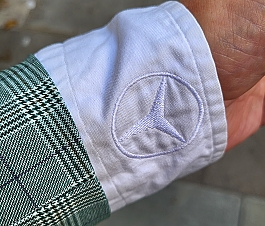
One of the shirts was perfectly satisfactory, but nothing exceptional. The other one had a feature that I only noticed when I first wore it. On its left sleeve cuff, there is a beautifully embroidered Mercedes Benz logo. Otherwise, there was nothing untoward about it. One label inside it bears the words “New England Gentleman” and near it another informs the wearer that it was tailored in Honduras. I suspect that the shirt was part of a batch made for a Mercedes Benz dealership, Whenever I wear it, I do not feel short changed (shirt changed ??), but instead I think that owning it is the closest I have got to possessing a Mercedes Benz.
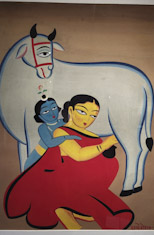
SURVEYING THE REPRESENTATION of women by artists in a single exhibition might seem a daunting task, if not impossible. Yet, this is what the exhibition “Visible/Invisible” achieves successfully. Curated by Kamini Sawhney, Arnika Ahldag, Vaishnavi Kambadur, Riya Kumar and Arshad Hakim, this magnificent display of artworks can be viewed at the recently opened (in late February 2023) Museum of Art and Photography (‘MAP’) on Kasturba Road in Bangalore (Bengaluru). The exhibition, which is displayed in most of the rooms on one floor of MAP confines itself to works created by artists, both male and female, from the Indian subcontinent and its diaspora. However, this did not hinder the curators’ aim of demonstrating the female in art over the centuries.
The 130 artworks on show range in date of creation from the 10th century AD to the present. MAP’s website reveals that the various artworks: “… are interwoven into four key sections based on narratives and counter-narratives: Goddess and Mortal, Sexuality and Desire, Power and Violence, and Struggle and Resistance. Each section presents how women’s lives have been portrayed, the spaces that they occupy and challenges that women have faced in the Indian subcontinent. The themes and ideas explored in Visible/Invisible hopes to encourage audience awareness of the history and role of women and gender in art.” And the exhibition successfully raised my awareness of the multiple ways in which the lives of women have been portrayed by artists of both genders over the centuries,
The artworks include sculptures, paintings, photographs, film posters, textiles (some created by female artists and others woven in traditional patterns by craftswomen), and prints. Almost every exhibit was a joy to behold, What was particularly interesting were examples of artworks created within the last few decades that demonstrate how Indian women artist have taken control of the way they portray women and their lives, What the viewer sees is how women see themselves, which is a contrast to what has happened in earlier times when women have often been shown in the way that men have viewed their lives.
All in all, this exciting exhibition is compelling both visually and conceptually. The curators have expressed their ideas beautifully and powerfully, but not without considerable subtlety.
MANY INDIANS STRIVE to gain a Master of Business Administration (‘MBA’) degree. I can say little or nothing about the merits of this academic qualification, but know many friends who have been awarded it.
A long time ago, soon after we married in Bangalore, we attended an engagement party held for one of our friends. During the evening, the priest who would eventually officiate at the marriage gave a speech. He spoke in English with a strong South Indian accent. He introduced the couple as follows: “These two dear people are well-matched. He has a yem bee yay. And she has a yem bee yay…” Just in case you did not make sense of that, ‘yem bee yay’, it is the way that many Bangaloreans would pronounce ‘MBA ‘.
This distant memory of our friends’ engagement party was prompted by noticing a tea shop on Bangalore’s St Marks Road. It is named “MBA CHAI WALA”. Above the name are the words “India’s Most Iconic Chai Wala”. As we were in a hurry on our last day in Bangalore, we had neither the chance to sample a cup of tea nor to discover whether the place had anything to do with the MBA degree. On our next trip to Bangalore, I will investigate and get back to you.
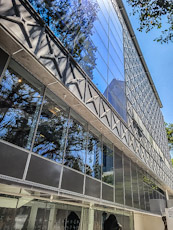
THE MUSEUM OF ART and Photography (‘MAP’) in central Bangalore has just opened (on the 18th of February 2023. Facing the Visvesvaraya Industrial & Technical Museum, MAP is housed in a brand new building with some attractive architectural features.
The edifice has five floors and a basement, which is home to an exorbitantly priced café, run by a company called Smoor. The ground floor has a reception area, a book/gift shop, and some gallery space. This is currently housing an exhibition of fascinating, attractive sculptures by LN Tallur. Some of the works of this contemporary artist allude to Hindu deities in a novel way.
The first floor is home to an auditorium, named after one of MAP’s major donors, Mazumdar-Shaw. Kiran Mazumdar-Shaw, a childhood friend of my wife, is a keen collector of art and has helped finance many other cultural establishments. On the same floor, there is a digital exhibition, whose subject matter can be chosen by the visitor.
The second floor is dedicated to offices and a library. Above this on the third floor, there is currently an exhibition of photographs by Jyoti Bhatt (born 1934), who began his artistic career in the famous art school in Baroda (Vadodara) in Gujarat. His works range from excellent straightforward documentary photography to highly creative artistic photography and collage work.
On the fourth floor, we enjoyed a beautiful exhibition called “Visible/Invisible”. Curated by Kamini Sawhney, Arnika Ahldag, Vaishnavi Kambadur, Riya Kumar and Arshad Hakim, this show explores the visual representation of women in artworks through the ages. Words alone can not do justice to the impactful nature of the display, but I will give you a rough idea of its range. In addition to paintings, modern and old, there are sculptures; photographs; tapestries,; traditional textiles; prints; and a video installation. Most of the artworks in this show were created by Indians or members if the Indian diaspora. The show successfully demonstrates how women have been portrayed over the centuries and how this has changed, especially more recently.
The fifth floor has a terrace from which there are some great views. There were some tables and chairs up there, but the café, if it exists, was not open.
Some years ago, we were in Bangalore when its branch of the National Gallery of Modern Art (NGMA) was opened in a restored palatial mansion near the Bangalore Golf Club. A beautifully designed annex was built next to the old building. When it was opened, I decided that it was a ‘must-see’ attraction in Bangalore. It remains so, but MAP in its newly constructed home will join NGMA amongst my suggestions of what should not be missed by visitors (and inhabitants) in Bangalore.





 yamey
yamey 