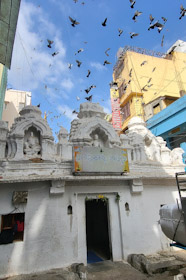
The bell tolls loudly
Within the holy mandir
Pigeons fly around

The bell tolls loudly
Within the holy mandir
Pigeons fly around
AT FIRST SIGHT, you might well think that you are looking at a crowded carpark which has been blown to pieces by a powerful bomb. There are parts of cars – bodywork, tyres, engine parts, etc., – all over the place.
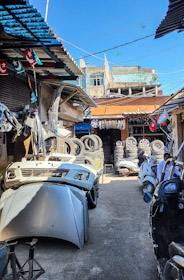
After a moment or two, you begin to realise that there is a semblance of order in this ocean of car parts, many of which have been salvaged from cars at the end of their useful lives. For this area in the Shivajinagar district of Bangalore is a car parts bazaar. There are many different dealers, each specialising in particular parts of a vehicle. For example, there are merchants selling radiator grilles, others purveying axles (both front and rear), there are sellers of tyres, there are shops selling car doors and body panels … and so on.
Near both Russell Market and St Mary’s basilica, the car parts bazaar is almost hidden from sight by the buildings surrounding it. It is approached by short gullies – narrow lanes. I first stumbled across it in late December 2007. Then, on subsequent trips to Bangalore, I tried to find it again, but in vain. Today, the 26th of December 2023, I managed to locate it, and spent a few minutes wandering around it, stopping to take photographs.
It seemed that most of the dealers were Muslims. Some of them stopped me, greeted me, and asked where I came from and my name. When I replied ‘Adam’, they asked me whether I am Muslim. This reminded me of my first visit to Kosovo in 1975. As soon as I stepped of the bus that had carried me from Skopje (Macedonia) to Prizren (Kosovo), a group of youngsters surrounded me. They wanted to know my name, and when I told them, they were very happy because they thought that, like them, I was a Muslim.
Most of the dealers in the car part bazaar were happy with my taking photographs, but a few in one section of the market asked me not to use my camera.
As far as I could see, no repair work was being undertaken in the bazaar. Nearby, next to Russell Market, there were plenty of cars being repaired. Often those involved in repairing a vehicle were engaged in noisy discussions.
It is seeing places like the seemingly shambolic car parts bazaar that help to endear India and its people to me.
ONE OF THE THINGS that struck me when I first visited India in January 1994 was how everyone was wearing clothing far more colourful than anywhere else I had been before. Wherever I have been in the country, there is a feast of colourful clothing to be seen. Whether the colourful garments are worn purely for aesthetic reasons and/or for ceremonial or group identity reasons, everywhere there is much to please the eye.
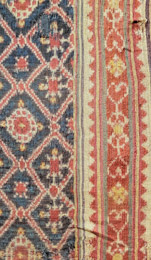
I am not alone in noticing the Indian penchant for wearing bright colours. In 1956, the famous style ‘diva’ Diana Vreeland noted in British Vogue magazine: “… pink is the navy blue of India …”. Following from this, an article in India’s “Economic Times” of January 2022, pointed out that “Red is the Indian beige and yellow is the Indian grey…”. In other words, that the exuberant colours worn by Indians contrast dramatically with the much more drab colours currently worn in the West. Actually, as my wife pointed out, long ago in Europe (eg the 18th century and before) clothes – especially those worn by the wealthy and the aristocracy – were far more colourful than now.
On the 23rd of December 2023, we were fortunate to get admission to an exhibition of sarees on its last day. Intriguingly entitled “Red Lilies, Water Birds”, the show was hosted by The Registry of Sarees in a house on Hayes Road in Bangalore. The Registry (established in 2016) is a trust set up by the Mysore Saree Udyog (founded in 1932). Its purpose is to promote the study, design, and conservation of handspun and handwoven textiles.
The nine rooms of the exhibition contained about 84 examples from the Registry’s much larger collection. Each room concentrated on either a particular region of India, or a specific method of creating the textiles. Every room was filled with sarees, which filled the viewer’s eyes with richly coloured, intricately patterned delights.
Many of the visitors to the exhibition, and the staff looking after, and explaining, the show were wearing clothing that demonstrated what I mentioned at the outset – namely, the preference of many Indians to dress colourfully.
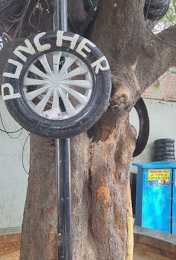
WHEN I FIRST visited India – that was in January 1994 – I carried my British and International driving licences with me. Boldly, I drove in the heavy traffic and densely crowded streets of the busy City Market area of Bangalore and also all the way to Ootacamund (‘Ooty’) – over 270 Km, and that was before the highway was constructed. You can share in these experiences by reading my book about travels in India, “The Hitler Lock & Other Tales of India”. This book/kindle is available from Amazon (https://www.amazon.co.uk/HITLER-LOCK-OTHER-TALES-INDIA/dp/B0CFM5JNX5/ ), and IF you live in India, from: https://store.pothi.com/book/adam-yamey-hitler-lock-and-other-tales-india/ .
DURING AN EXCELLENTLY guided walk through Bangalore’s Lalbagh botanical garden, I saw many parts of the place I had never seen before on several previous visits. One of these new ‘discoveries’ was a small neoclassical building with a triangular pediment on which the ganderberunda (double-headed eagle) of Mysore can be seen in bas-relief.

Painted with deep red paint, this small edifice is a recent reconstruction of Krumbiegel Hall, which was first built over 100 years ago (some say in 1860). For many years the original building was neglected, and it fell to pieces. In about 2020, it was rebuilt according to the original plans. So, today it looks brand new.
Gustav Hermann Krumbiegel (1865-1956) was born in Germany near Dresden. He was a botanist and garden designer who came to India in 1893, after having worked in London’s Kew Gardens. He helped to develop the Lalbagh Garden into the wonderful place it has become. Apart from designing the gardens, he introduced many interesting and exotic plants into Lalbagh. His importance in the development of the botanical garden cannot be overestimated.
The original building was used to hold lectures. Krumbiegel was one of those who spoke there. He used to enjoy practicing his speeches and talks in the hall. The construction of the replica of the original hall was stimulated in no little way by the campaigning of Krumbiegel’s great granddaughter, Alyia, who resides in south London.
When I saw the hall yesterday (22nd of December 2023), it was locked up and in front of it were a couple of lamps stands awaiting election. One day, I hope that I will be able to attend a lecture in this hall that has been replicated on the footprint of that which Krumbiegel would have used.
ON ARMISTICE DAY (11th of November 2023), we stopped to look at the war memorial that stands in a busy part of Bangalore, where Brigade Road crosses Residency Road. Erected in about 1928, its design was somewhat influenced by Lutyens’s famous Cenotaph in London’s Whitehall. Actually, it has a greater resemblance to the memorial clock tower in London’s Golders Green, where I was brought up.

The four-sided memorial in Bangalore is to commemorate the members of the Pioneers, who died in WW1. However, it also records other earlier campaigns that claimed the lives of Pioneers The Pioneers, more correctly the regiments of the ‘Madras Pioneers’, were established by the British in the 18th century, and later became known as the Madras Sappers. More details are to be found in an article in the hindu.com :
“A glance at some historical documents shows that the 61st Pioneers originated in 1758 and were raised as the 1st Battalion Coast Sepoys which became the 61st Pioneers in 1901 and later became the 1st Battalion of the 1st Madras Pioneers in 1922. The 64th Pioneers also originated in 1758 as the 5th Battalion Coast Sepoys and became the 2nd Battalion of the 1st Madras Pioneers in 1922. The 81st Pioneers stood apart and originated in 1786 as the 28th Madras Battalion and later became the 10th (Training) Battalion of the 1st Madras Pioneers in 1922.”
Apart from WW1, the monument records other campaigns that were fought so that the British could consolidate their Empire. These include (to mention but a few named on the memorial): Mysore, Seringapatam, Nagpur, Afghanistan (1878-80), Burma (1885-87), and China (1900). For some of these conflicts the numbers of men lost are recorded. Numbers of English and Indian fatalities are listed separately.
When we visited the monument on Armistice Day, we saw two fresh wreaths at its base. One had a label attached, which said it had been placed by the French Consulate in Bangalore. The other had no words but it bore ribbon with the colours on the flag of Germany. There was neither an Indian nor a British wreath to be seen.
YOU CAN SEE MURALS painted on walls throughout the Indian city of Bangalore (and in many other places in India). These paintings transform otherwise boring walls into something worth looking at.

Today, the 12th of November 2023 – Diwali, I visited Airlines Hotel in Bangalore. This place has an alfresco café and a large parking area. I saw some young people painting a mural. The design they were creating was a copy of a picture on the screen of a tablet or ipad. The building on which they were painting faces a long wall that marks the boundary of both the car park and the Airlines compound.
Since we last visited Airlines in February 2023, the boundary wall has been covered with a long painted mural. At first sight, this colourful painting brings to mind the work of the Dutch artist Vincent Van Gogh, who died long before it was made.
Though it resembles the style of the Dutch artist, on closer examination you can easily tell it is not by him. But its creator has certainly done a good job capturing the essence of Van Gogh’s style, and has livened up a hitherto unsightly, high breeze block wall. The other murals adorning the compound are visually engaging, but not as much as the Airlines “Van Gogh “
WHENEVER I THINK ABOUT Christmas trees, I envisage a smallish pine tree that is roughly conical in shape. Today, I noticed a tall conifer growing in a garden in Bangalore. Attached to it there was a metal label identifying it as “Christmas tree. Araucaria cookei.” This tree bore no resemblance to any Christmas tree I have ever seen.

I used the Internet to look up ‘Aracauria cookei’, and learned that it is commonly known as ‘Captain Cook’s Pine’. It was first ‘discovered in New Caledonia by a botanist travelling with Captain Cook on his Second Voyage (between 1772 and 1775).
One botanical website revealed that when planted in a pot, this tree can be used as an alternative to regular Christmas trees. Other websites describing this plant make no mention of this. In any case, the specimen I saw labelled in Bangalore was taller than an average three-storey building. It was far too tall to be used as a Christmas tree.
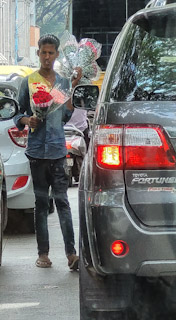
Risking danger
He sells roses on very busy streets
Buy some please
DURING OUR HONEYMOON in 1994, we travelled around places in southern India. At one point, we had to change trains at Coimbatore in Tamil Nadu state. With a few hours to spare, we ate dinner at a modest small restaurant near the station.

We sat down and banana leaves were placed on the table in front of us. These served as plates. There was no menu. A waiter hurried around the restaurant, stopping next to each diner and placing dollops of vegetarian culinary preparations on the leaves. He returned and placed a pile of steamed rice next to the mounds of vegetable items. He kept running from table to table, replenishing foods as required by the diners. This seemingly endless distribution of food set us back a total of 12 Rupees, which in 1994 was about £0.40 (yes, 40 pence). The coffee we drank at the end of the meal was the same price.
Yesterday, the 9th of November 2023, I was reminded of this experience whilst watching a waiter serving Andhra style vegetable preparations on a banana leaf in Bheema’s restaurant on Bangalore’s Church Street. Naturally, the meal cost a lot more than we paid in Coimbatore in 1994, but it was still very good value.
 yamey
yamey 