An exhibition in London at a gallery called Parafin

ONE OF THE MANY advantages of living close to central London is that it does not take long for us to reach the numerous commercial art galleries in Mayfair and Marylebone. Many of these hold exhibitions of modern and contemporary art, which is often fascinating to see. My mother was a sculptor, many of whose works were abstract rather than figurative. Being brought up in close proximity to someone so interested in the contemporary art world (of the 1960s and 1970s) might well have been a source of my lifelong interest in seeing works of contemporary artists (as well as modern artists who no longer live). My enthusiasm for viewing art has been enhanced by two people close to me. My wife has always had an interest in art in general and ‘modern art’ in particular. Our daughter, who works in the world of art and its propagation, has added to our enjoyment of experiencing artistic creations by recommending galleries with exhibitions that often prove to be most fascinating.

Recently, our daughter suggested that we see an exhibition, “As Above So Below”, by an artist with whom she is working. Creations of British born Tania Kovats (born 1966) are being displayed at an exhibition in a small Gallery, Parafin, in Woodstock Street (close to Bond Street Underground station) until the 24th of February 2024. Although she is known for her work in a wide range of artistic activities, she best known for her drawings and sculptures. The present exhibition includes many drawings and a few sculptural creations. The gallery’s ‘flyer’ (or handout) explained that:

“… Kovats’ enduring themes are the experience and understanding of landscape, geological processes, patterns of growth and the intersection of landscape, nature and culture and how art can speak to our critical climate crisis.”

This summarises what the artist is trying to convey with her artworks. Everything on display at the exhibition was pleasing visually and meticulously executed, but just by looking at the works I was unable to grasp anything about them but their beauty. Fortunately, the gallery’s flyer helps to explain the artist’s intentions.

Many of the works on display relate to the sea and evoke it beautifully. One exhibit, also connected with the sea, was a series of images of numbered, but un-named, graves of 20 migrants who lost their lives crossing the sea from Africa to the Italian island of Lampedusa. Near this artwork, there was another work – a line of used school shoes. This is Tania’s memorial to her son’s childhood, and (to quote the flyer):

“… explores how growth houses loss, and is built into the child’s progress towards individualisation.”

The passage of time is depicted in another work in the exhibition, “Luna”, in which a series of pictures depicting the phases of the moon as they change during a lunar month.

I am very pleased that our daughter recommended this exhibition by an artist, who we had not encountered before. Although I greatly enjoyed the exhibition, now that I write about it and reflect on what I saw and read, I feel that I would like to see the show once again because at a second viewing I will gain much more from it than during my first visit.

A twentieth century American artist who seemed to have lost his way

THE EARLY WORKS OF artists, who became famous for their successful experimentation in style and expression (such as Matisse, Picasso, Van Gogh, Miro, and Hockney), began by making quite conventional figurative pictures – always competently executed. Such was also the case with the artist Philip Guston (1913-1980), who was born in Canada, son of Jewish parents who had migrated from Czarist Russia. Born ‘Goldstein’, he later changed his surname to ‘Guston’. His family moved to Los Angeles (USA) in 1922. His childhood was filled with trauma: his father committed suicide, and soon after that his brother was killed in a motor accident. He began to be involved with art as a way of dealing with these sad events. In the 1930s, he engaged with political activity, fighting racism and anti-Semitism at a time when the Ku Klux Klan was enjoying some prominence. Several of his paintings depict hoods, such as were worn by the Klan.

There is a retrospective exhibition of Guston’s works at London’s Tate Modern until the 25th of February 2024. The paintings are exhibited chronologically on the walls of eleven interconnecting display areas. Like the artists listed at the beginning of this piece, Guston’s early works are figurative and very beautifully painted. Many of these powerful images reflect his concerns about the adverse political developments he observed during the 1930s. Later, in the 1940s, he became friends with artists like Mark Rothko and Willem de Kooning, and he moved successfully from figurative painting to abstraction. He became well-known as an abstract artist. After that, in the 1960s, his art seemed to my eyes to go downhill.

Guston’s later works, which are partly figurative and partly abstract, and created in and after the late 1960s, were undoubtedly created to send messages to the viewer. However, I found them to be crudely executed in comparison with his earlier abstract and much earlier figurative works. Whether this crudeness was deliberate or reflected a decline in the artist’s ability I cannot say. These later works express the artist’s personal crises and his reaction to injustices and other global catastrophes, but they did not do much for me from an aesthetic point of view. Had I left the exhibition without seeing them, my admiration for Guston would have been higher than it is having seen them.

A Brazilian artist and the River Ganges at Varanasi

MARINA RHEINGANTZ IS an artist whose works I had never seen until today, the 31st of October 2023. Her exhibition, “Maré”, which means ‘tide’ in Portuguese, is on at the White Cube Gallery in London’s Masons Yard until the 11th of November 2023. Most of the exhibits are painting, but there are also an embroidery and a tapestry.

Marina was born in 1983 at Araraquara in Brazil. She lives and works in São Paulo, Brazil. The works on display at White Cube tend towards being abstract, but they are not completely devoid of naturalistic content. As the gallery’s handout explained:

“Guided by observations of tidal rhythms, ocean beds and meteorological conditions, Rheingantz infuses landscapes of water with a quasi-sentient vitality … Expansive in scale and richly textured, Rheingantz’s landscapes deconstruct topography into its loosest arrangements.”

Although separated from him by many years, Marina’s paintings are almost as atmospheric as the great JMW Turner’s most impressionistic works. However, she has gone further than Turner in her almost abstract depiction of natural phenomena.

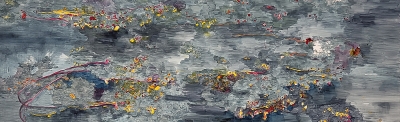
For example, this is evident in two paintings (detail from one of them above) she created following a recent visit to Varanasi (‘Benares’) on the Ganges River in India. These depict in an impressionistic way the orange embers that bodies being cremated on the burning ghats spit out onto the surface of the river. Other pictures on display express her perceptions of places as far afield as Brazil, Mexico, and Morrocco.

Not far from Piccadilly and the Royal Academy, White Cube Masons Yard is well worth a visit, It would be a shame to miss viewing the artworks created by Ms Rheingantz.

Creating art with wood and a chainsaw

BORN IN WHAT BECAME EAST GERMANY in the town of Deutschbsaselitz, the artist christened as Hans-Georg Kern (b. 1938), is better known by the name of Georg Baselitz. His first education in art was at Hochschule für Bildende und Angewandte Kunst in East Berlin, commencing in 1955. After two semesters, he was expelled from this academy because of his lack of compliance with the socialist diktats of the German Democratic Republic. By 1957. he was a student at the Hochschule der Künste in West Berlin. In 1961, he changed his name to Georg Baselitz in honour of the town where he was born. In 1979, he began creating sculptural works, some of which are on display at London’s Serpentine South Gallery until the 7th of January 2024.

The works being shown at the Serpentine are all made of wood. They were created between 2011 and 2015 as models (maquettes) for finished works, and as such were not originally intended for public display. The wood has a rough finish and is pitted with many saw marks. After making preliminary drawings, some of which are displayed at the exhibition, Baselitz used axes, chisels, and chainsaws to fashion huge bits of timber into intriguing sculptural forms. These works are beautifully displayed in the various spaces of the gallery.

Although Baselitz’s timber sculptures are more figurative and much more complicated than those produced by my mother, seeing them reminded me of her. After leaving the sculpture workshops of St Martins School of Art, my mother hired a garage near Golders Hill Park, and used it as her studio. There, she worked on huge pieces of wood, creating abstract sculptures. Unlike Baselitz, she had no power saws, but only chisels and a power drill. I recall that when she wanted to create a ring-shaped piece of timber, she would first trace circles on the wood and then using a power drill she would drill holes around the circumference until the circle was complete. After that, she had to smooth the edges to produce a perfect circle. It was laborious, and lifting the heavy timber (without lifting gear) damaged her back.

The works on display in the Serpentine  (and one outside it) appear to be crudely finished when looked at closely, but as semi-abstract sculptures they seem to mock the grandeur of classical Greek or Roman sculptures. Born a rebel, the artist has produced attractive works that comfortably go against the grain of traditional sculpture.

An artistic British Nigerian in Mayfair

WHEN WE ARE IN LONDON, we make regular visits to the commercial art galleries, many of which are to be found in and around Mayfair. Not only can one get to see some of the most recent works of contemporary artists, but also those that will eventually end up in private collections that are usually inaccessible to the general public. Today, the 12th of October 2023, we were walking along Cork Street, heading towards the Waddington Custot Gallery when we passed a gallery, the Stephen Friedman, which we had never entered before. Through its window, we saw works by an artist, whose oeuvre we enjoy, and entered.

Much of the exhibition at Stephen Friedman is dedicated to creations of the British Nigerian artist Yinka Shonibare. He was born in London in 1962. His Nigerian parents took him to Lagos in Nigeria when he was 3 years old, and he lived there until he was 17. A year later, he developed transverse myelitis, which left him paralysed on one side of his body. Despite this, he went on to study fine art at the Byam Shaw art school, and then later at Goldsmith College (part of the University of London). Because of his disability, Yinka directs a team of assistants to create his artworks (sculptures, photographs, fabrics, and much more). He has become a widely exhibited and highly acclaimed artist.

Yinka’s works are visually engaging and highly imaginative. They are also full of meaning. He uses his creations to:

“… question the validity of contemporary cultural and national identities within the context of globalisation. Through examining race, class and the construction of cultural identity, his works comment on the tangled interrelationship between Africa and Europe, and their respective economic and political histories.” (see https://yinkashonibare.com/biography/)

Although one can easily enjoy the aesthetics of his creations without understanding the artist’s messages contained within them, a good knowledge of colonial and post-colonial history will enhance the viewer’s experiences of them.

The exhibition is on until the 11th of November 2023. In addition to Yinka’s works, he has curated a small, but fascinating, collection of artworks by several artists from the African diaspora.

An artist who campaigned against slavery

HE WAS PASSIONATE about sketching and painting. However, his father, a wealthy Quaker brewer in Hitchin (Hertfordshire), insisted that his son should dedicate himself to working in the family business and use his spare time to create his art. The artist was Samuel Lucas (1805-1870). There is a wonderful exhibition of his creations at the beautifully laid out North Hertfordshire Museum in central Hitchin until the 12th of November 2023.

After schooling and an apprenticeship in London’s Wapping, Samuel worked in the family business in London before returning to work in Hitchin in 1834. As for his artistic ability, this appears to be self-taught. However, he was a keen visitor to the Royal Academy exhibitions in London. In 1837, he married Matilda Holmes, who had been a pupil of the artist John Bernay Crome (1794-1842). She was keen on sketching, but none of her works have survived. I speculate that it is not beyond possibility that Matilda, a water colourist, might have helped Samuel develop his superb water colour techniques.

Samuel’s sketches range from extremely detailed to impressionistic, resembling the work of JMW Turner to some considerable extent. The finished oil paintings, some of which were displayed at the Royal Academy, are beautifully composed, full of detail, and of great visual interest.

Two of the exhibits interested me more than the others. One of them is a pen and ink sketch depicting Thomas Whiting of Hitchin reading Harriet Beecher Stowe’s anti-slavery novel “Uncle Tom’s Cabin” (published 1852) to a gathering of people in a hall in Hitchin. Nearby, there was one of Samuel’s oil paintings. This shows seven men seated around a small table listening to a man standing with his left hand on the table. The standing man is Bishop Samuel Wilberforce (1805-1873). He is addressing members of the Oxford Mission amongst whom is the novelist Lord Lytton of Knebworth (Hertfordshire). The bishop was a son of the anti-slavery activist William Wilberforce. Bishop of Winchester from 1870 until 1873, he was both against slavery and Darwin’s Theory of Evolution. Samuel Lucas’s painting depicts him when he was Bishop of Oxford, which he became in 1845, and remained until he was shifted to Winchester. The Oxford Mission was an Anglican missionary organisation, which became important in Bengal in the late 19th century.

The two pictures described relate to Samuel Lucas’s involvement of the anti-slavery movement. In 1840, he was Hitchin’s delegate to the Anti-Slavery Convention held in London at Exeter Hall on the 12th to 23rd June 1840. During this period, he and his wife hosted some of the delegates who had come from the USA. The convention is portrayed in a painting by Benjamin Haydon (1786-1846), which is now in the National Portrait Gallery. The gallery’s website has a photograph of this painting, which has been displayed so that the viewer can identify each of the people in it. Samuel Lucas can be found near the back of the gathering near a pillar.

Lucas was against slavery, as were many of his fellow Quakers. In addition to this activity, his artistic creations, and his involvement in the family business, he was also an active contributor to the life and development of Hitchin. One of the largest of his paintings in the gallery, but not included in the exhibition, is a depiction of Hitchin’s Market Place. Each of the many people shown in the painting is a portrait of an actual person. The museum has an interactive guide to identify the people. One of them was Isaac Newton (1785-1861). This gentleman was not the famous scientist but the owner of a family firm of painters, plumbers, and glaziers. One of the many folks in the picture has a dark complexion. This is a portrait of Samuel ‘Gypsy’ Draper (1781-1870). He was a violinist, who played for dances and fairs in the area in and around Hitchin for about 20 years. Some of the local Quakers disapproved of him, but Samuel Lucas placed him at the front of the crowd in the centre of the painting. Had we not visited the North Hertfordshire Museum out of pure curiosity, I doubt that we would have ever come across the life and works of Hitchin’s Samuel Lucas. We spent most of our time looking at the superb exhibition about him, so that we had hardly any time left to see the rest of the museum. A fleeting glimpse of the other galleries in the lovely modern building was enough to persuade us that we need to return to see more.

Inspired by a novel by James Joyce

THE ARTIST ANSELM Kiefer was born in Germany a few weeks before the end of WW2 in Europe. He was brought up in a country devastated by warfare and with a shameful recent past. It is said quite reasonably that much of his artistic output has been influenced by the guilt-ridden environment in which he grew up.

Today, the 21st of June 2023, we visited the White Cube Gallery on Bermondsey High Street in south London. Until the 20th of August 2023, it is hosting a spectacular show of works created by Kiefer. To call it an exhibition is a bit of a misnomer – it is really an ‘immersive experience’. It occupies the gallery’s entire exhibition space as well as the long central corridor that links the various large display rooms.

The long central corridor is lined with a large variety of ‘objets trouvés’, which some might well describe as ‘junk’. Together, they form a large-scale cabinet of curiosities like those which wealthy people used to create in the past, but few of the objects would have appealed to such collectors. Three large rooms can be entered from the corridor. The walls of each of these are lined with what at first sight look like enormous paintings. They are made of metal, often quite three-dimensional, and coloured with paint. Each one is both visually exciting and satisfying. In the middle of each room, there is an installation that suggests that it has formed after some apocalyptic event – maybe, an atomic bomb explosion or some similarly catastrophic event. In one room, the centre is filled with a pile of sand in which discarded supermarket trolleys have been abandoned. Another room is filled with what look like huge books damaged by flood waters. In the third and largest room, there are the concrete and rusted iron remains of what might once have been a modern building – it is a scene of horrendous devastation.

Throughout the ‘exhibition’, there are handwritten words, phrases, and sentences. These can be found on the walls, on the painting-like panels, and near objects stored in the corridor. A gallery attendant told us that each of them had been handwritten by Kiefer when he came to inspect the installation of his show. The words were not his but are all taken from “Finnegan’s Wake”, published in 1939 and written by James Joyce (1882-1941). Hence, the exhibition at the White Cube has been given the name of this novel.

Superb as this exhibition surely is, I found it oddly claustrophobic. Although it is a visual feast and a great feat of imagination and creativity, I found it slightly disturbing – that might have been the artist’s intention. But please do not let me put you off visiting this unusual and wonderful show.

An artist named Balthus

ON THE LAST DAY of May 2023, I visited the Luxembourg Gallery on London’s Savile Row. My wife and I went to see a small exhibition of paintings and drawings by an artist whose name was not familiar to me – Balthasar Klossowski (1908–2001). Better known as ‘Balthus’, he was according to Wikipedia:

“…known for his erotically charged images of pubescent girls, but also for the refined, dreamlike quality of his imagery.”

Although there were three drawings that fall into the “erotically charged” category, most of the other works on display were delicately executed, attractive paintings. Most of these demonstrate what the gallery’s website described as follows:

“Exercising meticulous control over the form and placement of models, their bodily gestures, as well as the domestic or rural settings in which they reside, Balthus sought to create, at least in appearance, dreamlike scenarios, absent of time and devoid of emotional expression. Yet the restraint in his works results in suggestive and even violent relationships between elements or figures in the picture, as well as in their relation to viewers or the artist himself.”

The results are extremely pleasing to the eye.

The Wikipedia article mentioned something that particularly interested me:

“Throughout his career, Balthus rejected the usual conventions of the art world. He insisted that his paintings should be seen and not read about, and he resisted any attempts made to build a biographical profile. Towards the end of his life, he took part in a series of dialogues with the neurobiologist Semir Zeki, conducted at his chalet at Rossinière, Switzerland and at the Palazzo Farnese (French Embassy) in Rome.”

When I was studying for my BSc in physiology at University College London in the early 1970s, one of my teachers was Semir Zeki, mentioned in the quote above. I recall that he was an excellent teacher, who was able to explain complex topics extremely clearly.

Although I did not know about Balthus nor of Professor Zeki’s connection with him, I am very pleased I visited the Luxembourg Gallery and became aware of such a fine 20th century artist.

From Bombay to Belsize Park

SEVERAL OF OUR FRIENDS born in India came to study accountancy in the UK during the late 1960s and early ‘70s. In those days, studying accountancy had two benefits apart from giving our friends the opportunity to have careers in commerce and finance. First, coming to the UK was an opportunity to live abroad, and, more importantly, because they had to study whilst employed by an accountancy firm, they got income to cover their living expenses. All of them have had successful careers in business and/or banking. Some years earlier (in 1950), Lancelot Ribeiro (1933-2010), born in Bombay, came to the UK to study accountancy. However, he did not complete the course. Instead, he began studying art at London’s St Martins School of Art between 1951 and 1953. At that time, he lived in London’s Chalk Farm with his half-brother, the artist Francis Newton Souza (1924-2002), who was born in Goa. In August 1954, Lancelot was conscripted into the RAF. He was released from this in January 1955. Then, he returned to Bombay.

In Bombay, Lancelot was employed by the Life Insurance Corporation. He remained in this company for four years, by which time his poetry and painting were becoming recognised by Bombay’s artistic community, notably by the poet Nissim Ezekiel, the critic and poet Rajagopal Parthasarathy, the critic Rudolf von Leyden (German born, but lived most of his life in Bombay), and the Tata industrial group (who commissioned some of his works). By 1959, he had decided to make painting his profession. By the early 1960s, he was exhibiting in both group shows and solo exhibitions and was gaining wider, and influential recognition. Lancelot and his wife returned to London at the end of 1962/early 1963.

After living in various parts of London, the Ribeiro’s settled in the Belsize Park area of Hampstead – at Belsize Park Gardens – for a few years. By now, Lancelot’s works, and those of other Indian artists living in England, were being exhibited both in the UK and India. Life in London was not easy even in the late 1970s for people with ‘brown’ skins as Lancelot found out the hard way. Several times, he was attacked in the streets near Swiss Cottage, and once badly injured when attacked outside Hampstead Police Station. In addition, some of his pictures were vandalised when on display at the Swiss Cottage Library in 1986-87. However, none of this subdued his irrepressible creativeness.

Some of his prolific and highly inventive artworks were exhibited in Hampstead’s Burgh House when it held an “Indian Month” in 1980. Although he did not enjoy as much fame as his better-known half-brother, Ribeiro’s work is well worth seeing. An opportunity to do so is currently available at Burgh House until the 17th of December 2023. The well-displayed exhibition, “Lancelot Ribeiro: Finding Joy in a Landscape” can be seen free of charge. The Burgh House website describes it as follows:

“A journey through the changing landscapes of Hampstead-based expressionist poet and painter Lancelot Ribeiro, from his roots in pre-Independence 1930s India to life in mid-20th century Britain.

Ribeiro experimented with form and materials, moving from conventional depictions of the Lake District to otherworldly townscapes and sharp, bright abstracts inspired by geology. Each work encourages us to look anew, reconsider the form and substance of our environment, and how we might depict and share those landscapes with others.”

I can strongly recommend that you pay a visit to this show to see the works of an artist, who should be more widely known.

Finally, I wonder what would have become of our few dear friends had they abandoned accountancy prematurely. One of them, in his retirement from many years in banking, has become written a highly acclaimed novel. Another, who retired from a career in an international corporation, is now highly developing his skills as a cook. A third, who dropped out of accountancy, has become a successful translator.

In search of WC on Madeira

IN JANUARY 1950, the famous writer, painter, and politician, Winston Spencer Churchill (‘WC’) paid a short visit to the island of Madeira with his wife and his eldest daughter. They were accompanied by various British officials.

WC arrived on the island by sea, and stayed in the luxurious Reid’s Hotel in Funchal, which continues to flourish today. He left by seaplane a few days later to attend to affairs connected with an upcoming election in the UK.

While we were visiting the excellent photographic museum in central Funchal, we saw some photographs of Churchill, which were taken during his excursion to the picturesque fishing port of Camara de Lobos, which is a few miles west of Funchal. The photographs show WC painting a picture of the lovely bay surrounded by serried rows of houses. I have yet to see the picture, which I hope still exists.

We took a local bus to Camara de Lobos and disembarked close to a small bar named after WC. This is located close to a terrace overlooking the bay and its fishing boats. It was from here that he painted. A monument records this episode.

In 2019, a new hotel opened, the Churchill Bay. Outside its entrance, there is a sculpture depicting WC with cigar held between his lips. He is shown seated at an easel. Within the hotel’s lounge and bar, there is a fascinating collection of Churchilliana – photographs; letters signed by WC; a portrait by Felix Topolski; and contemporary artworks relating to WC.

Whether or not you are a fan of the Great WC, Camara de Lobos deserves a visit. Although there are plenty of tourists there, it manages to retain the feeling of a traditional fishing village.