An artist in Turkey with a famous Albanian ancestor

ALI PASHA OF TEPELENE (1740-1822) was born an Albanian in what is now Albania. He ruled the Ottoman pashalik of Yanina (Ioannina in Greek) with a large degree of autonomy. One of his descendants was Naciye Hanim. She married Lieutenant Colonel Abdurrahman Ziya Bey,

Naciye and her husband had only one child, a daughter called Melek, who was born in 1896 (in Istanbul) and died in 1976 ( in Munich, Germany). She became a renowned painter, sculptor, and writer (books and articles). I would not have heard of her had we not visited the magnificent Sakip Sabanci museum of art at the village of Emirgan on the European shore of the Bosphorus. At this place there was an excellent exhibition of Melek’s life and works. With information both in Turkish and English, it was an enlightening experience.
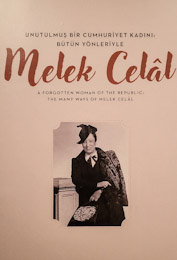
From an early age, Melek showed signs of artistic ability. She was brought up in an intellectual atmosphere. The Turkish poet Niğar Hanim encouraged her to take up painting. Her first lessons were with her uncle the soldier and painter Kâzim Bey. Later, she attended the Académie Julian in Paris. She also attended the School of Fine Arts for Women in Istanbul. While in Paris, Melek worked with various well-known French artists in their studios. Soon, she was recognised as an accomplished artist. This is evident from the many portraits and still-life’s on display in the exhibition.

In addition to painting and sculpting, Melek was a prolific writer of articles and books. She was also involved ed with Turkish politics during the period when the Ottoman Empire was dying and Ataturk’s modern Turkey was in its infancy. Her first book was published in 1938. In 1959, she published a book in French to introduce western readers to the delights of the Topkapi Palace complex in Istanbul. Many of her publications are on display alongside her paintings and one sculpture.

Melek married twice. First with Mr Celal in 1917. They had a son, and Celal died soon after that. In 1956, she married Dr Lampé, a physician. He died before she did. Melek died whilst being treated in a hospital in Munich.

Melek was one noteworthy descendant of Ali Paşa of Tepelene. There were others, who became famous Turkish intellectuals, including the writer Ebüzziya Tevfik(1849-1913), another writer Abdülhak Şinasi Hisar (1887-1963) and the author and poet Nâmik Kemal (1840-1888). These people of Albanian descent were not alone in shaping Turkey – both Ottoman and modern – in various ways, both peaceful and otherwise. I had heard about some of them, but Melek and her art are a wonderful discovery.

A COMMANDER OF THE BRITISH EMPIRE AND THE ARTISTIC INTERPRETATION OF COLONISATION

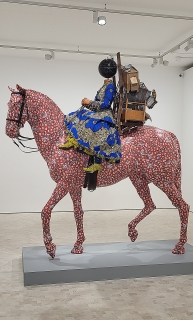
THE ARTIST YINKA SHONIBARE was awarded the prestigious CBE in 2019. In case you do not know what these three letters stand for, it is ‘Commander of the British Empire’ – not that Britain has much of, if any, empire left to boast of. For much of its long existence, places in the British Empire witnessed many injustices and inhumanities. This was especially true before the abolition of the slave trade in the early 19th century. Yinka Shonibare, who was born in London in 1962 and brought up between that city and Lagos in Nigeria, uses his artistic skills to explore Britain’s lengthy history of imperialism imaginatively and creatively. Even without knowing that he does this, his art works are in themselves visually exciting and fascinating to the viewer. The pieces on display until the 1st of September 2024 at the Serpentine South gallery in Kensington Gardens are well worth seeing both for their inherent beauty and for the way that Shonibare expresses his interpretation of Britain’s colonial past and its legacy.

For more information about the exhibition, please visit: www.serpentinegalleries.org/whats-on/yinka-shonibare-cbe-suspended-states/

From the screens of Instagram onto the walls of commercial art galleries

DO NOT UNDERESTIMATE the power of Instagram.

Today (the 2nd of April 2024), we visited Beers Gallery in Little Britain, a street which is close to St Bartholomew the Great church and Smithfield meat market. Until the 13th of April 2024, they have an exhibition of delightful paintings by Florent Stosskopf, who was born in Rennes (France) in 1989. Based in Brittany, he has qualifications in web and graphic design, as well as holding an Advanced Technician diploma from L’école Multimedia. Yet, he is a self-taught painter. His current exhibition at Beers is called “The Mocking Bird”. The gallery’s press hand-out says:

“The title, he informs us, is a loose reference to elements of his own autobiography that he found mirrored in the song ‘Mockingbird’ by Eminem.”

Be that as it may, the paintings are full of bold colour and vibrancy. It was a joy to see them.

We had never heard of Florent Stosskopf. We asked a lady who worked in the gallery how her establishment had got to know of this artist. The answer astonished us. She told us that it was after he began posting pictures of his paintings on Instagram (see: www.instagram.com/stosskopf_florent/)  that he began to be recognised as being a painter worth exhibiting in commercial galleries.

Many people with artistic tendencies and varying degrees of skill post images of their creations on Instagram. Even I use Instagram to try to promote some of my books. However, just posting on Instagram is not enough. To become truly successful by using Instagram, you need real talent, and that is what Monsieur Stosskopf has in a large amount.

AMAZING SCULPTURES AND COLLAGES BY A BRITISH POP ARTIST

HUMOUR, IMAGINATION, PLAYFULNESS, wit, social criticism, and creativity – these are all words that can be applied to the works of the artist Peter Blake, which are on show in a superb exhibition at the Waddington Custot gallery in London’s Cork Street until the 13th of April 2024.

Blake was born in 1932 in Dartford (Kent). He studied art at Gravesend Technical College, and then at the Royal College of Art in Kensington. He is a leading British exponent of Pop Art, which, according to Wikipedia:

“… is an art movement that emerged in the United Kingdom and the United States during the mid- to late-1950s.The movement presented a challenge to traditions of fine art by including imagery from popular and mass culture, such as advertising, comic books and mundane mass-produced objects. One of its aims is to use images of popular culture in art, emphasizing the banal or kitschy elements of any culture, most often through the use of irony.”

One of Blake’s most familiar works is the album sleeve for the Beatle’s LP “Sgt. Pepper’s Lonely Hearts Club Band”, which he designed along with Jann Haworth, his wife between 1963 and 1979. I wonder how many Beatle’s fans know that Blake was involved with making the image on this.

The exhibition at Waddington Custot is dedicated to Blake’s sculptural works. There has not been one during the last 20 years. Although there are many of his sculptures in the gallery’s three interconnecting rooms, many of his ingeniously witty collages are also on display. Employing images from comics, old books, and other printed matter, these collages are so carefully assembled that unless one looks at them closely and extremely obliquely, it is difficult to realise that these artefacts are not prints but collages.

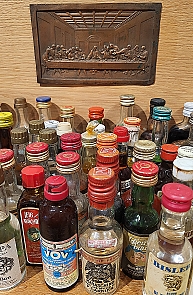
The sculptures are with only a very few exceptions, wonderful assemblages or tableaux constructed with found objects. For example, one of these is a shelf overloaded with miniature booze bottles, all positioned beneath a miniature image of Leonardo da Vinci’s depiction of the Last Supper. There are several model sailing boats, on which Blake has placed plastic models (toys) of people expressing a range of behaviours. Other sculptural assemblies are more complex and need to be seen rather than described. I mentioned ‘exceptions’ at the beginning of this paragraph. This refers to four objects – they look like large stones (one of which is a carved stone head) – which Blake called “Found Sculpture”. Each of these is mounted on its own plinth. By doing so, the artist has ‘elevated’ these natural objects to the status of ‘fine art’, and as the gallery’s hand-out said, they challenge:

“… conventional notions of artistic materials …”

I loved the exhibition. Every exhibit is both interesting and beautiful … and great fun. As the show’s hand-out correctly stated, Blake’s sculptures are:

“… by turns quirky, endearing or engaged with conceptual concerns.”

His creations:

“… offer starting points for imagined narratives, each with a glimmer of Blake’s typically gentle, English sense of humour.”

And this is quite correct. Skilfully conceived and executed, Blake’s works provide nourishment for both the eye and brain in a delightfully digestible form.  If you view the exhibition with an open state of mind, you are bound to gain great enjoyment from it.

An exhibition in London at a gallery called Parafin

ONE OF THE MANY advantages of living close to central London is that it does not take long for us to reach the numerous commercial art galleries in Mayfair and Marylebone. Many of these hold exhibitions of modern and contemporary art, which is often fascinating to see. My mother was a sculptor, many of whose works were abstract rather than figurative. Being brought up in close proximity to someone so interested in the contemporary art world (of the 1960s and 1970s) might well have been a source of my lifelong interest in seeing works of contemporary artists (as well as modern artists who no longer live). My enthusiasm for viewing art has been enhanced by two people close to me. My wife has always had an interest in art in general and ‘modern art’ in particular. Our daughter, who works in the world of art and its propagation, has added to our enjoyment of experiencing artistic creations by recommending galleries with exhibitions that often prove to be most fascinating.

Recently, our daughter suggested that we see an exhibition, “As Above So Below”, by an artist with whom she is working. Creations of British born Tania Kovats (born 1966) are being displayed at an exhibition in a small Gallery, Parafin, in Woodstock Street (close to Bond Street Underground station) until the 24th of February 2024. Although she is known for her work in a wide range of artistic activities, she best known for her drawings and sculptures. The present exhibition includes many drawings and a few sculptural creations. The gallery’s ‘flyer’ (or handout) explained that:

“… Kovats’ enduring themes are the experience and understanding of landscape, geological processes, patterns of growth and the intersection of landscape, nature and culture and how art can speak to our critical climate crisis.”

This summarises what the artist is trying to convey with her artworks. Everything on display at the exhibition was pleasing visually and meticulously executed, but just by looking at the works I was unable to grasp anything about them but their beauty. Fortunately, the gallery’s flyer helps to explain the artist’s intentions.

Many of the works on display relate to the sea and evoke it beautifully. One exhibit, also connected with the sea, was a series of images of numbered, but un-named, graves of 20 migrants who lost their lives crossing the sea from Africa to the Italian island of Lampedusa. Near this artwork, there was another work – a line of used school shoes. This is Tania’s memorial to her son’s childhood, and (to quote the flyer):

“… explores how growth houses loss, and is built into the child’s progress towards individualisation.”

The passage of time is depicted in another work in the exhibition, “Luna”, in which a series of pictures depicting the phases of the moon as they change during a lunar month.

I am very pleased that our daughter recommended this exhibition by an artist, who we had not encountered before. Although I greatly enjoyed the exhibition, now that I write about it and reflect on what I saw and read, I feel that I would like to see the show once again because at a second viewing I will gain much more from it than during my first visit.

A twentieth century American artist who seemed to have lost his way

THE EARLY WORKS OF artists, who became famous for their successful experimentation in style and expression (such as Matisse, Picasso, Van Gogh, Miro, and Hockney), began by making quite conventional figurative pictures – always competently executed. Such was also the case with the artist Philip Guston (1913-1980), who was born in Canada, son of Jewish parents who had migrated from Czarist Russia. Born ‘Goldstein’, he later changed his surname to ‘Guston’. His family moved to Los Angeles (USA) in 1922. His childhood was filled with trauma: his father committed suicide, and soon after that his brother was killed in a motor accident. He began to be involved with art as a way of dealing with these sad events. In the 1930s, he engaged with political activity, fighting racism and anti-Semitism at a time when the Ku Klux Klan was enjoying some prominence. Several of his paintings depict hoods, such as were worn by the Klan.

There is a retrospective exhibition of Guston’s works at London’s Tate Modern until the 25th of February 2024. The paintings are exhibited chronologically on the walls of eleven interconnecting display areas. Like the artists listed at the beginning of this piece, Guston’s early works are figurative and very beautifully painted. Many of these powerful images reflect his concerns about the adverse political developments he observed during the 1930s. Later, in the 1940s, he became friends with artists like Mark Rothko and Willem de Kooning, and he moved successfully from figurative painting to abstraction. He became well-known as an abstract artist. After that, in the 1960s, his art seemed to my eyes to go downhill.

Guston’s later works, which are partly figurative and partly abstract, and created in and after the late 1960s, were undoubtedly created to send messages to the viewer. However, I found them to be crudely executed in comparison with his earlier abstract and much earlier figurative works. Whether this crudeness was deliberate or reflected a decline in the artist’s ability I cannot say. These later works express the artist’s personal crises and his reaction to injustices and other global catastrophes, but they did not do much for me from an aesthetic point of view. Had I left the exhibition without seeing them, my admiration for Guston would have been higher than it is having seen them.

A Brazilian artist and the River Ganges at Varanasi

MARINA RHEINGANTZ IS an artist whose works I had never seen until today, the 31st of October 2023. Her exhibition, “Maré”, which means ‘tide’ in Portuguese, is on at the White Cube Gallery in London’s Masons Yard until the 11th of November 2023. Most of the exhibits are painting, but there are also an embroidery and a tapestry.

Marina was born in 1983 at Araraquara in Brazil. She lives and works in São Paulo, Brazil. The works on display at White Cube tend towards being abstract, but they are not completely devoid of naturalistic content. As the gallery’s handout explained:

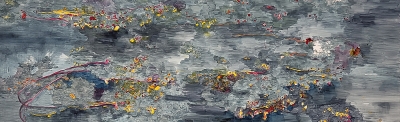
“Guided by observations of tidal rhythms, ocean beds and meteorological conditions, Rheingantz infuses landscapes of water with a quasi-sentient vitality … Expansive in scale and richly textured, Rheingantz’s landscapes deconstruct topography into its loosest arrangements.”

Although separated from him by many years, Marina’s paintings are almost as atmospheric as the great JMW Turner’s most impressionistic works. However, she has gone further than Turner in her almost abstract depiction of natural phenomena.

For example, this is evident in two paintings (detail from one of them above) she created following a recent visit to Varanasi (‘Benares’) on the Ganges River in India. These depict in an impressionistic way the orange embers that bodies being cremated on the burning ghats spit out onto the surface of the river. Other pictures on display express her perceptions of places as far afield as Brazil, Mexico, and Morrocco.

Not far from Piccadilly and the Royal Academy, White Cube Masons Yard is well worth a visit, It would be a shame to miss viewing the artworks created by Ms Rheingantz.

Creating art with wood and a chainsaw

BORN IN WHAT BECAME EAST GERMANY in the town of Deutschbsaselitz, the artist christened as Hans-Georg Kern (b. 1938), is better known by the name of Georg Baselitz. His first education in art was at Hochschule für Bildende und Angewandte Kunst in East Berlin, commencing in 1955. After two semesters, he was expelled from this academy because of his lack of compliance with the socialist diktats of the German Democratic Republic. By 1957. he was a student at the Hochschule der Künste in West Berlin. In 1961, he changed his name to Georg Baselitz in honour of the town where he was born. In 1979, he began creating sculptural works, some of which are on display at London’s Serpentine South Gallery until the 7th of January 2024.

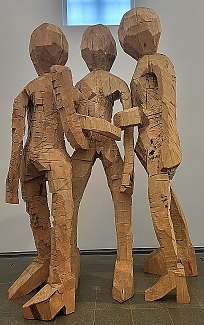
The works being shown at the Serpentine are all made of wood. They were created between 2011 and 2015 as models (maquettes) for finished works, and as such were not originally intended for public display. The wood has a rough finish and is pitted with many saw marks. After making preliminary drawings, some of which are displayed at the exhibition, Baselitz used axes, chisels, and chainsaws to fashion huge bits of timber into intriguing sculptural forms. These works are beautifully displayed in the various spaces of the gallery.

Although Baselitz’s timber sculptures are more figurative and much more complicated than those produced by my mother, seeing them reminded me of her. After leaving the sculpture workshops of St Martins School of Art, my mother hired a garage near Golders Hill Park, and used it as her studio. There, she worked on huge pieces of wood, creating abstract sculptures. Unlike Baselitz, she had no power saws, but only chisels and a power drill. I recall that when she wanted to create a ring-shaped piece of timber, she would first trace circles on the wood and then using a power drill she would drill holes around the circumference until the circle was complete. After that, she had to smooth the edges to produce a perfect circle. It was laborious, and lifting the heavy timber (without lifting gear) damaged her back.

The works on display in the Serpentine  (and one outside it) appear to be crudely finished when looked at closely, but as semi-abstract sculptures they seem to mock the grandeur of classical Greek or Roman sculptures. Born a rebel, the artist has produced attractive works that comfortably go against the grain of traditional sculpture.

An artistic British Nigerian in Mayfair

WHEN WE ARE IN LONDON, we make regular visits to the commercial art galleries, many of which are to be found in and around Mayfair. Not only can one get to see some of the most recent works of contemporary artists, but also those that will eventually end up in private collections that are usually inaccessible to the general public. Today, the 12th of October 2023, we were walking along Cork Street, heading towards the Waddington Custot Gallery when we passed a gallery, the Stephen Friedman, which we had never entered before. Through its window, we saw works by an artist, whose oeuvre we enjoy, and entered.

Much of the exhibition at Stephen Friedman is dedicated to creations of the British Nigerian artist Yinka Shonibare. He was born in London in 1962. His Nigerian parents took him to Lagos in Nigeria when he was 3 years old, and he lived there until he was 17. A year later, he developed transverse myelitis, which left him paralysed on one side of his body. Despite this, he went on to study fine art at the Byam Shaw art school, and then later at Goldsmith College (part of the University of London). Because of his disability, Yinka directs a team of assistants to create his artworks (sculptures, photographs, fabrics, and much more). He has become a widely exhibited and highly acclaimed artist.

Yinka’s works are visually engaging and highly imaginative. They are also full of meaning. He uses his creations to:

“… question the validity of contemporary cultural and national identities within the context of globalisation. Through examining race, class and the construction of cultural identity, his works comment on the tangled interrelationship between Africa and Europe, and their respective economic and political histories.” (see https://yinkashonibare.com/biography/)

Although one can easily enjoy the aesthetics of his creations without understanding the artist’s messages contained within them, a good knowledge of colonial and post-colonial history will enhance the viewer’s experiences of them.

The exhibition is on until the 11th of November 2023. In addition to Yinka’s works, he has curated a small, but fascinating, collection of artworks by several artists from the African diaspora.

An artist who campaigned against slavery

HE WAS PASSIONATE about sketching and painting. However, his father, a wealthy Quaker brewer in Hitchin (Hertfordshire), insisted that his son should dedicate himself to working in the family business and use his spare time to create his art. The artist was Samuel Lucas (1805-1870). There is a wonderful exhibition of his creations at the beautifully laid out North Hertfordshire Museum in central Hitchin until the 12th of November 2023.

After schooling and an apprenticeship in London’s Wapping, Samuel worked in the family business in London before returning to work in Hitchin in 1834. As for his artistic ability, this appears to be self-taught. However, he was a keen visitor to the Royal Academy exhibitions in London. In 1837, he married Matilda Holmes, who had been a pupil of the artist John Bernay Crome (1794-1842). She was keen on sketching, but none of her works have survived. I speculate that it is not beyond possibility that Matilda, a water colourist, might have helped Samuel develop his superb water colour techniques.

Samuel’s sketches range from extremely detailed to impressionistic, resembling the work of JMW Turner to some considerable extent. The finished oil paintings, some of which were displayed at the Royal Academy, are beautifully composed, full of detail, and of great visual interest.

Two of the exhibits interested me more than the others. One of them is a pen and ink sketch depicting Thomas Whiting of Hitchin reading Harriet Beecher Stowe’s anti-slavery novel “Uncle Tom’s Cabin” (published 1852) to a gathering of people in a hall in Hitchin. Nearby, there was one of Samuel’s oil paintings. This shows seven men seated around a small table listening to a man standing with his left hand on the table. The standing man is Bishop Samuel Wilberforce (1805-1873). He is addressing members of the Oxford Mission amongst whom is the novelist Lord Lytton of Knebworth (Hertfordshire). The bishop was a son of the anti-slavery activist William Wilberforce. Bishop of Winchester from 1870 until 1873, he was both against slavery and Darwin’s Theory of Evolution. Samuel Lucas’s painting depicts him when he was Bishop of Oxford, which he became in 1845, and remained until he was shifted to Winchester. The Oxford Mission was an Anglican missionary organisation, which became important in Bengal in the late 19th century.

The two pictures described relate to Samuel Lucas’s involvement of the anti-slavery movement. In 1840, he was Hitchin’s delegate to the Anti-Slavery Convention held in London at Exeter Hall on the 12th to 23rd June 1840. During this period, he and his wife hosted some of the delegates who had come from the USA. The convention is portrayed in a painting by Benjamin Haydon (1786-1846), which is now in the National Portrait Gallery. The gallery’s website has a photograph of this painting, which has been displayed so that the viewer can identify each of the people in it. Samuel Lucas can be found near the back of the gathering near a pillar.

Lucas was against slavery, as were many of his fellow Quakers. In addition to this activity, his artistic creations, and his involvement in the family business, he was also an active contributor to the life and development of Hitchin. One of the largest of his paintings in the gallery, but not included in the exhibition, is a depiction of Hitchin’s Market Place. Each of the many people shown in the painting is a portrait of an actual person. The museum has an interactive guide to identify the people. One of them was Isaac Newton (1785-1861). This gentleman was not the famous scientist but the owner of a family firm of painters, plumbers, and glaziers. One of the many folks in the picture has a dark complexion. This is a portrait of Samuel ‘Gypsy’ Draper (1781-1870). He was a violinist, who played for dances and fairs in the area in and around Hitchin for about 20 years. Some of the local Quakers disapproved of him, but Samuel Lucas placed him at the front of the crowd in the centre of the painting. Had we not visited the North Hertfordshire Museum out of pure curiosity, I doubt that we would have ever come across the life and works of Hitchin’s Samuel Lucas. We spent most of our time looking at the superb exhibition about him, so that we had hardly any time left to see the rest of the museum. A fleeting glimpse of the other galleries in the lovely modern building was enough to persuade us that we need to return to see more.