A gothic church for the poor next to a canal

SPIRAL RAMPS LEAD up to the Ha’penny Bridge, which allows pedestrians to cross the Paddington Arm of the Grand Union Canal, where it runs between Delamere Terrace on one bank and Blomfield Road on the opposite one. A few yards west of the bridge and south of the waterway, there is a Victorian gothic church with a tall tower decorated with layers of red brickwork separated by layers of white masonry and topped with a white spire. It is St Mary Magdalene’s church.

The church was designed by George Edmund Street (1824-1881) and completed in 1878. It was built in what was then an area with poor quality housing, where several hard-up families lived crowded together under one roof. The parish in which it is located began life as an offshoot of All Saints in Margaret Street (near Oxford Circus). Like All Saints, St Mary Magdalene’s was established as an Anglo-Catholic church. Its website, grandjunction.org.uk, revealed that Anglo-Catholicism:

“… emphasises the Catholic heritage and identity of the Church of England. In the mid-nineteenth century Anglo-Catholicism was very controversial and provoked riots. Anglo-Catholic churches were often built in very poor areas, and their clergy believed that their services, full of light, colour, music and ritual, were likely to appeal to the poor.”

Like All Saints Margaret Street, the interior of St Mary Magdalene’s is a masterpiece of Victorian gothic extravaganza, a riot of colour. The nave has a magnificent painted ceiling which includes faces of various saints. This was painted by Daniel Bell, a Victorian artist. Sculptures of saints carved by Thomas Earp (1823-1893) look down on the nave. The floor of the vast nave is decoratively tiled. Street did not believe in fixed pews such as are found in many other Victorian churches and were rented out to parishioners to raise money. He believed in ‘free seating’, especially in a church like St Mary Magdelene’s that was built to serve the poor. The apse is unusual in that it is polygonal, reminiscent of apses that the widely travelled Street had seen in French and Flemish churches.

An unusual feature of this out of the ordinary church is that although the nave is flanked by a south and a north aisle, the latter is barely wide enough to accommodate one person, whereas the south one is almost as wide as the nave. The reason for the narrow north aisle was related to building regulations in force when the church was being constructed.

If it is open, and it was when I visited the church, it is worth entering the undercroft. This area beneath the church is flanked on its south side by a chapel that was undergoing restoration in February 2022. This is the chapel of the Holy Sepulchre created to commemorate the church’s founder and first vicar Fr Richard Temple West (1827-1893). Containing much decorative artwork and resembling a mediaeval chantry chapel, it was created by the architect Ninian Comper (1864-1960).

Outside the church, there is a WW1 memorial, added by Martin Travers in 1929. It is a gold-coloured crucifixion with a stone base on which are inscribed the Latin words “Infinitum est”, which is neither classical nor biblical; it means ‘It is not finished’, which are ominous words on a war memorial and are most portentous on a memorial to the first of (so far) two world wars.

Added on to the west end of the church, there is a modern extension, which houses a pleasant refreshment outlet called the Grand Junction Café. This is a good place to rest for a while after the excitement of seeing inside the spectacular church.

Art deco in a north London suburb

THE HAMPSTEAD GARDEN SUBURB (‘HGS’), which I mention briefly in my new book about Hampstead, “Beneath a Wide Sky: Hampstead and its Environs”, began to be built as a Utopian experiment in providing housing for all social classes in about 1904. Many of the earlier homes were built in styles that alluded to traditional vernacular architecture such as is found in East Anglia and other rural areas. Many of the older houses incorporate Arts and Craft style decorative features.

Kingsley Close

Lyttelton Road, a stretch of the A1 trunk road, passes through a part of the Suburb known as the Market Place, one of the few parts of HGS with shops. The main road separates an older part of the suburb south of it from a newer section north of it.  Close to the Market Place but south of the main road, there is a cul-de-sac, Kingsley Close, which contains houses built in 1934 in the art deco (‘moderne’) style. They have curved suntrap windows made by Crittals. The residences were designed by the architects Herbert Welch (1884–1953), Nugent Francis Cachemaille-Day (1896–1976), and Felix Lander (1890-1960). Welch did much designing in HGS and in nearby Golders Green. According to the website, http://www.encyclopedia.com/education/dictionaries-thesauruses-pictures-and-press-releases/welch-herbert-arthur, Welch:

“… also designed the handsome curved terraces of shops and apartments in Golders Green Road that demonstrate the early C20 change of style from vernacular revival to Neo-Georgian. In collaboration with Frederick Etchells (the translator of Le Corbusier’s works into English), Welch, with Nugent Francis Cachemaille-Day (1896–1976) and Felix J. Lander (1898–1960), designed the pioneering International Modern Crawford’s Office Building, High Holborn, London (1930), with long bands of windows subdivided by steel mullions, much influenced by the Weissenhofsiedlung.”

The Weissenhofsiedlung was an estate built for an exhibition in Stuttgart in 1927. Apart from influencing Herbert Welch, it also stimulated the design and construction of the Lawn Road Flats (the Isokon) in Hampstead, which is described in my new book.

“Handsome” is not how I would describe the terrace of shops mentioned in the quote. However, I feel that the houses in Kingsley Close are more pleasing to my eyes. There are other art deco homes in the HGS, which I hope to write about in the future.

Book available here: https://www.amazon.co.uk/dp/B09R2WRK92

Art deco in Kensington

FROM THE LATE 19th century until a few years ago, High Street Kensington was a healthily flourishing retail centre. In its heyday, it boasted of three large department stores, Pontings, Barkers, and Derry & Toms. The impressive buildings that housed the latter two still stand and are fine examples of art deco architecture located close to the Underground station, which has been in service since the late 1860s. In recent years, the advent of on-line shopping, high rents, and the proximity of the Westfield Mall at Shepherds Bush (opened 2008), which has good parking, have conspired together to make High Street Kensington less appealing to shoppers. Consequently, at any one time a large proportion of shops remain empty awaiting new tenants. Sadly, what was once (especially in the 1960s and ‘70s) a bustling high street with trendy shops like Biba and the ‘funky’ Kensington Market, both gone, has become slightly dreary.

Barkers building

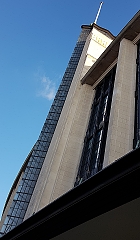
Barker’s former shop, a lovely art deco edifice, which opened in 1933, was designed by Bernard George (1894-1964). Between 1928 and 1962, he was the chief architect for Barker’s of Kensington in-house design group.  It is worth examining this building closely to enjoy is many attractive details.

Art deco discovered

BOMBAY IS RICH in fine examples of buildings in the art deco style, which flourished roughly between the end of WW1 and the end of the 1930s. There is a good collection of buildings in this style along Marine Drive in Bombay, the Oval Maidan, and elsewhere in the city. London has some fine examples of structures that exhibit features of this kind of decorative style, but, apart from along a stretch of the A4 road, there are few concentrations of art deco buildings in London, such as can be found in Bombay. In London, the art deco buildings are mostly scattered around the city.

At the end of December 2021, we were walking with friends along the bank of the Thames between the London Apprentice pub at Isleworth and Richmond Bridge when I spotted a row of houses built in the art deco style. I had never seen them before. They line the south side of Park House Gardens in Twickenham. The detached house nearest the river, number 66, is larger and more attractive than the others in the street. The rest of the art deco residences on the street are rather mundane pairs of semi-detached homes, constructed to a pattern that I have seen elsewhere in London’s suburbs. Most of them have curved art deco period Crittall windows, which have panes of glass framed in metal rather than wood.

Park House Gardens was laid out in the early 1930s when:

“…gravel pits were filled in with, according to the local people, rubble and other material from the foundations of the Old Hotel Cecil in the Strand. The first houses were then built in Park House Gardens at prices of up to £1600 for semi-detached with garages, about the price of a garage today.” (www.twickenhampark.co.uk/a-brief-history.html)

The Cecil Hotel was in the Strand. Of its many guests, one was Mahatma Gandhi.

Another source (https://haveyoursay.citizenspace.com/richmondce/easttwickenham-spd/supporting_documents/East%20Twickenham%20SPD_Oct%2015.pdf) dates the houses differently:
“The buildings are semi-detached with Art Deco details though they do not appear to have been built until c. 1950s.”

Apart from the above information, I have found nothing else about these art deco style houses and would love to learn more.

Lift your eyes

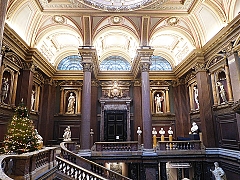
IT IS TEMPTING to concentrate on the wonderful collection of exhibits in Cambridge’s Fitzwilliam Museum, but you should spare some of your attention for the magnificent decoration of some of its galleries. Look up from the paintings and display cases to see superb ceiling decorations above you, and also around you when using the grand staircase. You are sure to be amazed.

The museum is housed in a neo-classical edifice initially designed by George Basevi (1794-1845), architect of London’s Grosvenor Square. After Basevi’s death, the planning of the structure was completed by Charles Robert Cockerell (1788–1863). Built to house the collection bequeathed to the University of Cambridge by Richard FitzWilliam, 7th Viscount FitzWilliam (1745-1816), the present museum was opened to the public in 1848. Over the years since then, the museum has been enlarged by adding newer buildings and now it is home to about 500,000 artefacts.

Years ago, I remember reading (I cannot remember where) a comparison of a museum in the USA designed by Ludwig Mies van der Rohe (1886-1969) with another one, the Guggenheim in Manhattan, designed by Frank Lloyd Wright (1867-1959). Both buildings are elegant but that by Mies Van der Rohe modestly allows the exhibits to grab the viewer’s attention more than the architecture, whereas the unusual design of Wright’s building competes with the artworks for the viewer’s attention. The internal decoration of the older galleries of the Fitzwilliam are sufficiently eye-catching to be able to compete with the exhibits housed in them, but somehow, they hardly do this. That is why I am asking you to take your eyes off the exhibits if only to glance briefly at the décor of the galleries,

Artists and secret agents

A REMARKABLE ENGINEER and furniture entrepreneur Jack Pritchard (1899-1992) and his family lived at 37 Belsize Park Gardens, in London’s Hampstead district. before WW2. Pritchard, who studied engineering and economics at the University of Cambridge, joined Venesta, a company that specialised in plywood goods. It was after this that he began to promote Modernist design. In 1929, he and the Canadian architect Wells Coates (1895-1958) formed the company, Isokon, whose aim was to build Modernist style residential accommodation.

Pritchard and his wife, a psychiatrist, Molly (1900-1985), commissioned Coates to build a block of flats in Lawn Road on a site that they owned. Its design was to be based on the then new ideas for communal housing that had been realised in Germany including the influential Bauhaus in Dessau. The flats are close to Fleet Road and the Mall Studios in Parkhill Road. Completed in 1934, they were, noted the architectural historian Nikolaus Pevsner, “… a milestone in the introduction of the modern idiom to London.” He continued, writing in 1952, clearly critical of the edifice, which:

“…put on a forbidding face towards the street, with large unmitigated concrete surfaces … It is all in the spirit of revolution, unaccommodating and direct to the verge of brutality.”

Well, I quite like the building’s elegant simplicity. In the basement space of the block, there was a refreshment area known as the Isobar. This and its furniture were designed by Marcel Breuer (1902-1981). Regularly, exhibitions were held in the Isobar and, according to an on-line article in The Modern House Journal these were attended by artists including Adrian Stokes, Henry Moore, Barbara Hepworth, Ben Nicholson and Naum Gabo. The article also noted that this refreshment area was frequented by modernist architects such as Erich Mendelsohn, Serge Chermayeff and, Wells Coates, as well as by left-wing politicians. Pritchard occupied the penthouse flat. In 1969, he sold the block, and now it contains accommodation for 25 keyworkers on a shared ownership basis and 11 flats are in private ownership. The block, first known as the Lawn Road Flats, is now called ‘Isokon. Lawn Road Flats’.

T F T Baker, Diane K Bolton and Patricia E C Croot, writing in A History of the County of Middlesex: Volume 9, Hampstead, Paddington, noted that the Lawn Road Flats were built partly to house artistic refugees, who had fled from parts of Europe then oppressed by dictators, notably by Adolf Hitler. Some of them had been associated with the Bauhaus. These included the architect and furniture designer Marcel Breuer, the architect Walter Gropius (1883-1969), and the artist and photographer Laszlo Moholy-Nagy (1895-1946). All three of them are regarded as being masters of 20th century visual arts.

Despite both having come from bourgeois backgrounds, the Pritchards aimed to free themselves from middle-class conventions. The concept and realisation of the Lawn Road Flats, were important landmarks in their quest to achieve a new, alternative way of living. It is accurate to say that the atmosphere that prevailed in the community that either lived in, or frequented, the Lawn Road Flats was predominantly left-wing and extremely welcoming to cultural refugees from Nazi Germany. Probably, it had not been anticipated that the place should become a convenient place for Stalin’s Soviet spies to use as a base. According to a small booklet about the flats Isokon The Story of a New Vision of Urban Living, published in 2016, the flats were home to the following espionage agents, who had been recruited by the NKVD in Central Europe: Arnold Deutsch, Simon Kremer, Jürgen Kuczinski, and Brigitte Kucynski Lewis. Jill Pearlman, one of the book’s several authors, noted that they found the Lawn Road Flats convenient for several reasons:

“Above all, they blended inconspicuously into the sociable community of tenants there. Many tenants too were refugees from Central Europe … Even the Lawn Road Flats building worked well for the spies. One could enter and exit any unit without being seen … no one could see in. At the same time, the cantilevered decks on each floor provided the tenants a perfect vantage point from which to survey the street below.”

Today, there is a small exhibition area in the garage of the flats. This is open on some weekends, but I have yet to visit it.

Pianos and art deco in Mayfair

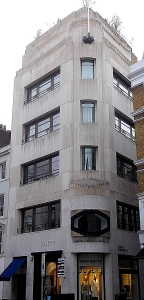
THE CORNER OF BROOK Street and Haunch of Venison Yard (in London’s Mayfair) is adorned with a fine building with a white Portland stone façade. It is built in the art deco style. The building, Greybrook House (28 Brook Street), was constructed in 1929 and designed by Sir John Burnet and Partners (https://historicengland.org.uk/listing/the-list/list-entry/1392996). Burnet, born in Scotland, lived from 1857 to 1938.

Greybrook House was built to house the showrooms of the piano company, Bechstein, founded in 1853 by Friedrich Wilhelm Carl Bechstein (1826-1900). In 1901, the firm opened a concert hall, Bechstein Hall, on Wigmore Street. In 1917, the hall was renamed the Wigmore Hall and is still used today. The hall was next to Bechstein’s showrooms, which were closed in 1916 because of its German connection. In 1928, Bechstein’s, which had been closed during and after WW1, re-established itself in the UK, and commissioned the building of Greybrook House to be used for their new showrooms. In addition to showrooms, the new building included practice rooms and office space.

I am not sure when Bechstein left its Brook Street premises. However, I noticed that beside the entrance to the flats there is a beautifully carved calligraphic inscription that reads “Allied Ironfounders Ltd”. This company had its showroom in Greybrook House in the 1950s. Judging by a photograph I have seen on the Internet (www.ribapix.com/allied-ironfounders-showrooms-28-brook-street-mayfair-london-the-showrooms-entrance-with-the-brick-mural-men-of-iron-designed-by-trevor-tennant_riba25422#), it must have been quite exciting visually.

Currently, the ground floor of Greybrook House is occupied by Joseph, an upmarket clothing retailer. The upper floors have been converted into luxury flats by Fenton Whelan and Vanbrugh Prime Property. This was done recently.

The lovely art deco façade of Greybrook House remains unaltered. By chance, or who knows, maybe deliberately, Bechstein’s Brook Street showrooms were almost opposite the house where the composer George Frideric Handel (1685-1759) lived from 1723 until his death. Finally, the company that had its piano showrooms in Greybrook House is currently constructing a new set of showrooms and a small 100 seat concert hall back in Wigmore Street where their first London premises were located (www.rhinegold.co.uk/international_piano/c-bechstein-returns-to-londons-wigmore-street/).

Once it was owned by Rothschild

ACCIDENTALLY, WE BOARDED a bus, which we believed would take us to Gunnersbury station in west London, but instead it took us to the edge of Chiswick Business Park furthest away from the station. This meant that we had to walk through the business park, and this was no bad thing.

The business park has been built on land that used to be owned by the Rothschild family, who owned nearby Gunnersbury Park for much of the 19th century and the early part of the 20th. In 1921, a bus company built a 33-acre bus maintenance establishment on the site where the Rothschild’s used to have orchards and where today the business park stands. This was closed in 1990, and various architects, including Norman Foster, drew up plans to develop the site with buildings around a central ‘piazza’.

Eventually, after gaining planning permission, the first building was completed at the end of 2000. Gradually, the rest of the buildings were constructed. The site was completed in 2015. The result is spectacular. The buildings are uncompromisingly modern, almost sculptural, and, most importantly, pleasing to the eye. They are arranged around an attractive lake or pond, complete with waterfalls, a bridge, and some metal sculptures. A number of small spherical glass and metal ‘meeting pods’ have been placed close to the water feature and there are several refreshment kiosks dotted around the place.

In 2019, a long footbridge, suspended from a series of giant oxidised steel hoops was constructed between the place where our bus (route 70) terminated within the business park and Chiswick Park Underground station. It is an elegant piece of engineering.

We have often passed the Chiswick Business Park whilst travelling by car or bus along Chiswick High Road that forms its southern border, but never bothered to walk in it. Today, we did, and it was a pleasant new experience.  

Party in a Tudor hall

WE ATTENDED A WEDDING in a most attractive location today, the 25th September 2021. The ceremony was held in the great hall of a palace favoured by Queen Elizabeth I. Built in 1497, most of the palace was demolished but this superb hall, a masterpiece of Tudor architecture, remains. The great hall has a newer neighbour, a triumph of Jacobean architecture: Hatfield House built in about 1608 and incorporating material from the former palace of which only the great hall remains. The Jacobean edifice was built for Robert Cecil (1563-1612), First Earl of Salisbury. Some of his descendants still reside in the house.

With about 250 people attending and dining at long tables, it was not hard to imagine such joyous festivities occurring during the Tudor heyday of the great hall.

A marvellous modern mosque

KINGS COLLEGE CAMBRIDGE has a superb perpendicular gothic chapel, whose construction commenced in about 1446 and took almost 100 years to complete. Its fabulously intricate fan-vaulting makes it one of the finest buildings in Cambridge, if not in all of England. Until recently, it was the one and only building in Cambridge that visitors to the city needed to see, even if they did not have time to see anything else. Although this continues to be the case, there is another building, which visitors should make time to see in addition to the chapel. Unlike the college edifice, this is not in the historic academic part of the city but in Mill Road, not far from the main railway station. Near the eastern end of this thoroughfare, which is rapidly becoming a ‘trendy’ part of Cambridge, you will come across a wonderful modern building set back from the road and separated from it by a pleasant, small garden. This structure is The Cambridge Central Mosque.

The mosque was completed in 2019 and designed by Marks Barfield Architects (London) in conjunction with Professor Keith Critchlow (1933-2020), who was Professor of Islamic Art at London’s Royal College of Art, and the garden designer Emma Clark. The designers of the mosque aimed (in the words of Abdal Hakim Murad, chairman of the Cambridge Mosque Trust) to create:

“…a brand new sacred space … to bring together something that’s very ancient and timeless with the very latest technologies.” (https://cambridgecentralmosque.org/design/)

This has been achieved very successfully. The visually spectacular deep portico, reached after walking through a pleasant garden, is supported by clusters of curved timbers, which immediately bring to mind thoughts of the masonry fan-vaulting in Kings College Chapel. These clusters continue through the entire building, creating a sense of continuity of the exterior and interior spaces. The vaulting that reminds us of the mosque’s gothic relative at Kings College also evokes purely Islamic architecture such as one finds at the Alhambra in Spain. The outside of the building is covered with brickwork in two colours, the bricks being arranged to produce patterns which are contemporary versions of a traditional Islamic design. The centre of the mosque is topped by a single dome made in matt-gold coloured metal.

The glass walls that separate the portico from the interior of the mosque reflect the mundane houses opposite the mosque (across Mill Road). I do not know whether the designers intended it, but I felt that these reflections were a way of giving the impression that the garden and the world beyond the mosque is merging with the building itself, that the religious structure was merging with its secular surroundings. Whether or not this was the designers’ intention, this mosque deserves a place in the highest echelon of great British architecture alongside Kings College Chapel. The beauty of the chapel and the mosque, separated by many hundreds of years in age, both have the effect of taking one’s breath away in amazement.