My trip from Bangalore to Calcutta began with a bang

OCCASIONALLY, I HAVE A YEARNING for ‘fast food’ – low taste, I know! While waiting at Bangalore’s Airport (terminal 1) for a flight to Calcutta, I felt the urge for a junk food snack, and headed for the KFC outlet in the departure lounge. I placed my order,and was asked to wait for 5 minutes – so much for so-called fast food.

I noticed that the foodstall was right next to a bookstall, run by the Relay company. With my KFC receipt in one hand I hurried towards a glass door that led into the shop. Either it was locked or I misjudged its position. Regardless of the reason, my forehead hit the glass door with great force. The glass remained intact, but not I.

I cursed loudly, and headed for another entrance to the bookshop. As I entered the shop, I touched my forehead and found my fingers reddened with blood. The charming young shop assistants, seeing me and my wound, found a stool and a first aid box, and began stemming the bleeding. With copious amounts of Dettol and Povidone Iodine solution, they cleaned me and my wound. They were very attentive and concerned about me. I was touched and impressed by their gentle and efficient care.

A few days after the accident, with a smaller plaster

When an enormous elastoplast had been applied and I had assured them that I was feeling OK, I returned to KFC, clutching my bloodstained receipt. I carried my meal back to where we were sitting, and tried to reassure my wife that things were not as bad as they looked. Then, I consumed my delicious chicken offering, which the KFC staff had kindly kept warm during my long absence from their stall.

After about 30 minutes, the manager of the Relay stall came up to me to check that I was alright. Then, he took a photograph of my boarding pass. Incidentally, whilst his staff were treating me, they also photographed me and my wound.

The flight took off only 30 minutes late, and I have been enjoying Calcutta since we arrived. I can truly say my trip to West Bengal began with a bang.
Road reversal in central Calcutta

BETWEEN 8 AM AND 1 PM, traffic flows one way – from south east to northwest – along Calcutta’s Park Street. After 1 pm, traffic on this important thoroughfare flows one way but from northwest to southeast.

Park Street is one of several main roads in Calcutta on which the traffic flows in one direction until 1 pm,and then in the opposite direction from this time until 8am. It has long puzzled us as to what happens during the period when the direction reverses on these one way streets. Today, we discovered the answer.

The barrier was removed at 1257 pm

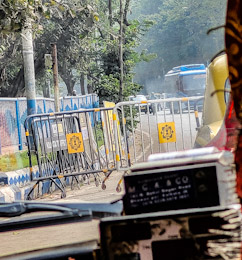
We were in a taxi at about 1250 pm, travelling east towards the start of Park Street. Some distance away from this point, there was a barrier preventing us and other vehicles from continuing towards Park Street. Our taxi and many other vehicles came to a halt at this barrier. Meanwhile, traffic coming towards us gradually diminished in volume to almost nothing.

At about 3 minutes to 1 pm, a traffic police officer slid away the barriers, and we began proceeding towards Park Street. Ours was one of the first cars to be travelling down Park Street from northwest to southeast.

Although I have visited many cities, it is only in Calcutta that I have seen this system of road reversal.

Feeding the spirit of the deceased by the River Ganges in Calcutta

WHILE WALKING ALONG the well-tended riverside path that runs alongside the Ganges (Ganga) in Calcutta, we reached the Gwalior Monument – a tall tower overlooking the river. Around this edifice, which was built by the British in 1847, we saw something we had never seen before.

A craftsman was shaping the stiff dark grey mud from the holy Ganges into rectangular slabs with numerous small regular depressions. The finished product looked a bit like an oversized old fashioned Casio calculator. There were quite a few of these to be seen on the flat ground surrounding the monument.

Small groups of men, often with shaven heads, congregated around these mud slabs. The men were chanting prayers and placing grains of rice, sweets,and other food substances into the depressions in the slabs. We asked a bystander what was going on, and he explained it to us in perfect English.

The groups of men were performing ‘shraddha’ on the eleventh day following the death of a family member. Our informant was also attending a shraddha being held because of the recent death of a friend or relative. The son of the deceased was performing the shraddha puja. I have read that it is very important for Hindu couples to have a son because only a son can do shraddha for his parents

On the eleventh day following death, the spirit (atma) of the dead person is still in contact with his or her loved ones. The food being placed on the mud slabs will not, of course, be physically touched by the spirit, but it is believed that it will sustain him or her on the next stage of its eternal journey. A similar shraddha is performed on the first death anniversary and, sometimes, at other times.

Our informant told us that he was not entirely clear about the deep significance of shraddha, but he was happy to believe in its necessity. It was, he felt, an important part of the passage of life.

The eleventh day and one year ceremonies are observed by many Hindus, but until today, neither my wife nor I had ever come across these mud thalis for feeding the spirit of the deceased.

A year after my father-in-law died, there was a special ceremony in which I played an active role, but it was completely different from what we saw next to the Gwalior Monument.

Perfect aim in a pharmacy shop in Calcutta

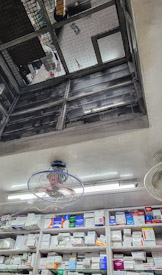
I HAVE BEEN TO many shoe shops in India. Some of these have the store room above the showroom. The ceiling of such showrooms has a hatch through which pairs of shoes can be thrown to the salesmen waiting below. The salesman asks for a particular shoe in a specific size, and someone in the store room drops the pair through the hatch. The shoes are caught by the salesman. Until yesterday, the 4th of January 2024, I had never seen such a system in shops other than those selling footwear.

The hatch in the ceiling of the pharmacy

Yesterday, we entered a chemist shop (a pharmacy) close to Calcutta’s New Market (SS Hogg Market). The walls were lined with shelves from floor to ceiling. These shelves were filled with boxes of medicines on what seemed like considerable disarray, although I feel sure that there must have been some organisation of the products. There were 5 or 6 men serving customers from behind the shop’s counters.

Like the shoe shops described above, the chemist shop had a hatch in the ceiling. The shop’s stock room was on the floor above the sale room. At frequent intervals, the salesmen yelled names of medicines, ointments, and so on. Somebody in the room above hurled the desired product through the small ceiling hatch. The product was aimed accurately at the salesman who asked for it. Different products kept dropping from the ceiling and being caught by the salesman who had shouted up for it. Whoever it was that was dropping the medications must have recognised the voice of the person who requested it. In addition, the person dropping the products must have had an extremely good aim. He (or she) would make a good cricket player. And the salesmen below never dropped a catch.

Having seen this amazing pharmacy, I have now poked my head into a few others, but none operated this remarkable aerial delivery system. For me, seeing things like that pharmacy near New Market is what makes India seem so wonderful.

An old white painted temple in the heart of Bangalore and a reformer of Hinduism

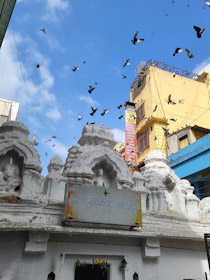
WHILE WALKING ALONG Bangalore’s Avenue Road, which runs from City (KR) Market to Palace Road, I spotted a mandir (Hindu Temple) down a side street. It was painted white, and its facade was surmounted by three tall niches, each containing a sculpture.

So many layers of paint had been applied over the years that the details on the sculptures had disappeared from view. At the rear of the mandir, I saw a tower like structure – part of the mandir’s roof. This was a popular landing place for pigeons. Within the building there were crudely carved stone pillars supporting the ceiling. These looked very old. Two rows of pillars lined a central ‘aisle’ leading to a shrine at the far end of the temple.

Above the entrance, there was a sign written in the script of the Kannada language, which I am unable to read. I showed a photograph of this sign to a bearer (waiter) in the dining room of the Bangalore Club. He deciphered it for me. The mandir is ‘Sri Belli Basavanna Devasthana”. This means ‘The Sri Basavanna Silver Temple’. Located in Basavannagudi Street in the Chickpet district, this is one of the oldest mandirs in Bangalore.

Born in Karnataka, Basavanna lived from 1131-1196 AD. A Shaivite (follower of Shiva) and social reformer, he was a founder of Lingayatism. His reforms included rejection of both social and gender discrimination. According to Wikipedia:
“Basava championed devotional worship that rejected temple worship and rituals led by Brahmins and replaced it with personalized direct worship of Shiva through practices such as individually worn icons and symbols like a small linga (sic). This approach brought Shiva’s presence to everyone and at all times, without gender, class or caste discrimination.”
Thus, we can see that Basava(nna) was a forward thinking person. He made religious worship personal rather than mediated by caste-conscious Brahmins.

Had my eye not been attracted by the flocks of pigeons flying around the small white mandir, it might have been many years before I became aware of Basavanna and his important ‘democratisation‘ of Hinduism.

A club founded for Indians in Bangalore

THE CENTURY CLUB in Bangalore is so-named because when it was founded in 1917 it was decided to limit its membership to one hundred. Today, the Club has about 6000 members. According to the Club’s website it was founded by the highly esteemed Sir M. Visvesvaraya (‘SMV’) who: “… was keen to promote what he felt was good in English society, particularly their orderly habits, punctuality, restraint in speech and social behaviour.”

The Club was founded during an era when Indians were not allowed to join or even enter the clubs (such as the Bangalore Club and the Madras Club), which were designed to be social clubs for the exclusive use of elite Britishers.

Shri Nalwadi Krishnaraja Wodeyar

SMV was inspired to establish a social club that admitted Indians after an unpleasant incident at the Bangalore Club. It occurred when SMV was the Diwan (Prime Minister) of the Kingdom of Mysore. When one day he was invited to the Bangalore Club he was wearing the royal turban of Mysore. The staff asked him to remove it and wear an ordinary cap instead. This insulting request upset him greatly, and led to him founding a club for ‘gentlemen’, which would accept Indians. Thus, the Century Club was born.

Shri Nalwadi Krishnaraja Wodeyar, the king of Mysore, allotted 7 acres of Cubbon Park for the use of the Century Club. Today, the Club is an oasis of peace and greenery in a city that is becoming increasingly less peaceful and disturbingly less green.

The Century Club began admitting Indians in 1917. Not far away, the Bangalore Club only began admitting Indians when India became independent (in 1947), or after that. And even worse, a few other Clubs (and other institutions) continued to admit only British (and other fair skinned Europeans) until the 1960s or later. This was quite remarkable in a country that had struggled for many years to free itself from foreign rule.

New Year’s Eve in Belgrade and Bangalore

ONE YEAR DURING THE 1980s, I was in Belgrade, then the capital of Yugoslavia, on New Year’s Eve. I was staying with my good friend Raša Raićevič. He suggested that we should see in the new year at a friend’s flat I New Belgrade.

Before we set off from his flat in the older part of the city, Raša warned me to keep away from windows and off the terrace as the midnight hour approached. In the 1980s, many retired military people resided in New Belgrade, and quite a few of them possessed firearms. It was customary in those days to fire the guns at the moment a new year commenced. The risk was that ricocheting bullets might break windows or hit people out on their terraces and balconies. Fortunately, we survived the evening without mishaps, and spent the first few hours of the new year at another friend’s home, a long taxi ride away from New Belgrade.

Many years later, sometime after 2006, we were in Bangalore over New Year. My wife and I stayed at home with my recently widowed mother-in-law, who was too frail to attend a party. Everyone else in the family went out to celebratory parties.

The three of us, who remained at home, decided that we would sit together until midnight. However, by about 10 pm on the 31st of December, we all fell asleep. It was only when our daughter phoned us at 3 am that we realised we had slept through the transition from one year to the next.

My New Year’s Eve spent in Belgrade was a complete contrast to that which we slept through in Bangalore. This evening, we plan to have a slap-up dinner followed by drinks under the stars high above the city of Bangalore. I hope that all of you, dear readers, will have a great 2024.

Shops and shrines on a busy road in old Bangalore

I KNOW OF TWO Avenue Roads. One is in London. Lined with the homes of the wealthy, it runs between Swiss Cottage and Regents Park. The other one is in Bangalore. It runs between KR Market (aka City Market) and a large Hindu temple (mandir) where Kempe Gowda Road becomes District Office Road. Both the road in London and its namesake in Bangalore carry much traffic, but there the similarity ends.

Avenue Road in Bangalore (‘AR’) is mainly lined with all kinds of shops, especially those dealing in paper goods (stationery as well as printed books). It runs through one of the oldest parts of the city: Chickpet. The lines of shops are punctuated by small lanes and alleys that lead away from AR.

Old pillars in a mandir on Avenue Road in Bangalore

As you stroll along the thoroughfare, you will pass mandirs and one church. And near the KR Market end of the road, a short lane leads to a Muslim shrine, the Dargah-e-Hazrath Manik Mastan Sha Saherwadi. It is well worth removing your footwear to enter this peaceful place. The grave it contains is in a small room with a mirrored, domed ceiling.

Some of the mandirs on or near AR are also worth looking into. Although some of their facades look fairly recent, the carved stone columns within the buildings look quite old. Near the street entrance of one of the mandirs on AR, I saw two intricate stone carvings of Hindu subjects. Both looked as if they might have been carved several centuries ago.

The Rice Memorial Church stands in its own small grounds, separated more from its neighbours than the mandirs on AR. Named after the British missionary, the Rev Benjamin Holt Rice, this Church of South India place of worship was built between 1913 and 1916 on the site of an earlier chapel first constructed in 1834, and then later rebuilt before being demolished. Although I have passed it often, I have not yet been able to enter it.

Not far from the church and a couple of picturesque mandirs, there is a branch of the Kamat chain of eateries. You can stop there for snacks and a variety of beverages. This place is in the midst of the numerous bookshops on AR. Proclaiming discounted books, these stores mainly stock textbooks and computer programming instruction manuals. Incidentally, AR is a good place to find a wide variety of diaries and calendars.

Bustling Avenue Road in Bangalore is a far more colourful and interesting thoroughfare than its rather elegant but staid namesake more than 5000 miles away in London. The street in Bangalore and the lanes leading off it give one a good idea of the ‘flavour’ of the parts of the city which existed before the arrival of the British imperialists. It makes a fascinating contrast to the newer Cantonment areas that became established after the British began settling in Bangalore.