It might be you one day

Public animal feeding in India… and reincarnation

yamey's avatarGUJARAT, DAMAN, and DIU

All over Gujarat (and in other parts of India that I have visited), I have seen wild creatures being fed in urban areas. Wild dogs are offered biscuits and other scraps. Pigeons and crows are given grain and water, often in special feeding and drinking vessels. Cattle are fed foliage at Hindu temples, and so on.

When I asked someone about this very prevalent public animal feeding, he told me that all of it was due to members of the Jain communities. I was unsure about the accuracy of this response. So, I asked other people about it. One autorickshaw driver in Ahmedabad, a Muslim, assured us that it was not just the Jains who care for the untamed creatures in the city; everyone cared for these animals.

Recently, when visiting a mosque in the centre of Ahmedabad, I spotted three bowls filled with clean water in front of the…

View original post 265 more words
Ganesh in the graveyard

How many gardeners do you know, with whom you can have a conversation about theology?

yamey's avatarGUJARAT, DAMAN, and DIU

One Tree Hill Garden is a luxuriant little park on the shore of Kankaria Lake in Ahmedabad. At one end of the park, there is a small graveyard. The graves, which date back to the 17th century, mark the final resting places of some of the Dutch folk who worked in the trading post that the Dutch East India Company established in Ahmedabad at that time.

The graves are crumbling and most of them have lost their inscriptions. A few stones bear the incomplete remains of now barely legible inscriptions.

In about 2000, a Dutch foundation constructed several attractive Islamic looking concrete shelters over some of the gravestones.

I noticed that someone had placed a plastic model of the Hindu deity Ganesh next to one of the dilapidated graves. We showed this to a couple of the garden’s workers, one a Hindu and the other a Muslim, and mentioned that…

View original post 101 more words

Weaving in Patan

PATOLA: A very complex traditional weaving process used to make durable valuable fabrics for Indian saris etc …

yamey's avatarGUJARAT, DAMAN, and DIU

Many people visit Patan in Gujarat to see the spectacular pre 14th century Rani ki Vav, one of the largest stepwells in the state. It was built by the Solanki dynasty.

Patan is also the home of a very special form of weaving called ‘Double Ikat Patola’. The fabrics produced are extremely durable, very colourfast, and display the pattern equally on the front and reverse.

When finished, even the experienced weaver cannot tell which surface of the material is front, and which is back. The textiles are woven to form saris. These are very costly and take many months to manufacture. The method of fabricating this kind of cloth is so complicated that, despite much research, no one has been able to produce a machine to replicate the process that has been done by hand for many centuries in the workshops in Patan.

We were very fortunate to have been…

View original post 516 more words

Male and female

I saw a post in French on Facebook. It read: Bonne nuit à toutes et à tous…

The literal translation of this is: good night to all and all.

In English, one would write: good night all, because all includes all people both male and female.

Clearly, in the land of liberté, égalité, fraternité, all are not equal!

A zoo in Ahmedabad

Reuben David, a former hunter became a conservator of animals. He founded the zoo in the Indian city of Ahmedabad. Join me in my discovery of the place…

yamey's avatarGUJARAT, DAMAN, and DIU

I was very keen to visit the Kamla Nehru Zoo in Ahmedabad. I had read much about it in a fascinating book, The Book of Esther, by the Ahmedabad author Esther David. She was born into a Beni Israel Jewish family. Her father Reuben David, a self taught veterinarian and keen naturalist, established the zoo on the shore of Lake Kankaria in 1951. The lake is man made and dates from the mid 15th century.

You can explore the zoo on foot or, for a modest fee, you can be driven around it in an electric vehicle. The driver stops wherever you wish and also helpfully draws your attention to cages and enclosures containing interesting creatures. Some of the cages look quite old and a little cramped, but the enclosures are quite spacious.

The reptile house contains a series of generously large enclosures housing snakes, both venomous and not.

View original post 100 more words

Shaking minarets

The Shaking Minarets in Ahmedabad were designed to be resistant to earthquakes many years ago. They are still standing long after the mosque to which they belonged collapsed…

yamey's avatarGUJARAT, DAMAN, and DIU

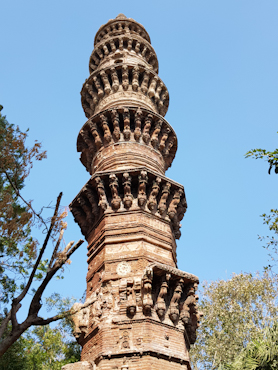
A pair of minarets is all that remains of a mosque. They stand within the precincts of the main railway station of Ahmedabad. The rest of the mosque was destroyed long ago.

Apart from being attractive, these two minarets, the SHAKING MINARETS, are special. They are able to resist earthquakes. They shake or swing instead of falling to pieces during seismic activity.

The large Jumma Masjid in the heart of Ahmedabad lost its two mighty minarets as a result of movements of the earth long ago.

No one knows why the Shaking Minarets are able to resist seismic disturbances. They are not the only minarets in the city that have this ability. When, long ago, British investigators took one of this kind of minaret to pieces, they were unable to discover the secret of its stability. They were also unable to reassemble the structure properly.

Some suggest that the Shaking…

View original post 224 more words

Ignorance is bliss

Many decades ago, ‘M’ and his then young wife ‘F’, both Indian Hindus, settled in the UK. F observed Hindu dietary practices far more than her husband. In the early days after their arrival in England, the couple were not well off. Consequently, if they treated themselves to a meal in a restaurant, they chose one which was not costly.

M used to take his wife out to a Wimpy Bar for a treat. For those of my younger readers, let me explain that the Wimpy Bars were fast food joints, rather like a very inferior version of McDonald’s.

M and F used to order hamburgers. F ate them quite happily, believing that they contained ham and not beef, which contravened her Hindu dietary restrictions. M said nothing to disabuse his wife’s misconception about the ingredients of the burgers, as she greatly enjoyed them.

Many years later, M inadvertantly revealed to F that the hamburgers that she had been enjoying during many visits to Wimpy Bars, contained beef rather than ham. She was horrified to learn this.

Nowadays after decades of happy marriage, the couple have become quite prosperous. I guess that now they would not be seen dead in a Wimpy Bar.

Better on a camel

While travelling through Gujarat in western India, I have seen many camels (? dromedaries) working as beasts of burden. They are well suited to the arid semi desert climate of Gujarat. The camels remind me of airline jokes I learnt in my childhood. Each joke gives another meaning to an airline’s name or acronym.

BEA was British European Airways. The joke version was Big Empty Aeroplanes;

TAP, Portuguese Airlines became Take Another Plane;

The Greek company Olympic became Only Like Your Money Pay In Cash;

EL AL, the airline of Israel, became Every Landing Always Late.

And this brings me to humped beasts of burden.

BOAC, which was British Overseas Airways Corporation, became Better On A Camel.

Postscript

When the petroleum company ESSO first became established in India, workers in Indian companies worked half day on Saturdays. Esso workers got a whole day off on Saturdays. So, ESSO became known as Ever Saturday Sunday Off.