Two names, one country

The Albanians now refer to their country as “Shqipëria”. Almost everyone else calls the same country “Albania” or some variant of this.

Here is an interesting article that discusses this difference: http://www.tiranatimes.com/?p=133209

Incidentally, the national symbol of Albania is a two headed eagle. This is appropriate for a country known by two names!

Giving and receiving

I love receiving gifts. I love giving gifts especially if the recipient expresses joy, rather than gratitude.

This photograph taken in the Khanderao Market in Vadodara (India) expresses the joy of giving, which, as in the case of this flower merchant, can be greater than the joy of receiving.

Mashed potatoes

Some restaurants in India serve both veg (vegetarian) and non-veg (meat, fish, eggs) food. Recently, my wife and I were sitting near to a young lady in a very good Italian restaurant in Vadodara in Gujarat.

Our young neighbour is a vegetarian. She ordered a veg pasta and asked the waiter if she could have a portion of mashed potatoes. I know that pasta and mashed potatoes are an unusual combination, but that is what she wanted.

The waiter told her that she could not order mashed potatoes with a veg pasta. Puréed potatoes, which are pure veg, could only be served with a non-veg dish.

We overheard the waiter telling this to our neighbour. My wife, who always tries to be helpful, interrupted the waiter and told him to bring a small dish of mashed potatoes with the pasta. Eventually, and somewhat reluctantly, the waiter did as asked. Our neighbour was so happy to receive the mash with her pasta that she got up and gave my wife an affectionate hug.

I am not a vegetarian.

Although I have met numerous pure vegetarians during the 25 years I have been visiting India, I still find it hard to believe that there are so many people, who have never tasted meat, eggs, or fish.

Tastes change

Once, long before ‘political correctness’ became fashionable, when my wife was an undergraduate student, she asked two Nigerian students whether they preferred their tea “black or white “. They looked at her indignantly before answering aggresively: “with milk“.

When I was a child, I drank tea without milk. That was the way my parents preferred it. That is what I became accustomed to. If I sipped even a little tea with milk, I felt nauseous. Tea with milk, as served in England, is made by adding brewed tea to milk or vice versa depending on your preference.

My prejudice against tea with milk persisted until I began visiting India in 1994. At first, I was suspicious of the “white” tea on offer, but soon began to enjoy it. I think that this is because it is made differently from that which is served in the UK.

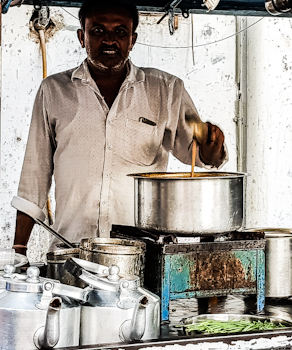
In India, tea leaves are boiled vigorously with milk. Often additives such as sugar, crushed ginger, cardamom, mint, and lemon grass are added to the hot bubbling mixture. After a while, the boiled milky tea is passed through a strainer, often cloth, and served in cups. The resulting drink is a harmonious blend of the flavour of tea and the additives. In my opinion, it tastes quite different from, and much better than what is served in England.

I have visited India many, many times since 1994. Apart from developing a great fondness for the country and its people, my tastes in food have changed for the better as a result of my exposure to life in India.

Slurp, don’t suck

Currently, many people want to “save the planet”. This is a worthy desire.

One way to help save our planet is to ditch plastics, which are not biodegradable, and replace them with paper that can be degraded biologically. Thus, plastic bags are giving way to paper and cloth bags. Supermarkets in the UK are now charging customers, who have not brought along their own reusable bags, a fee to buy a new plastic bag in which to carry home the goods which the supermarket companies have packed in non-biodegradable plastic!

Now, enter your café and order a drink with a straw. Trendy cafés, which are trying to be eco-friendly, supply biodegradable drinking straws Instead of the old fashioned plastic ones. This offers no problems if you suck your drink rapidly. If you prefer to linger over your drink, the paper straw absorbs fluid and becomes soggy. You might well need to use more than one paper straw to finish your drink. This will result in creating more rubbish than using a single plastic straw.

One solution to the straw problem, which I favour, is not to use one, but to put your lips to the glass or bottle that contains your drink: slurp, don’t suck!

Finally, to escape from the humble drinking straw, let us raise our heads to the solar panels with which we adorn our roofs in order to reduce our consumption of the rapidly reducing sources of natural fuels. A learned friend once told me that in order to manufacture these panels, more fossil fuel energy is expended than will ever be saved by the panels!

Save the planet by all means, but make sure that these means will actually save the planet, rather than simply salve our consciences.

Buzzing around Baroda

See the city in a three-wheeler

yamey's avatarGUJARAT, DAMAN, and DIU

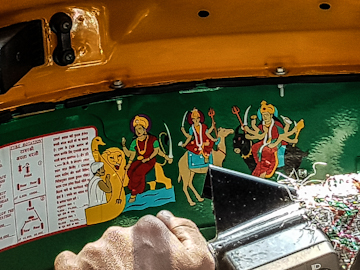
The best way to get around Baroda (now ‘Vadodara’) is by three wheeler autorickshaw (‘auto’). There are plenty of these nifty little vehicles for hire and although their drivers hardly ever use the meters, the fares are remarkably reasonable.

Unlike Bangalore, where the auto drivers are often argumentative and dodgy about fares, the drivers in Baroda are usually straightforward and friendly.

We have made a couple of long journeys in Baroda. As the auto drivers were uncertain about what to charge, they used their antiquated meters. These must have last been calibrated many years ago. According to such a meter, a journey of about 6 kilometres should cost 4 rupees and 20 paise. This is ridiculous because the shortest auto journey in Baroda costs 20 rupees today. The auto driver looks at his ancient meter and then, without looking at a conversion table, decides on a fee. We made the…

View original post 93 more words

A globe trotting chef in Gujarat

Really great Italian food … in a city in Gujarat…

yamey's avatarGUJARAT, DAMAN, and DIU

So-called Italian food is popular in India. Indians are fond of pasta and pizza and are happy to eat almost anything that claims to fall into these categories. Often what is served as “Italian food” would be almost unrecognizable to Italians.

However, things are changing. Increasing numbers of Indians now visit Europe and many Europeans and Americans familiar with authentic Italian food visit India. They are more discerning than about the quality of Italian food served in India than Indians who have not been abroad.

Despite this, very few Italian restaurants in India are serving what I would consider Italian food like Mamma would make. Chianti Restaurant in Koramangala (south Bangalore) does makes the grade.

Tonight, I ate at Fiorella in the Alkapuri district of Vadodara in Gujarat. This Italian restaurant serves brilliant food. It is Italian food which makes no compromises to satisfy traditional Indians’ palates.

We met Ravichandra…

View original post 147 more words