A cave underneath a seaside town in Devon

LONG, LONG AGO, the land where Torquay now stands was below the Equator in the southern hemisphere. Shifting of tectonic plates over the millennia has moved it to where it is now. Along with this migration, a series of caves has also reached this location but far beneath the town, about 1 mile northeast of the Torquay Harbour seafront. The cave network known collectively as Kents Cavern has been open to the public since 1952. What makes it fascinating is that archaeologists have found, amongst other things, the earliest known human remains in Britain. Three types of hominid have made, use of these caves: Homo heidelbergensis (thrived roughly 750,000 to 200,000 years ago), Homo neanderthalensis (thrived from 400.000 to 40,000 years ago), and Homo sapiens (that is us today: we have been around since about 300,000 years ago). The two earlier forms of hominid lived or sheltered in the caves. Now, we, the current edition of this type of primate, merely explore the caves as archaeologists, and visit them as tourists.
The earliest evidence of recent exploration of the caves is some inscriptions found within them. William Pete scratched his name on a stalagmite in 1571 and Robert Hedges did the same in 1688. Scientific exploration of the caves began in the early 19th century. In 1824, the geologist Thomas Northmore (1766-1851) made the first recorded excavation in 1824. Since then, others have made systematic archaeological excavations and discovered the remains of our early ancestors, their tools, and the remains of animals that sheltered in the caves. Two notable explorers of these underground passages and caverns are The Reverend John MacEnery (1796-1841) and William Pengelly (1812-1893). The latter established his reputation as an archaeologist by his discovery of the hominid remains in Kents Cavern. In addition, his discoveries helped in to prove that the biblical chronology of the earth was incorrect.

In 1903, the caves were acquired by a carpenter, Francis Powe, who used them as a workshop for constructing beach huts for the seafront in Torquay. His son, Leslie, converted them into a tourist attraction by installing electric lighting and laying down concrete paths. The caves are now run by a member of the family, Nick Powe.

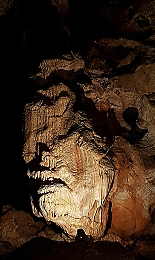
At first sight, the visitor complex with its shop and café seems unexceptional and rather too ‘touristy’ for my liking. Visitors are escorted within the caves in groups led by a guide. The tourist facilities give little or no clue as to the wonders that await visitors after they step into the parts of the cave system that are on display. We were guided by a knowledgeable man, who was able to make geology and archaeology both palatable and extremely comprehensible to us. Even if you had had no interest in these subjects prior to going on the tour, he was able to sow seeds of interest in these subjects during the tour. Not only did he relate the facts clearly, but he was able to recreate in our minds the nature of life in the caves as it was when our ancestors illuminated them with lamps consisting of fat impregnated moss or other vegetable matter in scallop shells, and when enormous wild bears and other creatures hibernated or roamed about in these dark spaces. In addition, he pointed out interesting features of the geology of the caves including, stalagmites and stalactites in various stages of their continuing formation. Throughout the tour, our guide explained the difficulties that early explorers of the cave encountered.

To conclude, a visit to Kents Cavern is both visually spectacular and of great interest. Having seen the place, I would say that a visit to Devon must include a wander through these caves.
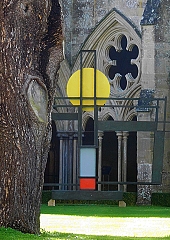
Hepworth and Mondrian in Salisbury

IN THE 1930s, both the sculptor Barbara Hepworth (1903-1975) and the painter Piet Mondrian (1872-1944) lived in Hampstead (north London). Hepworth and her two successive husbands lived and worked in the Mall Studios near Parkhill Road. Mondrian lived at 60 Parkhill Road. According to one of Hepworth’s biographers, Eleanor Clayton, writing in “Barbara Hepworth. Art and Life”:

“The beginnings of a friendship between Hepworth and Mondrian can be seen in her letters to Nicholson at the time: ‘so glad Mondrian said nice things about me & work. Goodness U did learn a LOT.’”

Visitors to the cloisters of Salisbury Cathedral can see an abstract sculpture at the southeast corner of the grassy space enclosed by them. At first sight, it looks like a sculptural version of a painting that might have been created by Mondrian. It is a sculpture by Barbara Hepworth called “Construction (Crucifixion)”. This bronze artwork was created in 1966, and then donated by the artist to the Cathedral in 1969. It is according to a notice by the sculpture:

“… Hepworth’s response to Christ’s Crucifixion …”

The interpretation of the piece’s symbolism is far from simple, as a website text (https://www.salisbury.anglican.org/news/the-crucifixion) explained:

“What we see are 3 verticals linked by a single horizontal bar, and by 2 other horizontals at different heights.

A large circle, attached to the intersection of the horizontal and vertical lines, is painted citrus yellow on one side and blue on the other. At the bottom of the central vertical, we see red on its own beneath the blue side of the circle, and red and white beneath the yellow. On the yellow side, a metal hoop encircles the point of crossing.

Hepworth wrote that she found it ‘very serene and quiet’, but that doesn’t have to guide what we make of this piece. We could see the yellow circle as the sun, the blue circle as the moon, the red paint as blood, the 2 verticals on either side as the crosses of the 2 men crucified with Jesus.

Or we could contemplate its hardness, weight, size (12ft tall and 2-and-a-half tons) and stark simplicity. We could seek to find meaning here, or we could stand before it and try to imagine the experience of meaningless horror and sheer emptiness which brutality of any kind must impose on those who witness it. For us, it need not seem ‘serene and quiet’ as for Hepworth. On the contrary this cross might confront us with the tragic lack of meaning which has so often afflicted humanity since the cross of Christ was first set up.”

Whatever its symbolism, Hepworth’s piece is attractive and looks good surrounded by the gothic architecture of the cloisters. Above all, its appearance immediately brings to mind thoughts about thw works of art created by Mondrian. One website (https://artistscollectingsociety.org/news/barbara-hepworth-sculpture-returns-salisbury-cathedral-permanent-display/) describes the piece as “Construction (Crucifixion): Homage to Mondrian” and then continued as follows:

“The sculpture is thought to explore the duality of Jesus Christ in its use of geometric symbols and features bold colours borrowed from the palette of ACS member Piet Mondrian, referenced in the artwork title.”

I was very pleased to see this work once again in March 2022, soon after publishing my book about Hampstead, past and present, in which I have included a substantial chapter about the modern artists who lived and worked in the area between the two World Wars. There is a good chance that Hepworth’s encounters with Mondrian and his work whilst they were both in Hampstead is reflected in the appearance of this abstract Crucifix, which stands in the cloisters at Salisbury.

PS My book, “Beneath a Wide Sky: Hampstead and its Environs” is available from Amazon (https://www.amazon.co.uk/dp/B09R2WRK92).

Point of departure

TORWOOD STREET RUNS downhill to the harbour of Torquay in Devon. This usually busy street is currently (March 2022) closed to vehicular traffic because it is undergoing repairs including resurfacing. During WW2, the street was resurfaced with concrete sufficiently strong to bear the weight of tanks and other heavy military vehicles that were making their way downhill to the harbour. One of our friends in Torquay told me that the current roadworks was partly to replace the concrete surface that was laid down in the 1940s. This US military equipment was on its way to the beaches of Normandy, where the invasion of German occupied France took place: the D Day Landings in 1944.

When these heavy vehicles reached the water’s edge, they had to be loaded onto boats. Concrete embarkation ramps were constructed in May 1943. They were used to load the equipment onto seagoing vessels in June 1944 to carry out Operation Overlord, which involved landing the US forces onto the Normandy coast. The concrete slipways, which have been preserved, were called ‘Embarkation Hards’. According to information displayed on a memorial close to the ‘hards’, the landing craft used in Operation Overlord operated a shuttle service between Torquay and the Normandy beaches. Soldiers of the 4th US Infantry Division, who embarked at Torquay, were amongst the 23000 troops who were landed at Utah Beach in Normandy. Along with them, 1700 tanks, guns, and trucks also arrived on that beach.

The ‘hards’, point of departure for Normandy, are not particularly attractive to look at, but they are an impressive souvenir of what was an important military operation, which in no little way helped to bring about the downfall of Hitler and the Nazi regime.

Docked in Dartmouth

MOSES AND HIS followers crossed the Red Sea without difficulty. However, things were not so simple when a group of people were trying to cross the Atlantic to enjoy freedom to worship as they wished without persecution in North America in 1620 during the reign of England’s King James I. These travellers. the Pilgrim Fathers, were English Protestants, Puritans who had been living in the Low Countries in Leiden but felt that conditions there had become unfavourable for them. As they did not expect to live safely in England, they bravely set forth to sail to the New World.

Bayards Cove

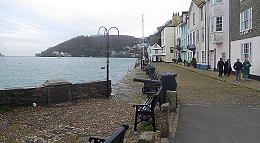
The Pilgrim Fathers and their families left Holland in the “Speedwell” (60 tons) and after crossing the North Sea, their ship was joined by the larger “Mayflower” (180 tons), which was carrying Puritans fleeing from London. While heading west, the boats headed into trouble. On about the 23rd of August 1620, the two ships slipped furtively into Dartmouth in Devon and lay at anchor near to the town’s Bayards Cove, close to where today a small ferry carries vehicles and pedestrians across the River Dart between Dartmouth and Kingswear. The secrecy was necessary because as Puritans, the passengers risked punishment in England.  They remained moored there until about the 31st of August while leaks on the “Speedwell” were being repaired.

After leaving Dartmouth to continue their voyage westwards, the “Speedwell” began leaking again. About 300 miles west-south-west of Lands’ End, the “Speedwell” had become almost unseaworthy. The boats returned to England, docking at Plymouth in Devon. There, the “Speedwell” was abandoned, and the “Mayflower” set sail for America with 102 passengers. The boat reached the harbour of Cape Cod in Massachusetts on the 21st of November 1620.

Although Plymouth is the place from which the Puritans finally left England, the point in the port from which they set off would now be unrecognisable to the Pilgrim Fathers were they able to see it. In contrast, although some of the buildings near Bayards Cove in Dartmouth have been built since the Pilgrim Fathers stopped there briefly, there remain sights that have not changed significantly since 1620.

397 Spanish prisoners held in in Torquay

FOR PERSONAL REASONS King Henry VIII dissolved all the monasteries and similar establishments in England during the 16th century. Many of their buildings were destroyed or left to disintegrate. Their lands were sold or given to new owners. Some of them incorporated the remains of the monastic structures that they had acquired into new buildings. A good example of this can be seen in Devon’s Torquay. It is the remains of Torre Abbey.

The abbey was founded by members of the Premonstratensian Order in 1196. By the time of the Dissolution in 1536, Torre Abbey was the wealthiest of the houses of the Order in Britain. In 1539, the monastery was given over to one of King Henry VIII’s commissioners. After that, the first leaseholder of the former abbey and its lands was the lawyer Sir Hugh Pollard (?1498-?1576). What was left of the monastic buildings was incorporated into a large house built for Thomas Ridgeway. After several others had owned the property, it came into the hands of the Cary family in 1662. In 1740, the residential building was remodelled in the Georgian style, which is what can be seen today. This family retained ownership of the abbey remains, the house, and its lands, until 1930, when a member of the family sold them to Torquay Borough Council. Since then, the house has been used for municipal administrative purposes and during WW2, it was occupied by the RAF.

Near to the main house, there is a large, intact tithe barn. This was constructed in about 1300. In the summer of 1588, the Spanish sent a large fleet, the Armada, to invade England with the intention of restoring the Roman Catholic religion in what had become a Protestant country. The Spanish failed miserably, and many of them became prisoners of war. Francis Drake (c1540-1596) forced one of the Spanish vessels to surrender and as a result captured 397 Spanish prisoners. They were held in the tithe barn for 23 days before they were transferred to Exeter. As a result of this, the barn is now known as The Spanish Barn. during WW2, the RAF used it as a gymnasium. Now, the barn is hired out for weddings and other special occasions.

The remains of the abbey, the barn, and the house built within the abbey ruins, overlook a park, a small golf course, and a few yards away, the waves in Tor Bay. The abbey grounds are a short walk from the commercialised harbour area in the centre of Torquay, and provide a pleasant contrast to the latter.

A stitch in time

ISAAC BASHEVIS SINGER, the author, should not be confused with Isaac Merritt Singer (1811-1875), the American born inventor of a successful version of the sewing machine. By 1862, he had fathered 18 children with several different women. In 1862, Isaac and his second wife, Isabella Eugénie (née Boyer), shifted from the USA to Europe because of his scandalous reputation in the States. They lived in Paris until the outbreak of the Franco-Prussian War in 1870. Then, they moved to England with their six children. For reasons connected with its mild climate, the family moved to the Torbay area in early 1872. By then, he had already purchased the Fernham Estate in Paignton, next to Torquay.

Oldway Mansion, (Paignton) Torquay

Singer and his family squeezed into Little Oldway, a villa on the estate, which had been built in about 1850. Next, he commissioned the architect George Soudon Bridgman (1839-1925) to help him design his ‘dream house’, the basis for the present grandiose Oldway Mansion, and the neighbouring circular building, the Rotunda. The latter was designed for stabling and as an exercise pavilion. The house was completed by the end of 1875.

What we see today is not what Isaac would have seen when the edifice was completed. Between 1904 and 1907, Paris Singer (1867-1932), one of Isaac and Isabella’s sons, who had bought the mansion from the Singer Trustees in 1893, made major changes to its appearance. He engaged two French men, the garden designer Achille Duchêne (1866 — 1947) and his father Henri, to design his new home, the present Oldway Mansion. His aim was to create an edifice inspired by the Palace of Versailles. The reconstructed (remodelled) mansion is a magnificent imitation of a French palace in the style of that which can be seen at Versailles. It incorporates decorative features copied from notable buildings in France. Its interior, which I was unable to see, is grandiose and includes fine paintings and a reproduction of the Hall of Mirrors.

In 1917, after having had an affair with the dancer Isadora Duncan (1877-1927) in 1917, Paris moved to the USA for tax reasons. After having been used for various purposes, Paignton Urban District Council bought the property from the Singer family. Currently, the building is mostly disused apart from a small, but pleasant café. Its formal gardens are well-maintained, but the mansion and the Rotunda are in need of maintenance. Oldway Mansion looks rather like an  abandoned  Russian aristocrat’s palace many years after the Revolution.

A post office and an abdication

BRADFORD-ON-AVON is a charming old-fashioned town in Wiltshire. It straddles the River Avon, which flows through Bath and Bristol. Its Town Bridge is not only old (construction includes some 14th century structure) but also it has a small building on it. This was originally a chapel but became used as a lock-up in the 17th century. Also of interest is the Roman Catholic church of St Thomas More, which is unusual in that it is housed on the first floor of what had once been the Town Hall (built 1854).

Despite the many old and attractive buildings in the town, what interested me most was the old post office. It stands in the picturesque Shambles, which used to be the part of the town dedicated to slaughtering animals and butchering. Compared to many of its neighbours, it is a relatively modern building; it was built in 1899 (www.bradfordonavonmuseum.co.uk/post). It was designed by William Henry Stanley. Then, in 1935 it was enlarged. By the time the new extension was complete, King Edward VIII had ascended to the Throne. What makes it most interesting and unusual is that it bears the monogram of King Edward VIII and the date 1936.

King Edward VIII, who succeeded King George V, reigned from the 20th of January 1936 until he abdicated on the 11th of December 1936. As is well-known, he gave up the throne to marry the American divorcée Mrs Wallis Simpson. What is less well-known is that few, only of a handful of, new post offices were opened in Edward’s brief reign (http://britishpostofficearchitects.weebly.com/bradford-on-avon.html), and Bradford-on-Avon’s extended branch was one of them.

I first spotted the Edward VIII monogram when we visited the town about 20 years ago. Then the post office in the Shambles was still in use. About 5 years ago, this special post office closed. It now operates from within a Co-Op supermarket in the town. However, the old office is now a protected building. The monogram remains but the building is now home to various shops.

Buried in Bath

THE WALLS OF Bath Abbey are lined with memorials to the dead, many of whom are buried within the church. A remarkably large percentage of the funerary memorials commemorate the lives of people who worked in Britain’s colonies. There are monuments to people who lived and worked in the Caribbean, North America, and Asia, especially for the East India Company, which ‘ran’ and exploited India until 1858.

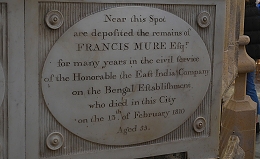
For example, Francis Mure Esq worked for many years in the civil service of “the Honourable the East India Company on the Bengal Establishment”. He died in Bath in 1810 aged 53. Henry Lynch Esq MD “of the island of Barbadoes” died in Bath in 1823, aged 49. Also from this place in the Caribbean was Benjamin Alleyne Cox Esq who died in Bath in 1802 aged 74.   In 1812, 78-year-old Rawson Hart Boddam also died in Bath, after having served as the Governor of Bombay in 1784. Robert Brooke Esq, who had served in the Bengal Civil Service died in 1843 aged 72 is also interred in Bath Abbey. Peter Read Cazalet, “of the Honourable East India Madras Civil Service”, who died in 1859, aged 37, is yet another old ‘India hand’, who is buried in Bath. Also in the abbey are the remains of Major General Sir Henry White KCB, part of whose inscription reads chillingly like some of the news bulletins in the current Ukraine crisis: “The judicious Position taken by his Division in the Attack on Agra Which accelerated its fall And the Reduction of The Strong Hill Fort at Gwalior By Siege Are Proofs of Zeal and Military Skill…” He died in 1822.

What puzzled me was why did so many of these men from the colonies ended their lives in Bath. Was it because they were sick and had come to the place to take the curative spa waters, which failed to cure them? Or had they retired to Bath? Or, as someone suggested, Bath is close to Bristol, which was in many ways involved with colonial affairs.

The answers to these questions must remain uncertain at present. However, I wondered why the wealthy American Senator William Bingham died in Bath in 1804, aged 49. He was involved with the Barings Brothers bank in London, which might have been a reason for him being in England at the time of his death. He left for England in 1801, when his wife was taken ill. What he was doing in Bath remains unclear.

Amongst the many fascinating memorials in the Abbey are several commemorating people who died abroad. Some of these people had been in India when their lives ended. An interesting example of this, which illustrates the hazards of warfare and the difficulties in subduing people, who have no wish to be colonized, is the monument to 1st Lieutenant George Dobson Willoughby, of the Bengal Artillery and the Commisary of Ordnance at Delhi, who died in 1857. His inscription includes the following details: “As a brave and zealous soldier he stood firm in the defence of the post intrusted to him, and when resistance failed blew up the Delhi Magazine on 11: May 1857 to prevent it falling into the hands of the mutineers and rebels. Burnt and wounded he subsequently fell a prey to the insurgents …”

Maybe, this is a lesson from which the dutiful Russian soldiers in Ukraine should take heed.

Ship to shore: a church in Kensington

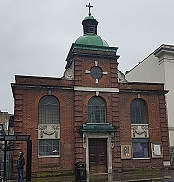
I HAVE PASSED IT innumerable times since I began living in the area (Kensington) almost 30 years ago. It has always intrigued me, but it has taken until now (March 2022) for me to decide to find out about it. I am referring to a small brick building located near Westbourne Grove on the south side of Chepstow Villas between Pembridge Place and Chepstow Place. Bearing a copper dome surmounted by a cross, it was built as a church. That much is obvious, but even its name has disappeared from its exterior.

A rapid search of the Internet has revealed that the building was constructed as The Kensington New Church. Although it looks much older, it was completed in 1925. It was affiliated to the General Conference of the New Church, which was founded in London in 1787 (https://kensingtonnewchurch.wordpress.com/). This branch of the Christian church is inspired by the theological concepts laid out by the Swedish scientist and philosopher Emanuel Swedenborg (1688-1772). According to Wikipedia, in 1744, he had a divine revelation. It seems that he believed that Jesus Christ had given him the task of writing “The Heavenly Doctrine”, a work that was aimed at reforming Christianity. for more details, please refer to https://en.wikipedia.org/wiki/Emanuel_Swedenborg#Theology.

In about 2020, the Kensington New Church building ceased to belong to the General Conference. By September 2020, it had been purchased by a branch of the Greek Orthodox Church (http://pembridgeassociation.london/wp-content/uploads/2020/09/PA-Newsletter-Sept-20.pdf). Currently, it looks disused and is locked up. This is a pity because when it was built its walls were lined with walnut wood panelling from an interesting source. It was salvaged from the Cunard liner RMS Mauretania, when it was dismantled in 1935 (for details, see: https://kensingtonnewchurch.wordpress.com/the-building/the-mauretania-wood/). So, it can be seen that the panelling was literally ‘from ship to shore’. I hope that whatever happens to the former church will include the preservation of this souvenir of a liner, which in 1907, made the eastbound crossing of the Atlantic at record speed on its maiden voyage, earning it the Blue Riband award for highest average speed.