A remarkable woman from Hong Kong

SERAMPORE NEAR CALCUTTA was a Danish colony, or at least under Danish administration, between 1755 and 1845. It was then known as ‘Frederiknagore’. When we visited the place briefly in 2019, we were struck by the similarity of the type of design of its Church of St Olave (built 1806) and that of the far better-known St Martin-in-the-Fields (built 1721-26) on the east side of London’s Trafalgar Square. Although there are similarities between the two churches, there are also many differences. One of them is that the interior of St Olave’s is far plainer that that of St Martin’s. Even though many thousands of miles apart, there is a tiny aspect of Asia in the church on Trafalgar Square.

In the southwest corner of St Martin’s, I spotted a memorial, which aroused my curiosity. It is a simple green cloth-covered square notice board surrounded by a wooden frame in which various things are carved. These include the words “Requests for prayer”; carved plant motifs; Chinese pictograms; and the words “Praise God for his servant Florence Li Tim-Oi DD. 1907-1992. The first woman ordained in the Anglican Communion 25 January 1944”. There were several notices and a couple of plastic drinking cups pinned on the board.

Florence was born in Aberdeen, Hong Kong during a time that most Chinese parents favoured male children. However, her parents were unusual in that they challenged the then current prejudice against girls. As a student, she joined the Anglican church, probably after hearing a preacher (in Hong Kong) asking for women to dedicate their lives to working for the Christian ministry. At her baptism, she chose her English name, Florence, to honour the late Florence Nightingale. After studying at the Canton Theological College, she was eventually, in 1941, ordained as a deaconess. At that time, she was sent to the then Portuguese colony of Macau to help refugees fleeing there from war-torn China.

When the Japanese occupied Hong Kong, it became impossible for ordained Anglican priests to reach Macau. Although she was not yet ordained, Florence had to perform all the functions normally carried out by an ordained priest. In January 1944, she met Hong Kong’s Bishop Raymond Hall in an unoccupied part of China. There, the bishop, realising that there was no Anglican priest in Macau and that Florence had the ‘gift of priestly ministry’, ordained her as an Anglican priest. In so doing, on the 25th of January 1944, Florence made history by becoming the first woman to be ordained as an Anglican priest. This was 30 years before the ordination of women was permitted by the Anglican Church in the rest of the world. So, her ordination was frowned upon by some leaders of the Anglican Church.

After WW2 was over, Florence lived and ministered in China. In Maoist China, churches were closed (from 1958 to 1974), and during the so-called Cultural Revolution, Florence led a miserable life, as did many other Chinese people. She was sent to a farm to work with chickens and her home was raided several times. After a long time, she was allowed to retire from the farm and was given permission to leave China. In 1983, she was taken to Canada, where she assisted in the religious activities of a church in Toronto. By then, the Anglican Church in Canada had approved of the ordination of women. On the 40th anniversary of her ordination in China, she was reinstated as a priest. In later life, Florence served at the Anglican Cathedral in Toronto, where she lived the rest of her life.

I do not know when the memorial noticeboard commemorating Florence was installed in St Martin-in-the-Fields. However, on the 25th of January 2014, a service was held in the church to mark the 70th anniversary of her ordination as the first female Anglican priest. I am pleased that I spotted the somewhat unobtrusive notice board because if I had missed seeing it, I might never have known about this remarkable woman of faith.

Crypto … coffee

ST MARTINS IN THE FIELDS church is a prominent landmark located on the east side of London’s Trafalgar Square. This 18th century church, which first opened in 1724 and was designed by James Gibbs (1682-1754), hosts many concerts, mostly of classical music.

There is a large crypt beneath the church. Its vaulted brickwork ceilings are supported by sturdy masonry pillars. There are many gravestones flush with the floor. The floor is covered with tables and chairs, which are used by the many customers of the café which uses the crypt as its home. It is a pleasant place to while away the time of day.

The café serves food and drink. The coffee served there is slightly below average in quality and is priced a just little bit higher than average for London. Regardless of price or quality, the crypt provides a pleasant ambience to meet friends or simply to relax peacefully.

Richmond’s last night out was in a London pub…

IN “REGENCY BUCK” by the English novelist Georgette Heyer (1902-1974), we read in chapter II:

“Weighs something between thirteen and fourteen stone,” said Mr. Fitzjohn knowledgeably. “They say he loses his temper. You weren’t at the fight last year? No, of course you weren’t I was forgetting. Well, y’know it was bad, very bad. The crowd booed him. Don’t know why, for they don’t boo at Richmond and he’s a Black, too. I daresay it was just from everyone’s wanting Cribb to win. But it was not at all the thing, and made the Black think he had not been fairly treated, though that was all my eye and Betty Martin, of course. Cribb is the better man, best fighter I ever saw in my life.

This extract includes two names ‘Cribb’ and ‘Richmond’. Both were boxers of great renown: Tom Cribb (1781-1848) was an English world champion bare-knuckle boxer and Bill Richmond (1763-1829) was more than simply a boxer.

Richmond was an ex-slave born into slavery in Richmondtown on Staten Island, New York (USA). He was then a ‘possession’ of the Reverend Richard Charlton. Hugh Percy, 2nd Duke of Northumberland (1742-1817), an officer commanding British forces during the American War of Independence, saw Richmond involved in a fight with British soldiers in a tavern, and recognised the black man’s skill as a boxer. After arranging fights between young Richmond and other British soldiers, Percy bough Richmond his freedom and sent him to England, where he organised his education, and apprenticed him to a cabinet maker in Yorkshire. Richmond married in England and later moved to London, where, already in his forties, he began his largely successful and lucrative career in boxing.  He also owned a pub, The Horse and Dolphin, for a while. Today the Dutch pub in Soho, De Hems, stands on its site.

Soon Cribb was challenging and beating some of the best boxers of the time. However, in 1805, Richmond challenged Cribb, and lost. This led to bad relations between the two men, which lasted for years. Richmond met another former slave Tom Molineaux (1784-1818). Recognising his new acquaintance’s potential as a boxer, Richmond gave up boxing to train Molyneaux. After having narrowly lost two fights with Cribb, in 1810 and 1811, Molyneaux fired his trainer, Richmond.

After losing money on training and sponsoring Molyneaux, Richmond, by then aged 50, took to the boxing ring again. At this advanced age, he challenged and beat two younger champion boxers, Jack Davis and then Tom Shelton. After these two victories, he wanted to challenge Cribb again, but the latter had already retired. In 1820, Richmond founded a boxing academy for training amateur boxers. Amongst those he trained were two now famous literary figures: William Hazlitt and Lord Byron.

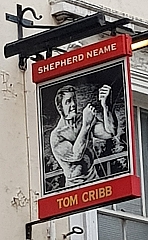
As he and Cribb aged, they became friends. It was in the pub that Cribb owned, The Union on Panton Street (near Leicester Square), that Richmond spent the last evening before his death. The Union still exists but is now named the Tom Cribb. A plaque on the outside of this hostelry commemorates Cribb’s achievements and another one records Richmond’s last night out, which was spent with his friend Tom Cribb.

A house where music has been played for many centuries

Burgh House, Hampstead, London

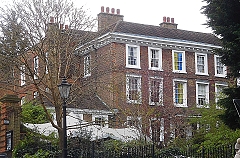
Burgh House stands high above the southwest end of Well Walk in north London’s historic village of Hampstead. Here is a little bit about it, an extract from my new book about Hampstead:

“… Burgh House is entered from a steep side street called New End Square. The house, built in 1704, is close to the Hampstead Well Spa (see below). According to Bohm and Norrie, the House is named after its 10th owner, The Reverend Allatson Burgh (1769-1856), who was the vicar of St Lawrence Jewry in the City of London. Burgh, who was keener on music than looking after his parishioners, neglected both them and his house. Thomas Barratt wrote:

“Mr. Burgh was a rector in the city, and the composer of a work on church music, published by Longmans. Burgh House is depicted on five pieces of the Wedgwood service, made in 1774, for Catherine II., Empress of Russia.”

Between 1858 and 1884, Burgh House became the headquarters of the Royal East Middlesex Militia. After having been put to a variety of uses, the house became used as a cultural centre in 1979. It now contains a small art gallery, a café, a shop, and a Hampstead Museum. The Reverend Burgh would have been pleased to know that today his former home also hosts many fine concerts of classical music.

From the bottom of the garden of Burgh House, the ‘Wells Tavern’ pub can be seen dominating the view along the gently inclined Well Walk. Known as ‘The Green Man’ until 1850, when it was rebuilt and renamed the ‘Wells Tavern’, a pub has stood on his spot since at least 1762. The pub’s name reflects one of the reasons that Hampstead became popular in the 17th century.  Apart from enjoying clean air, people were attracted to the mineral water springs issuing chalybeate (iron-rich) water that were beginning to be exploited in Hampstead at that time…”

My book is called

“BENEATH A WIDE SKY: HAMPSTEAD AND ITS ENVIRONS”

YOU CAN BUY the paperback or ebook (Kindle) from Amazon:

https://www.amazon.co.uk/dp/B09R2WRK92

From his garden to his grave

IT IS PLEASANT to stroll beside the Thames along Chiswick Mall. Occasionally, we take a look at the graveyard of Chiswick’s St Nicholas Church. On a recent visit to this place, we walked deeper into it than usual and spotted a grave marked by a remarkable sculpture.

The idyllic, romantic, leafy churchyard by the river is chock full of graves. Several of them caught my attention. One is that for the artist William Hogarth, who lived close-by. His monument is protected by a cast-iron fence. An urn on a plinth decorated with an artist’s palette and brushes. It was erected after the death of his sister in 1781 (who is also commemorated on this monument) and was restored by a William Hogarth of Aberdeen in 1856. Another painter, Philippe Jacques de Loutherbourg (1740-1812), who was born in Strasbourg, is buried with his wife Lucy de Loutherborg (née Paget). Like Hogarth’s, their decaying monument on the north side of the cemetery is surrounded by cast iron railings. In 1789, Philippe gave up painting temporarily to develop his interest in alchemy and the supernatural. Later, he and his wife took up faith-healing. The remains of yet another painter, James Abbott McNeill Whistler (1834-1903), lie in the cemetery.

Private Frederick Hitch (1856-1913) is less famous than these artists. He was awarded the Victoria Cross for his brave actions during the Battle of Rorke’s Drift (January 1879) in the Anglo-Zulu War fought in South Africa. He is also buried in this large cemetery.

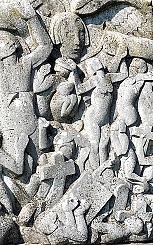
Amongst the more recent graves is the one with the unusual sculpture. It is that of Baronet Percy Harris (1876-1952), who was a Liberal politician. Son of a Polish immigrant, he was born in Kensington, and died there after a long career in parliamentary politics. According to a website listing British Jews in WW1, Percy was Jewish, yet his grave is distinctly Christian in sentiment. Aesthetically, his grave is the most remarkable one in the cemetery next to St Nicholas. It includes a semi-abstract, vorticist carving of The Resurrection of the Dead, created by the sculptor Edward Bainbridge Copnall (1903-1973) in the 1920s. Harris had acquired it for display in his garden long before it was moved to adorn his grave.

Although Percy Harris was born Jewish, he is buried in the graveyard of a Church of England parish church. Despite searching the Internet, including reading his extensive entry in the Dictionary of National Biography, I cannot determine whether or not he converted to Christianity sometime during his life.

Don’t even think about doing these things

AS A SPECIAL TREAT when I was a young child, I was allowed to feed the pigeons on Piazza Signoria in Florence (Italy), a city we visited annually during my childhood. My parents used to purchase paper cones filled with corn kernels for my sister and me. We used to put a few of these in the palms of our hands and allow the pigeons to perch on our fingertips whilst they fed on the corn. Looking back on this activity, which gave me great pleasure, I am surprised that my health and hygiene conscious mother allowed what the former Mayor of London, Ken Livingstone, called ‘rats with wings’ to risk sullying our hands and harming our health.

Oddly, when we were kids, we fed the pigeons in Florence but never fed their cousins that flocked around Trafalgar Square in London. Today, the 25th of April 2022, my wife and I walked across Trafalgar Square and observed that nowadays there are signs that indicate that feeding pigeons is forbidden. However, this activity, which I enjoyed as a child on holiday in Florence, is not the only thing forbidden in Trafalgar Square. The lovely fountains in the square now contain signs in the water, on which the words “No Entry” are written. Yet another activity in the square is no longer allowed. There are signs to deter visitors from climbing on the sculptures of the lions that lie at the base of Nelson’s Column. So, when you next visit Trafalgar Square with plans of feeding the pigeons, or bathing in the fountains (even to celebrate New Year), or straddling a lion, do not realise any of them: they are all outlawed.

Dusty no more: a town on the Thames

HENLEY-ON-THAMES is located at the Oxford end of a bridge across the River Thames, which separates the county of Oxfordshire from its neighbour Berkshire. Located on the old main road between London and Oxford, it retains much ‘olde-worlde’ charm. Its streets are lined with many buildings that were constructed in the 18th century and before. Some of these used to be coaching inns but are no longer. However, some of the hostelries that served wayfarers in times long ago are still serving thirsty and hungry customers today, for example: The Red Lion, where William III might have visited, now an upmarket restaurant; and The Catherine Wheel, now a branch of the Wetherspoons company. On a recent visit in April 2022, we enjoyed superb coffee at Pavilion on The Market Place, close to the Town Hall.

Beer lovers will not need reminding that Henley is the home of Brakspear & Sons, the brewery company. Founded in Henley in 1722, beer was brewed in the town since then, although some of the comapany’s products are now brewed elsewhere. Many of the brewery’s older buildings, now converted for new purposes, can be seen alongside New Street. The company’s offices are now located on Bull Courtyard off Bell Street.

The stone bridge across the river was built in 1788. It is the finishing place of the annual Henley Royal Regatta held in summer, ever since its inception in 1839. Near the bridge, stands Henley’s parish church of St Mary the Virgin, which has a 16th century tower. The exterior walls of the southeast corner of the church is an eye-catching chequerboard of alternating masonry and flint squares. The church’s interior has been much modified by the Victorians. The churchyard north of the church is surrounded mainly by almshouses. Immediately next to the north side of the church stands a two-storied, half-timbered building, the Chantry House, some of whose beams come from trees felled in 1461 (according to scientific dating methods). Between 1552 and 1778, this edifice housed a school. Since 1923, it has housed the Parish Rooms.

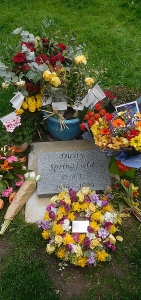
The churchyard is filled with many gravestones. One of them immediately attracts the visitor as it is surrounded by generous amounts of fresh flowers. It is a memorial to the singer Dusty Springfield (1939-1999), who died in Henley. In the 1990s, Dusty lived by the Thames at Hurley near Henley. While in the area, she suffered from several bouts of breast cancer, the cause of her demise. Her funeral at St Mary’s in Henley was attended by many of her fans and leading lights in the British popular music scene including Elvis Costello, Lulu and the Pet Shop Boys. According to her wishes, Dusty was cremated, and some of her ashes were scattered in Henley and the rest in Ireland.

Dusty was not the only music celebrity to have lived in Henley. A man we met outside his house in the town reminded us that the Beatle George Harrison (1943-2001) had also lived in the town. He also mentioned that Henley’s former MP, the present Prime Minister Boris Johnson, had attended meetings in his home, and that he could tell us a thing or two … but he did not!

Remembering a generous lady in Westminster Abbey

CALL ME UNINFORMED but until the afternoon of the 22nd of April 2022 when I attended a service in Westminster Abbey, I had thought that Sidney Sussex College in Cambridge was named after someone called Sidney Sussex. Now, I know better.

On the 22nd, we attended choral Evensong in Westminster Abbey. The choir was that of Sidney Sussex College, and they sung well despite the not too brilliant acoustics in the huge church. After the service, a select group of us, consisting mainly of people associated with the College, moved over to a small side chapel behind and north of the High Altar: The Chapel of St Paul. When we were all crowded into the small chapel, already filled with funerary monuments, the choir of Sidney Sussex squeezed in. They sung a short mass, and then the Master of the College laid a floral wreath at the foot of the monument to Frances Sidney, Countess of Sussex (c1531-1589). This ceremony, commemorating the founding of Sidney Sussex College, has been performed annually since her death.

Frances Sidney, aunt of the poet Phillip Sidney (1554-1587), was a philanthropist. She had inherited a great deal of money when her husband Thomas Radcliffe, Lord Fitzwalter, Lord Deputy of Ireland and from1557 the 3rd Earl of Sussex, died in 1583.  One of her many good deeds is recorded on her colourful stone monument in Westminster Abbey. As per tradition, the Master of Sidney Sussex read out aloud the resumé of Frances’s life as recorded on the monument. The part that is pertinent to the college is as follows:

“…By her last will and testament she instituted a divinitie lectur to be redd in this Collegiate Church and by the same her testament gave also fyve thowsande powndes towards the buildinge of a newe colledge in the Universitie of Cambridge, with sufficient yerelie revenew for the continuall maintenaunce of one Maister, X Fellowes, and XX Schollers, eyther in ye same Colledge or ells in another house in ye said Universitie already builded, comenlie [commonly] called Clare Hall…”

To put it in plainer English, on her death in 1589, she bequeathed £5,000 (worth far more than £ 1 million today) to pay for the building of a new college in the University of Cambridge and to provide an annual revenue sufficient to finance 1 Master, 10 Fellows (i.e., academic teachers) and 20 scholars. The first sentence of the quote states that a “divine lectur” (i.e., prayers) should be said annually in the Abbey. And this is what was being done as we stood assembled in the small chapel. It was a curiously moving occasion especially when the wreath was laid at her monument. Later, one of the clerics who had been present at the ceremony explained to me that not only had Frances Sidney paid for the college, which is named in her memory but also she would have had to pay for the elaborate marble and alabaster monument erected to remember her.

As for the name of the college, Sidney Sussex, this is a shortened version of its full name: The College of the Lady Frances Sidney Sussex.