Up and down Molesworth Street

YOU CAN BYPASS the small town of Wadebridge in Cornwall by speeding along the A39 road, which extends from Bath in Somerset to Falmouth in Cornwall, but that would be a pity because it is a charming town. Wadebridge thrives because of its fine bridge across the River Camel. The great writer Daniel Defoe (c1660-1731) wrote about the town and nearby Padstow in his “A Tour Through the Whole Island of Great Britain”, published 1724-26, as follows:

“Padstow is a large town, and stands on a very good harbour for such shipping as use that coast, that is to say, for the Irish trade. The harbour is the mouth of the river Camel or Camal, which rising at Camelford, runs down by Bodmyn to Wodbridge or Wardbridge [sic], a large stone bridge of eight arches, or thereabouts, built by the general goodwill of the country gentlemen; the passage of the river there, before, being very dangerous, and having been the loss of some lives, as well as goods…”

Defoe noted that the passage from Wadebridge to Ireland via Padstow could be achieved in 24 hours. Thus, Wadebridge and its river crossing, now much widened since Defoe’s time, was an important stage for vehicles carrying passengers and goods between England and Ireland. The route for this transport would have been to first cross over the Camel on the bridge and then to proceed north westwards up the slope of Wadebridge’s then main thoroughfare, Molesworth Street. During daylight hours, most of this road is closed to motorised vehicles and provides a pleasant pedestrian precinct.

Molesworth Street is lined with shops, eateries, and some pubs. The Molesworth Arms, a former coaching inn, has existed since the 16th century. It was previously known by other names including The Fox, The King’s Arms and The Fountain. It got its present name in 1817. Nearer the bridge, there is The Swan Hotel near the old bridge, originally named ‘The Commercial’, is much newer than the Molesworth Arms. It was constructed the late 19th century.

I cannot explain why, but spending time on Molesworth Street always satisfies me. The recently opened (late 2021) Dollies café provides good coffee and exceptionally wonderful English breakfast items; everything is prepared freshly after ordering. Up the hill, stands Churchill Bars. Housed in the premises of the still functioning Wadebridge Conservative Club, it comprises a bar and a small restaurant named Winston’s. Popular with locals, this eatery serves generous helpings of lovingly prepared, tasty food. Its speciality, which is well worth trying, is roast belly pork served with roast potatoes, gravy, and vegetables (not overcooked). Unlike so many other places serving food in Cornwall, this place is good value and not pretentious.

Apart from several charity shops, a good newsagent, two butcher’s shops, a hardware store, banks, and so on, there is a small bookshop on Molesworth Street. This independent bookstore stocks a superb range of Cornwall-related books, both fiction and non-fiction. In a backroom, there is a large selection of second-hand books. Small booksellers such as this one on Molesworth Street make a welcome change from the countrywide bookshops such as Daunt’s, Waterstone’s, and WH Smiith’s.

Not as ‘trendy. as places such as Fowey, Falmouth, St Ives, and Padstow, Wadebridge seems a more ‘normal’ or ‘real’ kind of place, not wholly dependent on tourism. It is well placed to make excursions to places all over the county of Cornwall.

Two similar churches, one in Kensington and the other in Wiltshire

ENNISMORE GARDENS MEWS IS about 380 yards west of Exhibition Road near South Kensington. It is the site of a church with an Italianate façade, now the Russian Orthodox Cathedral of the Dormition of the Mother of God and All Saints. A tall bell tower stands to the right of the façade as you look at it from the street. Pevsner described the style of the façade as “Lombardic Romanesque”. He noted:

“The Early Christian/Italian-Romanesque style was a speciality of the 1840s…”

Russian Orthodox church in Kensington, London

Although many of the fittings in the church are typical of Russian Orthodox places of worship (e.g., iconostasis and icons), the interior is not typical of edifices built specifically for the Orthodox church. The coloured panels above the arches (supported by iron pillars) lining the nave are not typical of the kinds of images usually associated with the Orthodox Church. They have captions in both English and Latin, but not in Cyrillic. The church was designed as the Anglican Church of All Saints in 1848-1849 by Lewis Vulliamy (1791-1871). The tower was constructed in 1871. Most of the decoration within the building is in the late 19th century Arts and Crafts style.

The Anglican parish, which was based in the former All Saints, merged with another in 1955. Then the church was let to the Russian Orthodox faith and its name changed to its present one. In 1978, the Sourozh Diocese purchased the edifice. The Sourozh is under the control of the Patriarchate of Moscow. The church in Ennismore Gardens Mews has a multi-national Orthodox congregation.  I asked a bearded priest how the cathedral differed from the Russian church in Harvard Road, Chiswick. He replied:

“We are the Orthodox Church based in Moscow, but the other one in Chiswick is the Orthodox Church based outside Russia … it is very complicated.”

Wilton in Wiltshire is almost 80 miles southwest of the Russian church in Ennismore Gardens Mews. Famed for its fine carpet manufacturing, the town has a church, St Mary and St Nicholas, whose façade looks not too different from that of South Kensington’s Russian Orthodox Cathedral. The Wilton church has a similar bell tower, but it placed on the left side of the façade. The church was commissioned by Sidney Herbert, 1st Baron Herbert of Lea (1810-1861), a close ally and supporter of Florence Nightingale of Crimean War fame. Sidney was a son of George Herbert, 11th Earl of Pembroke and his Russian spouse Catherine (née Yekaterina Semyonovna Vorontsova). The church, completed in 1845, was designed by Thomas Henry Wyatt (1807-1880) and his assistant David Brandon (1813-1897).

With many features borrowed from Italian Romanesque architecture, and some from Byzantine designs, the edifice at Wilton, despite being an Anglican parish church, felt to me slightly more like an Orthodox church than the converted ex-Anglican, now Orthodox, church in Ennismore Gardens Mews. However, the interior fittings in the church in Wilton borrow from what can be found in traditional Italian churches rather than in typical eastern Orthodox churches. But, the mosaic covered cupola over the chancel in Wilton’s Anglican church, with its depiction of Christ with two saints resembling what is often found in Byzantine churches, contrasts with the undecorated cupola over the chancel in what has now become the Russian Orthodox Cathedral in Kensington.

Placed side by side, many differences could be discerned between the church in south Kensington and that in Wilton. But it is the similarities between two churches designed by different architects that are remarkable.

On the wall

IT IS ODD how seeing a mundane object can stimulate less than mundane thoughts. Embedded into a wall in Salcombe (Devon), I saw an official post box for depositing mail. At first, I took little notice of it. Then, when I saw it a second time, I noticed that its red-painted front bears the letters “GR”. This refers to a King George. Because the first letter boxes were installed in the reign of Queen Victoria, the GR on the letter box in Salcombe must refer either to George V (reigned 1910-1936) or George VI (reigned 1936-1952) because the other King Georges all preceded Victoria.

Possibly the GR on the box in Salcombe refers to George V because he was the first George to follow Victoria, in whose reign the boxes bore the letters “VR” (Victoria Regina). Even though Edward VII was the first monarch to follow Victoria, boxes installed in his reign include the Roman numeral VII. Likewise, in the case of other monarchs who followed Victoria, their initials on post boxes include numerals identifying which king or queen they denoted (i.e., E VII R, G VI R and E II R). Not having ever looked out for it before, I am not sure whether any post boxes installed during the reign of George V bear the logo G V R or, as I saw in Salcombe, simply GR. A rapid search of the Internet revealed that most George V post boxes illustrated on websites dealing with post boxes bear the letters GR, as was the case with the example I noticed in Salcombe.

I suppose that when Charles or his son William come to the throne, letter boxes, if they still exist in the age of electronic mail, will bear the logos “C III R” and “W V R” respectively, rather than “CR” and “WR”. Why the V (meaning ‘5’) was not included on the post boxes issued during the reign of George V but the VII (meaning ‘7’) appears on those installed during his predecessor’s reign is not clear to me.

Going up in smoke

CORNWALL’S COAST WITH its numerous, sometimes almost inaccessible, coves is perfect for smuggling. It is not by chance that Gilbert and Sullivan’s opera is named “The Pirates of Penzance”, rather than, say, “The Pirates of Suffolk”.  When we visited Falmouth, a Cornish seaport, in May 2022, I noticed a souvenir of an era of smuggling, now long past.

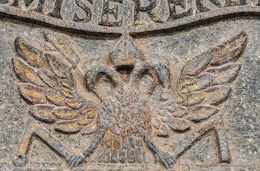
Next to the old customs house (now a pub) on the Town Quay, the old harbour of Falmouth, there is a tall brick structure. On a square base, it is built in four sections, each one slenderer than the one beneath it. The tall object bears a plaque inscribed with an anchor framed by a shield and above it a double-headed eagle. Below these symbols are the words:

“King’s Pipe. Formerly used for the destruction of contraband tobacco.”

According to the website historicengland.org.uk, the King’s Pipe was likely to have been constructed in about 1814, when the customs house was built. The tall chimney stands on a base that contained a furnace that was accessible from the courtyard of the customs house. Overshadowing the town and its harbour, I imagine that many of the townsfolk were far from happy when they saw and smelled the tobacco smoke, which they would have enjoyed creating in their pipes, being emitted from the King’s Pipe.

The double-headed eagle on the plaque affixed to the former chimney interested me. Two major families in Cornwall use this mythical creature in their heraldry: the Godolphins and the Killigrews. It is most likely the latter to which the creature on the plaque refers because in the early 17th century (1613), Sir John Killigrew (1583-1633), helped create the port of Falmouth.

Although we had spent several pleasant days in Falmouth a few years ago, we did not spot the King’s Pipe on that visit. It only goes to show that revisiting places can enhance one’s enjoyment of, and interest in, them.

Remembered in a Cornish car park

THE FORD CONSUL was made in the UK between 1951 and 1962, when I was 10 years old. As a young child, I used to be extremely impressed by this vehicle and was happy when I was occasionally driven in one. Recently, I was in a car park near the Art Deco swimming pool by the sea in Penzance (Cornwall) when I spotted a well preserved example of a Consul, which was still in use. Seeing it, brought back memories of many years ago.

No longer in use

THE CORNISH COUNTRYSIDE often seems wild and almost at the end of the earth. It is richly dotted with reminders of its industrial past, much of which was concerned with mining minerals, notably tin bearing ores. The tiny hamlet of Cripplesease lies on a road that links St Ives with Penzance (the B3311). On a hill north of the place and high above it stands a ruined tower (with arched windows and large doorways) built with granite blocks. Standing on a square plot, this edifice has a gently tapering conical chimney attached to its southeast corner.

This tower is almost all that remains to be seen of the Giew Mine, first worked in the 18th century. It was one of many sites where tin was extracted from the depths of the earth. The tower was used from between when it was built in 1874 and when the mine was closed in 1922. The tower housed a pump engine and the winding gear for Frank’s Shaft, which was sunk to a depth of 1302 feet. Initially steam powered (hence the chimney), an electrically operated system was later installed close to the tower. The electricity for this was provided by a generator also located near the tower.

Ore that was brought to the surface was taken from the tower and moved to an ore crushing facility across the B3311. It was transported across the road by an overhead tramway, which has long since been removed. The tower, whose arches reminded me of Romanesque buildings can be entered. When I visited it, there was a spooky sound echoing within it. Looking upwards towards the open sky that can be seen because the tower has lost its roof I saw that it was being created by a solitary crow perched high up on one of the walls.

The old engine house is easily accessed by a gravel track that leads off the B3311. The unmarked track leads to a small car park, and the remains of the tower are a few feet away.

A chiming pub in Cornwall

EGLOSHAYLE IS ACROSS the Camel river, facing the Cornish town of Wadebridge. The Earl of St Vincent pub is hidden away up a hill behind Egloshayle’s St Petroc church. It is housed in a building built in the 17th century as a boarding house for masons. Later, it became a pub. One of its many guests was Admiral Sir John Jervis (1735-1823).

The interior of the pub has timber roof beams and a delightful feeling of times long gone by. It is a great example of many people’s idealised vision of a typical ‘olde worlde English’ country pub. Soon after entering the dimly lit establishment, and your eyes adjust to the low light levels, it becomes evident that the pub is full of clocks, mostly differing in design. Most of them appear to be in working order, but not many of them show the same time. A great number of the clocks chime at least once an hour, but not all at the same time. This being the case, there is usually at least one clock chiming at any given moment. This produces a lovely background symphony of chimes.

I asked one of the pub’s staff why there were so many clocks in the pub. She replied:

“Some people like children. We like clocks”

Later, I asked the landlady about the clocks. She told me that when they took over the pub some years ago, there was no clock in it. She and her husband bought one clock for the pub, and this became the start of their collection. They could not stop buying timepieces. She told me that there are over 200 clocks in the pub and winding them up every day is quite a huge task.

Apart from the fascinating clocks, the pub can be recommended for the delicious, excellently prepared, unpretentious food that can be eaten there.