An artist named Balthus

ON THE LAST DAY of May 2023, I visited the Luxembourg Gallery on London’s Savile Row. My wife and I went to see a small exhibition of paintings and drawings by an artist whose name was not familiar to me – Balthasar Klossowski (1908–2001). Better known as ‘Balthus’, he was according to Wikipedia:

“…known for his erotically charged images of pubescent girls, but also for the refined, dreamlike quality of his imagery.”

Although there were three drawings that fall into the “erotically charged” category, most of the other works on display were delicately executed, attractive paintings. Most of these demonstrate what the gallery’s website described as follows:

“Exercising meticulous control over the form and placement of models, their bodily gestures, as well as the domestic or rural settings in which they reside, Balthus sought to create, at least in appearance, dreamlike scenarios, absent of time and devoid of emotional expression. Yet the restraint in his works results in suggestive and even violent relationships between elements or figures in the picture, as well as in their relation to viewers or the artist himself.”

The results are extremely pleasing to the eye.

The Wikipedia article mentioned something that particularly interested me:

“Throughout his career, Balthus rejected the usual conventions of the art world. He insisted that his paintings should be seen and not read about, and he resisted any attempts made to build a biographical profile. Towards the end of his life, he took part in a series of dialogues with the neurobiologist Semir Zeki, conducted at his chalet at Rossinière, Switzerland and at the Palazzo Farnese (French Embassy) in Rome.”

When I was studying for my BSc in physiology at University College London in the early 1970s, one of my teachers was Semir Zeki, mentioned in the quote above. I recall that he was an excellent teacher, who was able to explain complex topics extremely clearly.

Although I did not know about Balthus nor of Professor Zeki’s connection with him, I am very pleased I visited the Luxembourg Gallery and became aware of such a fine 20th century artist.
An interesting intersection

WHERE BURLINGTON GARDENS meets the south end of New Bond Street and the north end of Old Bond Street, there are two things that reminded me of my late mother.

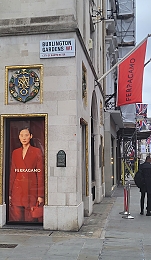
One of them is a shop in a colourfully decorated building. This edifice used to be the home of Atkinson’s – a firm that sold perfumes and beauty products. Founded in 1799, it moved to the building on the corner of Burlington and Old Bond Streets in 1832. The decorative building is surmounted by a carillon of 23 bells, which is played by hand occasionally – to celebrate both public and private special occasions. Currently, the ground-floor is occupied by a branch of Ferragamo’s. And this firm has a connection with memories of my mother.

Salvatore Ferragamo (1898-1960), born in Italy, was a designer of luxury shoes. His clients included the Maharani of Cooch-Behar, Eva Peron, and Marilyn Monroe. He died in Florence (Firenze), where he had a shop on the Via dei Tornabuoni. This shop was close to Via del Giglio, where we as a family used to spend a fortnight in the city every year until I was about 15.

One of my clearest memories of our sojourns in Florence was not the Uffizi or the famous Duomo or the Medici Chapels, or even Michelangelo’s statue of David, but Ferragamo in Via dei Tornabuoni. You might wonder why. It was not that I have a shoe fetish or any great interest in footwear. It was because of my mother. Hardly a day passed without us having to enter Ferragamo’s to watch my mother trying on several pairs of shoes. For a youngster like me this was not an interesting way to spend my precious school holidays. And what is more, I cannot recall my mother ever buying a pair of shoes in that shop.

Facing Ferragamo’s on the corner of New Bond Street and Burlington Gardens, there is a small paved open space. In the middle of it, there is a bronze sculpture of a horse and rider. This was sculpted by Elisabeth Frink (1930-1993). My mother was also a sculptor and met Frink (or ‘Liz Frink’, as we knew her) at St Martins School of Art (in Tottenham Court Road), where they both worked in the Sculpture Department. They became close friends. I used to meet Liz Frink when she was invited to our house for dinner occasionally.

The Frink sculpture has been on Bond Street since 2018. Before that, it was located at the corner of Dover Street and Piccadilly, where it was placed in about 1975. As for the branch of Ferragamo’s that faces it across Burlington Gardens, I am not sure how long it has occupied its present site. However, it was only today that it occurred to me that the intersection of the two Bond Streets with Burlington Gardens has a connection with recollections of my mother.

A Knightsbridge landmark

FIVE YEARS AGO, I wrote the following:

In the early 1960s, my parents installed a Permutit water softening unit in our family home. I have no idea why they did this. Maybe it was to save soap and the furring up of pipework. I am not sure that they would have done it had they known of the research that shows that heart disease is reduced as the hardness of drinking water increases.

The apparatus consisted of two cream-coloured cylinders, each about five feet high, which stood next to each other in our garage by the side of the house. One of the cylinders was sealed shut and surmounted by a circular metal control wheel. Its neighbour could be opened by lifting a lid. Once a week, my father had to refresh the ion-exchange resin in the sealed container. This was done by adding salt in large quantities to the other cylinder …

… A special salt, called dendritic salt, was required for the weekly process … There was only one store that would both supply sacks of dendritic salt and, also, deliver it to our home. That store was the world-renowned Harrod’s in Knightsbridge, which brought us the salt in their silent, electrically powered delivery vehicles.  In order to get these regular deliveries, my parents had to open a Harrod’s account...”

Today, at the end of May 2023, I paid a visit to Harrod’s – a department store, which I last entered about 15 years ago. Since then, its interior has been modified considerably. The Ancient Egyptian themed central escalator hall is as it was when I last saw it, as is the superb, tiled food hall. Otherwise, it seemed unrecognisable to me.  

Rather than being what I have always believed a a department store should be – a large shop in which its various sections display different kinds of goods (for example, men’s clothing, kitchen appliances, toys, etc), todays Harrod’s is a collection of departments, each one dedicated to a brand rather than a type of product. Wandering through the store, trying to find our way out, it occurred to me that Harrod’s has become more like a shopping area in a large international airport than an ‘old-fashioned’ department store. Is this, I wonder, because today’s customers are more interested in brand names than the products to which they are attached? Also, I am curious to know whether Harrod’s still deliver sacks of dendritic salt to addresses in the Hampstead Garden Suburb, where we used to live.

A leather purse

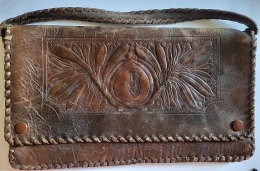
OF MY FOUR GRANDPARENTS, I met only one of them – my father’s mother. The other three died before I was born. My mother’s mother was called Ilse – her parents were born in Prussia and Baden Württemberg before the Unification of Germany in 1870. From what I can recall, my mother told me that her mother was gifted artistically. She painted and made various kinds of objects by hand. One of these came into our possession some years ago. It is a large purse made from leather. With two industrial press-studs, it is held together with stitched leather. The front flap has a leafy design tooled in it. The image has the characteristics of the art-nouveau style that was popular in the late 19th century, and the early part of the following century. In the centre of the design, there is a pair of intertwined initials tooled in the leather. These appear to be “J” and “B”.

When Germans wrote in the late 19th century, they often used what looks to our eyes like the upper-case letter ‘J’ where we would now use the upper-case letter ‘I’. To write the letter ‘J’ (as in jelly), the old German alphabets used a ‘J’ that differed slightly from the ‘J’ used to denote ‘I’. Therefore, the initials on the purse are most likely ‘IB’. Now, IB could either refer to Ilse or to her husband, my grandfather, Iwan B.

Inside the purse, there is some handwriting, which I recognise as my mother’s. It gives her name, Helen B, and the address of the farm her mother bought after having been widowed twice:

“Bantouzelle, Stellenbosch. Phone No. Stellenbosch 2646.”

Beside this, she had written “Poste restante”. I imagine that she had done this because most of the time she was living not in Stellenbosch, but in Cape Town. This would have been before 1948 when she travelled to England to marry my father.

Apart from a few old photographs, this well-made purse is one of the very few material souvenirs of a grandmother whom I never met.

Water for the public

WE TAKE IT FOR GRANTED that when you turn on a tap in your bathroom or kitchen, fresh water will flow. And when, usually for maintenance purposes, the mains water supply is turned off temporarily, we can be truly inconvenienced. There are still many parts of the world where piped water is not available to domestic users, but the UK is no longer one of these.

During a recent (May 2023) trip to Lavenham in Suffolk, my wife noticed something next to a pavement. It was a now obsolete bit of plumbing, which has been preserved to demonstrate that even as late as 1936, the small town did not have a public piped water supply for its dwellers. I suppose that before that date, the people had to rely on springs and wells.

The object that can be found on the east side of Church Street, south of Water Street, is a public standpipe. A notice near it explained that piped water came to Lavenham in 1936 to 1937. Several standpipes were erected to give the public access to the water. At that time, people had to collect water from the standpipes and take it to where they required it. However, they did not yet have the luxury of having taps that supplied water in their own homes. The standpipe, which we saw, is now non-functional, but is one of nine such items still to be found in Lavenham.

Lavenham is full of small reminders of how different life was many centuries ago. The standpipe is a small souvenir that makes us realise how different life was less than 100 years ago.

Alas, poor little Clopton

THE GLORIOUS GOTHIC CHURCH in Lavenham (Suffolk) attests to the prosperity that the town enjoyed many centuries ago when it was involved in the then extremely lucrative wool trade. In those far-off days, infant mortality was far from uncommon amongst people from all social classes. Related to this, there is something quite unusual on the floor in front of the chancel of Lavenham’s large early 16th century church of St Peter and St Paul.

The strange object in the floor is a funerary brass. These are commonly found in mediaeval churches, but differ from the one in Lavenham. At first sight, the small brass looks a bit like a fish. However, on closer examination, it can be seen to be a depiction of a baby wrapped in swaddling clothes or chrism robes.  At one end, the babies small face is visible. The brass is curious because it is, if not the only, one of the few, surviving examples of a funerary brass depicting an infant, rather than an older person. The brass marks the grave of Clopton, the first-born son of the antiquary and politician Sir Symonds d’Ewes (1602-1650). His son died in 1631 only 10 days after being born, and 4 days after having been baptised.

The prominent position of Clopton’s grave probably relates to the fact that his father had married Anne, the daughter and heiress of Sir William Clopton, and in so doing had become very wealthy. In 1636, he was appointed the High Sheriff of Suffolk. He was also Lord of the Manor in which Lavenham was located. Clopton was not the only of their offspring to die young. In the “The autobiography and correspondence of Sir Simonds D’Ewes, bart., during the reigns of James I. and Charles I”, we read about Clopton’s demise in 1631:

“Our sweet infant was a little ill, Thursday, July the 7th, but we had no suspicion or fear of his approaching end till Saturday, July the 9th, when he was surprised with a violent and little intermitting lask [i.e., looseness] or scouring; with which he having been grievously afflicted and disquieted all the day, he had some intermission about four of the clock in the afternoon, and so lay quietly breathing out his last and innocent breath till near upon six of the clock the same evening, when he rendered up his blessed soul into the hands of his eternal Creator. I had attended him, fasting the greatest part of the day; and when he had given up the ghost, my dearest and myself could not refrain from many tears, sighs, and mournings…”

Two sons followed Clopton’s death – Adrian and Geerardt. Both died early in their lives. Sir Symonds wrote that in 1633, Adrian:

“… was interred, March the 14th, Thursday, in Lavenham chancel, also in the same grave with Clopton D’Ewes, his elder, and Geerardt D’Ewes, his younger brother.”

From this, it seems that the unusual brass not only marks the grave of Clopton, but also the final resting places of Adrian, and Geerardt. And in 1634, we learn:

“Between two and three of the clock in the afternoon of the same day, she [i.e., Symond’s wife] was safely delivered of her fourth son, who was baptized in Ixworth parochial church, on the 1st day of August, and named Clopton. For though we had lost the eldest of the same appellation, yet my dear esteem of my wife and her family made me once more bestow her surname on this son, who was at this time, his three elder brothers being dead, one heir-apparent.”

Alas, the second Clopton never lived long enough to inherit his father’s baronetcy. In about 1650, about 9 years after Anne had died, Symond’s second wife, Elizabeth (née Willoughby) produced a son – Willoughby D’Ewes, who inherited the baronetcy.

Although I have visited St Peter and St Paul in Lavenham several times before, it was only during my most recent visit that I noticed the unusual ‘baby brass’. Many of Lavenham’s charms – notably its abundance of half-timbered houses and its Guildhall (built 1525) – are obvious. In addition, the town is full of fascinating less prominent details, such as Clopton’s brass I have just described.

A spike in Stamford

ELEANOR OF CASTILE (1241-1290) was the first wife of King Edward I. They married in 1254. The pair were devoted to each other. She even travelled to the Middle East with her husband, to the battlefields of the Crusade of 1271-1272. When she died of (possibly) a malarial disease, after having survived sixteen pregnancies, at Harby in Nottinghamshire (close to Lincoln), her husband was at her bedside for the last three days of her life.

Her body was embalmed in Lincoln, and then transported ceremoniously to Westminster Abbey – a journey that took several days. At each of the places where her corpse stopped overnight, Edward ordered memorial crosses to be erected. These became known as Eleanor Crosses. They were placed at: Lincoln, Grantham, Stamford, Geddington, Hardingstone near Northampton, Stony Stratford, Woburn, Dunstable, St Albans, Waltham, Westcheap, and Charing (now a part of central London, but originally a small hamlet close to the Thames). Of the original crosses, only significantly large remnants of three survive.

The cross at Stamford in Lincolnshire was demolished but a small fragment of it is in the local museum. Not much is certain about where the cross stood in Stamford. It is believed that it might have been destroyed between 1646 and 1660 by zealous Parliamentarians (http://stamfordlocalhistorysociety.org.uk/queen-eleanor%E2%80%99s-cross).

Currently, a tall tapering sculpture – a tall, sharp spike with a circular base – stands on the place that was most likely where the Eleanor Cross stood. It was designed by Wolfgang Buttress (born 1965) – a sculptor from Nottingham. His creation, completed in 2009 and made of local Ketton stone, incorporates the kinds of decorative motifs that might have been on the original cross. It is surrounded by a ring of benches. Both the seats and the spike are studded with circular bronze discs, each of which contains a word from a Japanese haiku, so I have read. Sadly, I did not examine the object closely enough to see them because we were close to the expiry time of our parking space.

Picture this: art and photography

SOME OF MY REGULAR readers will know that recently I published a short book about the Victorian photographer Julia Margaret Cameron (1815-1879). Her photographic creations, which she produced mainly between 1863 and 1875, differed significantly from those of her contemporaries. At the time that she was taking pictures, most other photographers concentrated on using their cameras to produce slavishly accurate renderings of their subject matter – often portraiture. In contrast, Julia experimented with her focussing, film processing, and other aspects of creating photographic images, to create imaginative artworks, often achieving effects that had been hitherto impossible for painters to produce. She used the camera not to reproduce nature but to produce often expressionistic or impressionistic renderings of her subject matter. For her, the camera was not merely a method of mirroring reality, but a pathway to creating works of art.

Today, the 23rd of May 2023, I visited the Waddington Custot gallery on London’s Cork Street. My wife and I enjoyed viewing an exhibition, “Picture This: Photorealism 1966-1985” – Photorealism was a term created by Louis K Meisel in 1969. The show continues until the 24th of June 2023. At first sight the pictures on display seem to be enlarged, well-focussed photographs. Soon, you will notice that these fabulous pictures of scenes in the USA are not photographs, but paintings created using oil and acrylic paints. One of the gallery staff explained that some of them are not images of actual places, but scenes imagined by the artists. Furthermore, he made an interesting point about them. He remarked that the artists have not painted the scenes as they would have appeared to the naked eye, but instead they have painted them how they would have looked if the images of them had been created using photographic techniques. In addition, by making their paintings of often imagined scenes in this way, the viewer is forced into questioning the assumption that photographs capture the truth.

After seeing the exhibition, it occurred to me that whereas Julia Margaret Cameron was using her camera to create art, the Photorealists were doing quite a different thing – creating artworks that imitate what can be achieved by accurate photography.

[You can get a copy of my book from Amazon: https://www.amazon.co.uk/dp/B0BZFCVLX9/]

Life at the bottom

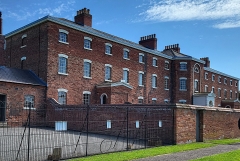
THE NATIONAL TRUST (‘NT’) maintains many buildings of great historic interest, and makes them accessible to the public. Most of the properties under the care of the NT are places where the well-off and the famous lived. Visitors to these homes and gardens can see finely decorated rooms. Often, the servant’s quarters are also displayed. This May (2023), we visited an unusual NT property in Nottinghamshire. Its distinctiveness lies in the fact that the buildings housed not the rich but the very poorest in society. Located at Southwell near Nottingham, it is the Southwell Workhouse.

The Workhouse was built in 1824 to house (usually temporarily) the poorest and most infirm people in the 49 parishes that made up Nottinghamshire’s Southwell Union, which financed the institution. Some of these people were impoverished during the advent of the Industrial Revolution in the early 19th century. For example, many households in the area made a living by making knitwear in their homes. When factories opened with industrial knitting machines, many of these artisans were left without work and income.

The Southwell Workhouse admitted people following assessment of their condition by a parish’s local Relieving Officer. The rather bleak Workhouse was divided into several separated sections: for women with children less than two years old; for women, both abled and disabled; for men, both able and disabled; boys aged 7 to 15; girls aged 7 to 15; and for other children, aged between 2 and 7 years. The children received elementary schooling in the Workhouse classroom; this improved their chances of obtaining employment. There was no mixing between men and women. Women worked mainly in the kitchens, which are in the cellars of the building. To avoid contact with men, who worked in the institution’s vegetable gardens, produce required for cooking was passed into the kitchens through hatches.

Except for the extremely infirm, the idea was to make the Workhouse as uncomfortable as possible so that the able-bodied inmates had an incentive to leave as soon as they felt able. Consequently, the food provided was dull and meagre. All able-bodied inmates had to work. Some of this work was either meaningless, like breaking stones, or physically difficult, like picking oakum. The maintenance of the institution was also carried out by the inmates. The Workhouse was designed to provide food and shelter for the most destitute, but not to make it so comfortable that they had no incentive to leave. By pooling their resources, the parishes in the Southwell Union saved money because without the workhouse each parish would have had to conform to legal requirements to set up their own facilities for looking after those at the bottom of the social pile. The Southwell Workhouse was an example of an economy of scale.

The Southwell Workhouse was the brainchild of the Reverend John Thomas Becher (1770-1848). A friend of Lord Byron, who wrote poems to him, Becher not only established the Workhouse, but four years later wrote a pamphlet, “The Antipauper System”. In this publication, he explained how successful the Workhouse was in reducing the “poor rates” by 75%.  His work led to the establishment of other similar wirkhouses in the country following the passing of the Poor Law Amendment Act of 1834 (‘The New Poor Law’).

With the establishment of the NHS in 1948, the Workhouse became an institution run by a local authority and many things relating to the care of the poor changed in Britain. Until the 1970s, the Workhouse, re-named Greet House (after the River Greet), housed the poor, but ins slightly more comfortable conditions than were available to its earlier inmates. The NT has done a beautiful job of restoring the Southwell Workhouse. Arrows guide the visitor though the whole building. All along the route, NT volunteers greet you and explain what each room was used for and provide other fascinating background information. Although the Workhouse is a fairly grim looking place, a visit to it is extremely interesting and a dramatic contrast to the often-glittering, resplendent places that can be seen in the majority of NT properties.