Water music

I BELIEVE THAT SOUND travels well over water. I do not know if that is scientifically proven, but I like to think that it is the case.

BLOG KENWOOD 2

Yesterday, we visited Kenwood in north London. The neo-classical mansion, remodelled by Robert Adam (1728-1792) and completed in about 1780, contains a superb collection of fine art (the Iveagh Bequest), mostly paintings. Because of the Coronavirus pandemic, Kenwood House was closed, but its extensive grounds were open. Although the official car park was fully occupied, there was no sense of crowding in the grounds.

A wide terrace at the rear of the mansion overlooks a sweeping panorama including a lake at the bottom of the grassy slope that falls away from the terrace. From this vantage point, the viewer can see what looks like a fine bridge with balustrades and three arches at the eastern end of the body of water. However, what meets the eye is not a bridge, but a sham, a trompe-l’oeil, made in wood to produce a picturesque view. It was designed by Robert Adam and constructed in about 1767 and fully restored in the late 20th century.

The bridge has survived the progression of time, but another structure that was a notable feature on the side of the lake furthest from the House has not.  This was an edifice shaped like the quarter of a sphere. Within this shelter, a whole symphony orchestra could be comfortably seated with their instruments. On summer evenings, orchestras used to play music that travelled across the lake to huge audieces seated on the grassy slope leading down to the water.

I used to attend these concerts occasionally during my younger days. They were, as I can recall, often on Saturday evenings. Two kinds of tickets were available. The costlier ones allowed a person to sit on one of the deckchairs arranged in rows on the part of the slope closest to the lake. The cheaper ones permitted holders to sit on the grass above the rows of deckchairs. Many people, who sat on the grass, brought rugs and picnics, which they enjoyed whilst listening to the music. I have never liked sitting on the floor and always preferred to experience the concert in a comfortable deckchair.

It was delightful sitting outside hearing well-performed music whilst the sun set slowly, and the twilight enveloped us all. The acoustics were good, but the first halves of many concerts were subject to the frequent the competition from noisy aeroplanes passing overhead. Usually, by the second half of the performance, there were few interruptions by ‘planes.

When we returned to Kenwood yesterday, the orchestra ‘dome’ was not visible. Where it had been has been replaced by bushes and trees. There is not a trace of it left. It looks as if it had never existed and I worried that maybe my memory had played a trick on me. We stopped a couple of elderly women and asked them about the concerts. They remembered them well and told us that they had been stopped a few years ago because, incredibly, local residents had complained about being disturbed by the noise (and increased traffic) during the few events that occurred each summer.

The lakeside concerts were held every year between 1951 and 2006, the year the English Heritage was forced to put an end to what had been a lovely annual event and an important money-spinner for them. I remember those concerts with fondness and hope that the wealthy inhabitants who live around the area, quite distant from the lake, will one day relent to allow music lovers to enjoy fine music wafting across the water. Well, as often is the case, money has more clout than culture.

Clive in India

I AM NOW IN CALCUTTA. Last time I came here, for miles and miles along the railway lines and at stations, there were starving people. Now there is not a sign of famine – it has been organised with the ability of genius…” 

Thus, wrote Clive Branson (1907-1944) from Bengal on the 11th of November 1944. Later in the same letter, this British soldier in India added:

“… it is reported that in the week ending November 5th, 267 deaths occurred in Chandpur town and in the 53 unions (groups of villages), on an average more than 200 in each. The report states ‘Almost all the dead bodies were thrown into the ‘khal’ and paddy fields – to be devoured by dogs, jackals and vultures – as there was no man available to bury or burn those corpses.”

A few lines later, he adds:

The point is that out in the villages people can starve to death without anyone knowing about it, while on the basis of the falling mortality rate in Calcutta Amery will no doubt claim that the famine is over.”

‘Amery’ to whom Branson referred was Leo Amery (1873-1955), who was Secretary of State for India during WW2. The famine was that which decimated many Indians in Bengal and other parts of India.

clive

Writing on the 28th of August 1943, Branson suggested that the famine was to some large extent man-made rather than the result of natural disasters:

But the fact is there is enough food in India now …”

A major cause of the famine he suggested it was:

“… the hoarders, the big grain merchants, the landlords and the bureaucrats who have engineered the famine …”

And, on the 14th September 1943, Branson wrote:

The thing that stands out a mile is that the Government showed no signs of weakness when it came to the arrest of the Congress in glaring contrast  to its utter helplessness (??) (or should we call it co-operation, tie-up) in the face of the grain profiteers (and in a similar situation – the cloth merchants – the coalowners, re employment of women underground).”

These quotes, damning indictments of the situation Clive Branson observed whilst serving in India come from a book, “British Soldier in India”. It contains the letters that Clive wrote from India to his wife in England and was published in 1944 by ‘The Communist Party, London’. The slender volume contains an introduction written by Harry Pollitt (1890-1960), who was General Secretary of The Communist Party of Great Britain from 1941 to 1956. I came across the book while reading an excellent book about the 1943 Bengal famine, “Churchill’s Secret War” by Madhusree Mukherjee, and ordered a copy.

Clive was born in Ahmednagar (India), son of an army officer. Ironically, most of his time in India during WW2 was spent in the town where he was born. He trained to be a painter at The Slade School of Art (part of University College London) and became a prolific and talented artist. Some of his works are housed in London’s Tate Gallery. From the age of 20, Clive became interested in Communism and joined the Communist Party in 1932. Pollitt wrote of him:

He was one of those who endear themselves to all who came in contact with them … he was able to inspire others to hate poverty and fight to remove it, to hate ugliness and see beauty … He was not only a brilliant speaker and organiser, but also did more than his share of what is sometimes called “the donkey work”. Nothing was too much for him …”

During the Spanish Civil War, Clive both recruited for, and from 1938 fought with, The International Brigade. In March 1938, he was taken prisoner by Franco’s Nationalist forces and interned in San Pedro de Cardeña concentration camp, where he painted and sketched the camp and many of its inmates. These artworks are currently stored in the Marx Memorial Library in London’s Clerkenwell Square. Pollitt reports that a fellow prisoner said of Clive:

In any difficult time, Clive was always cheery, putting forward what we should do … He was one of the most popular and most respected among the British prisoners.”

Clive, a true patriot and ardent anti-fascist, joined the Royal Armoured Corps during WW2 and was posted to India where he arrived in May 1942, the month that he sent his first letter published in the book. Pollitt accurately notes that Clive’s letters from India:

“… will make you angry and they will make you sad. They will make you see new colours and shades, an unimaginable suffering and a truly heroic grandeur, extraordinary nobility and equally extraordinary bestiality. It is a vivid and many-sided picture which Clive wanted to record in painting, and which we may be sure he would have executed with feeling and sincerity...”

Reading Clive’s letters today, 76 years after they were composed, still evoked a sense of anger because of the awful things he saw as well as a sense of wonder because of his very evident love and admiration of India and its people.

Whenever he was able, Clive mixed with Indians from all strata of society and delighted in their company.  While in Ahmednagar, Clive was introduced to an Indian artist. At this person’s house, he:

“… did a drawing for 1½ hours of his little niece aged 10. I did it in indelible pencil and ink – this is the medium I shall do most of my work in as it is more lasting – does not smudge – than ordinary pencil. But how difficult are Indian clothes – I shall have to do a lot of careful observation and drawing before I shall know what to do technically’ The Indian just sat and watched me working. He speaks English quite well, and knows a number of famous Indian painters – he himself went to the Bombay School of Art…”

This was noted in a letter dated 13th of April 1943. Several months later, in mid-September, Clive was invited to lunch with his artist friend. I loved his description of the occasion, which was new to him but typically Indian:

We sat on wooden seats about 2 ins. off the ground. The meal was in a room just off the kitchen. Of course we had taken off our boots etc. Each had a large silver plate with the various ingredients put around the edge. A small bowl of what they call butter-milk took the place of water. A pattern, done with vermilion and white powder had been drawn on the ground. In front of me was placed a little silver stand in which a stick of incense burned. Nana’s elder daughter also ate with us. The whole affair was very civilised and friendly.”

In general, Clive was enamoured of all of the Indians he encountered, both those from sophisticated and also humble backgrounds. He was horrified at the way that the British and their government treated them. This is a significant feature of what he conveyed in his letters. Also, the failure and apparent unwillingness of the British to address the terrible famine concerned and upset him greatly. He communicates this eloquently and powerfully in his writing.

One of Clive’s many observations struck a personal chord. It concerns the bookshops that Clive visited in India in search of reading material. In a letter written from Bombay in September 1942, he noted:

I have said a lot about going to bookshops, but I have never mentioned something which hits you in the face about the general trend of literature: 1. Hitler’s ‘Mein Kampf’ is on sale prominently at every bookstall …”

Seeing copies of “Mein Kampf” openly on sale in most bookshops in India is something that has always surprised me since my first visit to India in 1994.

As a Communist, Clive’s political views are not concealed in his letters. He showed little or no sympathy for the policies of Gandhi and the All India Congress. On the 10th of March 1943, he wrote:

How stupid Gandhi’s fast looks compared to the grandeur of a handful of Indian peasants and workers uniting to demand their human rights!  No wonder the Viceroy corresponds with Gandhi and sends the police after the people.”

As for the Muslim League in Bengal:

The net result of the League’s scheme is to launch the peasants against the little men and leave the big bastards to control the famine via the black market – such is the first practical application of the policy of Jinnah.” (letter dated 19th June 1943)

Also, as a staunch anti-fascist, he regarded Subhas Chandra Bose as contemptible because he had chosen to fight alongside the Japanese, who were allies of fascist Germany. During his stay in India, Clive met and discussed matters with members of the Indian Communist Party. This is described in the letters and was not removed by the censors. In addition, his harsh but justifiable criticism of Britain’s mishandling of the famine in India passed the censors’ scrutiny and reached his wife’s letter box intact.

Clive was constantly upset by seeing examples of British racism in India. He mentions this often in his letters. The most eloquent example appears in a letter written on the 29th of November 1943:

I am sitting on the grass outside a long army hut. Not far away is an African negro … reading a book. Five minutes ago a B.O.R. [British other rank] came up, stopped, and said to him, ‘Can you read?’ ‘Yes.’ ‘What’s the book? Miss Blandish?’ ‘No, Pygmalion.’ I had to record this – whole books could not present the present world situation better.”

(I imagine that the B.O.R. was referring to “ No Orchids for Miss Blandish”, a  raunchy thriller by James Hadley Chase)

In the same letter, Clive noted that the British Conservative MP, Ferris:

“… has made a study of Indian affairs, and has delivered himself of the profound judgement that India is not ready for self-government. I wonder how many whiskies and sodas it took to produce such an original conclusion.”

Sadly, Clive did not live long enough to see India becoming independent in 1947. He was killed in action early in 1944 “…commanding an M3 Lee tank of B Squadron, 25th Dragoons. He was hit a glancing but fatal blow on the back of the head by a Japanese anti-tank shell near Point 315 at the end of the Battle of the Admin Box.” (source: Wikipedia).

Clive’s letters provide a moving collection of well-described observations of India, a country in which many of its citizens were enduring a plight at least as bad as that of people suffering in Nazi occupied Europe. They were under the control of the British, who were fighting to defeat Nazi tyranny. The British were under the leadership of Winston Churchill, who is reported (by his close colleague Leo Amery) to have said:

I hate Indians. They are a beastly people with a beastly religion.”

Here are two short videos well worth watching in connection with what I have written:

https://youtu.be/QI6qg1ERmGE

(Pathé Newsreel with scenes of the famine. Commentary in Punjabi, but images are very powerful)

https://youtu.be/fUjtxHFGUrg

(An Indian historian/author/politician gives a fresh view of Churchill)


Hummus in Hampi (south India)

MANY PEOPLE WILL HAVE EATEN HUMMUS, the chickpea-based dip, but far fewer will be familiar with Hampi, which is the location of an extensive archaeological site in the south Indian state of Karnataka. The village of Hampi contains the fantastic ruins of what was once one of the world’s greatest cities, rivalling Ancient Rome and second in size to Beijing, the world’s largest city in the 16th century. The metropolis, known as ‘Vijayanagara’, now in ruins, was the fabulously prosperous capital of the Vijayanagara Empire, which thrived between about 1336 AD and 1565 AD, when it was defeated by a group of Moslem sultanates. After this, the city began to decay, leaving the spectacular ruins that can be explored by visitors today.

BLOG HAMP 1

The ruins of Vijayanagara lie mainly on one side of the River Tungabadra. They are distributed over a large rocky area rich in huge boulders – almost a lunar landscape. We first visited Hampi in about 1997, when there were relatively few tourists clambering amongst the ruins of temples, palaces, stepwells, and miscellaneous other buildings. Since then, we have visited the place another four times. On each successive visit, we have noticed an increase in fellow visitors, both Indians and foreigners. With the increased visitor footfall, there has been ever growing deterioration and damage to the ruins. This is especially noticeable at the Vitthala Temple. It was intact in 1997, but when we last visited a few years ago, it was in a miserable state, with plenty of damaged carvings and being propped up by ugly pillars of grey concrete blocks. Sad as this is, this is not what I want to dwell on in this piece.

India has become a popular destination for Israelis, particularly the younger ones. India is probably a complete contrast to Israel, which I have never visited. In brief, to Israelis India must seem far more ‘laid back’ than their highly organised country. Many Israeli visitors to India visit Hampi to ‘chill out’ and relax.

During one of our stays in Hampi, we took a walk along one bank of the River Tungabadra. We came across a couple of riverside eateries advertising that they served Israeli food. As it was near lunchtime and our daughter and I love hummus, we entered one of these establishments, whose menu included the chickpea paste that we enjoy so much. Also, I was curious to try hummus in India. It was then not a food item I was expecting to see on sale a few years ago. Now, it is becoming available in select food stores such as branches of the upmarket chain Nature’s Basket.

We sat down on a rickety looking terrace overlooking the river and, with mouths watering, and ordered a portion of hummus with pitta bread. It took quite a while to arrive as the hummus was made fresh whilst we waited. When it arrived, the pitta looked remarkably similar to an Indian chapati, rather than an Arabic or Turkish pitta. As for the hummus, this was disappointing to say the least. Its colour was acceptable, but its texture resembled lumpy rice pudding rather than even the coarsest hummus. As for the taste, there was little to report: it was unseasoned and tasteless. I dread to think  what a direct Israeli guest would have made of, or said about, the hummus we were served at Hampi. I had not the heart to send it back to the charming locals who had produced it, but neither was I hungry enough to finish it.

Why don’t trees fall down?

SOME YEARS AGO, I was walking in Stoke Common (just north of Slough) with my teacher and close friend, the late Professor Robert Harkness. The Common was a wooded area with a variety of trees. Some of them looked very awkward in that their curved or leaning trunks seemed to defy gravity. Yet, the trees did not fall over despite this.

TREE 3

Robert, who was a renowned physiologist, was also a naturalist. Everything natural aroused his interest. As we walked through the woods, he explained that the trees did not topple over because each of them maintained their own centres of gravity as they grew. These centres of gravity must, he considered change constantly during the long lifetimes of the trees. How, he wondered, did the trees grow in such a way that they never became unbalanced and always remained standing?

He never told me the answer. Maybe, he did not know, but ever since that damp grey afternoon with him on Stoke Common, I always look at trees and wonder whether anyone knows the answer to his question. This afternoon, I was walking along the lovely tree-lined path that leads to Kenwood House from its public car park, when I noticed some trees growing on a steep slope lining it. The trees’ roots seemed to be clinging to the slope, hanging on for dear life. Seeing them reminded me of Robert and his wondering about arboreal ‘assessment’ of centres of balance and a fine old friend, who passed away in June 2006.

Czech point


MUCH OF WHAT HAPPENED when we visited the Czech Republic in 1999 was our fault, but what followed left a bad taste in our mouths. We drove to Loket in the western part of the country, in what was once known as the ‘Sudetenland’ and stayed in a nice hotel, where we had stayed two years earlier, in the centre of the small town near to Karlovy Vary. Every day, we used our car to explore the country.


LOKET wiiki

LOKET in Czech Republic  (Source: wikipedia)

One day, we drove to Teplice (Teplitz in German). It was here that Beethoven met Goethe at the town’s well-known spa. On the way, we stopped in the square of a small town near to Teplice.  My wife and our small daughter were standing, waiting for me, when a car sped towards them and skidded to a halt about a foot away from them. Had it come any closer and they had not run, my family would have been badly injured or worse. Why had the Czech youths driving the car done this? Was it to scare them or even to hurt them because my Indian wife looked to them like a gypsy? The gypsies in many central and eastern European countries face much hatred and prejudice from those who regard themselves as true locals.

Somewhat shaken, we continued our journey to Teplice, where I parked in a spot (next to a police station) where one needed to purchase a parking ticket to display in the windscreen. Inadvertantly, I did not buy a ticket. We went off for a walk for an hour or so, and then headed back to the car. Before we reached it, I went into a music store to look at CDs and the others walked ahead to the car. A few minutes later, I reached our dark blue SAAB.

Our vehicle was surrounded by policemen. My wife was shouting at them in erratic German, accusing them and the Czechs of behaving like Nazis and trying to murder us. It was only after a couple of minutes that I noticed the clamp attached to one of our wheels. Blue in colour, it matched our car perfectly. It had been placed because of my not having bought a parking ticket. We were required to pay a fine.

“How much?” I asked.

“1500 Crowns”

“I don’t have that much cash.”

“How much do you have?”

“Five hundred,” I replied.

“Not enough. Go to that cash machine. Get more.”

We paid 1500 Crowns (about £25 in 1999) as required, and then asked for a receipt for what seemed like an excessive amount to pay for a parking infringement. One of the police officers brought a receipt book. He wrote something on one page, and then tore it and 14 other pages out of the receipt book. We looked at the fifteen receipts we had been given, each one to the value of 100 Crowns. Only one of them bore a date and our car’s registration number. The fine must have been 100 Crowns, and the rest a gift to the policemen of Teplice.

The following day, our penultimate in the Czech Republic, we ran out of cash. I suggested that as it was a Sunday and banks were closed, that we drove to a border crossing where we were likely to find a bureau de change. Why we did not look for a cash machine, I cannot remember. We drove along a road that led to a frontier post on a road into what had once been East Germany. On the way, we passed a road sign that I did not recognise but will now never forget. As soon as we drove into the Czech frontier post compound, our car was once again surrounded by uniformed men. They told us to drive into a small gravelly parking lot where I noticed an abandoned car with British registration plates. We were asked to disembark and hand over our passports. At this point, my wife, who was already fed up with the corruption of Czech officialdom, began banging her forehead against our car. Meanwhile, our passports were taken into a hut to be photocopied. Our crime was that we had driven to a frontier post that could only be used by local Czech and German pedestrians.

It transpired that the solution to our problem was to pay a fine.

“How much?” I asked, trying to explain that we had arrived at this post hoping to change some money.

“How much have you got?”

Having already learnt that 500 Crowns was likely to be insufficient, I said that I had enough Deutschmarks to pay up to 1000 Crowns.

“You will pay one thousand Crowns. You can change money there,” we were informed by one of the uniformed officers who pointed at a booth nearby.

Once the transaction was over, our passports were returned, and we headed back to our hotel in Loket, thoroughly disgusted by the corrupt behaviour of some Czech officials.

My wife and daughter went up to our attic bedroom to rest whilst I stayed at the reception to settle our bill.

“I have come to pay for our stay.”

“36,000 Crowns,” announced the receptionist in impeccable English.

“But,” I replied, “you agreed 18,000 in your confirmation email.”

“Your daughter has extra bed.”

“No, she did not. We brought her bed from London, as agreed in the email.”

“No, it is 36,000”

I took out my credit card. I knew that the hotel was trying to cheat us and that if I fell for their price, my wife would have found it hard to forgive me after what had happened to us already in the hands of the various officials we had met recently. Waving my card at the receptionist, I said:

“18,000 and no more.”

“We need 36,000”

“18,000, and no more,” I said more forcefully that I am usually and placing the credit card back into my wallet.

“Ok, 1800 will do.”

We left the Czech Republic the next day and have not yet felt the need to return. This is a pity because the country, which I have visited four times, does have a lot to offer the visitor.

Many years after our unfortunate trip to the Czech Republic, we were in Bangalore (India) when I learnt how to deal with corruptible policemen. Our driver, ‘R’, decided to take a short cut by driving down a one-way street in the wrong direction. A policeman stopped him. We said to R that we would pay the fine. Getting out of the car, he told us not to worry.

After a few minutes, R returned smiling. He told us:

“Fine is usually 300 rupees. I told him that if he accepted 100 rupees, it would save him the trouble of writing out all of that paperwork. He was happy with that.”

Clearly, a considerate crook can expect considerate behaviour from a crooked cop.

EVERYONE NEEDS GOOD NEIGHBOURS

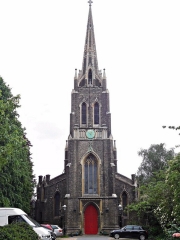
I HAVE BEEN ASSOCIATED WITH INDIA since my earliest days. This association was unconscious for the first 18 years of my life, that is before I met Indians, including my future wife, at university. During my childhood and until I was 30, I lived in Hampstead Garden Suburb (‘HGS’) in the shadow of the tall conical spire of St Judes Church. This brick edifice that can be seen from all around the HGS and many other places in northwest London was designed by Edwin Lutyens (1869-1944) the husband of Lady Emily Bulwer-Lytton (1874–1964), who was a daughter of the 1st Earl of Lytton, a former Viceroy of India. It was Lutyens who was given the task of designing New Delhi, the new capital of British India, between 1912 and 1930.


H0

St Judes Church by Edwin Lutyens

The construction of St Judes began in 1909, a year after our family home at 36 Hampstead Way was built. The church was consecrated in 1911, but not completed until 1935, after Lutyens had finished working on New Delhi. The north side of the church lines one side of the grassy Central Square, which was also laid out by Lutyens. The north side of the square is lined by the south side of the Free Church, a domed edifice designed by Lutyens. Its construction began in 1911 but was not fully completed until 1960.  As a child and for many years later, I had no idea that Lutyens had an important connection with India. In general,  I do not like the buildings designed by Lutyens in either HGS or in New Delhi. The only one of his buildings that appeals to me is Castle Drogo in Devon.

A recent visit to the HGS brought back several memories that I will share with you. Our house at 36 Hampstead Way looks much as it did when I was a child. In those days, and still today if you look carefully, the name ‘Inverugie’ can be discerned above the front porch beneath layers of whitewash. When my parents bought the house back in the early 1950s, they did not like the name and had it covered with paint. Despite many repaintings, it can still be seen if you know where to look.

When I was a child, our neighbour on Hampstead Way was the elderly spinster Miss Reinecke. Our other immediate neighbours on Hill Close were the very elderly Mr and Mrs Palmer. They sold the house to a young family, Mr and Mrs ‘S’. I used to babysit their children when I was a teenager. It was an easy way to make some pocket money because their children were always asleep when I arrived, and they never woke up while I was on duty. On one occasion, I was baby-sitting long enough to listen to the five long-playing records (LPs) that contained an entire performance of Wagner’s “Mastersingers of Nuremberg”. We rang on the doorbell the other day. Although Mr S could not recognise me at first, once he knew who I am, he remembered all sorts of things. He told me that all of the other houses in Hill Close have changed hands, sometimes several times, since we sold the house in the early 1990s.

A house at the top end of Hill Close used to be occupied by one of my father’s colleagues at the London School of Economics (‘LSE’), Professor Percy Cohen (1928-1999).  He was born in Durban, South Africa, and after obtaining a degree in social anthropology, he moved into the field of sociology. Occasionally, he used to stop his car and pick me up to give me a lift a part of the way to University College London, where I studied for many years.

A few steps lead up from the Cohen’s end of Hill close to a footpath that runs between hedges. When I lived in HGS, there was a tennis court on the south side of the path. All of the houses on Hill Close, including ours, had access to this court. In the second half of the 1960s, I used to play tennis there after school with three of my friends. We used to play in the fading light of the late afternoon. What with poor light and the well-worn markings on the hard court, there were often arguments about whether a ball had landed inside or outside the lines. Today, the court has disappeared and has been replaced by a well-manicured lawn, which is used by residents of a block of flats on South Square.

The footpath that begins at the end of Hill Close disgorges at South Square. A house on the corner of the footpath and South Square was once occupied by the Zacharias family. Mr Zacharias was a US diplomat. My sister and his daughter, Missie, became good friends. I enjoyed spending time with Missie’s brother, and my parents got on well with his. Occasionally, we would be invited to parties at their house. At one of these, we were introduced to Patrick Gordon Walker (1907-1980), who was an important British Labour politician. I remember being impressed at the time. I realised he was a famous person but had no idea why he was. Eventually, the Zacharias family returned to the USA. Just before they left, they came to our house to give us many half empty bottles of liqueurs and spirits.  My parents stored them in a cupboard in my father’s study. They were not keen drinkers. The bottles remained untouched, gathering dust for many years. They were still there when my father sold the house. I hope someone managed to enjoy their contents rather than chucking them away.

Henrietta Barnett School and the HGS Institute line the eastern side of Central Square. Until our recent visit, I had never noticed a stone plaque inserted in the wall of the school building. It reads: “This stone was unveiled by Her Royal Highness The Princess Margaret on 2nd July 1957 to commemorate the jubilee of The Hampstead Garden Suburb, 1907-1957”.

I was 5 years and two months old on the 2nd of July 1957. I remember that day well. I was spending the day at my mother’s sisters house near Wildwood Road in HGS. Sometime that morning, she took me and my young cousin to Wildwood Road and seated me on a piece of street furniture, a metal cupboard fixed to the pavement, which contained equipment needed for telephones. She handed me a Union Jack flag attached to a blue wooden stick. When the fancy car carrying Princess Margaret drove past, I waved the flag. You might wonder how I remember so much about that flag. The reason is that it was stored in my aunt’s downstairs bathroom for many years afterwards and I saw it each time I used the room.

Southway leads east from the south-east corner of Central Square. Harold Wilson (1916-1995), Prime Minister between 1964 and 1970 then again from 1974 to 1976, lived in a semi-detached house on Southway until 1964, when he moved to 10 Downing Street, closer to his workplace. Unlike his minister Gordon Walker, I never met him. The brickwork on the former Prime Minister’s home in Southway includes three bricks inscribed with letters. One reads “HCP”, another “AEP”, and the third “1909”, which might be the year the house was built.

Bigwood Road intersects South Way and leads south to Meadway, crosses it,  and then becomes  Meadway Close. One of my father’s close colleagues at the LSE, Lionel Robbins (1898-1984), lived in a substantial semi-detached house on this cul-de-sac that ends close to the Hampstead Heath Extension. Lord Robbins was an important twentieth century British economist. I cannot tell you about his contributions to economics because I only knew him as a friend of our family.

Lionel was over six feet tall and his wife, Iris, was truly short. He drove a tiny Mini and Iris drove a far larger vehicle. My mother knew that Robbins was fond of spaghetti. My parents were fond of Italians, and often invited my father’s Italian postgraduate students, amongst which was the former Prime Minister of Italy, Romano Prodi, to our home for dinner. Almost always, they invited Lionel Robbins as well. This was because my parents knew that most of my father’s Italian students were in awe of the great Lionel Robbins. At these dinner parties, my mother served spaghetti which Robbins enjoyed, and the young Italian guests sat around the great man enjoying his presence and the opportunity to chat with such a famous economist.

Almost opposite the home of the Robbins was the home of my school friend at Highgate School, Timothy Clarke. Tim is the younger brother of Charles Clarke, who became head boy at Highgate School before studying at Cambridge University. A member of the Labour Party, Charles served as Home Secretary between 2004 and 2006 in Tony Blair’s government. Once a Head Boy, always a Head Boy! I lost contact with Tim after we left Highgate. Whenever I pass his childhood home, I remember that there was a stylised metal sailing ship attached to its front door. When I passed it recently, I noticed that the door was no longer decorated with a ship.

We had parked our car near the intersection of Hampstead Way and Meadway, opposite a house on the north-east corner of the intersection. The building is a kind of terrace containing three or four houses. I never knew anyone who lived there, but I do remember that whenever there was to be a general election, somebody in that group of houses always put up an orange poster promoting the Liberal Party. Despite this and Harold Wilson living in the Suburb, the majority  of voters in the Hendon South Constituency, in which HGS is located, always voted for the Conservatives. When I was young, our MP had a memorable name: Sir Hugh Lucas-Tooth (1903-1985). I wonder whether his name subconsciously inspired me to take up dentistry. He held Hendon South from 1945 until 1970, when he retired from politics.

We drove away from the Suburb, a place that I found dull in my youth, with many memories revived in my head. I hope that you have enjoyed the selection I have shared with you.


Richmond, Russell, and India

DID THE YOUNG BERTRAND RUSSELL ever rush up King Henry’s Mound in Richmond Park and enjoy the famous view of St Pauls Cathedral ten miles away? We might never know the answer to this, but there is a good chance that he did (on days with clear sky) because this small hillock (184 feet above sea level) that might once have been a Neolithic burial ground is only about 330 yards from Pembroke Lodge. This Georgian mansion in Richmond Park was built in the mid-18th century. In between 1788 and 1796, it was extended according to plans by the famous architect Sir John Soane (1753-1837). In 1847, Queen Victoria granted the lodge to her then prime minister, John Russell (1792-1878).


RUS 6

Eric Gill’s cover for the book in which Bertrand Russell wrote the preface

John Russell had a son, John Russell (Viscount Amberley), who was born in 1842. He died in 1876, four years after his son, Bertrand Arthur William Russell, was born (in Monmouthshire, Wales). Bertrand’s mother died in 1874. Bertrand and his brother were placed in the care of their grandparents, who were living at Pembroke Lodge. Had Bertrand’s parents lived longer, they would have been pleased to have learnt that their son was awarded a scholarship to study mathematics at Trinity College Cambridge in 1890.

Bertrand Russell was one of the greatest philosophers of the twentieth century, but I am not qualified to describe his contributions to that field. In his autobiographical book “Unended Quest”, the famous Karl Popper (1902-1994) wrote of Russell that he was:

“… perhaps the greatest philosopher since Kant.”

That was praise indeed.

When I visit places for the first time, they often ignite new interests. Pembroke Lodge was  no exception, and visiting it sparked my interest in its former inhabitant Bertrand Russell. It appears that he was interested in a huge range of things. One of these, which also interests me, was the Indian freedom struggle that culminated in the country becoming independent in August 1947. Wikipedia reveals:

“During the 1930s, Russell became a close friend and collaborator of V. K. Krishna Menon, then President of the India League, the foremost lobby in the United Kingdom for Indian self-rule Russell was Chair of the India League from 1932-1939.”

Krishna Menon (1896-1974), born in Telicherry (now in Kerala, India) came to study at the London School of Economics (‘LSE’) in 1925, then at University College London. He became a keen promoter of the idea of independence for his native land. He was founder and president of the India League from 1928 to 1947.  The League was Britain’s foremost and most influential organisation fighting against the continuation of British imperialism. During the 1930s, Bertrand Russell was one of its its leading supporters and its Chairman for a while.

In 1932, the League decided to send a delegation to India to investigate conditions there. The group, which included Menon, spent 83 days travelling the length and breadth of the country, interviewing people, Indians and Britishers, in all walks of life. After the delegation returned to the UK, they prepared a damning report, “Condition of India”, which was banned by the Government of India but published in England in 1932. Its cover was designed by the artist Eric Gill (1882-1940) and Bertrand Russell wrote its preface. Bertrand Russell began the preface with the following words

“… TO obtain a true picture of the present state of affairs in India is as important as it is difficult. Many English people content themselves with the remark that India does not interest them. If India were independent, they would perhaps be justified in this attitude, but so long as the British insist upon governing India, they have no right to ignore what is done in their name by the Government which they have elected. There has been no lack of interest in the misdeeds of the Nazis in Germany; they have been fully reported in the Press, and have been commented on with self-righteous indignation. Few people in England realise that misdeeds quite as serious are being perpetrated by the British in India. Large numbers of men and women, including many of the highest idealism, have been imprisoned under horrible conditions, often without any charge having been made against them and without any hope of being brought to trial…”

Later in the same piece Russell wrote:

“In India, the peasants are powerless against the landlords and the Government combined, so that no economic lesson is learned from their hardships, and they are expected to ‘Starve quietly without making a fuss’. Only people with political power have a right to make a fuss ; this is one of the great lessons of history, and, lest history should not sufficiently impress the Indians, we are teaching it by the lathi and the gaol. Our ruling classes have lost their former skill, and I fear the ultimate result of their folly In India must be disaster. For in India, also, if the new regime is ushered in by bloodshed the result will not be so good as if it came peacefully. Statesmanship is dead in the post-war world, and India, like other countries, suffers in consequence.”

Like the philosopher Richard Congreve (1818-1899) many years earlier (in 1857), Russell was clearly convinced that the British should leave India. By 1938, Russell, who had dedicated a substantial part of his political activity to matters regarding the future of India, began to concentrate more on philosophy and academia. In the late 1950s, he re-entered political activity, becoming one of the founder members of CND, which opposed the atomic bomb and other nuclear weaponry.

Incidentally, after India became independent, Russell’s former collaborator in Indian affairs, Krishna Menon, then India’s High Commissioner to the UK, and others including Jawaharlal Nehru and Edwina Mountbatten founded the India Club in 1951. In the mid-1950s, its premises shifted to 145 The Strand, near the LSE and India House, where it still stands today. Its shabby looking second floor restaurant preserves its original 1950s look and houses a portrait of Krishna Menon. It has a nice old-fashioned bar on the floor below. A few years ago, before the India Club got a licence to serve alcohol in its restaurant, alcohol could only be served to members of the Club. The only requirement for joining it was to pay an annual subscription of 50 pence.

Returning Pembroke Lodge, we enjoyed hot drinks with our friends in its tranquil garden. It was then that one of our friends pointed out its links with the great philosopher, who spent his childhood there (from 1876 to 1894). After returning home, I looked up Bertrand Russell on the Internet and that is when I found that he had a connection with the history of India. It is wonderful that someone brought up in such fine surroundings as Pembroke Lodge should have felt moved to fight for the people of India, very few of whom would have enjoyed such a luxurious childhood as Russell did.

She died for the Empire

I HAVE MISLAID my copy of “Noor-un-nisa Inayat Khan” by Jean Overton Fuller (1915 -2009), first published in 1952. Jean was born in England, the only child of an officer in the British Indian Army. She was a friend of the Inayat Khan family, one of whom was Noor-un-nisa Inayat Khan (1914-1944). At the end of WW2, Jean travelled around Europe interviewing people who had been connected with Noor’s activities during WW2.


Noor 4

A few days ago, during a pleasant walk in London’s West End, we stopped near Hyde Park Corner to look at the memorial to those citizens of the Indian subcontinent who had fought for the British Empire during the two World Wars. Part of the memorial is a small pavilion that looks Indian in design. The ceiling of this structure is inscribed with the names of those who were awarded the prestigious George Cross and Victoria Cross awards during the two Wars. We looked up at the names, not expecting to see any that we would recognise, but were both surprised and pleased to see that one of the names is ‘Noor-un-nisa Inayat Khan’, who was awarded the George Cross, posthumously. Noor and her family were not people we knew, but her story was familiar to us.

Noor was born on the first day of 1914 in Moscow, where her father had arrived (from Baroda, now in Gujarat) in 1913 to promote Sufism in the ‘West’. Her father’s family were Muslim nobility, her father’s mother was a descendant of the great Tipu Sultan, who died in 1799, fighting the British. Her mother was an American of European origin.  Shortly after Noor’s birth, her family shifted to London, where Noor attended a nursery in Notting Hill. By 1920, the family had moved to Paris. At the outbreak of WW2, the family fled to England, landing at Falmouth in Cornwall.

During WW2, after joining the Women’s Auxiliary Air Force (‘WAAF’), she soon became a member of Special Operations Executive (‘SOE’), where she underwent tough training. Already a trained wireless operator, she had an advantage over other women who were to be ‘courier’s, who worked behind the enemy lines helping to support those resisting the Nazis. Her fluency in French was another advantage that Noor had over many of the other couriers. Also, her appearance was such that it could easily have been considered European.

Noor was flown from Britain to Europe on the night of 16th /17th June 1943 and landed in northern France. Her courageous exploits have been well-described in a detailed book by Shrabani Basu, “Spy Princess”, published in 2006. Sadly, her presence in France was betrayed (by one of two Frenchmen), and she was first arrested by the Gestapo on about the 13th of October 1943. After intense interrogation, during which she revealed nothing of use to the Germans and nothing that compromised her comrades,  she was shot at dawn in the Dachau concentration camp near Munich in September 1944. In addition to being awarded the George Cross, Noor was also a posthumous recipient of the French Croix-de-Guerre. A commemorative blue plaque on her last home in London, 4 Taviton Street in Bloomsbury, was the first to be put up in honour of a woman of Indian origin.

Michael Richard Daniell (‘MRD’) Foot (1919-2012, the historian and former member of SOE, wrote in his introduction to Basu’s book:

“Holders of the George Cross are out of the common run; Noor Inayat Khan was even farther out of it than most.”

The memorial near Wellington’s triumphal arch at Hyde Park Corner was inaugurated in 2002. In addition to recording Noor’s name, there are over seventy other names of those awarded either the VC or the GC. Many of them have Indian sounding names, such as Noor’s, but a few have names that sound English, such as FC Booth and ECT Wilson. The Indian names suggest a fair mix of Hindu, Muslim, and Sikh recipients of these medals. Of the Indian recipients, or those who have Indian sounding names, of the two honours, the VC and the GC, awarded during WW2, the only one who was involved in behind-the-lines espionage and resistance activities was the young Noor Inayat Khan.

Noor was in favour of Britain giving India her freedom, ending its status as a colony within the British Empire. However, unlike some of the fighters for Indian independence like Subhas Chandra Bose, who favoured an alliance with the enemies of Britain during WW2, she was, to quote Basu:

“… convinced that Indian leaders should not press for independence when Britain had its hands full of fighting the war. She felt that if the Indians backed Britain and won gallantry medals it would create a sense of confidence in them, and the British would readily grant independence to India after the war…”

After WW1, there were 22 Indian recipients of VC and GC, but Britain did not relieve its domination of India. Instead, it began to tighten its grip. Noor and the other awardees of the high honours for bravery as recorded in the monument near Hyde Park Corner demonstrated the gallantry of people from the Indian sub-continent, but I am sure that this was not part of the reason that Britain released its long hold on its prize colonial possession in 1947.

I am sorry that I cannot find my copy of Overton Fuller’s biography of Noor. It is the source of some of the information in Basu’s book, which contains much material that Overton Fuller did not have access to when she wrote her book. When I find it eventually, it will be interesting to compare what the earlier author wrote about Noor with what Basu wrote 54 years later.

Facts, figures, and famine

blog churchill


THE BRITISH PRIME MINISTER, Mr Boris Johnson, appears to be strongly dependent on his chief adviser, Mr Dominic Cummings. Mr Johnson’s hero, the late Winston Churchill, was also very reliant on his chief advisor Professor Frederick Lindemann, First Viscount Cherwell (1886-1957), a scientist. Madushree Mukherjee, the author of “Churchill’s Secret War”, wrote:

“On most matters, Lindemann’s and Churchill’s opinions converged; and when they did not, the scientist worked ceaselessly to change his friend’s mind …”

Lindemann created the ‘S Branch’, a group of specialists whose role it was to report to Churchill after distilling “ …  thousands of sources of data into succinct charts and figures, so that the status of the nation’s food supplies (for example) could be instantly evaluated…” (Wikipedia).

Mukherjee noted:

“… the mission of the S branch was to provide rationales for whichever course the prime minister, as interpreted by the Prof, wished to follow.”

It would seem from this that Churchill pulled the strings, and even the great Lindemann was somewhat of a puppet. In contrast, it is difficult to say whether the puppet-master is our present prime minister or his chief adviser.

Two Commonwealth countries, Australia and New Zealand  erected large war memorials to their citizens near Hyde Park Corner and the gardens of Buckingham Palace. A more modest memorial complex, the Commonwealth Memorial Gates (inaugurated 2002), was put up to commemorate the great contribution that people from countries in the Indian subcontinent, the West Indies, and Africa made to defending the British Empire during the Second World War. An information panel informs the viewer that during the First World War, 1,440,500 men and women from the Indian subcontinent and Nepal “Volunteered for military service in the Indian Army”, and during WW2, “…over 2,500,00… “ men and women from the subcontinent fought for the forces of the British Empire. Between about 64,500 and 74,000 of the military personnel from the Indian subcontinent died in combat during WW1, and over 87,000 Indian (that is from pre-1947 ‘British India’) soldiers died during WW2. These figures are of necessity approximate and without doubt horrific. However, during WW2, the number of Indian citizens, who died of starvation in their own country during WW2 is far more difficult to know. The most reliable approximations give the number of Indians dying of starvation in Bengal during WW2 as being at least three million, that is about half the number of civilians who died because of Hitler’s demented racial theories.

The three million or most probably more Indians, who starved to death, lived mainly in Bengal. They did not perish by accident, as Madhusree Mukerjee explained in her book, which has been highly acclaimed. Unlike other famines in India caused by failures of harvest, what happened in Bengal in 1943 and ’44, the starvation of the Bengalis was probably largely man-made. And, as the book suggests using damning evidence that has come to light since WW2, two men who were most significant in its making were Churchill and his chief adviser Lindemann. 

Churchill was quite rightly focussed on winning the Second World War and at the same time preserving the integrity of the British Empire, which was being challenged by Indian nationalists throughout the two decades leading up to the outbreak of war and after the fighting began. For reasons I cannot explain Churchill did not like the Indian people. To give just one example, he is reported to have said of them in November 1942 that they were:

“… the beastliest people in the world next to the Germans.”

His adviser, the eugenicist Lindeman (Cherwell) was also no lover of the Indians. Mukerjee wrote in her book:

“Inferior as the British working class was in Cherwell’s view, he nonetheless ranked it far above the black and brown subjects in the colonies.”

Later, she wrote:

“All the evidence points to the prime minister and his closest adviser having believed that Indians were ordained to reside at the bottom of the social pyramid …”

Long after India had become independent, Lindemann described (according to Mukerjee who provides reference for this):

“… ‘the abdication of the white man’ as the worst calamity of the twentieth century – more deplorable than the two world wars and the Holocaust”.

The gist of Mukerjee’s book is that important amongst the reasons that the 1943 famine in Bengal was not relieved was that Churchill was not in favour of releiving it. The author wrote that although at times vital supplies and shipping were at critical levels, there were opportunities for famine relief supplies to be sent to Bengal. However, the British government under the leadership of Churchill came up with many excuses to avoid supplying famine relief.

I found the evidence provided in Mukerjee’s book to be reliably persuasive. However, there are many who would prefer not to hear anything but good of the man who helped Britain and its allies win WW2, Winston Churchill. For a defence of Churchill’s behaviour during the Bengal famine, I refer you to https://winstonchurchill.org/resources/in-the-media/churchill-in-the-news/bengali-famine/, an on-line article that tries to demolish an article by Gideon Polya with the title “Media Lying Over Churchill’s Crimes”, published in 2008 (see: https://sites.google.com/site/afghanistangenocideessays/media-lying-over-churchill-s-crimes). 

You can judge Churchill’s possible role in Bengal’s 1943 famine however you wis,  but see what Professor Amartya Sen, a former colleague of my father at the London School of Economics  said. Michael Portillo said to him in a BBC interview on the 14th of January 2008:

“What’s interesting about your description is that it doesn’t appear to rest upon a shortage of rice.”

Sen, who appears to be far more generous than Mukerjee about Churchill’s attitude to the famine, replied:

“No it wasn’t. I think I have to say the British Indian government was callous. I don’t think they were criminal but they were certainly extremely callous and didn’t really worry too much about it. And secondly they were badly misinformed. What had happened is that there was a considerable expansion of demand for food because of the war boom. And with the same supply they were having rising prices. So it wasn’t connected with food deficit at all.”

(https://sites.google.com/site/drgideonpolya/bengal-famine-broadcast).

Seeing the war memorials near Hyde Park Corner and a Holocaust memorial nearby in Hyde Park, and having recently finished reading Mukerjee’s book, inspired me to write this short piece in order to provoke interest in one of the horrible tragedies that happened during WW2, the Bengal Famine of 1943.

Mukerjee’s book presented me with one very superficial resemblance between Churchill and his admiring biographer Boris Johnson. Both had their devoted advisers. Although Churchill might not have done things to everybody’s satisfaction, he did play an extremely important role in suppressing the forces of evil that were threatening Britain and its allies during WW2. Let us hope that Boris will follow in Winston’s footsteps in our fight against another evil enemy, the Corona virus, and lead us to victory.